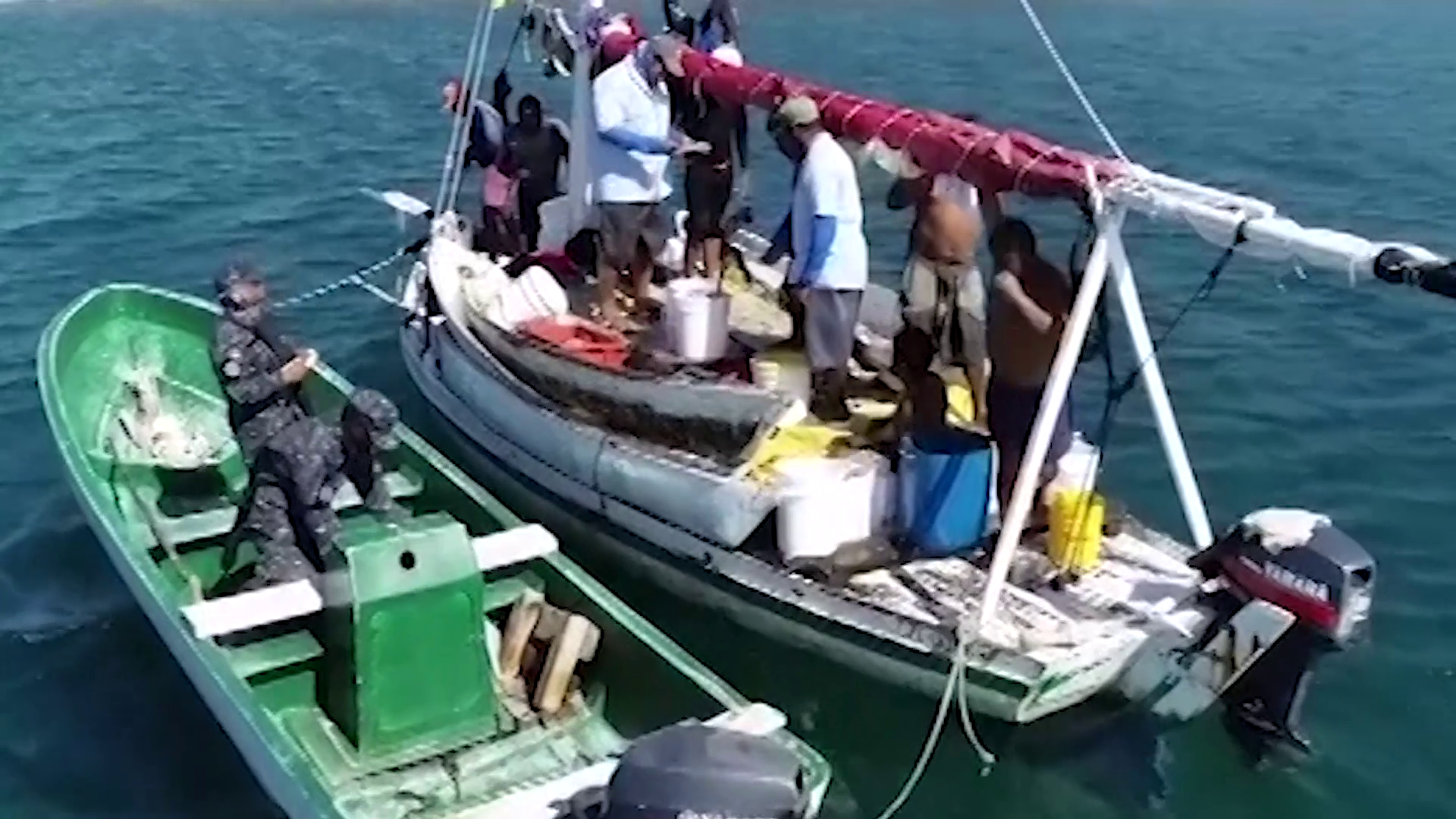
A planned government vessel tracking initiative designed to boost maritime safety and crack down on unregulated fishing has sparked growing tension in Belize, with licensed stone crab and shark fishers demanding the October 22 installation deadline be paused to allow for full industry consultation.
For generations of Belizean small-scale fishers, the open ocean serves not just as a source of income, but a critical lifeline that feeds families and sustains coastal communities, where vessels often operate hundreds of miles from emergency support. The Belize Fisheries Department has framed its Vessel Monitoring Systems (VMS) pilot program as a forward-thinking policy that will bring three core benefits: precise real-time tracking of vessel movements, stronger enforcement of fishing regulations, and targeted action to curtail illegal fishing operations that erode shared marine resources.
Adriel Castanedas, Acting Fisheries Administrator, explained that the pilot is the latest phase of a years-long effort to identify a monitoring solution that works for both regulators and fishing operators. “This is going to be implemented in two important fisheries that we have, which are highly regulated and what we call special license fisheries. The VMS are part of an updated condition of license we’ve added for these operators. This pilot is a continuation of work we’ve been doing for years to find a device that is convenient both to the fishers and to our department, allowing us to monitor movement and address persistent issues with illegal fishing and enforcement gaps.”
But as the mandatory installation deadline looms, industry leaders say the government bypassed meaningful input from the communities that will be directly impacted by the new rule. Jorge Aldana, President of the San Pedro Fisherfolk Association, argues that the arbitrary deadline imposed on specialized fishers is fundamentally unfair, calling for regulators to hit pause on the rollout and engage in full, transparent dialogue with affected stakeholders.
“You are going to put a deadline to us: by October 22, you must have this tracking device installed if you are fishing for stone crab or shark,” Aldana said. “This is wrong. You must put the brakes on and come consult with us first.”
While the initial pilot only applies to a relatively small subset of Belize’s fishing industry, Aldana emphasizes that the lack of consultation for even a small group sets a dangerous precedent. He estimates there are roughly 50 to 60 active shark fishing licenses across Belize, and around 15 licensed stone crab fishers operating out of the northern coastal communities of San Pedro and Caye Caulker, with additional operators based further south along the country’s coastline.
“Even if the number of affected fishers is not huge, that does not mean we do not deserve to be consulted before a rule that can take away our livelihoods is imposed,” Aldana added.
The Fisheries Department has acknowledged that it did not host broad, cross-industry public consultations ahead of launching the pilot, but Castanedas pushes back on claims that stakeholders were completely locked out of the process. He says officials held direct discussions with representatives from both fisheries, and that while fishers raised valid, legitimate concerns about the program, those representatives ultimately agreed to participate in the testing phase to work out kinks together. “We made contact through existing association leaders, we discussed the plan with them, and they shared it with their members,” Castanedas explained. “While they had some legitimate concerns, they agreed to install the devices because this is a pilot – we’re all testing it and learning together, both fishers and our department. For shark fishers in the south, we are organizing an informational session tomorrow to address their outstanding questions and help them understand the program better.”
For Aldana, the core issue extends far beyond the current pilot mandate. He warns that the rollout is just the first step in a broader government plan to expand mandatory vessel monitoring to nearly all commercial and recreational fishing operations across the country. In recent discussions with fisheries leadership, Aldana says he learned that a second phase will expand the requirement to all deep-sea fishers operating electric reels in Zone Nine, followed by a final phase that will include recreational fishing tour operators and guides who rely on Belize’s marine resources for their businesses.
Castanedas confirmed that expanding industry-wide vessel monitoring is indeed the department’s long-term goal, but he rejected claims from fishers that the program is intended to enable government surveillance of private fishing operations. Instead, he stresses that the VMS technology includes a built-in emergency SOS feature that will drastically improve response times for fishers facing distress at sea – a critical safety feature at a time when piracy remains a persistent threat in regional waters. “If fishers encounter a problem out on the water, they can trigger the SOS signal immediately, and both the Coast Guard and our department will receive the alert right away to launch a response,” Castanedas noted.
Forty-five affected fishers will receive free VMS devices through a regional development program funded by Taiwan, part of the Central American Integration System (SICA) initiative. Even with the free hardware, however, the biggest hurdle facing the Belizean government is not technical implementation of the tracking system – it is rebuilding trust with fishing communities who feel sidelined in the policy process, and convincing them that the new technology will protect rather than undermine their livelihoods.
This report was prepared by Shane Williams for News Five.