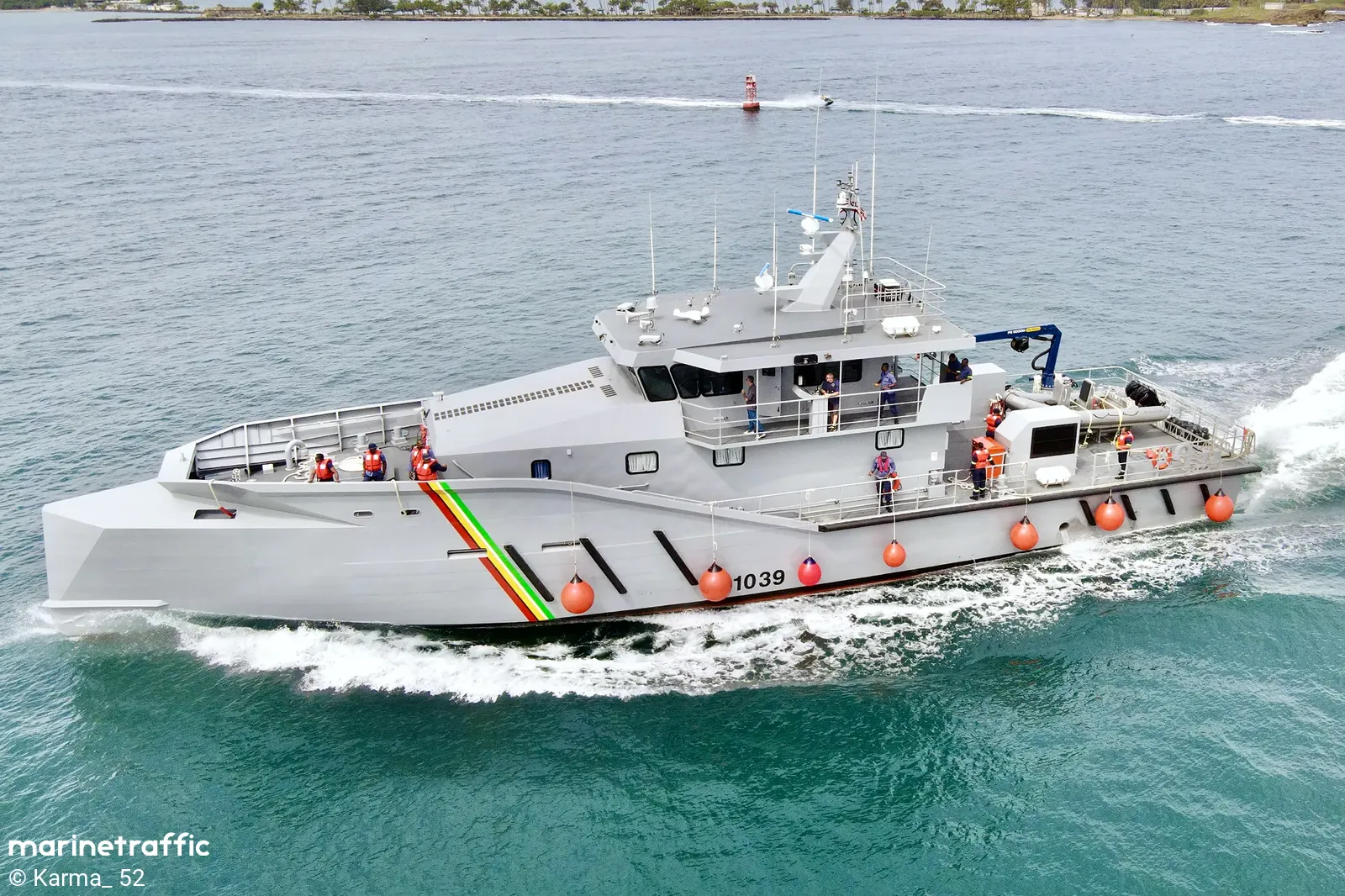
A senior Guyana Defence Force (GDF) Coast Guard officer has detailed the service’s emergency response to the 2025 sinking of the MV Barima ferry, publicly defending the deployment timeline of his command vessel during a formal commission of inquiry held this Thursday at the Arthur Chung Conference Centre in Liliendaal, Greater Georgetown.
Lieutenant Rolwyn Heywood, who served as commanding officer of the large GDFS Shahoud during the search and rescue operation, told the inquiry that the first distress alert from the sunken ferry reached Coast Guard command via Cheddi Jagan International Airport’s air traffic control tower at 10:51 PM on July 18. Twenty minutes after receiving the alert, at 11:11 PM, Heywood issued orders to personnel stationed at the Pomeroon floating base — the closest facility to the accident site — to get underway immediately after receiving emergency position-indicating radio beacon (EPIRB) signals from the sunken vessel. Heywood confirmed the Pomeroon base was the nearest coastal outpost to the sinking, though he could not provide an exact distance to the scene.
Heywood and his team, including a registered nurse, departed the Coast Guard’s Ruimveldt headquarters in Georgetown at 3:30 AM, four hours and 39 minutes after the initial alert came through, and arrived at the accident site at 7:30 AM. When questioned by commission of inquiry counsel Arudrunauth Gossai about the delay in the large vessel’s deployment, Heywood outlined multiple justifications for the timeline, arguing it was the fastest possible response under the circumstances.
“GDFS Shahoud is a large vessel, so it takes some time to get out,” he told the inquiry. He added that the service required two hours to mobilize off-duty crew members from their private homes, noting that deploying the vessel with insufficient staff would have created unnecessary risk: “because you also don’t want to deploy GDF Shahoud with short strength or short manpower, and then we also become a casualty.” He further explained that crews first needed to confirm the nature of the emergency before deploying a large resource like the Shahoud, to avoid wasting assets if the alert had been a false alarm for a vessel other than the MV Barima.
By the time the Shahoud reached the accident area, five smaller GDF Coast Guard vessels were already actively conducting search operations. Heywood’s team encountered three empty life rafts drifting in rough open water, where four to seven second swells created hazardous conditions for small craft. Early in the response, Heywood made contact with local fishing captain Haresh Singh, who had already recovered 11 survivors from the sinking and requested medical support. With two police officers already aboard Singh’s vessel providing initial care, Heywood instructed the fishing boat to proceed directly to shore to drop off the survivors, a decision he said he was comfortable with given the existing law enforcement presence.
Prior to deploying the Shahoud, Heywood confirmed that command completed a chart-based location analysis and attempted to contact other nearby vessels to cross-verify the sinking, with no other watercraft in the area available to confirm the incident. On arrival, the Shahoud took over overall coordination of the response, which included six GDF Coast Guard vessels and approximately 12 civilian craft that had joined the search. “When we got on-scene, the smaller vessels were already on-scene. They were conducting their various search looking for bodies… when we got on-scene, that’s when we took control of that,” Heywood told the commission.
The ongoing commission of inquiry is tasked with investigating the full circumstances surrounding the sinking of the MV Barima, which was traveling along the coastal route from Georgetown to Parika when it went down with 179 passengers and crew on board.