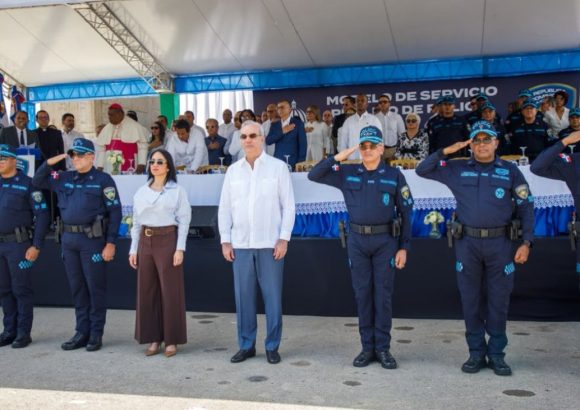
On a Friday ceremony held in the coastal Dominican province of La Altagracia, President Luis Abinader formally inaugurated the second phase of the country’s ambitious Model of Police Service and Patrol (MSPP), a cornerstone initiative of the national government’s ongoing public safety reform agenda. As part of this expansion, 990 newly trained and fully equipped police officers have been deployed to the province, where local law enforcement operations have been reorganized into 84 geographic quadrants and 39 patrol corridors covering seven key population centers: Verón, Higüey, Villa Cerro, La Otra Banda, El Hoyo de Friusa, Bayahibe and San Rafael de Yuma.
The rollout in La Altagracia marks a major milestone in the government’s broader police modernization program, which has set a target of rolling out the new patrol model across all 24 national police departments by 2026. Unlike traditional policing models that rely on reactive response, the MSPP framework leverages granular territorial crime data, standardized operational protocols, specialized officer training and ongoing performance oversight to strategically deploy personnel where and when they are most needed.
Speaking at the launch, Interior and Police Minister Faride Raful highlighted the proven effectiveness of the new model in the four regions where it was first implemented. Official ministry data shows that between January and July of this year, reported robbery incidents dropped by 35% across those pilot departments, translating to 1,046 fewer criminal cases than the same period prior to the reform.
Raful emphasized that expanding the program to La Altagracia carries unique strategic importance, noting the province’s rapid population growth and its status as one of the Dominican Republic’s core hubs for tourism and commercial activity. A visible, well-trained, and responsive police presence is critical to supporting continued economic growth and protecting both residents and visitors, she added.
As part of the national initiative, more than 1,000 officers have now completed training through the Basic Police Tactical System (SITAB), a curriculum designed to modernize policing practices. Coursework focuses on core competencies including constructive community engagement, standardized tactical response, evidence-based decision-making, proportional use of force, and officer mental and physical resilience.
Beyond training and reorganization, the new model also conducts targeted needs assessments for each patrol territory to address gaps in personnel, mobility and equipment, directly strengthening local operational capacity. According to government officials, the ultimate goal of this expansion is to embed the principles of police reform into the daily lives of Dominican citizens by building a police service that is more organized, more accessible to communities, and better prepared to address public safety needs, all while upholding constitutional protections, human rights and individual dignity.