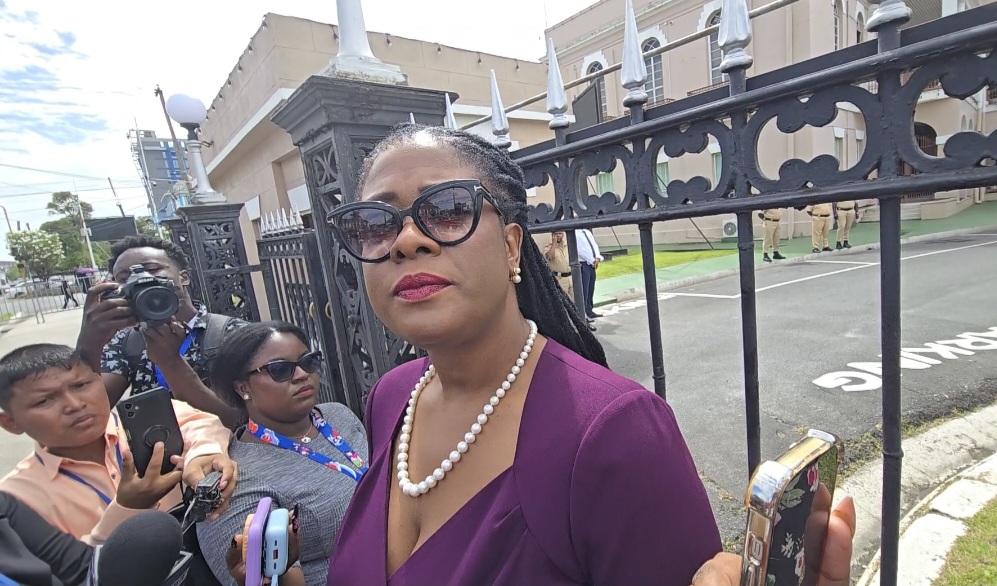
Published on Saturday, November 21, 2026 at 5:18 a.m. local time by Denis Chabrol for Demerara Waves Online News, the report outlines a fast-developing diplomatic debate unfolding in Guyana following a newly signed U.S.-Venezuela military cooperation agreement. On Friday evening, the Forward Guyana Movement (FGM), a parliamentary opposition party holding one seat in Guyana’s national legislature, issued a formal public statement pressing the Irfaan Ali-led national government to immediately seek clear, official explanations from U.S. authorities about recent comments made by U.S. Defense Secretary Peter Hegseth referencing Venezuelan territorial control and border restoration.
FGM leader Amanza Walton-Desir, who previously served as the shadow foreign minister for the A Partnership for National Unity+Alliance For Change coalition between 2020 and 2025, noted that official U.S. Department of Defense records frame Hegseth’s comments as part of a broader regional counter-narco-terrorism and transnational threat mitigation strategy. Even so, she emphasized that specific language referencing Venezuela regaining its borders and sovereign territory carries direct implications for Guyana’s long-running, internationally mediated territorial dispute with Venezuela, which centers on the 1899 Arbitral Award that formally demarcated the shared land boundary between the two nations.
Walton-Desir acknowledged and welcomed the U.S. government’s public reaffirmation that the 1899 Arbitral Award should be respected as a binding legal instrument, unless a competent international legal body or mutual consent from both Guyana and Venezuela establishes a revised boundary. However, she restated the FGM’s unwavering position that the 1899 award constitutes a full, final, and non-negotiable settlement of the border dispute, and that the party fully supports ongoing proceedings at the International Court of Justice (ICJ) to resolve the matter, rejecting all attempts at negotiated settlements that would bypass the ICJ’s pending ruling.
Hegseth’s public remarks, delivered after the military cooperation pact was signed, framed the U.S. partnership with Caracas as a framework to rebuild Venezuelan military capabilities, modernize defense institutions, and root out narco-terrorist networks that U.S. officials claim have occupied portions of Venezuelan national territory for 27 years. Speaking under the framework of the Donald Trump administration’s bilateral engagement with the Delcy Rodriguez-led Venezuelan government, Hegseth stated that a sovereign nation cannot exist without defined borders, and that enhanced U.S. security support would accelerate Venezuela’s efforts to reclaim full territorial control and eliminate all non-state armed threats to stabilize the country permanently.
The FGM leader argued that these remarks have sparked widespread anxiety among Guyanese citizens regarding their nation’s own sovereignty and territorial integrity, and that the sitting government has a clear public duty to address those concerns by securing formal, specific answers from U.S. officials and communicating those findings transparently to the public. She further called on the Ali administration to hold timely, substantive consultations with opposition parliamentary blocs, which collectively hold 28 seats across the We Invest in Nationhood (16 seats) and APNU (12 seats) caucuses, and to disclose full details of all diplomatic engagements related to the U.S.-Venezuela military deal, including specific questions Guyana has raised, clarifications sought, and formal assurances received from Washington. “On a matter of such existential consequence for our national security, vague general assurances and official silence are entirely unacceptable,” Walton-Desir emphasized.
Parallel to these developments, newly appointed Venezuelan Defense Minister Gonzalez Lopez issued his first public statement since taking office, confirming that the new U.S.-Venezuela military cooperation framework would operate in full compliance with Venezuela’s national constitution, respect the country’s sovereignty, independence, and territorial integrity, and retain full Venezuelan armed forces control over all military leadership, command structures, and operational decision-making. The statement followed the widely documented January 3 military intervention in which U.S. forces removed former Venezuelan leader Nicolas Maduro from power.