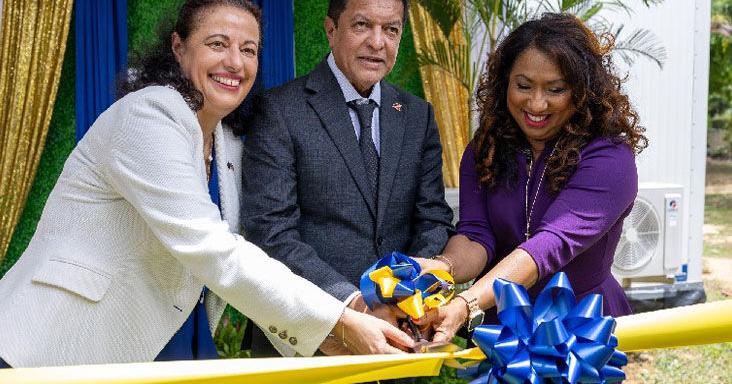
On a recent Friday in Port of Spain, top health and diplomatic officials gathered at the Federation Park headquarters of the Caribbean Public Health Agency (Carpha) to inaugurate a landmark Regional Emergency Operations Centre, a facility designed to unify the region’s response to growing cross-border public health risks.
Addressing the official commissioning ceremony, Trinidad and Tobago’s Minister of Health Dr. Lackram Bodoe emphasized that no Caribbean nation, no matter how prosperous or resource-rich, can tackle the increasingly complex public health threats of the 21st century in isolation. The new facility, he noted, is tailored to strengthen coordinated preparedness, response, and recovery capacity across all 26 of Carpha’s member states, and reflects Trinidad and Tobago’s enduring commitment to regional collective action.
“Health security cannot be achieved by any one country acting alone,” Bodoe told attendees. “Our greatest strength comes from partnership: open information sharing, mutual support, and collective action that puts the well-being of all Caribbean people first. This centre is far more than a physical building—it is a symbol of the solidarity that has always guided Carpha’s work, and that will carry us through whatever public health challenges lie ahead.”
Carpha Executive Director Dr. Lisa Indar explained that as a region made up almost entirely of Small Island Developing States, the Caribbean’s interconnected economies, open borders, and tightly linked communities leave it uniquely vulnerable to rapid spread of public health emergencies. The new operations centre will directly address this gap by enabling early threat detection, unified regional coordination, and consistent protection of population health across the archipelago.
European Union Ambassador to Trinidad and Tobago Cécile Tassin, whose organization provided full funding for the facility’s construction and outfitting through the 11th European Development Fund Programme for Communicable Disease Prevention and Control, echoed the call for collective action. Tassin noted that the centre stands as a testament to the Caribbean’s shared commitment to protecting its people through preparedness, solidarity, and pooled expertise.
In an official news statement released following the inauguration, Carpha framed the launch of the operations centre as a transformative milestone for regional public health capacity. Built in full alignment with the World Health Organization’s Public Health Emergency Operations Centre Framework, the facility has earned classification as a Type C Emergency Operations Centre—the highest tier of operational capability recognized by the global health body. This classification means the hub is equipped to coordinate complex, multi-country public health emergencies while providing critical support to national emergency operations centres across the Caribbean.
Powered by Carpha’s custom-built Regional Integrated Early Warning Surveillance and Response System (RIEWSS), designed specifically for Caribbean contexts, the centre will dramatically improve the region’s ability to spot emerging threats early, maintain real-time situational awareness, and roll out faster, evidence-based responses to crises. As the central regional coordination hub, it will deepen collaboration between national ministries of health, disaster management agencies, regional bodies, and international partners. Additional core functions include deploying specialized technical response teams, coordinating emergency logistics, facilitating consistent risk communication, and maintaining a unified shared operating picture during active public health emergencies.
The development of the centre drew directly on hard-won lessons from recent regional crises, Carpha confirmed. Events including the global COVID-19 pandemic, recurring large-scale dengue outbreaks, Hurricanes Melissa and Beryl, and a growing number of climate-linked disasters have all underscored just how critical coordinated regional action is to limiting the damage of public health emergencies.
The operations centre operates on a scalable activation model, allowing it to shift smoothly from routine daily surveillance and monitoring to full-scale regional emergency activation when needed. It will lead coordination for responses to a wide range of events, including infectious disease outbreaks, severe weather events that carry public health risks, environmental and chemical incidents, mass gatherings, and any other event with regional or international public health implications.
Beyond emergency response, the new hub will also strengthen Caribbean countries’ implementation of the 2005 International Health Regulations by boosting regional surveillance capacity, streamlining information management, improving cross-border emergency coordination, and raising overall operational readiness. Carpha officials emphasized that the inauguration of the centre is just one part of the agency’s ongoing commitment to advancing regional health security, ensuring all Caribbean nations are better prepared to face both existing and emerging public health threats.