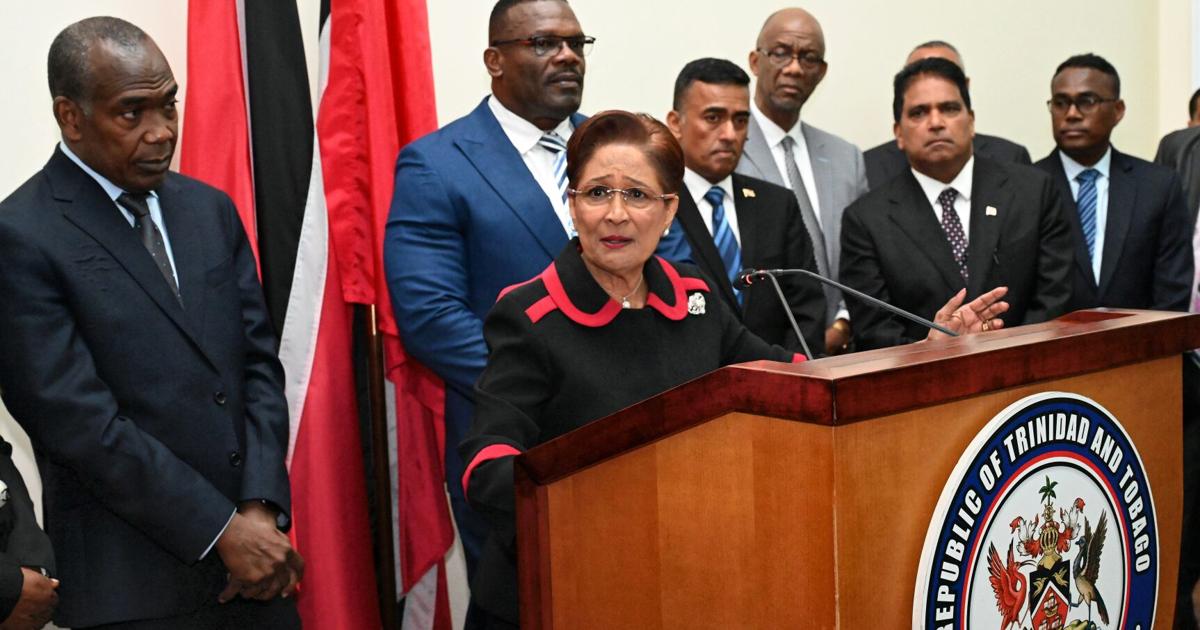
For more than two months, Trinidad and Tobago has not held a formal post-Cabinet media briefing, sparking widespread debate over government communication practices and transparency standards. The final such briefing was held on May 7, when cabinet ministers addressed reporters on a broad spectrum of pressing public issues, from the high-profile triple homicide in Belmont’s Rifle Hill to regional security coordination following the Shield of the Americas summit, the country’s UN Security Council non-permanent seat bid, new UK visa requirements for Trinidad and Tobago citizens, and bilateral relations with neighboring Venezuela. That session was chaired by Wilfred Nicholas Morris, Minister in the Office of the Prime Minister.
In recent interviews, two leading Trinidadian political scientists have offered divergent perspectives on the ongoing hiatus, while agreeing on a core legal point: there is no binding legal mandate requiring the government to host these formal press briefings.
Dr. Bishnu Ragoonath, a prominent political scientist, explained that longstanding constitutional and procedural traditions frame Cabinet deliberations as inherently confidential. Cabinet meeting minutes and discussion notes are legally protected from public disclosure, he noted, and no constitutional clause or statutory law requires ministers to update the public immediately following every Cabinet gathering. Ragoonath added that post-Cabinet briefings emerged in recent decades as a voluntary practice for governments seeking to signal greater openness and align with modern good governance standards, not as a legally required obligation.
While affirming the lack of a legal requirement, Ragoonath emphasized that transparency remains a foundational pillar of legitimate democratic governance. “I have always been one for accountability and transparency. Ethics is dependent upon integrity and accountability and transparency,” he stated. That said, he harshly criticized the current government’s broader communication strategy, arguing it is structurally inadequate and frequently fails to provide necessary context for major policy changes.
Pointing to the recent suspension of the Military-Led Academic Training (MILAT) Programme as a key example, Ragoonath said officials only announced the termination of the program without offering any public explanation for the decision. He later learned through unconfirmed secondary sources that the program carried a price tag of roughly $135,000 per trainee, a cost that reportedly prompted the review. “If those were the facts which caused the review of the programme, come out and say it. Without giving context and without adequate background, one wonders whether or not there is a hidden agenda,” Ragoonath said.
Dr. Indira Rampersad, another respected political scientist, shared Ragoonath’s conclusion that no legal obligation exists for post-Cabinet briefings, but pushed back on the framing that the current government is failing to communicate with the public. She argued that Prime Minister Kamla Persad-Bissessar and her cabinet have maintained consistent public outreach through alternative channels, making announcements and responding to reporter questions on all major policy topics. These include the mid-year budget review, national crime reduction initiatives, regional diplomatic affairs, and the country’s successful campaign for a UN Security Council non-permanent seat.
Rampersad noted that the government’s approach is flexible: officials share information when they have updates to deliver, through whatever format works best, rather than adhering to a rigid requirement for a formal post-Cabinet briefing every time. She also pointed to practical logistical reasons that may explain the current hiatus, noting that Cabinet meetings often run well over schedule due to crowded policy agendas, leaving little time for an immediate press briefing.
Further, Rampersad said the public has not been left uninformed, and ministers remain accessible to journalists for questions and comments. She also reminded observers that some matters, including ongoing criminal investigations and sensitive national security issues, cannot reasonably be discussed publicly by cabinet ministers for legal and public safety reasons.