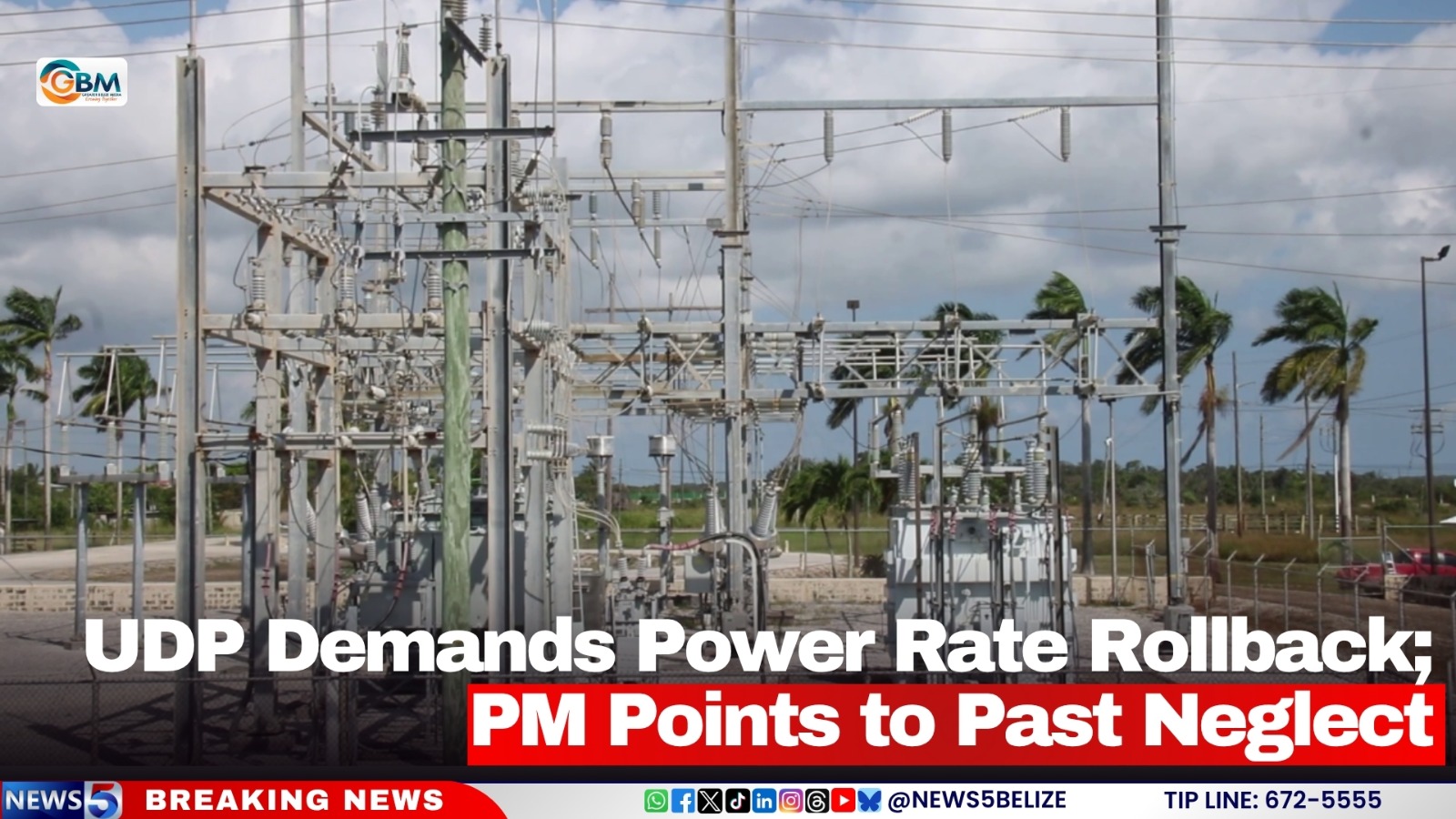
A heated political and public policy debate has erupted in Belize over a recently approved electricity rate hike, with the main opposition United Democratic Party (UDP) calling for an immediate reversal of the increase and the sitting prime minister pushing back by placing blame for the price adjustment on decades of infrastructure neglect by the opposition’s previous rule.
The UDP’s leadership has stressed that the new 1.5 cent per kilowatt-hour rate increase comes at an untenable time for ordinary Belizean households. As costs for essential basic goods and services already eat up larger shares of working- and middle-class incomes, the party argues that households have no room to absorb higher energy costs. Beyond the immediate affordability crisis, the opposition is also questioning the government’s management of public energy investments. It notes that nearly $400 million in public funds has already been allocated to acquiring and upgrading national electricity infrastructure, and it dismisses government claims of progress in the energy sector, asking why consumers have not seen any corresponding reduction in costs after the massive public expenditure.
Prime Minister John Briceño, leading the current administration, has rejected the opposition’s accusations that state-owned utility Belize Electricity Limited (BEL) is unfairly profiting from higher rates at consumers’ expense. In his response, Briceño explained that BEL has actually been selling electricity to domestic customers at a sustained loss. During peak demand periods, the utility is forced to import power from neighboring Mexico at costs as high as $1 per kilowatt-hour, yet it retails that power to end users for only $0.42 to $0.44 per kilowatt-hour, creating a persistent gap that necessitated the rate adjustment.
Briceño pinned the root cause of the current energy pricing pressure on 13 years of neglected investment during the UDP’s previous administration. He argued that the outgoing UDP government failed to make critical investments in BEL’s generation capacity, transmission networks, and core infrastructure, leaving the current government to address long-standing systemic gaps in the energy sector. To counter claims of inaction, the prime minister outlined a slate of major ongoing energy infrastructure projects designed to lower long-term costs for consumers. These include a $100 million loan from the World Bank to develop 40 megawatts of grid battery storage, financing from Saudi Arabia for a large-scale solar power generation project, and the near-completion of a multi-million-dollar submarine power cable that will reduce the country’s reliance on expensive diesel-generated electricity.