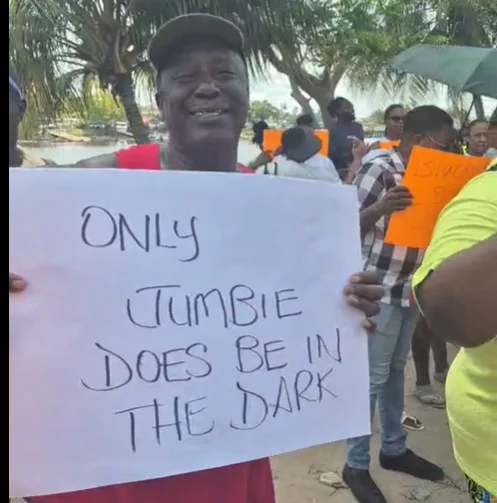
On Monday, November 2, 2026, hundreds of residents in Linden, Guyana’s historic bauxite-producing hub, poured onto the town’s main thoroughfares to voice simmering anger over days of crippling power cuts and total loss of running water. The demonstration converged outside the headquarters of the Linden Utility Services Co-operative Society Limited (LUSCL), where crowds chanted “No water, no light, fix this right!” and held hand-painted placards laying bare their cascading hardships. Signs carried messages ranging from “No light, no school. Stop the blackout” and “No light, no work” to the local Creole quip “Only jumbie does be in the dark” and frustrated pleas that “Our children have to learn” and “We are tired of spoiled meat from broken refrigeration.”
Witnesses confirmed the municipality had been completely cut off from grid electricity for more than 30 consecutive hours by the time protests erupted, a failure that immediately shut down the town’s electric-powered water pumping system, leaving households with no access to potable running supply. The unrest drew public remarks from Sharma Solomon, People’s National Congress Reform (PNCR) member, former Linden mayor, sitting A Partnership for National Unity (APNU) lawmaker and ex-Regional 10 (Upper Demerara-Upper Berbice) chairman, who lambasted national authorities for decades of neglect of the region’s aging, overstretched transmission and distribution infrastructure, paired with chronically underinvested generation capacity.
Solomon pushed back against the government’s long-running public touting of the 300-megawatt national gas-to-energy plant as a universal fix, noting that utility reliability in Linden has steadily worsened even as that flagship project was promoted to voters. He laid out a targeted, actionable proposal to resolve the crisis: renegotiate the existing power purchase agreement between the central government and Linden’s Chinese-operated bauxite firm BOSAI Minerals to ramp up local generation output, build dedicated reserve and backup capacity, and unlock enough stable supply to support fast-growing residential and commercial expansion across Region 10. He noted that the town’s current 14.5-megawatt generation allocation is already overwhelmed by demand, with roughly 40 active sawmills drawn to Linden’s discounted GY$12 per kWh industrial tariff, a fraction of the GY$65 per kWh rate charged to coastal Guyanese businesses. The strain is further compounded by new large-scale developments including the DDL Moblissa cattle farm, dozens of new housing subdivisions, and rising air conditioner use during recent record hot weather, a factor the central government has previously cited to partially explain the persistent outages.
The veteran lawmaker emphasized that Region 10 now requires a minimum 100 megawatts of dedicated local generation capacity to keep pace with projected industrial growth, residential expansion, and public service needs, and called for formal, structured collaboration between central government, the Linden Economic Investment (LEI) body, LUSCL, and the municipal council to map out a data-driven long-term infrastructure investment roadmap rather than ad-hoc stopgap repairs. He warned that months of unstable, intermittent power have already inflicted severe, widespread harm: small market vendors have lost perishable stock, households have faced costly damage to refrigerators, televisions and other sensitive appliances, schoolchildren cannot complete after-hours assignments, and local commercial activity is seizing up. As a broader systemic reform, Solomon proposed that all 10 of Guyana’s administrative regions conduct independent audits of their local renewable and conventional generation potential, to unlock excess capacity that can be fed back into the national grid for shared revenue and greater national energy resilience. At the time of publication, the national Ministry of Public Utilities had not issued any official statement or response to the protestors’ demands or Solomon’s policy proposals.
Lindeners protest no water, no light