Preliminary data released by Suriname’s General Bureau of Statistics (ABS) on November 3 shows that the combined cost of construction materials and on-site building services recorded a 1.8% average sequential increase in the third quarter of 2026, compared to the three months ending June 2026, marking the steepest quarterly growth rate recorded this year so far.
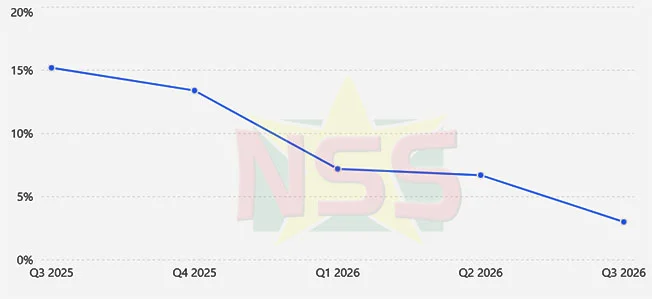
The official Construction Price Index climbed from 1245.7 index points in Q2 2026 to 1268.3 points in Q3 2026, outpacing the modest 0.1% quarter-on-quarter rise logged in the first three months of the year and the 0.7% uptick seen between April and June. Despite the accelerating sequential cost growth, the year-over-year construction inflation trend has continued its steady downward trajectory from the double-digit highs recorded in 2025. Annual price growth for the sector dropped from 15.2% in Q3 2025 to 13.4% in the final quarter of last year, before decelerating further to 7.2% in Q1 2026 and 6.7% in Q2 2026, landing at 3% for the July-to-September 2026 period.
A granular breakdown of index performance across sub-sectors reveals stark divergences in cost movements. Tiling work saw one of the sharpest jumps, with its sub-index surging from 1715.0 points to 1796.8 points over the third quarter, while carpentry services also posted a notable increase from 1452.6 points to 1541.7 points. By contrast, steel and concrete work recorded a notable contraction, with its index falling from 1466.9 points to 1426.9 points, and plumbing and sanitary installation costs edged down slightly from 1633.0 points to 1622.3 points.
The Construction Price Index tracks average price fluctuations for a fixed basket of goods and services deployed across residential, commercial, and civil infrastructure projects, drawing on data from 107 individual components grouped into 16 core categories. Price surveys are conducted across roughly 50 data collection points located in Suriname’s capital Paramaribo and the adjacent Wanica district. Labor accounts for the largest weighting in the index composition at 41.73%, though the ABS notes that no separate regular price surveys are conducted for labor inputs, and its weighting share is kept constant in the index calculation framework.
Bouwprijzen stijgen met 1,8 procent in derde kwartaal