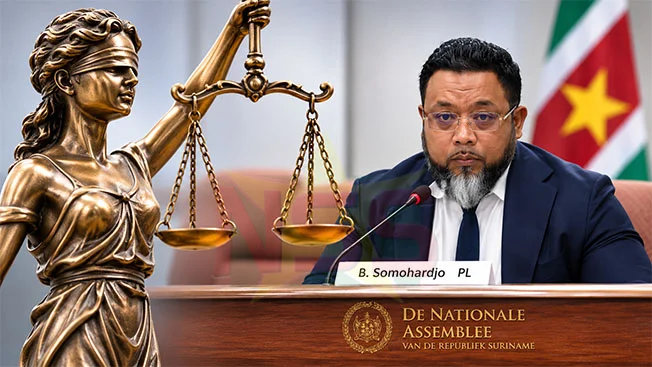
A sitting member of Suriname’s National Assembly (De Nationale Assemblée, DNA) does not forfeit their status as a people’s representative the moment a criminal investigation is launched against them. They retain their full legislative seat, official duties, and constitutional obligation to exercise independent oversight over state institutions — a principle that unequivocally applies to Bronto Somohardjo, faction leader of the Pertjajah Luhur (PL) party. Yet the ongoing criminal case against Somohardjo has become a point of contention after the country’s top public prosecutor blocked his formal request for aggregated data on the national public prosecution policy framework.
Garcia Paragsingh, Suriname’s Prosecutor General, formally rejected Somohardjo’s application for the datasets, citing the active criminal probe targeting the parliamentarian as justification for the refusal. The move has drawn widespread scrutiny, as Somohardjo did not request access to any case files related to his own personal legal matter. Instead, his application sought fully anonymized, system-wide statistical data on prosecution and case dismissal (sepot) rates across high-priority offense categories including drug trafficking, domestic violence, assault, and theft, as well as breakdowns of any documented disparities in how suspects are treated across different demographic or socioeconomic groups.
While legitimate restrictions on releasing certain datasets could theoretically apply due to privacy regulations or formal statutory constraints, any such denial would require explicit, transparent public explanation. No clear logical connection has been laid out to justify why an individual’s separate, unrelated personal criminal investigation would block access to fully generalized, aggregate public statistics that contain no personal identifiable information tied to that individual.
The Prosecutor General holds a uniquely privileged position within Suriname’s constitutional rule of law framework: the Public Prosecution Service (Openbaar Ministerie, OM) is guaranteed full operational independence to conduct investigations and pursue prosecutions without political interference. This independence is a critical safeguard for fair judicial process, but it does not grant the OM blanket immunity from public and legislative accountability. The formulation and implementation of national prosecution policy is a core public interest matter, and all citizens have a fundamental right to trust that laws are applied equally and consistently to every person under state jurisdiction. Formal, legitimate queries about the fairness and functioning of that system deserve substantive, evidence-based responses, not arbitrary procedural blocks.
Somohardjo does not require a formal acquittal in his ongoing criminal case to defend his legally enshrined rights as an elected parliamentarian. The question of whether he has committed any criminal offense must be settled exclusively through due legal process, and his elected position should never grant him special, preferential legal protections that are not available to ordinary citizens. At the same time, a mere active suspicion of wrongdoing cannot be used as unsubstantiated justification to arbitrarily restrict a sitting legislator from carrying out their constitutionally mandated parliamentary duties.
Beyond the immediate dispute between Somohardjo and the Prosecutor General, the incident exposes a far more systemic, longstanding flaw in Suriname’s judicial system: the cripplingly slow pace of criminal case processing. Hundreds of cases drag on for years on end, leaving suspects, victims, and all related parties trapped in extended, debilitating uncertainty. A prolonged criminal investigation can inflicts severe, cascading harm on an individual’s professional career, social standing, household income, family stability, and long-term life prospects. While the OM is vested with far-reaching investigative and prosecutorial powers, it bears a corresponding non-negotiable responsibility to conclude all proceedings carefully, fairly, and within a reasonable, legally defined timeframe.
This dynamic is thrown into particularly sharp relief in Somohardjo’s case: his ongoing personal criminal probe is now being invoked as a pretext to withhold general public data that directly relates to his core legislative oversight responsibilities, meaning the unprocessed legal matter is actively interfering with his ability to represent his constituents effectively. Expedited, fair processing of his case is not justified because Somohardjo, as a politician, deserves special priority over other citizens; it is a basic requirement of procedural justice, as no person should be unjustly barred from carrying out their professional and public duties due to an unnecessarily prolonged, unresolved legal procedure.
The controversy also raises critical questions about the role and institutional backbone of Suriname’s National Assembly as a whole. The DNA has a constitutional duty to defend the ability of all its members to carry out their official oversight functions unimpeded. This does not require the full legislative body to rally around Somohardjo as an individual criminal suspect, but it does demand that parliament actively safeguard the principle that a legislator’s ability to fulfill their constitutional mandate should never be contingent on their unrelated personal legal status.
Legal scholars and civil society organizations across Suriname have already issued widespread criticism of the Prosecutor General’s ruling, and the concerns raised extend far beyond this single isolated case. Today, the restriction targets a Pertjajah Luhur party legislator; tomorrow, it could be used to block a member of any other political party from accessing critical public information needed to hold state institutions to account. A parliament that only defends its institutional powers when members of its own ruling political coalition are targeted will steadily erode its own independent authority and public credibility. The OM also has a direct stake in resolving this ambiguity clearly: if the requested statistical data does not exist, the service should state that publicly. If the data is legally prohibited from being released, it should publish a full, clear explanation of the relevant statutory provisions. If the request must be submitted through an alternative formal channel via the national executive branch, the OM should explicitly guide the applicant to that correct procedure.
An active ongoing criminal investigation does not render an elected representative untouchable and above the law, but it also cannot strip them of their fundamental legal and parliamentary rights. The dual principles of an independent, unobstructed Public Prosecution Service and a fully empowered legislature capable of exercising robust public oversight are both foundational to a functioning democratic rule of law state, and both deserve equal protection. Using an active criminal probe to effectively silence a sitting elected legislator does not merely violate that individual’s rights: it weakens the entire oversight power of the people’s elected assembly, eroding a core check and balance that protects all Surinamese citizens.
Column: Een strafzaak mag een parlementariër niet monddood maken