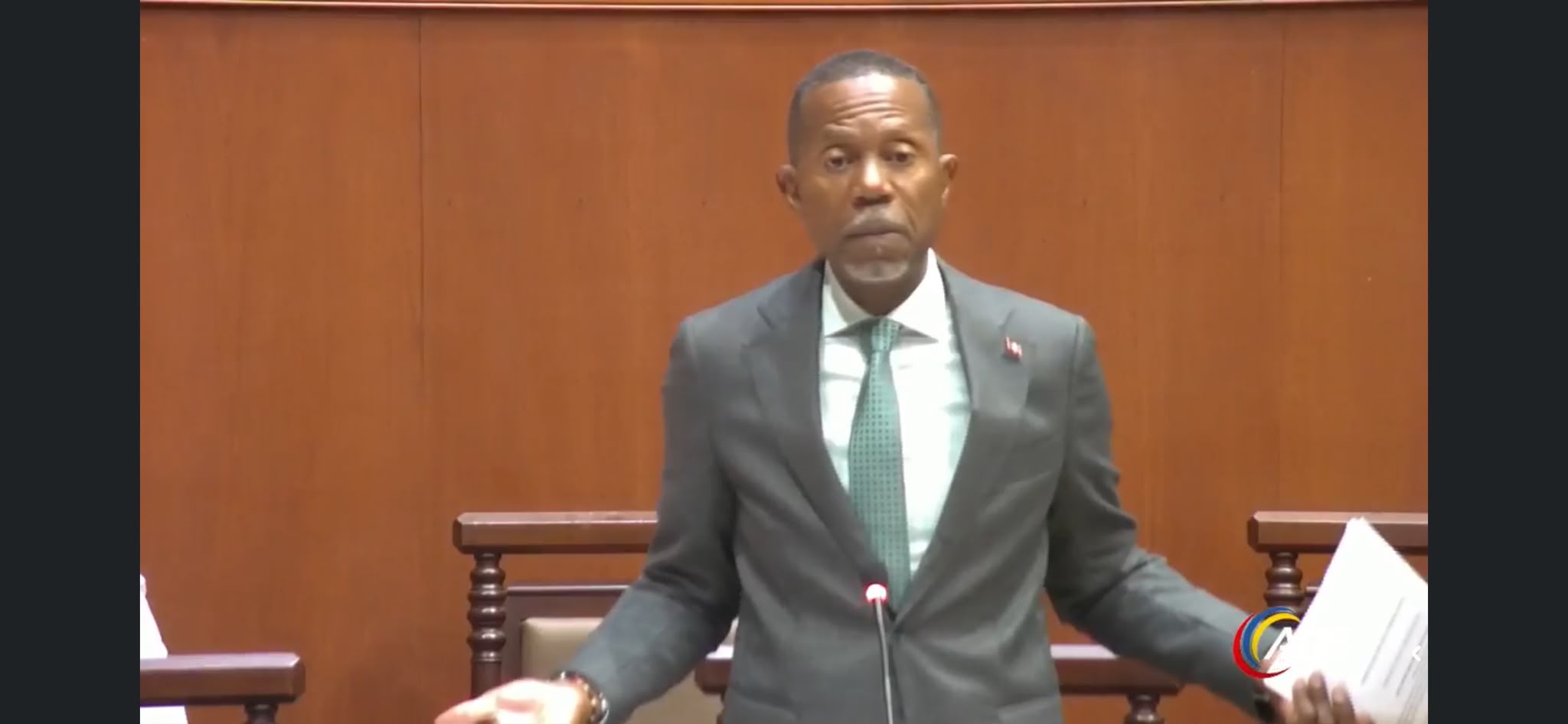
During a Tuesday parliamentary debate centered on a resolution outlining negotiating principles for talks with Washington, Member of Parliament for Barbuda Trevor Walker has delivered sharp criticism of the Antigua and Barbuda government’s approach to potential negotiations with the United States over the transfer of third-country nationals. Walker argued that the Browne administration is entering discussions from a fundamentally disadvantaged position, stripped of meaningful bargaining leverage due to long-standing stringent U.S. visa restrictions that already impact the Caribbean nation.
In stark, plain-spoken remarks to the chamber, Walker emphasized, “I want Antiguans and Barbudans to hear me. Antigua and Barbuda don’t have no cards. You have no cards.” While he stopped short of rejecting negotiation outright, he pressed the government to outline exactly what reciprocal concessions it intends to secure in exchange for cooperating with U.S. demands, arguing that this call for clarity is a completely reasonable request.
Walker stressed that this high-stakes issue should not be weaponized for partisan political gain, noting that any final agreement reached with the United States will shape the lives of all citizens across Antigua and Barbuda, regardless of political affiliation. “This matter ought not to be partisan and political because it will affect all of us,” he said.
The MP pointed to the already strict U.S. travel constraints placed on Antiguans and Barbudans as evidence of the government’s weak hand, noting that citizens are currently limited to maximum 30-day stays in the United States. He shared his own recent personal experience clearing U.S. immigration, where an officer explicitly reminded him of the 30-day rule despite Walker’s plan to stay just four days for his trip.
Walker further demanded that Prime Minister Gaston Browne publicly explain how Antigua and Barbuda arrived at what he called one of the most strained periods in bilateral relations with the U.S. “The Prime Minister of this country has an obligation … to let Antiguans and Barbudans understand why Antigua and Barbuda at this time is placed in a position where things are almost at the highest element of hardship when it comes to United States travel restrictions,” he said.
To contextualize the current strain, Walker drew a contrast to relations in the mid-2000s, when then-U.S. Secretary of State Condoleezza Rice publicly commended Antigua and Barbuda for passing national legislation focused on boosting government accountability and transparency. He raised pointed questions about whether the recent deterioration of ties is connected to international scrutiny of the country’s popular Citizenship by Investment Programme, arguing that the public is owed a full public accounting if that is the case.
Beyond criticizing the national government’s approach, Walker also took aim at regional leadership through the Caribbean Community (CARICOM), faulting bloc leaders for failing to agree on a unified regional stance on the third-country national transfer issue. He argued that small island developing states across the Caribbean would hold far more bargaining power if they negotiated as a collective bloc rather than individually. “These guys cannot sit down and come up with a common position so that this issue can be dealt with,” Walker said, urging both the Organization of Eastern Caribbean States and the broader CARICOM community to align on a coordinated approach moving forward.
Walker also called on the government to conduct widespread public consultations before finalizing any agreement with Washington. He argued that key national stakeholders including the Antigua and Barbuda Bar Association, the national Chamber of Commerce, and wider civil society groups should be engaged early to build a broad national consensus on the terms of any deal. Greater transparency around the negotiations, he added, would help the general public fully understand the far-reaching implications of any arrangement struck with the U.S.
Closing his remarks to parliament, Walker laid out non-negotiable priorities that any final decision must uphold: the government must protect Antigua and Barbuda’s core economic interests, most notably the critical tourism sector, while also preserving the ability of ordinary citizens to travel, study, and conduct business in the United States. “Our access to the United States, to do business, to go to school … and also the whole question of our economic survival, which is tourism, all those things must be taken into consideration,” he emphasized.