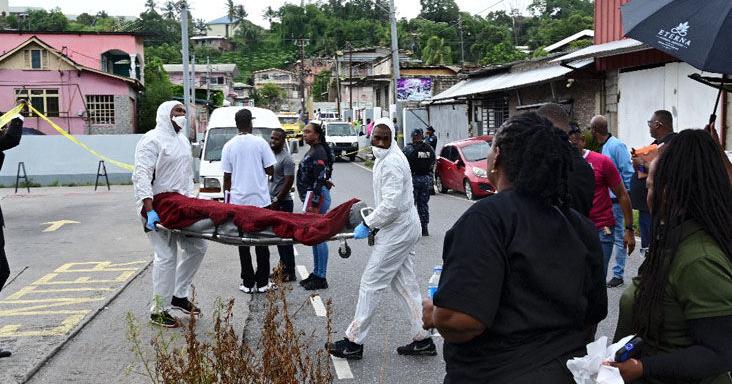
A routine social gathering turned into a devastating early-morning tragedy on the Uriah Butler Highway in Caroni, after a speeding vehicle carrying four people crashed headlong into a concrete lamppost. The force of the collision was so severe that the sedan split cleanly in half, leaving one passenger dead at the scene. Local law enforcement confirmed that emergency dispatch received the distress call shortly before 6 a.m., reporting the catastrophic collision on the highway’s northbound stretch, close to the Caroni Flyover. When first responders arrived to secure the area, they discovered the wreckage of a black Hyundai Elantra, bearing registration number PCZ 4157, resting on the road’s shoulder, its two severed halves scattered across the pavement. Investigators located the deceased passenger’s body a short distance from the destroyed vehicle. As of midday yesterday, the victim had not been officially identified by authorities. Police described the victim as a man of African descent, wearing a plain white T-shirt and three-quarter length pants, with no form of personal identification found on his person at the time of recovery. Two additional passengers pulled from the wreckage sustained life-threatening critical injuries in the crash. They have been positively identified as Renesha Joseph, a resident of Malick, Barataria, and Ronnie Rodriguez. Both injured survivors were rapidly transported by emergency ambulance to the Eric Williams Medical Sciences Complex in Mt Hope, where they remain hospitalized in stable condition under ongoing care as of the latest update. Police have not yet released additional details on the events leading up to the crash, including whether speed or impaired driving were contributing factors, and the investigation remains ongoing.
标签: Trinidad and Tobago
特立尼达和多巴哥
-

Kamla to honour ‘jahaji legacy’
On a historic visit to a small island off the coast of Trinidad that holds deep meaning for the nation’s Indo-Trinidadian community, Prime Minister Kamla Persad-Bissessar has formally unveiled plans to rename Nelson Island, a landmark forever tied to the arrival of more than 140,000 Indian indentured labourers between 1845 and 1917. The announcement, made alongside India’s Minister of External Affairs Dr Subrahmanyam Jaishankar, frames the renaming as a long-overdue act of historical reclamation that centers the stories of the people who gave the site its enduring cultural significance, rather than the colonial figures for which it was originally named.
Persad-Bissessar emphasized that the island is far more than a geographic landmark: for descendants of indentured labourers, it is the sacred first touchpoint of their ancestors’ journey across the Kala Pani, the dark waters of the Atlantic that separated workers from their home country. The Prime Minister’s own family history is intertwined with this legacy; her maternal great-grandmother, 16-year-old Sumaria Seepersad, arrived at the island from Madras in the 1880s speaking only Bhojpuri, and went on to toil on south Trinidad’s sugarcane estates after being widowed young. “I do not believe Sumaria could ever have imagined that one day, upon the very shores where she first arrived, her great-granddaughter Kamla would stand as Prime Minister of Trinidad and Tobago,” Persad-Bissessar told the gathered crowd.
In her remarks, the Prime Minister drew a clear line between the injustices of indentureship and the transatlantic slave trade that preceded it, calling the system a deliberate form of human trafficking designed to prop up the British colonial economy after emancipation. “Indentureship was a form of human trafficking, bearing many of the same labour controls, abuse and humiliation of the transatlantic slave trade that preceded it,” she said. Workers endured a grueling three-month voyage, often signed contracts they could not understand, and faced harsh, exploitative conditions on sugar plantations across the country. Despite this, Persad-Bissessar celebrated the resilience of the labourers, who built community and persevered through hardship out of hope for a better future for their descendants.
Addressing the once-pejorative term “coolie” used to describe indentured labourers, a label that is still sometimes used against people of Indian descent today, Persad-Bissessar rejected any shame associated with the term. “I feel no shame at that. We were coolies, and I said the other day, it took a little coolie girl from a place down in Siparia to become the Prime Minister of Trinidad and Tobago,” she said, drawing loud applause from attendees including government ministers and members of the Indian delegation.
To guide the renaming process, Persad-Bissessar announced that a cross-institutional committee led by Natasha Barrow, Permanent Secretary in the Office of the Prime Minister, in partnership with the National Trust of Trinidad and Tobago, will oversee the project. A public-facing website will also be launched to collect name suggestions from communities across the country, making the renaming a collective, public-led process.
Following the announcement, Persad-Bissessar and Jaishankar unveiled a commemorative plaque on the island to mark the occasion. The visit was the first of three official engagements for the day, which also included the launch of a new agro-processing facility at Brechin Castle and a national prosthetics center in Penal.
Persad-Bissessar framed the renaming as part of a broader global movement of post-colonial self-definition, pointing to India’s renaming of colonial-era cities such as Bombay to Mumbai, Madras to Chennai, and Calcutta to Kolkata as a precedent. “Such changes reflect historical reclamation, cultural dignity, and national self-definition by a free people,” she noted. She added that Trinidad and Tobago has a long history of renaming colonial sites after independence, from renaming King George V Park to Nelson Mandela Park to rebranding streets after national cultural icons including Janelle “Penny” Commissiong, Black Stalin, and Lord Kitchener.
While the island’s legacy is most closely tied to Indian indentured labour, Persad-Bissessar also acknowledged its layered history: under British colonial rule, enslaved Africans were forced to build military fortifications on the site, and the name “Nelson Island” itself is derived from Thomas Neilsen, a British doctor who took ownership of the land after it was originally called Stephenson’s Island. The island also holds other important chapters of national history: in the 1930s, Jewish refugees fleeing Nazi Germany were detained on the island, and prominent 20th century labour leaders Tubal Uriah “Buzz” Butler and George Weekes were once imprisoned there. Still, Persad-Bissessar argued, the island’s core identity is shaped by the tens of thousands of indentured labourers who first stepped onto its shores on their journey to building new lives in the Caribbean, and that identity deserves to be permanently enshrined in its name.
-

Man offers ‘compensation’ to suppress HDC contracts story
An ongoing investigation into alleged bid-rigging and contract collusion within Trinidad and Tobago’s suspended $3.4 billion national housing program has taken an unexpected turn, after an intermediary claiming to represent a senior Housing Development Corporation (HDC) official under scrutiny offered a cash compensation bribe to the *Sunday Express* in exchange for scrapping the investigative story.
The meeting took place last Thursday on Ariapita Avenue in Woodbrook, with the intermediary — a well-connected figure with deep ties to local political circles — laying out a clear quid pro quo for the newsroom’s investigative team. If the outlet agreed to kill the story about the alleged collusion, the journalist behind the investigation would receive financial compensation, plus access to a cache of internal documents detailing claims of mismanagement that occurred at HDC during the previous People’s National Movement (PNM) administration.
“Bringing this kind of negative light on the HDC at this time is not what they want,” the 6-foot-tall intermediary told *Sunday Express* reporters. When pressed for clarification on the offer, he repeated the terms: dropping all coverage of the collusion allegations would result in the payout, plus additional documented scoops on other HDC controversies.
The *Sunday Express* immediately rejected the bribe offer, noting that the contract awarding process under investigation is a matter of significant public interest, given the multi-billion-dollar scale of the housing program and the public funds allocated to it.
The attempt at hush money came after the newspaper had spent the preceding week reaching out to the implicated HDC official and the two private contractors awarded the contested contracts, in response to formal complaints of collusion filed by whistleblowers. The intermediary first contacted the newsroom on Wednesday morning, the day before the in-person meeting, claiming the official was open to negotiating a discussion about the contract controversy. Since the bribe offer was made, the story has moved forward with new developments from the contractors involved.
Within 24 hours of the meeting, Chaguanas-based attorney Denelle S Singh submitted a pre-action protocol letter to the *Sunday Express* on behalf of one contractor and his firm. The letter denied all collusion allegations and threatened immediate legal action if the contractor’s name is published in any upcoming coverage.
The second contractor, who secured one of the multi-million-dollar HDC contracts under investigation, initially spoke briefly with the *Sunday Express* last Tuesday, before submitting a detailed formal response via WhatsApp late Friday evening. In his statement, the contractor emphasized that his company is barred from disclosing confidential client arrangements, commercial terms, or project-specific details unless required by law or explicitly authorized by involved parties.
He firmly denied that his company has ever engaged in collusion with any HDC official related to housing projects in Freeport or any other location across the country, adding that all of the firm’s construction work has always been carried out in strict compliance with legal contractual and commercial standards. When asked directly about any personal or improper business relationship between his firm and the implicated HDC official, the contractor brushed the question aside, noting that like all construction firms operating in the country, his company interacts with dozens of industry stakeholders and public officials as part of routine commercial activity.
“[Company name] has provided construction, renovation, and related contracting services for numerous commercial entities over time,” he said in response to questions about whether the firm had ever done work for businesses owned by the HDC official. “As a matter of company policy, we generally do not publicly disclose confidential client relationships, commercial arrangements, or project-specific details unless legally required to do so or authorised by the relevant parties. Any services provided by the company, where applicable, would have constituted legitimate commercial construction services performed at arm’s length and in the ordinary course of business.”
The contractor “firmly and unequivocally” rejected all allegations, suggestions, or implications of collusion, noting that the company maintains a strict zero-tolerance policy toward bribery, corruption, and all forms of unethical business conduct. When asked about his relationship with the other contractor awarded a contested multi-million-dollar HDC contract, he repeated his policy of not disclosing confidential commercial arrangements, adding that the company has always acted properly, professionally, and in full compliance with the law throughout the entire contracting process for the HDC project.
“We complied with the applicable procurement, tendering, and submission requirements as communicated by the relevant authorities,” he said. “We remain confident that our experience, technical capability, operational capacity, and performance record qualified us to participate in and be considered for such opportunities.”
The $3.4 billion national housing program at the center of the allegations has already been suspended by authorities, and the bribery attempt has intensified questions about transparency and accountability in public infrastructure contracting across Trinidad and Tobago. The *Sunday Express* has confirmed it will continue its investigation into the collusion allegations, despite the bribe attempt and pending legal threat.
-

HDC official under scrutiny for collusion
A corruption and conflict of interest scandal has thrown Trinidad and Tobago’s massive $3.4 billion public housing programme into limbo, after a whistleblower complaint prompted regulators to order an immediate halt to newly awarded contracts. The case centers on a senior official at the country’s Housing Development Corporation (HDC), who is alleged to have long-standing personal and private business ties to two of the 11 contractors that secured shares of the multi-billion public works package.
Shortly after the HDC announced the list of winning contractors for the public-private partnership programme in early April, the Office of Procurement Regulation (OPR) received multiple formal and informal complaints. Acting on these submissions — which included a formal complaint filed on behalf of activist Wendell Eversley by attorney Randall Mitchell — the regulator ordered the state-owned housing agency to suspend all programme activities pending a full, independent review of the entire bidding and award process.
Multiple independent sources with direct knowledge of the award process and the ongoing investigation have confirmed to local outlet the Sunday Express that the ties between the HDC official and the two contractors date back roughly a decade. The first contractor, a prominent local businessman who owns a popular chain of retail stores, previously purchased an entire chain of businesses from the HDC official. While the businessman’s company currently holds contracts with another state entity, multiple sources confirmed it has never led a large-scale residential construction project before this award.
Records indicate the second contractor also shares a long personal and professional history with the HDC official. Around 10 years ago, the two partnered on a private housing development in Trinidad’s Freeport area, and the HDC official previously hired the second contractor to complete renovation and repair work on multiple commercial properties across the country. The second contractor also has well-documented business ties to the first contractor, and has assisted in constructing several of the first contractor’s commercial buildings over the years. Sources familiar with the investigation confirm these overlapping relationships will be a core focus of the OPR’s review.
Public concerns about the integrity of the procurement process were first raised by opposition People’s National Movement (PNM) officials, including Member of Parliament Camille Robinson-Regis and former prime minister Stuart Young. Young publicly questioned the qualifications of multiple winning firms, noting that many of the awarded companies have little to no prior experience delivering large-scale housing construction projects. A check of the Ministry of Land and Legal Affairs’ Companies Registry Online System confirmed all winning companies have been legally registered in the country for multiple years, though that verification does not address their industry experience.
When contacted for comment last Friday, HDC chairman Feeroz Khan declined to speak on the record about the allegations. “Given that the matters relating to the procurement process in question are currently engaging the attention of the Office of the Procurement Regulation, Senior Counsel has advised that the matter is sub judice, and hence it would be improper to comment on same,” Khan said.
-

Faith and heartbreak on Mother’s Day
For Sharon Vasquez-Rochard, this Mother’s Day brings no quiet celebration—only a heavy heart, as she waits by the hospital bed of her 28-year-old son Christon Battersby, a Caribbean Airlines first officer who has remained on life support for nearly 14 months after a catastrophic diving accident. What began as a casual day out with friends in March 2025 turned into an ongoing battle for survival that has tested her family’s resilience, faith, and financial stability, prompting an urgent public appeal for support to access life-changing specialized care abroad.
The fateful accident unfolded on March 15, 2025, at Tobago’s popular Pigeon Point Heritage Park. Battersby, a resident of Maracas Valley, St. Joseph, was socializing with friends near the jetty when he dove into shallow water and struck his head against an unseen submerged object. He was pulled unconscious from the water immediately by on-duty lifeguards, who began cardiopulmonary resuscitation (CPR) right away. Two visiting tourists—Sarah Persson from Sweden and Anna Hospedales from Canada—stepped in to assist with ongoing resuscitation efforts, a moment captured in a widely circulated video that spread across local social media. By the time emergency responders arrived, Battersby had already suffered a broken neck, cardiac arrest, and near-drowning; his heart had stopped beating, he had no pulse, and he was not breathing. Yet the quick action of bystanders saved him long enough to reach care, and he was first transported to Scarborough General Hospital before being transferred to the Intensive Care Unit (ICU) at Port of Spain General Hospital, where he has remained ever since, dependent on a mechanical ventilator to breathe.
In the 14 months that have followed the accident, Vasquez-Rochard says the entire experience has been an unrelenting ordeal that has strained her family in every possible way. “Watching my son fight for his life after such a devastating diving accident in Tobago has been the most painful experience we have ever faced,” she shared in an interview with the *Sunday Express* ahead of this year’s Mother’s Day. Despite the overwhelming severity of his injuries and the emotional drain of more than a year in the ICU, Battersby has never stopped fighting. Vasquez-Rochard says he has already shown small but meaningful signs of progress that keep the family’s hope alive. He can eat normally, shrug his shoulders, and make small voluntary movements of his neck. He remains fully mentally alert, with unimpaired brain function, and is deeply engaged in his own recovery process. “He is fully mentally alert and aware, and very knowledgeable about what is happening to him. He is like a doctor right now,” his mother said.
Still, his condition remains extremely complex. Prolonged immobility has led to persistent nerve pain, frequent muscle spasms, and progressive muscle atrophy. The advanced, integrated neurological and physical rehabilitation he needs to make meaningful recovery is not available in any single local medical facility. Two specialized international centers—one in Panama and one in Colombia—have evaluated Battersby’s case and confirmed they can provide the comprehensive care he requires, including intensive physical therapy, respiratory rehabilitation, neurological therapy, and mobility training tailored specifically for high cervical spinal cord injuries. When factoring in treatment costs, travel, accommodation, medical equipment, and ongoing rehabilitation, the total price tag comes to more than US$400,000 (equivalent to roughly TT $2.72 million), a sum far beyond what Battersby’s family can cover on their own. Insurance coverage has not materialized as the family expected, forcing them to turn to public fundraising. Vasquez-Rochard launched a GoFundMe campaign, alongside a dedicated bank account for direct donations, to raise the required funds in time to begin treatment as soon as possible. “I believe timely, specialised care at an international institution can maximise his chances of recovery, independence and quality of life,” she said.
For the family, every small improvement is a milestone worth celebrating. Battersby has already been able to speak briefly through a tracheostomy valve, shown improvements in sensory function, and demonstrated consistent small neurological responses to stimulation. “These are small steps, but they give us hope,” Vasquez-Rochard said. “Every small improvement is a victory for us and a reminder that progress is still possible. With God’s grace and mercy, anything is possible through faith.”
This Mother’s Day marks 14 months since the accident, and Vasquez-Rochard acknowledged the emotional weight of the moment, noting that the crisis has impacted her family emotionally, physically, spiritually, and financially. Still, she says faith has been the family’s anchor through the most uncertain moments. “There were many moments of fear and uncertainty, especially in the early months. But we have had to remain strong for Christon and continue encouraging him every single day,” she said. “We say to each other daily, ‘I love you,’ and we trust God completely.”
The family has extended heartfelt gratitude to the many groups and individuals who have supported them since the accident. They thanked the medical staff at Port of Spain General Hospital for their consistent care, Christon’s colleagues at Caribbean Airlines, the Trinidad and Tobago Airline Pilots Association (TTALPA), their local church community, and prayer groups across Trinidad and Tobago. They also reaffirmed their thanks to the tourists and bystanders who saved Battersby’s life on the day of the accident, whom Vasquez-Rochard has long called “angels.” “Angel Sarah, angel Anna, and the other angels who came and rescued, revived, and gave back life to my son—I want to say thank you from the bottom of my heart,” she said.
Just before the accident, Battersby had gained social media attention for sharing a video documenting his journey to become a commercial pilot at a young age, a dream he still holds onto today. Now, his family is asking the public to stand with them to give him a second chance to achieve that dream. Members of the public can contribute to Battersby’s recovery fund via the family’s GoFundMe campaign or through direct deposits to Republic Bank savings account 3500 2188 9031.
-

‘Crime is bigger than race and colour’
A public debate over race, crime and systemic inequality has erupted in Trinidad and Tobago after Homeland Security Minister Roger Alexander made targeted comments calling on young Black men to reject a life of criminality. The remarks came in the immediate aftermath of a fatal police shooting of four Black men suspected of carrying out a string of home invasions, putting the long-simmering conversation over how to address crime and racial stereotyping back into the national spotlight.
In his public address, Alexander urged young Black men to abandon criminal activity, framing collective action within the community as a path to national and familial pride. “To the young black men, life does not revolve around crime and criminality. We must not be seen as a threat to humanity. We can do better than that,” Alexander said, adding that young people should choose to build stable foundations rather than become part of troubling crime statistics.
But community and academic leaders across the country have pushed back on the minister’s framing, arguing that the conversation about crime must extend far beyond racial targeting to address the underlying systemic and social conditions that drive violent offending.
Reverend Kwame Clarke was among the first to respond, acknowledging that Alexander had every right to speak publicly on rising crime but emphasizing that the problem is far more complex than surface-level discussions about race allow. “I think that as a minister, it is within his purview to comment on the impact of crime on both the community and in the lives of those involved in criminal activity,” Clarke noted. However, he argued that concentrated economic disadvantage and failing social systems are the true catalysts for criminal behavior, noting that “the issue is more tied to economics and socialisation. It is a fact that communities which are considered oppressed by dysfunctional family structures, little to no income in the home, or insufficient social support infrastructure are the farm houses for gang culture and criminalisation.”
Clarke added that solving the national crime crisis requires a collective “whole village approach” that brings together all segments of society to contribute resources and solutions to the multifaceted problem, rather than focusing on a single demographic.
David Muhammed, founder and director of the Black Agenda Project, shared that while he understands the minister’s concern over rising violent crime, he worries that narrowly targeting Black youth reinforces harmful, unfounded stereotypes that paint an entire community as inherently dangerous. He compared the framing to unfair generalizations made against other ethnic groups, such as stereotypical assumptions linking Syrians to drug trafficking or Indo-Trinidadian men to domestic abuse.
Muhammed also pointed out that the outsized focus on street crime committed by poor Black people often overshadows the far greater economic damage caused by white-collar crime, which is predominantly committed by non-Black Trinidadian citizens. “The impact of white-collar crime by non-Africans still has much more of a consequential effect on our economy than all the crimes committed by poor black people all put together,” he said. He further criticized the repeated politicization of Black youth, noting that politicians from all parties regularly deploy these comments to score cheap political points, with little sincerity behind the calls for change.
Criminologist Kerron King added his expertise to the debate, arguing that crime statistics should be used to investigate root causes, not to stigmatize an entire group of people. He noted that while Black men are overrepresented as both perpetrators and victims of violent crime in national statistics, the vast majority of young Black men in Trinidad and Tobago never engage in criminal activity. “The vast majority of young black men in our nation are not involved in crime, and whilst it’s true that they are over-represented in violent crime statistics as both perpetrators and victims of violent crime, we must use this statistic to ask why,” King said.
King outlined multiple well-documented social risk factors that push youth toward crime: poor academic performance, low civic engagement, association with criminally involved peers or family members, and a lack of consistent adult supervision during adolescence. To address these gaps, he called for a sweeping overhaul of the national education system, from primary to secondary school, with a core policy goal of ensuring every child completes secondary education. “We must adopt a policy that no child, boy or girl, must be left behind. Every child will graduate, every child will cross the stage. This should be our mantra. It’s such a low-hanging fruit with such great returns. We’re not too far gone—we just need to be smart on crime and not tough on crime,” King said.
Rhondall Feeles, president of the Single Fathers Association of Trinidad and Tobago, echoed the critique of the minister’s broad comments, noting that the speech overgeneralized a problem that is specific to gang-related crime, not all Black communities. Feeles pointed out that every ethnic group in Trinidad and Tobago is stereotypically linked to specific types of crime: gang-related murder is most often associated with Afro-Trinidadian communities, while domestic murder is more prevalent in Indo-Trinidadian communities, and drug and arms trafficking stereotypes are frequently attached to Syrian and Hispanic communities.
Crucially, Feeles emphasized that no ethnicity is inherently predisposed to crime, arguing that environmental factors are the primary shaper of criminal behavior. “Someone is not born criminal. If you are in a location where gang affiliation is prominent and strong, and you don’t have the right mentorship and the right person to harness that young mind in a positive way, then you will end up with someone with gang affiliation,” Feeles said. He extended this logic to all types of crime, noting that exposure to domestic abuse cultivates domestic abusers, and growing up around corrupt unethical parents often produces people who engage in white-collar crime.
Feeles also raised a critical underdiscussed point: the street-level gang members that are the focus of public attention are rarely the ones behind the large-scale importation of illegal weapons and narcotics that fuel gang violence. He argued that focusing solely on Black street gang members ignores the larger transnational criminal networks that supply the weapons driving the violence, many of which are led by people of other ethnicities.
To truly eradicate crime, Feeles said, the country must focus on preventing the development of criminal minds by transforming vulnerable communities through a collaborative two-pronged approach that pairs state institutions with local non-governmental organizations. This strategy would center on empowering marginalized communities with critical skills: financial literacy, small business development, digital literacy, emotional and psychosocial support, and trade training, giving residents viable alternatives to criminal activity and reducing the systemic conditions that drive offending.
-

How would you grade Guevarro?
As Trinidad and Tobago Police Service (TTPS) Commissioner Allister Guevarro approaches his one-year anniversary in the top law enforcement role next month, Homeland Security Minister Roger Alexander is opening the door for public and peer input on his tenure — declining to share his own personal rating ahead of the broader feedback period.
Alexander made the announcement during the TTPS’s 103rd annual Sports and Family Day, held Tuesday at St James Barracks, where reporters pressed him for his assessment of Guevarro’s leadership and what areas may need improvement. Guevarro and several senior TTPS deputies, including Junior Benjamin and Suzette Martin, were in attendance during the media interaction.
When asked to weigh in on Guevarro’s leadership of the national police force, Alexander pushed back on framing policing performance as a one-person responsibility. “It’s a team effort and not an individual effort. For the team effort, I have total confidence in the Trinidad and Tobago Police Service, from where I came from,” he told reporters.
The conversation also turned to longstanding public demands for mandatory body-worn cameras for frontline patrol officers, a policy widely cited as a tool to boost transparency and police accountability. While Alexander confirmed the government and TTPS do not oppose the adoption of body cameras, he said outfitting officers with life-saving protective gear is the immediate priority, given the rising danger facing law enforcement in the country.
“At this time, I have decided to protect law enforcement first by giving them the requisite protection gear so they can better protect you as citizens and this nation as a whole,” he explained. Pointing to the increasingly heavy firepower used by criminal actors, including 7.62mm and 5.56mm ammunition, Alexander questioned whether the public should prioritize recording equipment over officer safety: “What do you want? Do you want a man to be confident enough to take on these persons or do you want him to tape it with all the requisite equipment?”
After reporters reiterated the role of body cameras in ensuring transparency and accountability, Alexander shifted the conversation to what he called the deeper root causes of violent crime in the country: systemic failures in family and community upbringing. He argued that public discourse too often focuses exclusively on police performance, while ignoring the role of family members who harbor violent criminals and fail to intervene in harmful behavior early on.
“Why this conversation is not with the parenting aspect of this?” he asked. “Greater attention must be paid to family structures, community influence and early intervention in schools. We often question police officers, but less focus is placed on parents and grandparents, and on the fathers and them who are shooting persons, killing young children and then going to sleep and hugging up their children.”
Alexander added that even during the event, there are families across the country turning a blind eye to the criminal activity of their relatives: “Right now, while we’re speaking here, there’s someone — a grandmother, a mother, somebody — looking out the window to see when the police is coming because their criminal son is lying on the bed. He’s sleeping because he was out all night.”
To address these root causes, the minister confirmed the government is rolling out a new, multi-stakeholder psychosocial intervention initiative focused on crime prevention, a strategy the administration says is unprecedented in Trinidad and Tobago. A dedicated intervention team will work directly in schools and local communities to address harmful patterns early, partnering with criminologists, psychologists, parent-teacher associations, and faith leaders to implement preventive measures.
“At this time, the police have a psychosocial intervention team that we are putting together to enter the schools, to enter the community… Things that were never done before, because we understand prevention is the first stage,” Alexander said. “We have a wide range of professionals and community leaders coming on board because they understand prevention is better than cure.”
-

Investigation launched into alleged oil spill reported by Venezuela
A cross-border environmental dispute has emerged between Venezuela and Trinidad and Tobago after Caracas accused Port of Spain of being the source of a major oil spill that has inflicted widespread harm to coastal ecosystems and communities in eastern Venezuela.
In an official communiqué released Wednesday evening, Venezuela’s interim government under Acting President Delcy Rodríguez publicly raised alarm with the global community over the incident. The statement pinned the origin of the spill on the Republic of Trinidad and Tobago, noting that contamination has already spread across the Gulf of Paria and the shorelines of Venezuela’s Sucre and Delta Amacuro states.
Preliminary technical assessments conducted by Venezuelan agencies have confirmed that the spill has left measurable damage across multiple key zones: open marine habitats, public coastlines, ecologically sensitive natural areas, and the fishing communities that form the backbone of the local regional economy. According to the communiqué, experts have documented severe threats to the region’s mangrove forests, coastal wetlands, native marine wildlife, and critical hydrobiological resources that underpin both local food security and the broader ecological balance of the Gulf of Paria. Records also confirm harm to vulnerable native species and ecosystems categorized as exceptionally sensitive to disruption.
Following the detection of the spill, the Venezuelan government has issued a formal set of demands and next steps. Caracas has instructed its Ministry of Foreign Affairs to immediately launch a formal request for full access to all relevant details about the incident from Trinidad and Tobago, alongside a comprehensive copy of Port of Spain’s containment and mitigation action plan. The communiqué also emphasized that Venezuela demands Trinidad and Tobago uphold all binding obligations under international environmental law, and move forward urgently to implement reparations measures for the damage already inflicted by the spill.
“ The Government of the Bolivarian Republic of Venezuela will continue to deploy all necessary actions to protect the affected ecosystems and safeguard the impacted communities,” the statement concluded.
Responding to requests for comment from local outlet Trinidad Express, Trinidad and Tobago’s Energy Minister Dr. Roodal Moonilal confirmed that a formal investigation into the claims is already underway. Moonilal stated that Heritage Petroleum, the state-owned energy company of Trinidad and Tobago, has launched its own internal inquiries into the reports, and that additional details will be released to the public once preliminary findings are compiled.
-

PM announces committee to rename Nelson Island
On the first day of Subrahmanyam Jaishankar, India’s Minister of External Affairs, official two-day visit to Trinidad and Tobago, the two nations took a meaningful step toward honoring a shared, painful historical legacy on Nelson Island, a small Caribbean landmass etched deep into the history of Indo-Trinidadian communities.
During a waterfront ceremony that began with an early-morning water taxi journey from Port of Spain, Prime Minister Kamla Persad-Bissessar of Trinidad and Tobago made a major announcement: a specialized oversight committee has been formed to guide the renaming of Nelson Island, a project rooted in reckoning with the island’s role in the system of East Indian indentureship. Spearheaded by Natasha Barrow, Permanent Secretary in the Office of the Prime Minister, the committee will work in close partnership with the National Trust of Trinidad and Tobago to steer the process forward. In a deliberate move to center public voice in the historical reclamation project, Persad-Bissessar emphasized that the renaming process will be open and inclusive, with all citizens invited to submit name proposals and recommendations for consideration.
Addressing attendees alongside Jaishankar, Persad-Bissessar offered a blunt recharacterization of the 19th and early 20th century indentureship system, framing it as a deliberate form of human trafficking created to prop up the economic interests of the British Empire after the abolition of chattel slavery. She noted that the indentured laborers who arrived on these shores brought no financial wealth or formal guarantees, but carried with them unshakable religious devotion and cultural resilience that would go on to shape modern Trinidadian and Tobagonian society.
The centerpiece of the day’s events was the unveiling of a commemorative plaque, dedicated to honoring the enduring legacy and immeasurable sacrifices of the thousands of indentured workers who passed through the island. Following the plaque unveiling, Jaishankar announced a landmark commitment: the Government of India will provide a financial grant to support conservation and infrastructure upgrades to transform Nelson Island into a fully accessible, internationally recognized heritage site.
In comments given to the Express on the sidelines of the ceremony, Jaishankar called his first day in the country “splendid”, and highlighted the enormous untapped potential for deepening bilateral cooperation between India and Trinidad and Tobago. He noted that growing ties between the two nations will deliver shared benefits for citizens of both countries in the years ahead.
For context, Nelson Island carries unmatched historical weight for Trinidad and Tobago. Records from the National Trust of Trinidad and Tobago confirm that between 1866 and 1917, more than 114,000 indentured Indian laborers were processed through Nelson Island and the adjacent Five Islands. Upon arrival, workers had their identity documents verified, personal details including name, birthplace and religion recorded, before being dispersed to sugarcane, cocoa and coconut plantations across Trinidad to begin their contracted labor. The island also functioned as an assembly and repatriation hub until 1936, serving workers who completed their contracts and chose to return to India.
Jaishankar’s visit to Trinidad and Tobago is part of a wider 9-day regional tour that includes stops in Jamaica, Suriname and Trinidad and Tobago from May 2 to 10, where he will hold high-level discussions focused on strengthening bilateral ties and addressing regional and global issues of shared concern. On the second day of his stop in Trinidad and Tobago, Jaishankar is scheduled to lead the ribbon-cutting for a new agro-processing facility at Namdevco in Brechin Castle, Couva, followed by the official launch of a national prosthetics programme in Penal, where Prime Minister Persad-Bissessar will deliver the keynote address and unveil a second commemorative plaque.
-

‘Murder rate would be higher’
A shocking early-morning gang-linked triple shooting that claimed the life of a two-year-old child has ignited a fiery political debate in Trinidad and Tobago over the ruling government’s crime control policies, just months into its second state of emergency (SoE) implemented to curb spiraling violent crime.
On Thursday, gunmen ambushed a vehicle carrying Akini Kafi, 2, his father Aquil Kafi, and Anthony Wilson in the Port of Spain neighborhood of Belmont, killing all three. The child’s mother, Antonia Cain-Kafi, was struck by four bullets and remains in critical condition at a local hospital. This brutal killing followed a similar April attack in Morvant that left nine-year-old J’Layna Armstrong dead alongside three adult relatives, in what police described as another targeted gang shooting.
Prime Minister Kamla Persad-Bissessar addressed the tragedy Tuesday during a parliamentary crime debate, following a diplomatic ceremony at the Port of Spain Red House where 2,000 Indian-donated laptops were distributed to students across seven districts and bilateral education memoranda were signed. Opening her remarks, Persad-Bissessar expressed profound grief over the unnecessary loss of innocent life, emphasizing that the killing of a child represents an unconscionable national tragedy.
“Every life lost is a heartbreak to many, and especially when there’s a child, it’s a tragedy,” she told reporters. “I know our law enforcement officers are doing the best they can to pursue those responsible for this tragedy, and our hearts go out to the families and the loved ones left behind.”
Against this backdrop of national mourning, the prime minister defended her administration’s core crime control measure: the ongoing state of emergency. She pushed back against growing public and opposition criticism of the policy, arguing that the national murder rate would be far higher if the SoE had not been put in place. Persad-Bissessar also confirmed that no nationwide curfew would be introduced at this stage of the emergency.
Persad-Bissessar’s government won a decisive victory in the April 28, 2025 general election. Just three months after taking office, the administration declared its first state of emergency in response to rapidly escalating gang violence and mounting national security threats. A second SoE was extended on March 3 of this year, after intelligence services received concrete warnings of imminent gang reprisal attacks across the Port of Spain metropolitan area.
The parliamentary debate devolved into partisan acrimony after Defence Minister Wayne Sturge made the bombshell claim that the recent Belmont triple murder and the April Morvant quadruple killing are directly linked to ongoing inter-gang turf wars in constituencies controlled by the opposition People’s National Movement (PNM). Sturge, who is a resident of Belmont, told the chamber that two local streets – Serraneau Street and Belle Eau Road – have long been divided into rival gang territories, with residents blocked from crossing into the opposing area. He confirmed that both recent mass shooting incidents are rooted in this long-running territorial feud.
Sturge launched a scathing counterattack against opposition calls for his resignation and that of Homeland Security Minister Roger Alexander, pointing to the PNM’s own record of out-of-control violent crime when the party held power. He reminded lawmakers that under the previous PNM administration, the national murder rate hit all-time record highs, including one 24-hour period in July 2019 that saw 11 separate killings. Sturge went further, dismissing PNM MP Stuart Young, who first called for the ministers’ resignations, as one of the most ineffective national security ministers in the country’s history.
“When 11 murders take place under his watch, he has the gall to come and call for resignations on this side,” Sturge said. “What he’s not saying is that his own constituents are largely responsible for the most murders in this country, and they refuse to allow zones of special operations (ZOSO) to be implemented in the area.”
In a charged verbal exchange, Sturge pressed his attack, telling Young: “The same way you wouldn’t know when your constituents are going to murder some of your other constituents a street away, you expect us to know? But, let me tell you something, what we wouldn’t do, we wouldn’t know that four people are trapped in a pipeline and wait and let them die.”
Young immediately stood to object, labeling Sturge’s remarks “gibberish” and “verbal diarrhoea.” Sturge quickly shot back, responding: “He could call it all kinds of things, verbal diarrhoea; you know what he couldn’t say? That I lie.”