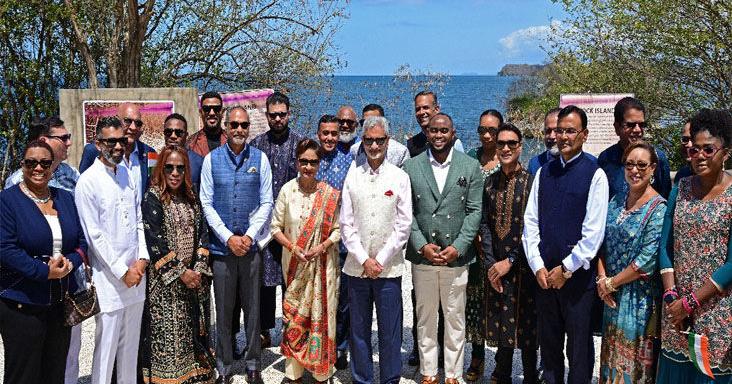
On a historic visit to a small island off the coast of Trinidad that holds deep meaning for the nation’s Indo-Trinidadian community, Prime Minister Kamla Persad-Bissessar has formally unveiled plans to rename Nelson Island, a landmark forever tied to the arrival of more than 140,000 Indian indentured labourers between 1845 and 1917. The announcement, made alongside India’s Minister of External Affairs Dr Subrahmanyam Jaishankar, frames the renaming as a long-overdue act of historical reclamation that centers the stories of the people who gave the site its enduring cultural significance, rather than the colonial figures for which it was originally named.
Persad-Bissessar emphasized that the island is far more than a geographic landmark: for descendants of indentured labourers, it is the sacred first touchpoint of their ancestors’ journey across the Kala Pani, the dark waters of the Atlantic that separated workers from their home country. The Prime Minister’s own family history is intertwined with this legacy; her maternal great-grandmother, 16-year-old Sumaria Seepersad, arrived at the island from Madras in the 1880s speaking only Bhojpuri, and went on to toil on south Trinidad’s sugarcane estates after being widowed young. “I do not believe Sumaria could ever have imagined that one day, upon the very shores where she first arrived, her great-granddaughter Kamla would stand as Prime Minister of Trinidad and Tobago,” Persad-Bissessar told the gathered crowd.
In her remarks, the Prime Minister drew a clear line between the injustices of indentureship and the transatlantic slave trade that preceded it, calling the system a deliberate form of human trafficking designed to prop up the British colonial economy after emancipation. “Indentureship was a form of human trafficking, bearing many of the same labour controls, abuse and humiliation of the transatlantic slave trade that preceded it,” she said. Workers endured a grueling three-month voyage, often signed contracts they could not understand, and faced harsh, exploitative conditions on sugar plantations across the country. Despite this, Persad-Bissessar celebrated the resilience of the labourers, who built community and persevered through hardship out of hope for a better future for their descendants.
Addressing the once-pejorative term “coolie” used to describe indentured labourers, a label that is still sometimes used against people of Indian descent today, Persad-Bissessar rejected any shame associated with the term. “I feel no shame at that. We were coolies, and I said the other day, it took a little coolie girl from a place down in Siparia to become the Prime Minister of Trinidad and Tobago,” she said, drawing loud applause from attendees including government ministers and members of the Indian delegation.
To guide the renaming process, Persad-Bissessar announced that a cross-institutional committee led by Natasha Barrow, Permanent Secretary in the Office of the Prime Minister, in partnership with the National Trust of Trinidad and Tobago, will oversee the project. A public-facing website will also be launched to collect name suggestions from communities across the country, making the renaming a collective, public-led process.
Following the announcement, Persad-Bissessar and Jaishankar unveiled a commemorative plaque on the island to mark the occasion. The visit was the first of three official engagements for the day, which also included the launch of a new agro-processing facility at Brechin Castle and a national prosthetics center in Penal.
Persad-Bissessar framed the renaming as part of a broader global movement of post-colonial self-definition, pointing to India’s renaming of colonial-era cities such as Bombay to Mumbai, Madras to Chennai, and Calcutta to Kolkata as a precedent. “Such changes reflect historical reclamation, cultural dignity, and national self-definition by a free people,” she noted. She added that Trinidad and Tobago has a long history of renaming colonial sites after independence, from renaming King George V Park to Nelson Mandela Park to rebranding streets after national cultural icons including Janelle “Penny” Commissiong, Black Stalin, and Lord Kitchener.
While the island’s legacy is most closely tied to Indian indentured labour, Persad-Bissessar also acknowledged its layered history: under British colonial rule, enslaved Africans were forced to build military fortifications on the site, and the name “Nelson Island” itself is derived from Thomas Neilsen, a British doctor who took ownership of the land after it was originally called Stephenson’s Island. The island also holds other important chapters of national history: in the 1930s, Jewish refugees fleeing Nazi Germany were detained on the island, and prominent 20th century labour leaders Tubal Uriah “Buzz” Butler and George Weekes were once imprisoned there. Still, Persad-Bissessar argued, the island’s core identity is shaped by the tens of thousands of indentured labourers who first stepped onto its shores on their journey to building new lives in the Caribbean, and that identity deserves to be permanently enshrined in its name.