
The annual rainy season in Suriname is no unforeseen event. Every student learns about the country’s distinct seasonal patterns in school, the national Meteorological Service issues advance warnings, and even long-time residents mentally prepare for wet conditions months ahead. Yet year after year, when the heavy downpours arrive, the widespread chaos they trigger still catches communities off guard. As a healthcare worker working in a local clinic, these disruptions are visible from the very start of the rainy season. Patients cancel appointments or fail to show up entirely because their yards and homes are submerged under floodwater. Others arrive hours late after impassable roads forced them to abandon their vehicles halfway to the facility. Temporary parking lots turn into makeshift ponds, turning what should be a quick trip to the hospital into an unexpected, logistically challenging expedition. Even routine procedures such as blood draws become unnecessarily complicated. Access roads to off-site testing laboratories are frequently rendered unusable, and some collection sites face flooding themselves. What was supposed to be a standard check-up gets pushed back not out of patient negligence, but simply because reaching the care facility has become impossible. The impact of unmanaged flooding stretches far beyond the healthcare sector, however. Flooded homes leave residents with water-damaged furniture, destroyed electrical appliances, and the unplanned burden of cleaning and rebuilding. For households already struggling to make ends meet, these unexpected repair costs push budgets even further out of balance, leaving a costly bill the rainy season leaves behind that many cannot afford. Food prices for fresh vegetables and other staple groceries have also spiked in the wake of repeated flooding. For many Surinamese families, accessing affordable nutritious food was already a major challenge; seasonal flooding only makes that burden much heavier. On top of economic strains, flood conditions create ideal breeding grounds for a range of health hazards. Standing water is the perfect environment for mosquito breeding, driving up the risk of mosquito-borne diseases across affected communities. Floodwater also increases exposure to dangerous infections such as Weil’s disease, which spreads when people come into contact with water contaminated by rat urine. To add to the list of problems, the rising floodwaters drive unwanted wildlife — including rats, cockroaches, and even snakes — out of their natural habitats and into dry residential homes, turning living spaces into unexpected refuges for displaced wildlife. It is important to acknowledge that individual residents bear some responsibility for reducing flood risk. Improper disposal of waste in drainage trenches and canals is a common contributor to blockages, and unkempt residential yards can make flooding worse. A clogged drainage system can often trace its origin back to a single plastic bottle or plastic bag discarded carelessly. But individual responsibility is only one piece of the puzzle. Building and maintaining a flood-resilient Suriname is first and foremost a public responsibility. The government bears the core duty of ensuring routine maintenance of drainage canals, sewer systems, and other flood management infrastructure. This work should not wait until streets are already submerged; it needs to happen long before the first heavy rains of the season arrive. As the old saying goes, an ounce of prevention is worth a pound of cure — and this principle applies as much to public governance as it does to healthcare. As a physician, I would far rather prevent high blood pressure than treat the life-threatening complications that result from uncontrolled disease. I would rather manage diabetes early to prevent kidney failure than intervene after irreversible damage has been done. Prevention requires advance planning, consistent ongoing maintenance, and sometimes upfront investments whose benefits only become visible years down the line. Flood management works exactly the same way. A well-maintained, fully functional drainage system rarely makes headline news. But a flooded residential neighborhood does. This may be the core challenge we face. Too often, governments and communities only invest in infrastructure after a crisis has already developed and become visible to the public. But effective governance, just like effective healthcare, centers on stopping problems before they ever start. The rainy season was never unexpected. Only our preparation for it was.
标签: Suriname
苏里南
-
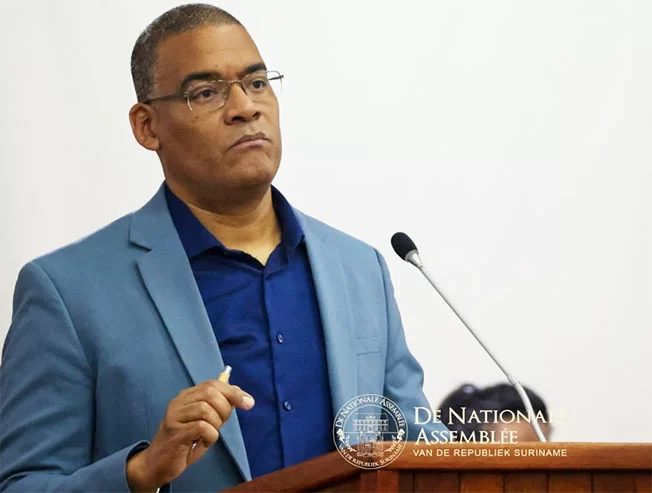
Ministerie dat economie moet aanjagen krijgt slechts 0,4% van staatsbegroting
During ongoing parliamentary debates over the 2026 national budget, Suriname’s Minister of Economic Affairs, Entrepreneurship and Technological Innovation (EZOTI), Andrew Baasaron, has sounded a urgent alarm over the critically underfunded state of his ministry, which is tasked with driving the country’s long-term economic expansion, private sector growth and economic diversification.
-

Baitali legt zich neer bij uitvoering Van ‘t Hogerhuysstraat, maar zet juridische strijd Voort
On June 25, Farsi Khudabux, chief executive of Surinamese construction firm Baitali NV, announced that the company will not block the implementation of the long-awaited Van ‘t Hogerhuysstraat rehabilitation project, despite losing a summary injunction lawsuit against the Surinamese state. The firm, however, maintains its opposition to what it calls an unjustified disqualification from the public tender for the project, and is currently reviewing potential further legal action against the government.
Khudabux shared his response one day after the state signed a formal contract for the project with Kuldipsingh Infra, the winning bidder selected after Baitali’s disqualification. He pointed out that it was notable for the government to move forward with executing the court ruling within 24 hours of its issuance, a level of speed the government rarely demonstrates for other court decisions that do not align with its priorities.
“It is good that the state follows up on a ruling within one day — we wish they were always this efficient,” Khudabux sardonically noted, adding that the accelerated timeline demonstrates the government’s pattern of prioritizing rulings that benefit its agenda while leaving unfavorable court orders stagnant for extended periods.
Despite this criticism, the Baitali CEO emphasized that the firm respects the court’s ruling and will comply with its requirement to allow work to move forward. “We operate under the rule of law, and we will abide by the court’s decision,” Khudabux said. “But where we disagree with the outcome, we will exhaust every legal recourse available to us to defend our position.”
He clarified that Baitali never sought to derail the rehabilitation project entirely. Months ago, the firm informed the Ministry of Public Works that it had no objection to Kuldipsingh Infra carrying out construction work, as long as existing contractual agreements with Baitali were honored. Khudabux stressed that the company’s fight has never been about claiming the project for itself, but about challenging the validity of its disqualification from the bidding process.
In the recent ruling, the judge did not make any substantive ruling on whether the disqualification itself was legally justified. Instead, the court weighed the public interest of advancing the long-delayed infrastructure project against Baitali’s commercial interests, and ruled to allow work to proceed immediately. The core question of the tender’s fairness has been deferred to a full trial on the merits, if Baitali chooses to move forward with that legal route.
Currently, Baitali is working with its legal advisors to outline next steps. Both an appeal of the summary ruling and a full substantive trial on the tender disqualification remain on the table, according to Khudabux. The CEO acknowledged that the court ruled the judgment immediately enforceable, meaning the government can proceed with construction regardless of whether Baitali files an appeal. Even so, the firm extended a wish of success to Kuldipsingh Infra for the execution of the project.
Khudabux reaffirmed his claim that the international tender process was riddled with irregularities. He highlighted that three out of the five total bidders were disqualified, including two experienced international contracting firms with extensive global infrastructure experience. Adding to the suspicion around the evaluation process, Khudabux noted that Baitali recently qualified for a far larger international infrastructure project overseas, despite being disqualified from this smaller municipal rehabilitation project in Suriname — where the firm has operated as a trusted contractor for decades.
“That discrepancy leads us to believe that something went wrong in the bid evaluation process,” Khudabux said. “That is why we will continue to fight until a court makes a clear ruling on whether our disqualification was justified.” He closed by reiterating the firm’s commitment to the rule of law, confirming Baitali will respect the court’s ruling while pursuing all legal avenues to have its disqualification reviewed.
-
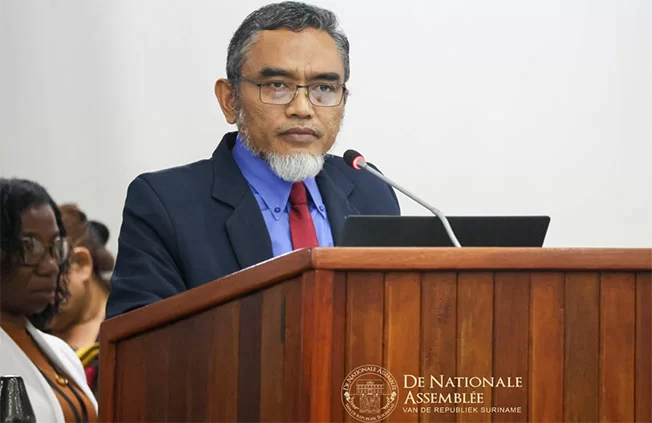
Soeroredjo: lopende grondconversieaanvragen worden opnieuw beoordeeld
In a budget address delivered to the National Assembly, Minister Stanley Soeroredjo of the Ministry of Land Policy and Forest Management (GBB) has outlined the Suriname government’s plan to overhaul the country’s existing land conversion policy, citing systemic gaps that have opened the door to abuse and widespread land speculation. The government remains committed to completing a full review of the current policy framework, and all pending land conversion applications will now be assessed on a strict individual basis, with the government also considering potential refunds for applicants who have already paid processing fees for unapproved claims. Soeroredjo stressed that the government does not oppose land conversion in principle – the original policy was designed to deliver greater property rights security for ordinary citizens who have lived on or invested in state-owned plots for years. Instead, the review is targeting critical flaws embedded in the current state decree that run counter to that original mission. Three core gaps have been identified by the ministry: the current framework places no limit on the number of parcels a single individual or legal entity can convert to private ownership, sets no cap on the total amount of land one party can acquire, and requires no minimum holding period before conversion can be approved. These oversights have created a loophole that allows speculators to convert plots to private ownership immediately after they are allocated, a practice that directly contradicts the original intent of the policy, according to Soeroredjo. GBB is also currently investigating reports of large-scale, questionable land conversions carried out through foundation structures, as well as cases where land was converted to private ownership at valuations far below market rate. All of these findings will be incorporated into the ongoing policy evaluation. Recognizing that thousands of ordinary applicants have already incurred processing costs for their claims, the ministry will sort applications by their current stage of review and assess each case separately. Once the full evaluation is complete, the government will issue clear guidance on next steps for all pending claims, including a formal decision on whether refunds will be issued for applications that cannot ultimately be approved. Looking forward, the government is already drafting an updated regulatory framework for land conversion that will close the existing loopholes. Proposed new rules include caps on the number of parcels and total land area a single entity can convert, a mandatory minimum holding period before conversion is allowed, and additional safeguards to crack down on speculative activity. Soeroredjo emphasized that the end goal of the overhaul is to build a balanced system: one that delivers the property rights security guaranteed to honest, eligible citizens, while preventing misappropriation of state land through abuse and speculation that diverts public assets from their original public purpose.
-

China neemt Amerikaanse kroon over voor snelste supercomputer ter wereld
For the first time in nearly a decade, a Chinese supercomputer has seized the number one position on the world’s most influential ranking of high-performance computing systems, ending a multi-year run of U.S. leadership and underscoring Beijing’s expanding capacity to compete with Washington in cutting-edge technological development.
The new champion, LineShine, is hosted at the National Supercomputing Centre in Shenzhen. It recorded a performance of 2.198 exaflops — equivalent to more than two quintillion calculations per second — giving it a 20% performance lead over the previous title holder, the U.S.-built El Capitan supercomputer. El Capitan, located at Lawrence Livermore National Laboratory in California, had held the top spot on the biennial TOP500 ranking since November 2024. Following LineShine and El Capitan in the updated rankings are two other U.S. systems: Frontier at Oak Ridge National Laboratory in Tennessee takes third place, and Aurora at Argonne National Laboratory in Illinois claims fourth. Germany’s Jupiter rounds out the top five, with other top 20 spots distributed across nations including the United Kingdom, Japan, South Korea, Italy, the Netherlands, and Switzerland.
This milestone marks the first time a Chinese system has topped the TOP500 list since 2017, when China’s Sunway TaihuLight held the leading position. Industry analysts say LineShine’s ascent is particularly notable because it comes despite years of strict U.S. export restrictions targeting advanced semiconductors for high-performance computing. Jack Dongarra, an emeritus professor of computer science at the University of Tennessee and one of the lead organizers of the TOP500 project, noted that LineShine’s performance proves China remains competitive in the supercomputing space even amid trade barriers. “Export restrictions may slow China’s access to certain imported components, but they have also accelerated the development of domestic alternative solutions,” Dongarra explained. He added that China’s return to the top position was not entirely unexpected.
A unique feature of LineShine that sets it apart from other leading exascale systems is its all-central processing unit (CPU) architecture. Unlike graphics processing units (GPUs), which have become the standard for powering large AI models such as ChatGPT and Claude due to their parallel processing capabilities, CPUs have fewer cores and are generally slower for complex AI workloads. Even with this design choice, the TOP500 confirms LineShine is the first and only CPU-only supercomputer to ever break the 2 exaflop performance threshold.
First launched in 1993, the TOP500 list is published twice yearly, ranking systems based on their performance on the LINPACK Benchmark, a standard test that measures how quickly a system can solve a large system of linear equations. China previously dominated the global supercomputing landscape, holding nearly half of all TOP500 spots in 2019, but its representation on the list declined in recent years amid worsening U.S.-China geopolitical tensions.
While the TOP500 has remained an influential industry benchmark for decades, some experts argue its relevance has faded as computing priorities have shifted following the AI boom. Most of the world’s most powerful AI-optimized computing systems are operated by large private tech corporations including Microsoft, Amazon, Meta, and Alphabet, and these private systems rarely participate in the voluntary TOP500 ranking, which is dominated by public sector and academic systems. For context, a 2025 analysis from Cornell University estimated that El Capitan holds only 22% of the total computing power of xAI’s private Colossus supercomputer.
Dongarra emphasized that the TOP500 only measures performance on one specific benchmark, and should not be treated as a comprehensive measure of overall global technological leadership. “Scientific output, energy efficiency, software maturity, reliability, usability, and support for broad research communities are all equally important metrics,” he said.
Addison Snell, co-founder of technology research firm Intersect360 Research, noted that while LineShine’s top ranking was not surprising, it is notable that Chinese developers have returned to active participation in the TOP500 ranking after years of reduced involvement. Snell argued that LineShine’s new leading position will have ripple effects for the United States, Europe, and Japan as they compete for global AI dominance. “The U.S. still holds an overall technological lead, but the gap has narrowed dramatically,” Snell said. “With rapid advancements across the sector, the global technology order can shift very quickly. Digital sovereignty has become a core priority in supercomputing and AI, and every major region is now investing heavily to build its own independent capabilities.”
For a decade, the U.S. and China have been locked in intensifying competition for global leadership in advanced technology sectors including AI, with export controls and sanctions used as key tools in this rivalry. A 2026 research report from Stanford University found that China has effectively closed the performance gap with the U.S. in core AI model capabilities. While the U.S. still produces more leading-edge large AI models, China leads the world in AI-related patents and industrial robot adoption.
Snell added that even if large private tech firms could outperform the TOP500’s top-ranked systems, the ranking remains critical for scientific supercomputing, a distinct field from consumer-facing AI development. “AI dominance does not automatically translate to scientific computing dominance,” he explained. While consumer AI applications such as image generation, automated translation, and chatbots are important, they are not sufficient to meet global research needs. “Policy should support AI development for scientific progress, not pit AI investment against scientific computing investment. Governments need to invest in both areas to secure long-term technological competitiveness.”
-

Pokie: bijna 2.000 klachten onderzocht, bestanden worden opgeschoond
When Diana Pokie took office as Suriname’s Minister of Social Affairs and Housing, she inherited a social welfare system riddled with systemic backlogs, administrative ambiguity, and critical gaps in record-keeping and oversight. Now, just months into her tenure, the minister is leading a sweeping, multi-pronged reform effort to clean up messy beneficiary databases, root out fraud, and improve public service delivery for vulnerable populations.
One of the most pressing challenges Pokie’s team has prioritized is resolving the backlog of issues related to the country’s Moni Karta social welfare payment cards. When Pokie assumed office, the ministry was flooded with public complaints: thousands of eligible beneficiaries never received their payment cards, and had no way to track their missing documents. Speaking during the national budget debate in the National Assembly, Pokie outlined the core dilemma her ministry faces: it confronts widespread public need on a daily basis, but operates with severely limited public resources, all while tackling deep-rooted organizational and administrative dysfunction inherited from previous administrations.
To address citizen concerns directly, the ministry established a dedicated communications unit that reports straight to the minister’s office. Since January alone, the unit has registered 1,719 individual Moni Karta cases. As of the latest update, 947 of these cases have been fully resolved, 117 remain active while duplicate cards are produced, and hundreds of additional citizen reports are still being processed. To fix the systemic issues that led to the distribution crisis, the ministry has moved all Moni Karta operations under a centralized specialized backoffice that now manages full oversight, registration, and distribution of the cards, ending the lax controls that allowed the crisis to develop.
Beyond the Moni Karta backlog, Pokie has uncovered widespread irregularities in national social benefit beneficiary rolls. Investigations have found multiple cases of ineligible individuals collecting unauthorized benefits, alongside forged medical documents, incorrect beneficiary registrations, and cards routed to the wrong recipients. To combat these issues, the ministry has launched a full national database cleaning initiative and tightened verification protocols. The new measures include publishing public name lists of registered beneficiaries, investigating all citizen complaints of fraud or error, and blocking cards for individuals found to be ineligible for support.
Currently, the main national social welfare registry includes more than 180,000 registered individuals. There is also a separate registry of more than 50,000 people who registered online for the national Purchasing Power Enhancement program, many of whom have never gone through the ministry’s standard eligibility verification process.
Pokie emphasized that the reform initiative is not aimed at cutting social support for vulnerable people who qualify for assistance. Instead, the goal is to build a more targeted, efficient system that ensures benefits actually reach the intended groups: senior citizens, people living with disabilities, low-income households, and children in need.
“We cannot help every single person,” Pokie stated. “But we must make sure that our scarce resources go to the people who actually need them most.”
Alongside the database cleaning effort, the ministry is rolling out broader reforms including full digitalization of administrative processes, improved direct communication between staff and beneficiaries, strengthened local neighborhood service offices, and new permanent control systems designed to reduce fraud and administrative error in the long term.
-

Column: Selectieve rechtvaardigheid van de VAR
The 2026 FIFA World Cup is currently in its early group stage, and the tournament has already delivered no shortage of drama, unexpected results and breakout performances that have kept global football fans on the edge of their seats. A number of underrated nations have exceeded all pre-tournament expectations to put in dominant displays, while several historically elite sides have underperformed drastically and already crashed out of contention after just two group matches. Even teams from the Concacaf confederation, often dismissed as lesser competitors at the global stage, have held their own against higher-ranked opponents, while traditional football powerhouses have dropped unexpected points against tournament debutants.
Though off-field stories have dominated headlines during this edition of the World Cup, it is impossible to discuss the tournament’s on-pitch action without addressing the growing controversy surrounding the Video Assistant Referee (VAR) system, which has come under fire for inconsistent decision-making that has altered the course of multiple matches.
VAR made headlines just days into the tournament, when it intervened to overturn an on-field referee’s decision and issue a yellow card to Paraguay star Miguel Almirón under a new rule covering identity confusion. Many football observers praised this early intervention, arguing that the expanded authority of VAR would help crack down on unsportsmanlike behavior and ensure players could no longer escape punishment for rule breaks that match officials missed on the pitch. That goodwill quickly evaporated, however, when VAR failed to intervene in a high-profile incident where global superstar Lionel Messi was caught stepping directly on the Achilles tendon of an Algerian opposition player. While the on-pitch referee likely missed the intentional foul, VAR protocols require the system to flag obvious missed violations – leaving fans and analysts stunned that no action was taken, with many arguing Messi should have received a straight red card for the incident.
The pattern of inconsistent decisions continued just a few matches later, when VAR once again intervened to flag an infringement by Almirón, this time resulting in a red card for the Paraguayan. Beyond these high-profile cases, multiple contentious incidents inside the penalty area went unpunished, leaving several nations at a unfair disadvantage. The most controversial decision came when a valid goal by Brazil star Vinícius Júnior was disallowed, with VAR ruling that he had impeded an opposition defender in the build-up. Critics have pointed out that the ruling made little sense, given that football is inherently a contact sport – FIFA even runs an official 11+ youth coaching program specifically designed to train players on legal forms of physical contact with opponents, leaving the logic of this disallowed goal impossible to follow.
This pattern of wildly inconsistent VAR decision-making has sparked serious public questions about the integrity of the tournament. Has the outcome of the 2026 World Cup been pre-orchestrated? If so, who is pulling the strings? Are decisions being manipulated to deliver a specific desired outcome, and what interests does that outcome serve? Are financial or other hidden incentives driving the questionable calls?
Regardless of the answer to these questions, the selective enforcement of rules and apparent bias of VAR at this tournament is completely unacceptable. Inconsistent decision-making has ruined the flow of matches and drastically reduced the entertainment value of the world’s biggest sporting event. The World Cup is meant to be a showcase for the world’s most talented footballers to display their skills to a global audience, not a stage for VAR to take center stage and negatively alter the outcome of matches. Critics argue that now is the time for a full independent review of VAR’s performance at this tournament, before irreversible damage is done to the reputation of the World Cup.
-
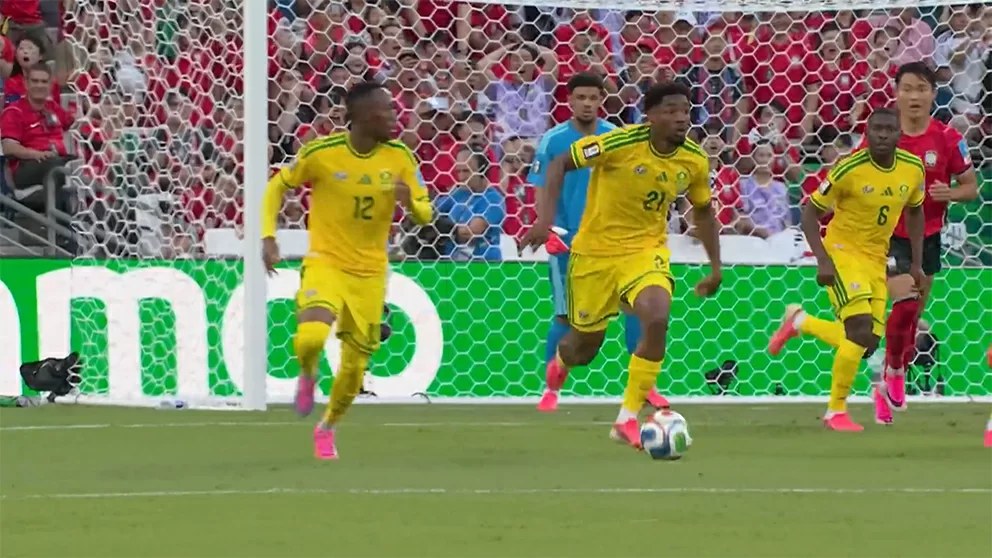
Derde helft WK 2026: Zuid-Afrika wint historisch duel van Zuid-Korea en bereikt knock-outfase
The 2026 FIFA World Cup Group A produced one of the tournament’s most memorable underdog stories on June 25, as South Africa claimed a tense 1-0 victory over South Korea to secure their first-ever knockout stage berth in World Cup history. The result has turned the Group A standings on their head, leaving South Africa firmly in position to advance while South Korea faces a devastating early exit from the competition.
A major talking point ahead of kickoff was the surprise omission of South Korean star forward Son Heung-min from the starting lineup, marking the first time the Tottenham Hotspur attacker had not started a World Cup match for his nation since 2010. Despite the unexpected change, South Korea got off to a flying start, creating a clear goalscoring chance within the opening two minutes. After a corner into the box, Bayern Munich defender Kim Min-jae directed a powerful header toward goal that was cleared off the line by South Africa’s Aubrey Modiba, and the ball went just wide of the post.
South Korea continued to carry the bulk of the attacking threat for much of the first half, with Paris Saint-Germain’s Lee Kang-in firing a low effort narrowly off target. South Africa looked shaky at times in their build-up play from the back, but when they won possession, they posed consistent problems on the counter. Midfielder Thalente Mbatha forced a strong save from South Korean goalkeeper Kim Seung-gyu to prevent an early South African lead, while striker Evidence Makgopa also sent a header just inches away from the goal.
South Korean center-back Lee Gi-hyuk put in a string of solid defensive interventions to keep the game scoreless, most notably blocking a close-range effort from South Africa winger Oswin Appollis. Just before halftime, Thapelo Maseko sent a long-range effort over the crossbar for South Africa, and the first 45 minutes ended goalless, with tension building steadily as both sides fought for the vital result that would secure their knockout stage hopes.
South Korea manager made three attacking changes at halftime, bringing on star man Son Heung-min along with Jens Castrop and Kim Jin-gyu in place of Hwang Hee-chan, Lee Tae-seok and Paik Seung-ho, looking to inject more attacking thrust into his side. The substitutions upped the tempo of the match, and the deadlock was finally broken in the 63rd minute: Maseko received a well-timed through ball from Tshepang Moremi, cut inside onto his strong foot, and fired a blistering shot into the bottom right corner of the net to put South Africa ahead.
The late goal completely flipped the Group A qualification outlook. Before the strike, a 0-0 draw would have seen South Korea comfortably through to the next round, but the result now leaves South Africa in pole position to finish in the top two of the group.
South Africa dug in deep after taking the lead, showing immense defensive discipline and organization to protect their slender advantage. Despite South Korea throwing everything forward in the final half-hour and winning multiple late set pieces, South Africa’s compact defensive block held firm every time. Son, who had entered the game to turn the tide, found every space closed down quickly by the South African backline, and he could not create the clear chance South Korea desperately needed.
Six minutes of stoppage time gave South Korea one last chance to find an equalizer, but their desperate late attacks failed to break down South Africa’s resistance. When the final referee’s whistle blew, it sparked jubilant celebrations among the South African squad and fans, as the nation celebrated a groundbreaking milestone: their first ever appearance in the World Cup round of 16.
This historic victory, built on a foundation of stubborn, organized defense and clinical, purposeful attacking play, marks a landmark turning point for South African football, and sets the stage for what promises to be an exciting knockout stage run for the African side at the 2026 World Cup.
-

Derde helft Wk 2026: Mexico wint overtuigend van Tsjechië en sluit groepsfase foutloos af
June 25, 2026 — Co-host nation Mexico has wrapped up its 2026 FIFA World Cup Group A campaign in dominant fashion, clinching a 3-0 victory over Czechia at Mexico City Stadium to secure a full nine points from three matches and book its place in the knockout round with soaring momentum.
The first half of the match unfolded as a tight, tactical stalemate, just as many pre-match analysts had predicted. Czechia set up in a compact, deep defensive block, limiting the space for Mexico’s attacking players to exploit and allowing the co-hosts to hold the majority of possession without creating clear-cut high-quality chances. While Mexico pushed continuously forward, probing the flanks and testing through central runs, they could not break through the organized European defense. Czechia, meanwhile, looked for opportunities to hit on the counterattack, keeping the Mexican back line honest and ensuring the half ended goalless as both sides headed to the locker rooms to reset.
It was a completely different story after the break, as manager Jaime Lozano’s side upped their intensity and shifted into a higher gear. The pressure on Czechia’s goal grew rapidly, and it did not take long for the deadlock to be broken. In the 55th minute, Miguel Chávez García opened the scoring after a beautifully crafted build-up play from Luis Romo, the opening goal lifting the pressure off the hosts and unlocking their confidence.
Just six minutes later, Mexico doubled their advantage to put the game almost out of reach. Julián Quiñones found the back of the net in the 61st minute, tapping home a well-placed cross from Jorge Sánchez to put the co-hosts 2-0 up. While midfielder Edson Álvarez picked up a yellow card in the 64th minute for a late challenge, the booking did nothing to slow Mexico’s momentum or disrupt their control of the match.
In stoppage time, Mexico added a third goal to put the final gloss on an already impressive performance. In the 94th minute, Álvaro Fidalgo finished off a neat counterattack, tapping in a cross from Roberto Alvarado to seal the 3-0 scoreline, prompting a roar of celebration from the tens of thousands of cheering home fans inside the stadium.
The result capped a flawless group stage for Mexico, which had previously secured 2-0 and 1-0 wins over South Africa and South Korea respectively. With three wins from three matches, Mexico finishes top of Group A and advances to the round of 16, a result that confirms the team’s steady improvement as the tournament progresses.
For Czechia, the result brings an early end to their 2026 World Cup journey. The European side finished the group stage with just one point from three matches, having drawn with South Africa and lost to South Korea and Mexico, failing to accumulate enough points to qualify for the knockout round. Post-match, analysts acknowledged that Czechia put up a stubborn defensive fight for much of the match, but ultimately could not match Mexico’s higher intensity, superior combination play and greater individual quality in the final third.
As co-hosts, Mexico heads into the knockout round with growing expectations. The side has long been plagued by a history of early exits at the World Cup, consistently falling in the round of 16 in previous tournaments. But their error-free, dominant group stage performance has dramatically boosted confidence within the squad, with veteran leaders like Álvarez, Romo and Quiñones leading a balanced side that combines polished positional play with the raucous support of home fans, leaving the co-host dreaming of a deep run in the tournament this year.
-
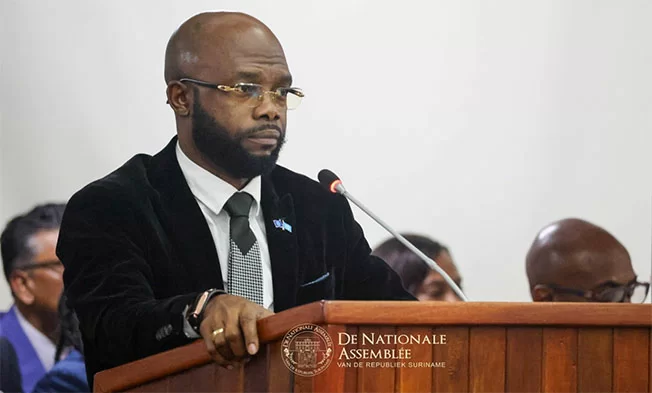
Misiekaba wil verpleegkundigen historisch beter belonen; nieuwe loonreeks naar regering
Suriname’s Minister of Public Health, Welfare and Labor (VWA) André Misiekaba has unveiled an ambitious plan to deliver long-overdue recognition for the nation’s nursing workforce, marking a landmark step toward addressing the country’s growing health care staffing crisis. Speaking for over three hours during the national budget debate in the National Assembly, Misiekaba firmly threw his support behind a special working group’s proposal to significantly boost nurse salaries, a move designed to slow the steady exodus of skilled health personnel to higher-income countries abroad.
Misiekaba emphasized that fair financial compensation for nurses stands as the top priority for his ministry’s sweeping health care reform agenda. The working group’s draft pay framework proposes setting entry-level nurse salaries between $700 and $1,000 U.S. dollars, converted to local Surinamese dollars, with final pay levels adjusted based on the classification and size of the facility where a nurse works. According to the minister, the proposal will undergo additional technical and financial reviews before being submitted to the Surinamese cabinet for approval around August.
Making his stance on nurse compensation unmistakably clear, Misiekaba stated firmly: “No one will touch my nurses.” He described nurses as the literal backbone of Suriname’s entire health care system, noting they have gone without adequate recognition and fair pay for far too long. For years, the minister explained, nurses have been systematically underpaid and undervalued despite bearing full responsibility for keeping health care services running every single day. He specifically highlighted the irreplaceable role nurses played in the country’s response to the COVID-19 pandemic, and pointed to the ongoing global shortage of skilled health care workers that has created intense competition for qualified nursing staff.
Official data shared by the minister shows that between 2020 and 2025 alone, Suriname lost more than 1,000 nurses to migration, with most relocating to the Netherlands, Belgium, and Sint Maarten. Left unaddressed, Misiekaba warned, this damaging brain drain will only continue to erode the capacity of Suriname’s health care system.
The minister rejected a piecemeal alternative proposal that would have only increased nurse allowances, arguing that the administration is intentionally pursuing a structural, long-term solution. The new standardized pay scale will harmonize salaries across the entire health sector and bring compensation in line with the value of nurses’ work, he explained.
Beyond salary adjustments, the plan includes additional measures to retain nursing talent. Starting in 2027, the Surinamese government will fully cover the cost of nursing training for students at the COVAB nursing school, in exchange for a requirement that graduates work in the country for a set number of years after completing their program. Officials are also exploring targeted housing support for nurses, and are negotiating with the Netherlands to develop joint nursing training programs that align with Suriname’s long-term staffing needs.