标签: Suriname

苏里南

  • Trump: Dagen van Venezolaanse president Maduro zijn geteld

    Trump: Dagen van Venezolaanse president Maduro zijn geteld

    In a recent interview with CBS, U.S. President Donald Trump sent mixed signals regarding the possibility of a military intervention in Venezuela, while simultaneously dismissing talk of ‘war’ and issuing veiled threats against Venezuelan leader Nicolás Maduro. Trump warned that Maduro’s days as president are numbered, a statement made amidst the buildup of U.S. military forces in the Caribbean. The U.S. has conducted multiple strikes on alleged drug-smuggling vessels in the region, actions that United Nations officials and legal experts argue violate both U.S. and international laws.

    When questioned about the potential for war with Venezuela, Trump responded, ‘I doubt it. I don’t think so.’ However, when asked if Maduro’s presidency was nearing its end, he stated, ‘I would say yes. I think so.’ American media outlets have reported that Washington is considering attacks on Venezuelan military installations as part of its war on ‘narco-terrorism.’ While Trump appeared to deny plans for such strikes, he did not entirely rule them out, stating, ‘I wouldn’t be inclined to say that I would do that,’ and ‘I’m not going to tell you what I’m going to do with Venezuela.’

    Maduro, who faces U.S. charges of drug trafficking, has accused Washington of using the drug offensive as a pretext to impose ‘regime change’ in Caracas to seize Venezuela’s oil reserves. Over the past weeks, the U.S. military has carried out more than a dozen attacks on ships in the Caribbean and the Pacific, resulting in at least 65 deaths. These actions have drawn criticism from governments across the region.

    The United Nations High Commissioner for Human Rights, Volker Türk, and human rights organizations have condemned the attacks, which began in early September, as ‘extrajudicial executions,’ even if they targeted known drug smugglers. Washington has yet to publicly provide evidence that the attacked vessels were involved in drug smuggling or posed a threat to the U.S.

  • 4 kg goudroof zonder braaksporen bij Grassalco

    4 kg goudroof zonder braaksporen bij Grassalco

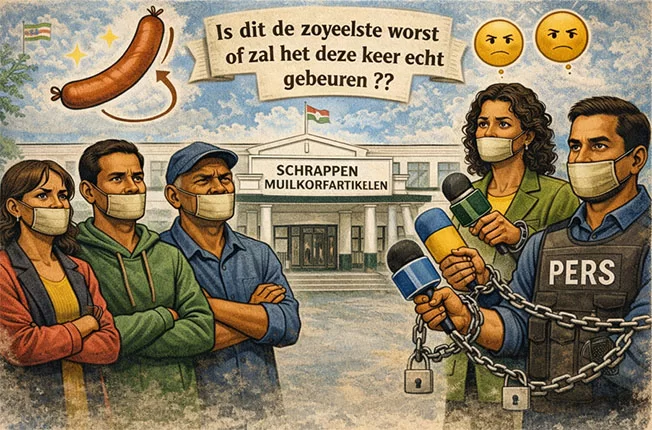
    In a shocking turn of events, over four kilograms of raw gold, valued at more than $400,000, have mysteriously vanished from the vault of state-owned mining company Grassalco N.V. The gold was discovered to have been replaced with counterfeit replicas, raising suspicions of an inside job. The discovery was made on October 13, but the incident was only officially reported to the Livorno police station on Friday. Investigators found no signs of forced entry, suggesting the theft was orchestrated internally. The counterfeit gold was systematically placed in the vault, indicating a well-planned operation. The police are treating the case as a high-priority investigation. Grassalco’s President-Director, Wesley Rozenhout, stated in an interview with DTV Express that he initiated an internal investigation immediately after the discovery. He informed President Jennifer Simons on October 29, following the completion of the final report. Rozenhout emphasized that he is responsible for general policy, not daily operations, and does not believe he should resign as the company’s head. The company’s management stressed that only authorized personnel have access to the vault. This incident comes amid a series of fraud and theft cases involving government-owned enterprises, including the Melkcentrale and several police stations.

  • Minister GBB: Aanlegsteiger Leonsberg ten onrechte uitgegeven als privéterrein

    Minister GBB: Aanlegsteiger Leonsberg ten onrechte uitgegeven als privéterrein

    In a significant development, Minister Stanley Soeropawiro of Land Policy and Forest Management (GBB) has confirmed to Starnieuws that the Leonsberg pier, a vital transportation hub used daily by hundreds of passengers, was indeed sold as private property during the previous administration. ‘It is true: this pier was formally issued as a private parcel in the last governance period. That is a fact,’ stated Soeropawiro. ‘However, this is also one of the clearest examples of how misguided policies can directly harm public interest.’

    The sale has dealt a severe blow to dozens of boat operators who rely on the pier for their livelihoods. Without access to the docking facility, these operators, who have long facilitated passenger transport between Leonsberg and Nieuw-Amsterdam—often maintaining the pier themselves—are now left stranded. The minister acknowledged their concerns, assuring that his ministry is actively working on a solution while further investigating the matter.

    Soeropawiro emphasized that the sale of the pier is ‘one of many missteps we have encountered at the ministry.’ He highlighted the current government’s commitment, under President Jennifer Simons, to restore public facilities to the people. ‘The public deserves fair governance. Public land is not private property,’ he asserted. ‘Those who approved such transactions will be held accountable. This government will restore order—step by step, case by case.’

    The minister vowed that the government will not allow public infrastructure to fall into private hands. ‘This marks the beginning of rectifying what was wrong,’ he concluded.

  • Oorzaak landelijke stroomstoring nog onduidelijk

    Oorzaak landelijke stroomstoring nog onduidelijk

    A significant portion of Suriname experienced a widespread power outage on November 3, affecting not only the capital city of Paramaribo but also multiple districts across the country. The Energy Companies of Suriname (EBS) confirmed that the disruption was a nationwide issue, though the exact cause remains unidentified. According to EBS, the outage occurred suddenly and without warning. The blackout began at approximately 9:45 AM and was largely resolved within an hour, restoring electricity to most areas. Authorities are currently investigating the incident to determine the root cause and prevent future occurrences. This unexpected event has raised concerns about the reliability of the nation’s power infrastructure and its impact on daily life and businesses.

  • VS-Venezuela: toenemende spanning, maar nog geen directe aanval

    VS-Venezuela: toenemende spanning, maar nog geen directe aanval

    Tensions between the United States and Venezuela have intensified following a significant increase in military presence in the Caribbean region. The deployment of warships, fighter jets, and thousands of troops to the Gulf of Venezuela and adjacent maritime areas has raised concerns. While Washington claims these movements are part of an international operation against drug trafficking, analysts perceive them as a political show of force targeting the regime of Venezuelan President Nicolás Maduro.

    The Venezuelan government has condemned the actions as ‘border provocations’ and placed its armed forces on high alert. President Maduro warned over the weekend that the US is ‘playing dangerously with regional peace.’ Meanwhile, US President Donald Trump denied any plans for military strikes on Venezuelan territory, describing the activities as ‘preventive security patrols’ and ‘support for regional partners.’

    Domestically, Venezuela is divided over the foreign pressure. Some opposition groups view the US presence as an opportunity to further isolate Maduro’s authoritarian rule, while others fear potential intervention could lead to national chaos.

    Internationally, Russia has sharply criticized the US military buildup, labeling it ‘excessive power projection’ and pledging diplomatic support for Caracas. China and Iran have also strengthened their defense cooperation with Venezuela.

    The escalating tensions have regional implications. Diplomats in the Caribbean are concerned about the security of trade and transport routes, as well as the potential increase in migration flows if the situation worsens.

    Military observers note that Venezuela’s armed forces have been significantly weakened by years of economic crisis, corruption, and sanctions. In contrast, the US possesses overwhelming resources and infrastructure in the region, including reopened naval bases in Puerto Rico and the Caribbean.

    For now, neither side appears to seek direct confrontation, but diplomatic and military tensions persist.

  • Trainingen museumwezen waardevol voor werkveld

    Trainingen museumwezen waardevol voor werkveld

    The training sessions conducted in October have proven to be immensely beneficial for employees and owners of museum institutions in Suriname. This was highlighted during the certification ceremony held last Friday, where 25 participants successfully completed the program. Artists Runaldo Klas, Jules Brandflu, and Sunil Puljun praised the training for offering fresh perspectives on heritage restoration and storage. Former museum director Elvira Sandie and VHJI Museum coordinator Sharon Pawiroredjo also expressed their satisfaction, emphasizing the practical applicability of the knowledge gained. The program, a collaborative effort between Suriname’s National Museum Commission (NMS) and the Netherlands’ Cultural Heritage Agency, concluded in the presence of Roseline Daan, NMS Chairperson and Director of Culture. Daan lauded the outcomes achieved after months of preparation. Participants delved into topics such as collection management, registration, conflicting value systems, sector organization, sustainability, and preventive conservation. The evaluation also revealed plans for museum institutions to unite, enhancing the structure and content of their work. The NMS is now focusing on follow-up activities and discussions with PURP regarding the rehabilitation of Building 1790, a ruin within the Zeelandia complex, envisioned as the site for a future national museum.

  • Column: De stilte van Surinaamse vrede

    Column: De stilte van Surinaamse vrede

    The world is engulfed in chaos, with conflicts and disasters striking multiple regions simultaneously. In Darfur, hundreds of Syrian civilians lost their lives, while border clashes between Afghanistan and Pakistan claimed dozens more. A tragic fire in a Mexican store resulted in numerous casualties, and Sudan is reeling from horrific murders. Floods in Vietnam and Hurricane Melissa in Jamaica have caused widespread devastation. Tanzania witnessed hundreds of deaths due to excessive violence, and protests erupted in Serbia. Closer to home, police raids in Rio de Janeiro led to dozens of fatalities, and in neighboring Guyana, the elected opposition leader was arrested. The world seems upside down, with political, humanitarian, and natural crises everywhere. In Suriname, such news is often skimmed over, rarely prompting deep reflection on the shared humanity of those affected. In Beijing, participants of the CIPCC Program (China International Press Communication Center 2025 Program) from these conflict zones briefly discuss their homelands before moving on, as deadly conflicts have become a normalized part of their lives. Perhaps the perspective would shift if a loved one were involved. In Suriname, too, there is a growing indifference to murders, robberies, stabbings, and hit-and-run incidents, which have become alarmingly routine. The mentality of ‘every man for himself, as long as it doesn’t affect me’ is on the rise. Surinamers are known for their warmth, peacefulness, and conviviality—intangible values that are priceless. This becomes evident when interacting with people from conflict zones, for whom survival is the primary concern. As Suriname approaches its 50th anniversary of independence, it is time to reflect on the often-overlooked blessing of peace. While much of the world grapples with daily turmoil, Suriname enjoys a quiet yet powerful peace—a peace that fosters safety, harmony, and progress. Too often, we fail to recognize the value of this peace. Amid global crises, we sometimes forget our own blessings. Peace is not a given; it is a fragile asset that must be cherished and protected. This requires not only avoiding conflict but also fostering mutual respect and collaboration for a better future. Over 50 years of independence, Suriname has faced many challenges, but the foundation of its society remains its intangible wealth: peace. It is the invisible glue holding its diverse society together. It is our responsibility to view our blessings with fresh eyes and ensure this peace is passed on to the next generation. Let this milestone inspire gratitude and reflection on how to strengthen peace, for only with peace can we build a sustainable and just Suriname where everyone has the opportunity to thrive.

  • Regering herfinanciert buitenlandse schuld: geen nieuwe lening, wel ademruimte

    Regering herfinanciert buitenlandse schuld: geen nieuwe lening, wel ademruimte

    Suriname has successfully raised approximately $1.6 billion through an international capital market operation, marking a significant milestone in its financial recovery journey. Facilitated by BofA Securities (Bank of America), this refinancing initiative aims to restructure existing state bonds and signifies Suriname’s return to the global capital market. While the final settlement is expected on November 6, the transaction is already being hailed as a pivotal step in restoring financial confidence in the country.

    This operation is not a new loan but a refinancing of the 7.95% Cash/PIK Notes due 2033, issued following the 2023 debt restructuring. Investors were invited to tender their existing bonds at a fixed price of $1,002.50 per $1,000 nominal value. The proceeds from the new bond issuance will be used to repay older, more expensive debts, thereby shifting payment obligations to a later period when Suriname anticipates increased revenue from its oil sector. The primary goal is to alleviate budgetary pressure in the coming years without adding to the nation’s total debt burden.

    A senior government official emphasized that the operation is designed to ‘create breathing space for the state’s finances,’ allowing Suriname time to grow rather than merely delay borrowing. The transaction was meticulously planned, with the invitation to tender issued on October 23 and results finalized on October 30. The operation was executed through the Automated Tender Offer Program of the U.S. DTC, ensuring transparency and compliance with market regulations.

    The refinancing offers immediate liquidity benefits by replacing high-interest bonds with lower-rate, longer-term debt, reducing annual interest expenses. This creates fiscal flexibility for government spending in the coming years. However, experts caution that the strategy’s sustainability hinges on the timely realization of oil revenues and the government’s ability to channel freed-up resources into productive investments.

    The successful $1.6 billion raise underscores restored investor confidence, bolstered by Suriname’s improved credit rating. While the exact interest rate remains undisclosed, it is reportedly favorable compared to previous issuances. Notably, the refinancing was conducted independently of an IMF program, though the country continues to receive technical assistance from the fund.

    While the operation is a technical and diplomatic triumph, analysts warn that refinancing is not a structural solution but a temporary relief. Its success depends on budgetary discipline, political stability, and the timely inflow of oil and tax revenues. The government has pledged to release further details on the bond’s terms and repayment structure this week, providing clarity on the next steps in Suriname’s financial policy.

    Symbolically, this operation represents Suriname’s first independent access to the international capital market since the 2023 restructuring, signaling regained credibility in financial management. It aligns with broader efforts to drive structural economic reforms and strengthen ties with international financial institutions and investors.

    The challenge now lies in leveraging this financial breathing space to foster sustainable growth, ensuring future governments are not compelled to refinance old debts. This operation underscores that financial recovery begins not with loans but with trust—a trust that, once regained, must be carefully nurtured.

  • Bromfietser (14) overlijdt na botsing tegen vangrail

    Bromfietser (14) overlijdt na botsing tegen vangrail

    A devastating traffic accident occurred today on Meursweg, near Onoribo, resulting in the untimely death of a 14-year-old scooter rider. Preliminary police investigations reveal that the young driver, identified as A.V., was traveling along Meursweg, heading from Martin Luther Kingweg towards Kennedyweg. As he approached a right-hand curve near Onoribo plantation, it is suspected that excessive speed caused him to lose control of his scooter. The vehicle veered off the road and collided forcefully with the guardrail on the southern side. The teenager sustained severe injuries and succumbed to his wounds at the scene. A medical professional officially pronounced him dead. In accordance with the Public Prosecutor’s orders, the body has been seized for an autopsy to determine the exact cause of death.

  • Simons voert Surinaamse klimaatboodschap naar wereldforum in Brazilië

    Simons voert Surinaamse klimaatboodschap naar wereldforum in Brazilië

    President Jennifer Simons of Suriname is set to embark on a pivotal journey to Brazil, where she will participate in the Bélem Climate Summit from November 6 to 7. This summit serves as a precursor to the 30th United Nations Climate Change Conference (COP30), scheduled to take place in Bélem from November 10 to 21. During her stay, President Simons will engage in critical discussions on global climate action and highlight Suriname’s unique position as a carbon-negative nation. She will also hold bilateral talks with fellow heads of state, government leaders, and representatives from multilateral institutions, focusing on climate financing, forest conservation, and sustainable growth. Suriname, renowned for its vast forest cover, aims to set an example in sustainable forest management and climate action. President Simons’ leadership has already garnered international recognition, including her inclusion in TIME Magazine’s list of the 100 most influential climate leaders. Her administration is committed to preserving 90% of Suriname’s forest cover, part of the Amazon rainforest, for future generations. At COP30, President Simons will advocate for redirecting fossil fuel subsidies towards investments in forest protection, wetlands, and biodiversity, while empowering indigenous communities as stewards of nature. Her participation underscores Suriname’s dedication to global climate justice and sustainable development.