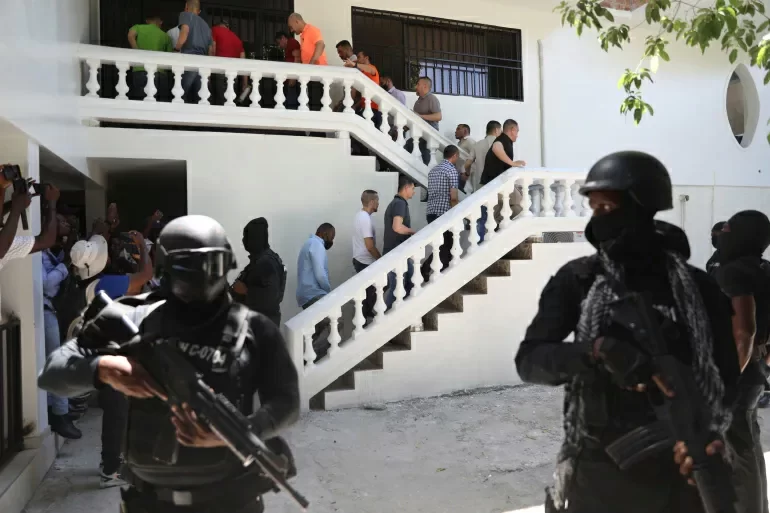
Four years after the assassination of Haitian President Jovenel Moïse, a major development in the long-stalled investigation has unfolded: 18 suspects linked to the killing have been transferred from Haiti to the United States to face federal prosecution. The group includes a former high-ranking Haitian government official and 17 Colombian ex-soldiers accused of acting as mercenaries in the July 7, 2021 attack that left Moïse dead at his private residence near Port-au-Prince and wounded his wife Martine Moïse. All 18 suspects made their first court appearance at a Miami federal courthouse on Monday, one day after they were flown out of Haiti’s capital on a U.S. military transport plane.
标签: Suriname
苏里南
-
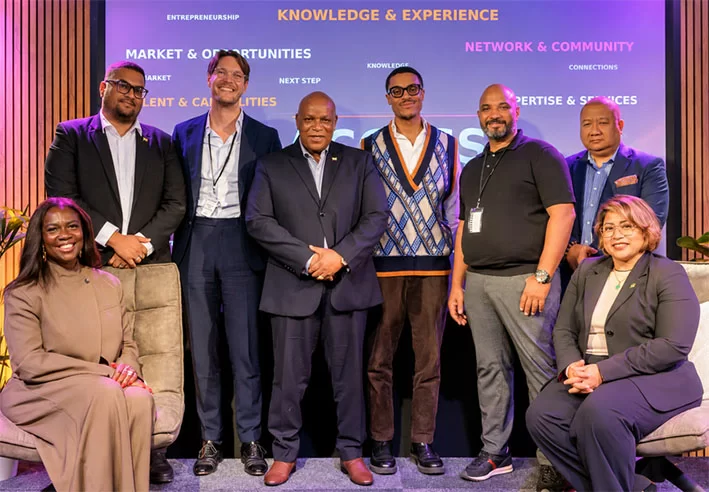
Panka wil Surinaamse ondernemers in Nederland sterker verbinden met economie
On a Friday gathering held in Amsterdam Zuidoost, Suriname’s ambassador to the Netherlands Ricardo Panka announced a new strategic push to integrate Surinamese diaspora entrepreneurs and young professionals based in the Netherlands into Suriname’s ongoing economic development and cross-border investment initiatives.
The event marked the official launch of ACCESS, a new entrepreneur support program organized by The Extra Mile, a regional business enablement organization. Lead by managing director Ryan Weibolt and co-initiator Mattias Scheek, ACCESS is designed to deliver targeted information, build professional connections, and stimulate growth among Surinamese-background entrepreneurs operating in the Netherlands. The partnership between The Extra Mile and the Surinamese embassy was facilitated by mediator Sandra Esseboom, and Panka was joined at the launch by other senior embassy officials, including councilor Shefron Kartowikromo, secretary Valeenee Wasimin, and commercial attaché Amrish Mankoe.
In his keynote address at the launch, Panka emphasized the untapped economic potential of the large Surinamese diaspora community in the Netherlands. Official embassy data shows more than 360,000 people of Surinamese descent currently reside in the Netherlands — a number that equals nearly half of Suriname’s total domestic population. “This makes the Surinamese community in the Netherlands one of our most important strategic priorities,” Panka stated.
Moving beyond traditional diplomatic functions, Panka outlined a new vision for the embassy as an open, accessible hub that supports not only standard diplomatic work but also prioritizes entrepreneurship development, young professional engagement, knowledge sharing, and bilateral economic progress. “We are reorienting our work to meet the evolving needs of our community and our nation,” he added.
The launch event also featured practical industry insights from guest speakers. Co-initiator Scheek, a veteran technology entrepreneur who co-founded Dutch audio technology firm Mayht Technologies, shared his professional journey with attendees. Mayht, which developed groundbreaking compact speaker technology, was acquired by U.S. audio giant Sonos for approximately $100 million in 2022, making it one of the most notable Dutch tech exits in recent years. Additionally, Niels Dolk, an M&A lawyer at international law firm Osborne Clarke, led a session covering key legal considerations that entrepreneurs face when navigating investment rounds, business acquisitions, and other major corporate transactions.
Following the event, Panka extended an invitation to Scheek for a follow-up discussion at the Suriname embassy to explore potential areas of collaboration and connection with Suriname’s domestic business ecosystem. According to the embassy’s communications department, the institution plans to continue expanding its outreach and connections with Surinamese entrepreneurs in the Netherlands long-term. The initiative focuses not only on attracting direct foreign investment to Suriname but also on leveraging the existing knowledge, professional experience, and extensive business networks built by members of the Surinamese diaspora to drive inclusive, sustainable economic growth at home.
-
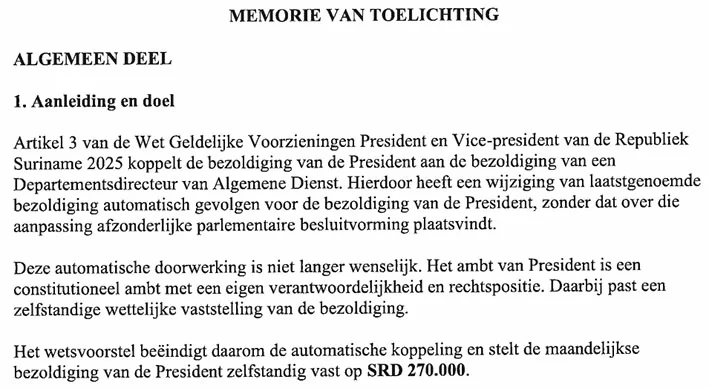
Gajadien en Pawiroredjo willen automatische koppeling salaris president schrappen
Two members of Suriname’s National Assembly (DNA), Asiskumar Gajadien and Jerrel Pawiroredjo, have tabled a private member’s bill on Monday that would break the long-standing linkage between the presidential salary and the pay of senior civil service department directors. The legislation, if approved, would mark a major shift in how the top executive’s compensation is set, prioritizing parliamentary oversight and fiscal accountability in the South American nation.
Under the current regulatory framework, which was formalized in the 2024 Law on Financial Provisions for the President and Vice-President of the Republic of Suriname, the president’s pay automatically rises or falls in line with changes to the salary of a General Service Department Director. This automatic adjustment mechanism means the National Assembly is not required to vote separately on any modifications to the presidential salary when civil service pay scales are updated. The new bill seeks to end this indirect adjustment process entirely.
If passed, the proposed legislation will set a fixed monthly base salary of 270,000 Surinamese dollars (SRD) for the president directly in law. The existing proportion for the vice-president’s salary will remain unchanged, with the vice-president continuing to receive 75% of the president’s monthly pay – equal to SRD 202,500 under the proposed base rate. While the old benchmark of four times a General Service Department Director’s salary will be retained as an indicative reference value, it will no longer trigger automatic changes to the presidential salary when the civil service figure is adjusted.
Under the new framework, any future change to the president’s salary will require a full new legislative process and approval from the National Assembly. When considering future adjustments, lawmakers will be required to take into account multiple relevant factors, including national price inflation and changes in household purchasing power, public sector salary trends across the board, and the current fiscal and budgetary position of the Surinamese state. The bill also mandates that a full review of the presidential salary must be conducted at least once every three years, though even a scheduled review will not automatically result in a pay increase – any adjustment still requires a separate parliamentary vote.
The push for decoupling comes amid renewed public and political debate over salary adjustments for senior political officeholders in Suriname. The existing law governing presidential and vice-presidential financial provisions was only passed in November 2024 and published as S.B. 2024 no. 159. Notably, this is not the first attempt to amend this legislation this year: an earlier private member’s bill was submitted to the National Assembly on February 23, 2026, which focused on revising the pay structure to align with the principle of pay equality. Unlike the earlier proposal, the new bill from Gajadien and Pawiroredjo specifically targets the elimination of automatic pay pass-through from civil service salaries to the presidency, arguing that hikes for lower-level administrative posts should not automatically translate to higher pay for the head of state.
The bill’s sponsors argue that the new structure will strengthen three core pillars of democratic governance: parliamentary oversight of executive compensation, greater transparency for public finances, and tighter budgetary discipline for the state. By requiring explicit legislative approval for any change to the presidential salary, the proposal aims to give elected representatives direct control over the executive’s pay, ensuring all adjustments are debated publicly and aligned with the country’s broader economic conditions.
-
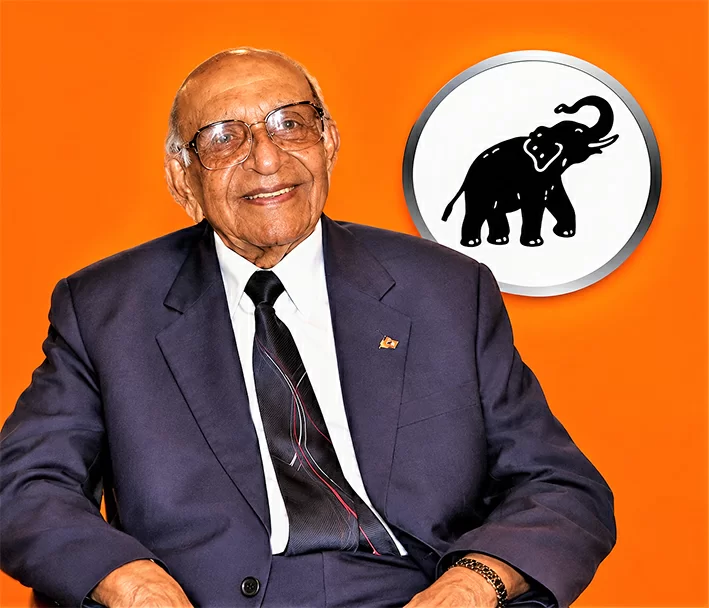
VHP herdenkt geboortedag van grondlegger en eerste voorzitter
On September 21 each year, the Progressive Reform Party (VHP) of Suriname pauses to honor the birth anniversary of its late founder and first chair, mr. Jagernath Lachmon — a towering figure whose legacy is deeply woven into the country’s modern political history. Lachmon’s name has become inseparable from Suriname’s long-standing political mission of reconciliation, tolerance, and national unity, values that guided every step of his decades-long public service career.
Throughout his time in public life, Lachmon worked tirelessly to build a Suriname where people from diverse ethnic, cultural, and religious backgrounds could coexist peacefully, and collaborate to build a stronger, more prosperous future for the entire nation. His vision of a unified multi-ethnic society gained formal national recognition in 2020, when the date of his birth was enshrined into Suriname’s law. Following a formal request from VHP’s national executive board, a resolution adopted on September 17, 2020 designated September 21 — Lachmon’s birth date — as the National Day of Reconciliation and Unity. The resolution explicitly emphasizes that reconciliation and national connection are core, foundational pillars for Suriname’s future as a multi-ethnic, multicultural democracy.
A striking and meaningful coincidence adds extra weight to this annual commemoration: September 21 also marks the International Day of Peace. The global call for peace on this date aligns perfectly with the core conviction that Lachmon championed throughout his entire life: that differences between communities do not need to be a source of division, but can instead strengthen national connection, foster mutual respect, and build collective national strength.
For the VHP and the people of Suriname, this annual commemoration is not merely a tribute to Lachmon the person, but a celebration of his enduring ideological legacy and his permanent call for reconciliation, unity, and mutual respect across all communities. Today, his life’s work and vision remain a timeless source of inspiration for current Surinamese society and for generations of Surinamese yet to come.
-
Omwonenden vragen NMA Halliburton-projecten opnieuw te beoordelen
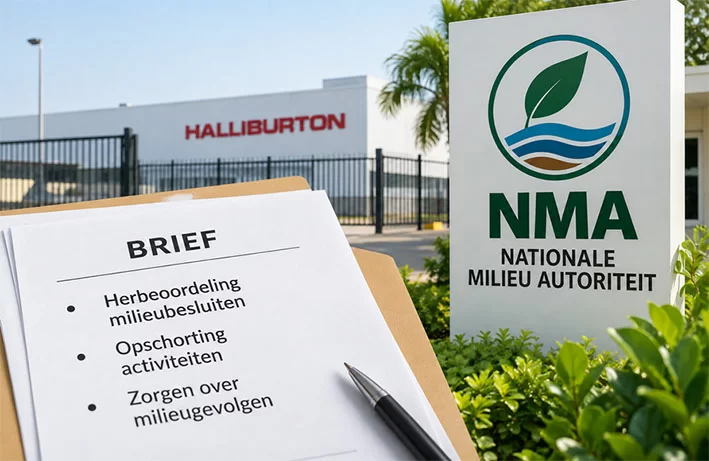
A group of stakeholders with interests tied to Suriname’s coastal area has launched a formal legal challenge to two planned Halliburton projects near Paramaribo, calling on the country’s National Environmental Authority (NMA) to revisit and reverse earlier environmental approvals that greenlit the developments. Through legal representation, the group has submitted an official request that pauses all pre-construction work on Halliburton’s proposed new operational base at Sir Winston Churchillweg 426, as well as halts ongoing permitting for an on-site radioactive materials storage facility linked to the energy firm’s regional operations. The challenge targets two separate environmental assessment dossiers: MEA 0049/2025, which covers the operational base, and MEA 0054/2025, the regulatory file for the radioactive storage facility. Stakeholders say they have raised fundamental concerns about how the projects were screened, classified, and evaluated for potential harms to local ecosystems and communities, arguing that earlier assessments failed to account for key risks. At the core of the dispute is the classification of the radioactive storage facility. The NMA previously categorized the project as an activity with low environmental impact but high site sensitivity, a designation that allowed the project to move forward with only a limited environmental review in the form of a standard Environment Management and Monitoring Plan (MMMP), rather than a full, comprehensive environmental impact assessment. Stakeholders argue this classification is incorrect and inconsistent with the risks of storing radioactive materials in a populated area near critical environmental resources, and are pushing the NMA to re-evaluate the designation in light of new evidence and research they have presented. The group is asking the NMA to investigate whether the original classification remains justified, and whether the decision to accept a limited MMMP review instead of a full assessment should be withdrawn or revised. Pending the outcome of this reassessment, stakeholders are calling for all further permitting work on the storage facility dossier to be suspended immediately. In their formal request, they also emphasize that any new environmental review must go beyond traditional ecological harm assessments, and include full analysis of the projects’ potential social and economic impacts on nearby communities and local industries. The NMA has been given a deadline of October 1, 2026, to issue a substantive response to the stakeholders’ claims and requests. It is important to note that the submission of the formal challenge does not automatically invalidate earlier environmental approvals or halt work on the projects at this stage. The NMA will first review the request to determine whether there is sufficient merit to reopen the assessment processes, revise earlier decisions, or implement the requested temporary suspensions. Halliburton, a major global energy services firm, has been expanding its operational footprint in Suriname amid growing offshore oil and gas exploration activity in the country’s waters, making the planned base and storage facility a key part of its regional strategy. The challenge comes amid growing public debate in Suriname over environmental regulation of the energy sector, and whether existing rules provide sufficient protection for local communities and fragile ecosystems. The outcome of the NMA’s review is expected to set a precedent for future large-scale energy infrastructure projects in the country.
-
Bewolkte maar nog steeds zeer warme dag
Released on 21 September at 04:45, this daily weather forecast covers major regions across Suriname, outlining conditions through the daytime and evening hours.
For Suriname’s capital Paramaribo, Monday will be dominated by extensive cloud cover, with unusually high temperatures for this time of year. Daytime temperatures are expected to range from a low of 24°C to a peak high of 37°C, paired with light wind coming from the eastern direction. The cloudy conditions will hold through the evening: around 18:00 local time, temperatures will still sit at roughly 31°C before cooling down to approximately 28°C as the evening progresses. Like the daytime, evening wind will remain light from the east, with no precipitation expected at any point.
In Stoelmanseiland, the day will bring partly cloudy to fully overcast conditions. Daytime temperatures will range from 23°C to 36°C, with light eastern wind, mirroring the conditions in the capital. Evening will retain the overcast cover, with temperatures dropping from 30°C at the start of the evening to 26°C by later hours.
In the inland region of Sipaliwini, overcast conditions are forecast for the day. Temperatures will span from a low of 22°C to a maximum high of 36°C. Wind will remain light, coming from either the east or northeast.
Coastal Nickerie will see slightly cooler conditions compared to inland areas. The day will start with sunny skies before transitioning to cloudy conditions, with temperatures fluctuating between 26°C and 32°C. Light, variable wind from the northeast will prevail. In the evening, partly cloudy conditions will stay, with temperatures falling from an initial 29°C to around 27°C later in the night.
-
VS en China voeren overleg in aanloop naar ontmoeting Trump en Xi
Top economic officials from the United States and China have launched high-stakes discussions in New York on Sunday, covering three core areas: bilateral trade, artificial intelligence governance, and critical mineral supplies. These talks are explicitly designed to lay diplomatic and policy groundwork for the much-anticipated upcoming summit between US President Donald Trump and Chinese President Xi Jinping, scheduled to take place later this week in Washington D.C.
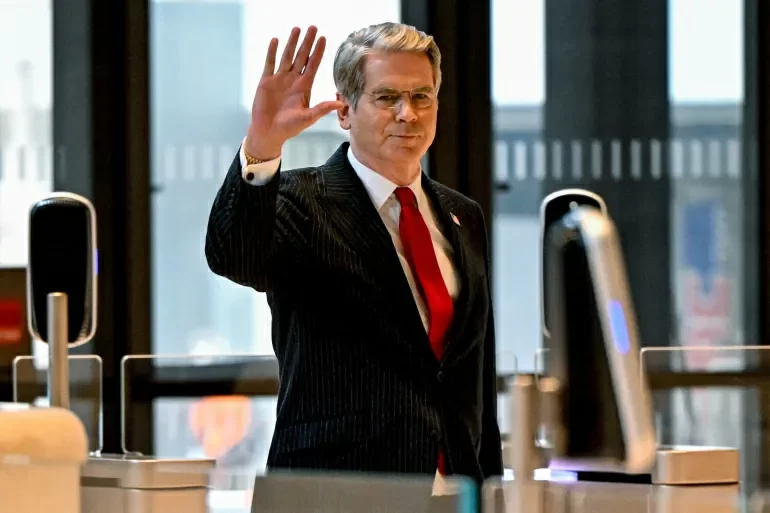
Hosted at JPMorgan Chase’s global headquarters in Manhattan, the meeting is led by US Treasury Secretary Scott Bessent and Chinese Vice Premier He Lifeng, with US Trade Representative Jamieson Greer also participating in the negotiations. The session forms part of a sustained series of bilateral engagements aimed at managing the complex economic relationship between the world’s two largest economies. In opening remarks upon his arrival, Bessent emphasized that the US side looked forward to “focused, substantive and constructive discussions that can lay a solid foundation for the meeting of our two national leaders.”
One of the most urgent agenda items is the future of the temporary bilateral trade truce, which is set to expire on November 10 under current terms. This existing arrangement has played a key role in preventing a fresh escalation of long-running trade tensions between Washington and Beijing, making its extension or replacement a top priority for negotiators.
Critical raw material supply chains, particularly for rare earth metals and other strategically vital minerals, also take a central spot in the talks. These resources are foundational to the production of a wide range of high-tech goods, from consumer electronics and electric vehicles to advanced semiconductors. Washington has long pushed for guaranteed, stable access to these supplies, while Beijing has increasingly framed control over key mineral exports as a core economic and strategic tool. Reuters sources confirm that securing reliable rare earth supply chains ranks among the US’s top negotiating priorities. Additional trade-related topics on the table include potential tariff reductions for selected non-strategic goods, and discussions around Chinese purchases of American agricultural commodities and Boeing commercial aircraft.
A new addition to the bilateral negotiating agenda is governance of artificial intelligence, a sector where both countries are global leaders in advanced system development, even as they maintain sharp competition over technological supremacy and national security. Bessent has confirmed that Washington is open to discussing shared AI risks, including potential regulatory frameworks for both open-weight and closed-weight AI models. Open-weight models allow users to download and modify core model parameters, while closed-weight models keep core system architecture fully controlled by their developers. In recent years, Chinese open-weight AI models have grown in popularity among US businesses, in large part due to their lower cost compared to comparable American-developed alternatives. This growing adoption has, however, reinforced Washington’s ongoing concerns over potential national security risks stemming from access to advanced Chinese AI technology.
Beyond economic and technological issues, the talks also touch on geopolitical matters with global ramifications, specifically US policy toward Iran. China maintains extensive economic ties with Iran and is one of the largest importers of Iranian crude oil, putting Beijing in a critical position for US efforts to ramp up economic pressure on Tehran. This inclusion of the Iran issue underscores how modern US-China negotiations now extend far beyond the original bounds of their bilateral trade dispute, touching on interconnected global geopolitics.
Despite the broad range of topics up for discussion, analysts and policymakers broadly do not expect a sweeping, comprehensive breakthrough agreement to emerge from the New York talks. Over the past several years, the two countries have prioritized stabilizing their economic relationship without resolving their broader structural strategic rivalry, leading most observers to anticipate only limited incremental agreements or extensions of existing arrangements rather than fundamental progress.
Anna Ashton, a leading analyst specializing in China and trade policy, argues that the most likely outcome is that both sides will prioritize preserving the status quo. Kurt Campbell, former US Deputy Secretary of State, has echoed this assessment, noting that the immediate core goal of the talks is to prevent a new escalation of bilateral tensions, rather than achieve a grand resolution. The New York discussions are ultimately aimed at refining and aligning positions to prepare for deliverables at the upcoming Trump-Xi summit in Washington, where the two leaders will address the full scope of economic and strategic relations between the United States and China.
-
Column: Vrede begint niet op een podium
September 21 marks the annual International Day of Peace, a global observance where communities, leaders and citizens across the world come together to deliver speeches, raise symbols of unity, and issue public statements reaffirming their shared commitment to peace. We often claim peace is one of our core values, so important that we have set aside an entire dedicated day to honor it. But how often do our actions match these grand words?
Even as speeches echoing across auditoriums and public squares today, many of us carry small, daily actions that undermine the very peace we claim to celebrate: quarrels with a neighbor over a boundary fence, judgment of a colleague for their different appearance or background, angry outbursts over minor traffic inconveniences, sharing divisive online content that targets and dehumanizes others, and staying silent when injustice demands we speak up. Preaching peace on a global stage is simple. Living peace in our daily lives is an entirely different, far more challenging practice.
Perhaps it is long past time we reexamined what peace actually means. For many, peace is defined only as the absence of large-scale war between nations. For others, it means basic security: a roof over one’s head, consistent food on the table, and safety walking home at night. For many more, peace is far smaller, more intimate: an evening free of persistent worry, a conversation free of blame and resentment, a quiet mind unburdened by constant stress and conflict.
Peace is not some lofty, abstract state that only exists between world leaders in international summits. It starts small. It starts with each of us, as individuals.
Inner peace is arguably the most underrated form of peace. A person who has found calm and balance within themselves carries that calm out into the world around them. They do not need to scream to be heard. They can listen to different perspectives without jumping to unfair judgment. They do not spread chaos and anger; they spread calm and perspective. This effect ripples outward, too. A person at peace with themselves passes that peace to their family, their friends, the strangers they interact with on the street. It is contagious, in the best possible way. Unfortunately, the opposite is just as true: unrest, frustration and distrust spread just as quickly through communities.
Building peace in our personal lives does not require every part of life to be perfect. It means learning to adapt to and handle the imperfections that are inevitable. It means choosing to address conflict head-on, rather than avoiding it or trying to destroy the other person to win. It means holding our own convictions while still respecting other people’s right to their own differing views.
Peace in our local communities means showing up for the people around us: the lonely neighbor living down the street, the young person struggling with unemployment or mental health, the colleague navigating a hard personal season. More often than not, peace only requires pausing for one minute and asking a simple question: “Are you okay?”
This reflection on peace hits especially close to home here in Suriname, a nation built by generations of people from vastly different roots, languages, faiths and cultural traditions: Creoles, Hindustanis, Javanese, Maroons, Indigenous peoples, Chinese, Lebanese and many more communities have built this country together. Of course, coexistence is not always smooth. There are still tensions, persistent prejudices, and occasional distrust between groups. But at the end of the day, we have built a remarkably peaceful shared life here. That is no accident. It is the product of generations of ordinary people who chose day after day to learn to tolerate, respect, and ultimately value one another’s differences.
We have a duty to cherish this hard-won peace, and most importantly, to keep building on it. As long as we only see each other as members of separate ethnic or cultural groups, we sell ourselves and our nation short. The true strength and wealth of Suriname comes from seeing each other first and foremost as Surinamers. This unity is not built on erasing our differences; it is built on embracing those differences while still choosing to move forward together. Look at the young people growing up here today: they play together, learn together, dream together. Why would we force on them the rigid, divisive social boxes that we have carried for generations?
On a day dedicated to global peace, it is entirely right to dream of a world free of war and division. But we must not forget that global peace does not start in a United Nations conference room in New York or a diplomatic meeting hall in Geneva. It starts at the kitchen table, in a school classroom, on the city bus, in the office, in the aisle of the local supermarket.
Peace is not some far-off destination we reach after decades of global negotiation. It is a small, daily choice each of us makes.
So today, yes, let us talk about peace. But more importantly, let us match our words with action. We do not need grand gestures; we only need small, consistent choices. Choose not to yell back when someone snaps at you. Choose to really listen when someone shares a different view. Choose to stay silent instead of adding fuel to a growing conflict.
Because peace does not start on a stage, at a podium, or in an international treaty. It starts with you. And it starts with me.
-
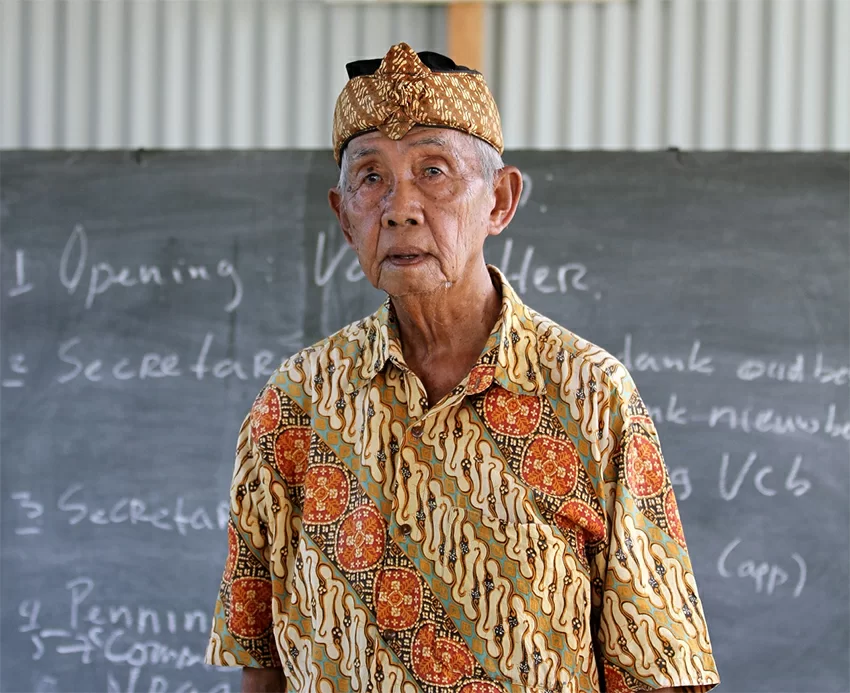
In memoriam Bapak Sapto Sopawiro (86)
Suriname is mourning the passing of one of its most beloved cultural stewards, Sapto Sopawiro — known to most simply as Pak Sapto, or affectionately as Pak Dhalang — who died in September 2026, leaving behind an indelible mark on the nation’s social and cultural fabric. The news of his death broke in an early morning WhatsApp notification reading “Pak Sapto has passed,” shared with a small, gently burning candle emoji, setting a tone of quiet grief and profound respect for a life dedicated to community and cultural preservation.
Born on 15 July 1940 in Kampong Baroe, Saramacca, Pak Sapto’s life journey shaped his lifelong commitment to bridging divides and expanding cultural understanding. After moving to Paramaribo in 1947 to continue his education with his mother on Heiligenweg, he later lived with his father in Nickerie before returning permanently to Paramaribo in 1962, settling in the Boxel neighborhood from 1970 onward — the area where most locals came to know him well. Before devoting himself fully to cultural work, he built an early career as a skipper-mechanic for the Suriname Shipping Company, and later worked as a mechanic and operator for Billiton Maatschappij Suriname.
A towering authority on Javanese culture, history, spirituality, language, and traditions, Pak Sapto inherited his deep knowledge of Javanese heritage and the craft of the dhalang (shadow puppeteer) from his father, but cemented his expertise as an insatiable self-learner. His personal library, which spanned far beyond Javanese epics like the Mahabharata and Ramayana or Indonesian history, reflected his insatiable curiosity about the full breadth of human experience: he collected works on economics, sports, art, agriculture, engineering, theater, classical composers, Italian opera, Russian ballet, culinary arts, and global politics. When asked if he truly found all these topics fascinating, he would smile and respond softly: “All of it together… that is life… and life is beautiful. We have reason to be grateful.”
As a pioneer of Javanism in Suriname, Pak Sapto reached a historic milestone in 2014, when he was appointed the first paid spiritual leader of Javanism in the country on the nomination of then-Minister of the Interior Soewarto Moestadja. A leading advocate for Agama Jawa, the traditional Javanese religious tradition, he taught regular classes and lectures, appeared on radio and television programs, and served for a period as spokesperson for the Federation of Javanism in Suriname. Back in 1987, he co-founded the socio-religious association Carita Wujud Ngesti Tunggal — translated as “Experiencing Unity Through the True Word” — which centers its core philosophy on the belief that “There is only one God, eternal and omnipresent, Creator of the universe.”
For most Surinamese, Pak Sapto will be best remembered as a master dhalang, the skilled performer of Javanese wayang kulit shadow puppetry. Through his craft, he brought centuries-old epic stories, timeless life lessons, cultural values, and shared history to vivid life for new generations, weaving modern Surinamese reality seamlessly into ancient tradition. Topics as contemporary as politics, economic shifts, smartphones, and the internet all found their place into his narratives, bridging past and present, tradition and current events, multiple languages and diverse cultural communities. His unique legacy was even captured in the documentary *The Last Dhalang*, which cemented his status as a national cultural treasure.
More than a cultural expert and performer, Pak Sapto was first and foremost a connector of people and generations. Students, researchers, fellow cultural caretakers — anyone seeking knowledge was welcome in his space. He delivered lectures and courses at leading Surinamese institutions including the Anton de Kom University of Suriname and the Institute for Learning and Education, and his expertise was drawn on across disciplines ranging from cultural studies and sociology to anthropology, medicine, and religious studies. He also played a key role in research into Suriname’s Javanese immigration history: as an interpreter and translator, he traveled to Yogyakarta, Indonesia, to support Surinamese historical and genealogical research, while also studying strategies to safeguard the continuity of wayang culture for future generations.
Pak Sapto’s decades of contributions earned him widespread national and international recognition, including the 2007 Gold VHJI Award, Indonesia’s highest cultural distinction in 2013, the GRANI of Wanica South-East in 2013, official recognition from the Surinamese Directorate of Culture in 2023, the Gold Honorary Medal in the Honorary Order of the Yellow Star in 2023, and induction into the NAKS Icon Calendar in 2025. A full archive of his life’s work is permanently preserved at the NAKS-EUFRIE Documentation Center for future research.
With his passing, Suriname has lost not only a singular cultural bearer, spiritual leader, master dhalang, storyteller, scholar, researcher, and translator, but a uniquely gifted unifier who brought disparate people and communities together. Pak Sapto received a full state cultural funeral on 20 September 2026, attended by a diverse cross-section of the nation he served. May he rest in peace.
-
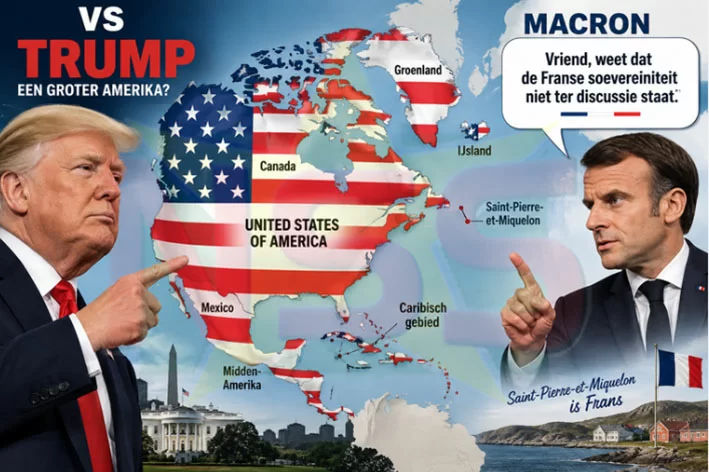
Frankrijk en Canada aan Trump: aan onze grenzen en soevereiniteit wordt niet getornd
In a striking departure from traditional diplomatic venue choices, French President Emmanuel Macron and Canadian Prime Minister Mark Carney gathered for high-stakes talks this week on Saint-Pierre-et-Miquelon, a tiny French overseas archipelago located just 25 kilometers off the Canadian coast. The location choice carries sharp political weight, coming on the heels of a provocative move by U.S. President Donald Trump, who recently shared an altered image depicting the French territory under an American flag. During his visit, Macron left no room for ambiguity about the islands’ status, forcefully reaffirming French sovereignty over the territory. This historic visit marks the first time a sitting French president has traveled to Saint-Pierre-et-Miquelon since 2014.
The timing of the meeting is no coincidence. Both Paris and Ottawa are currently navigating heightened diplomatic and trade tensions with Washington, and Canada has been actively pursuing deeper economic and strategic ties with Europe to reduce its long-standing overreliance on the United States. Just days before the Saint-Pierre-et-Miquelon talks, Carney addressed the European Parliament to argue for a far closer strategic partnership between Canada and the European Union, identifying energy, defense, artificial intelligence, critical minerals, and digital trade as core areas for expanded collaboration.
Located in the North Atlantic Ocean just off the coast of Canada’s Newfoundland and Labrador region, Saint-Pierre-et-Miquelon is made up of eight small islands and stands as the last remaining French sovereign territory in North America. France and Canada share a maritime border around the archipelago, a geographic fact that infuses the Macron-Carney meeting with unique symbolic meaning. Global news agency Reuters has characterized the visit as an intentional, coordinated signal directed at the Trump administration, a reading widely shared by diplomatic observers following Trump’s provocative social media post.
Beyond the symbolic posture against Trump’s territorial provocation, the two leaders used the meeting to advance concrete discussions on expanding cooperation in areas that are increasingly central to shifting global power dynamics. Energy cooperation topped the bilateral agenda, with additional talks covering aerospace development, critical mineral supply chains, and advanced technologies including quantum computing, satellite infrastructure, and supercomputing research.
For Canada, this meeting is part of a broader, deliberate strategy to diversify its international economic partnerships. Carney has made no secret of his government’s push for closer alignment with Europe at a time when Canada-U.S. trade relations are under growing strain. In a significant policy shift, the European Commission has recently floated the idea of Canada exploring a never-before-used “associate membership” status with the bloc. What this status would entail legally and practically remains unclear, and the proposal has already sparked internal debate among EU member states.
Trump has already issued sharp criticism of Canada’s European overtures and threatened punitive trade measures in response. Carney has pushed back against this pressure, emphasizing that deeper Canada-EU cooperation is not intended to create a new anti-U.S. power bloc. At the same time, Carney has highlighted the mutual benefits of the partnership: Canada holds extensive reserves of strategically important commodities that Europe is eager to access, including energy resources and critical minerals, and Carney has proposed expanding exports of liquefied natural gas (LNG) and clean hydrogen to European markets.
In sum, the meeting on the tiny islands of Saint-Pierre-et-Miquelon carries implications that stretch far beyond the archipelago’s limited geographic footprint. While Trump’s altered map reignited global debates over territorial sovereignty and the projection of American power, Macron and Carney seized the same location to simultaneously reaffirm French sovereignty and demonstrate a shared commitment to deepening strategic cooperation between Canada and Europe at a moment of shifting global alliances.