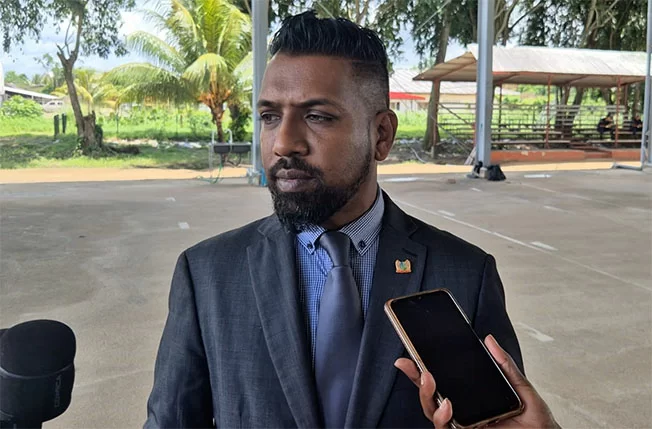
In a press briefing held earlier this week, Suriname’s Minister of Justice and Police Harish Monorath has laid out the stark challenges facing the country’s national police force, including a persistent staffing shortage and widespread exodus of experienced personnel to higher-paying roles abroad, while revealing that authorities quietly tolerate banned side work for officers to help them make ends meet. The comments came during a promotion ceremony Monday at the National Police Training Center, where 205 new recruits were formally elevated to the rank of Extraordinary Police Officer (BAVP).
Minister Monorath told reporters that for the police force to operate at full effectiveness across the country, its ideal total strength would sit at around 5,000 active officers. As of the latest count, however, the entire corps only numbers just over 2,700 personnel – less than 55% of the workforce needed to fulfill all core public safety mandates. Compounding this gap is a steady brain drain that the department has been unable to reverse: every year, more than 300 trained officers leave the force to take up positions elsewhere, most commonly in neighboring countries or other overseas locations where compensation packages are far more competitive than domestic salaries. Currently, the force can only recruit and train roughly 300 new officers annually to replace departing staff, while around 20 more personnel leave each month in search of better working conditions and higher pay, almost always outside Suriname’s borders. Monorath even noted that a common early warning sign of an officer planning to exit the force is a request for personal leave without objection, as officers prepare to transition to their new roles.
Addressing longstanding public debates over off-duty work for police and military personnel, Monorath clarified that while formal Dutch Caribbean law explicitly prohibits civil servants from holding secondary employment, the government has maintained a de facto tolerance policy to allow low-paid officers to supplement their incomes. “What people choose to do during their own free time is not something I can comment on or control,” the minister stated. He added that most police officers work rotating shift schedules, and the vast majority hold multiple jobs to cover basic living costs. Many officers take on private security work for gold mining companies, for example, while others travel to the country’s interior to earn extra income. He also refuted recent media reports claiming that Jean ‘Saya’ Mixon, one of his four appointed advisors, received or will receive police security protection, calling the claims completely untrue.
Public criticism of off-duty security work has grown in recent years, with critics arguing that when police or military personnel work for private third parties – particularly in Suriname’s resource-rich interior, where conflict over gold mining concessions is common – it creates major potential conflicts of interest that undermine public trust in state security institutions. Monorath acknowledged that the line between official duties and personal free time is not always clear cut when it comes to secondary work. However, he stressed that the department will take strict disciplinary action against any civil servant found to be carrying out unauthorized secondary work during their official paid working hours.