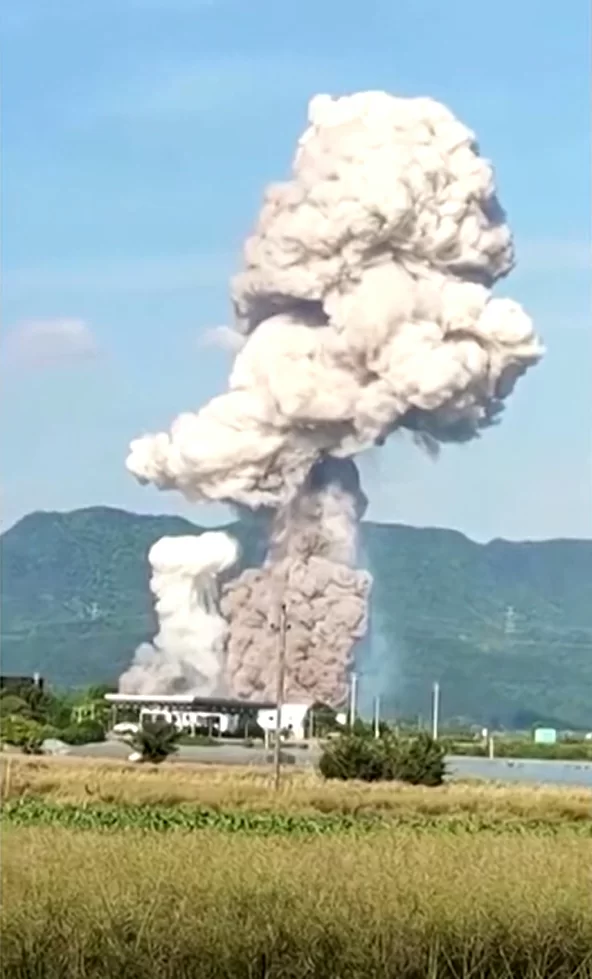
On a Monday afternoon in early May, a devastating explosion ripped through a fireworks manufacturing facility in Liuyang, a city in China’s central Hunan Province known globally as the country’s fireworks capital, leaving at least 26 people dead and 61 others injured. The blast, which occurred around 16:40 local time at the Huasheng Fireworks Manufacturing and Display Company, generated enough force to level nearby structures and send towering plumes of black smoke billowing kilometers into the sky above the region.
Emergency response operations mobilized rapidly in the wake of the disaster. More than 1,500 first responders, including firefighters, medical personnel, rescue workers, and police officers were deployed to the site, supported by 18 drones and specialized search-and-rescue robots to locate trapped survivors and bring the emergency under control. Authorities ordered the immediate evacuation of all nearby residential and industrial areas after identifying an ongoing risk of secondary blasts from two unignited storage facilities holding tons of combustible black gunpowder.
User-shared footage circulating on social media platforms captured thick plumes of smoke rising against the backdrop of the region’s characteristic green mountain slopes, while on-site reporters confirmed that the entire facility and surrounding adjacent plots had been reduced to rubble. The blast’s powerful shockwaves tore mature trees from the ground, leaving a heavy, acrid smell of gunpowder hanging over the disaster zone for hours after the initial explosion.
This tragedy is not an isolated incident for China’s fireworks industry, which has a long-documented history of workplace safety failures. Just one year prior, a nearly identical explosion at another Hunan Province fireworks factory left nine people dead and dozens more injured. More recently, a fatal blast at a chemical plant in northeastern China also claimed multiple lives, drawing renewed public and regulatory attention to the systemic risks of unsafe hazardous materials storage across Chinese industrial sectors.
As of Tuesday, local government authorities overseeing Liuyang (which falls under the administrative jurisdiction of Changsha) announced that search and recovery operations for missing victims had been largely completed. The factory’s general manager has been taken into police custody, while official investigations into the root cause of the explosion are ongoing. In an immediate precautionary move, all fireworks and pyrotechnic production facilities across Liuyang have been ordered to suspend all operations immediately to undergo mandatory safety inspections.
Chen Bozhang, Changsha’s deputy Communist Party secretary and mayor, delivered an official statement on behalf of local authorities expressing profound condolences to the families of the deceased and injured. “We feel extraordinary grief and take full responsibility for this tragedy,” Chen stated.
At the national level, Chinese President Xi Jinping has issued formal orders for a thorough and expedited investigation into the disaster, and has called for strict accountability for any parties found responsible for safety lapses that led to the explosion. The Chinese central government has assembled a special national investigation team, and Vice Premier Zhang Guoqing traveled directly to Liuyang to oversee on-site rescue, recovery, and subsequent investigation efforts. President Xi further emphasized that all industries handling hazardous materials must strengthen risk management and safety oversight, with the protection of human life and public property designated as the highest priority.
For Liuyang’s local economy, the fireworks industry is far more than a traditional trade—it is the single largest economic pillar of the region. A 2025 industrial report found that Liuyang’s fireworks sector generated 50 billion yuan (approximately 7.1 billion U.S. dollars) in annual revenue, spread across 431 licensed production facilities. The city supplies more than 60 percent of China’s total domestic fireworks demand, and accounts for roughly 70 percent of all Chinese fireworks exports worldwide. Nationwide, China’s 2025 fireworks exports totaled 1.14 billion U.S. dollars, representing more than two-thirds of the entire global fireworks market.
President Xi’s call for strengthened industrial safety controls comes shortly after he previously issued instructions for a nationwide upgrade to China’s disaster response and emergency management capacity. The latest order follows a deadly 2025 fire at the Wang Fuk Court residential complex in Hong Kong that claimed 168 lives, after which President Xi also issued formal instructions for improved public safety protocols.