标签: Suriname

苏里南

  • Bouva: Diplomatie moet tastbare resultaten opleveren voor Suriname

    Bouva: Diplomatie moet tastbare resultaten opleveren voor Suriname

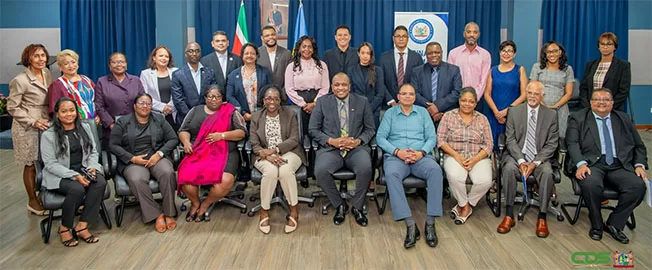
    Suriname’s Foreign Minister Melvin Bouva has issued a compelling mandate for diplomatic reform, declaring that diplomacy must transcend ceremonial functions to deliver concrete policy results and measurable societal benefits. The declaration came during the closing ceremony of the Suriname Diplomatic Course 2025, where certificates were awarded to 60 participants—35 attending physically and 25 via online platforms.

    Minister Bouva, overseeing Foreign Affairs, International Trade, and Cooperation, articulated a vision where diplomatic missions must actively serve as instruments for economic growth, investment attraction, climate financing, and regional stability. The minister emphasized that in an evolving global landscape, diplomats must pivot from traditional protocol duties to becoming active agents of national development.

    The comprehensive training program, administered by the Suriname Diplomatic Institute (SDI), equipped participants with essential skills in diplomatic protocol, negotiation techniques, economic diplomacy, and cultural relations. Dean Silochana Achthoven-Bhaghoe confirmed the curriculum addressed Suriname’s strategic positioning within international organizations.

    Foreign Affairs Director Miriam Mac Intosh characterized the course as an intensive preparation for diplomatic service, urging graduates to continuously invest in professional development. Trainer Rose-Ann Franklin highlighted critical competencies including protocol adherence, analytical capabilities, professional presentation, and precise reporting—emphasizing that diplomats serve as Suriname’s eyes and ears abroad.

    Minister Bouva concluded with a performance-oriented challenge: certification represents not an endpoint but a commitment to project initiation and execution. The new diplomatic corps must bridge the gap between international engagement and tangible national progress.

  • Het Venezolaanse leger heeft de sleutel tot de toekomst van het land in handen

    Het Venezolaanse leger heeft de sleutel tot de toekomst van het land in handen

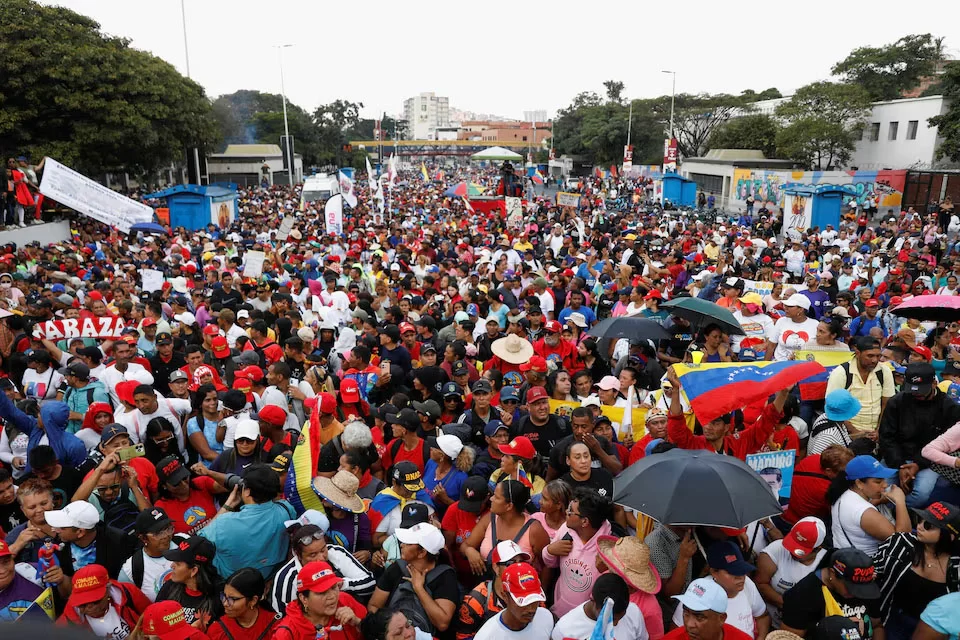
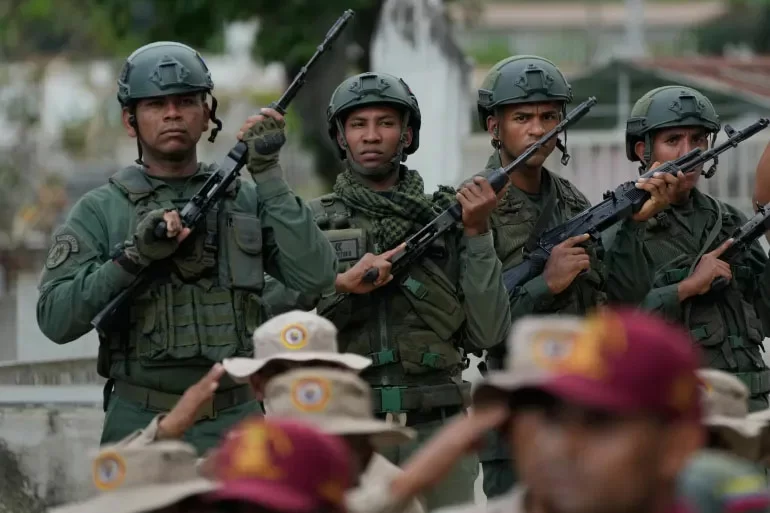
    Following the dramatic capture of Venezuelan President Nicolás Maduro by U.S. special forces, the Bolivarian National Armed Forces (FANB) confronts a pivotal moment that will determine Venezuela’s political future. The military operation, which extracted Maduro from Fort Tiuna—the nation’s largest military complex—has exposed significant vulnerabilities in Venezuela’s defense capabilities and created a power vacuum that demands strategic decision-making.

    For nearly three decades, the FANB served as the primary power broker for the Chavez and Maduro regimes, receiving extensive political appointments including ministerial positions, governorships, and control over state enterprises in exchange for enforcing authoritarian rule. This symbiotic relationship transformed Venezuela into a security state where military authority superseded civilian institutions.

    The current interim government under Delcy Rodríguez, despite enjoying support from the Trump administration, requires military backing to maintain stability. President Trump’s selection of Rodríguez over opposition leader María Corina Machado reflects calculated recognition that only a candidate acceptable to military leadership can navigate this transition.

    Military commanders now face compelling incentives to negotiate: the demonstrated superiority of U.S. military technology creates vulnerability to further interventions, while maintaining political influence requires accepting previously unthinkable concessions. These include distancing from narcotrafficking allegations, accepting U.S. energy companies’ control over Venezuelan oil resources, reducing repression of civilian populations, and fully supporting Rodríguez’s interim government.

    The military’s cooperation essentially means endorsing U.S.-Venezuela agreements that would establish a stabilization framework similar to American partnerships with military regimes in Egypt, Pakistan, and Thailand. Resistance risks triggering additional U.S. military actions that would further erode the military’s credibility and exacerbate Venezuela’s political and social instability.

    With limited options, the FANB’s leadership must choose between preserving some political influence through cooperation or facing complete marginalization through confrontation. Their decision will ultimately determine whether Venezuela’s transition occurs through negotiation or continued conflict.

  • Universiteitsinstituut Kinderrechten lanceert folder bescherming van kinderen

    Universiteitsinstituut Kinderrechten lanceert folder bescherming van kinderen

    The University Institute for Children’s Rights at Suriname’s Anton de Kom University has launched a groundbreaking informational brochure designed to empower communities in identifying and preventing child abuse and domestic violence. This comprehensive resource provides crucial guidance for recognizing warning signs and taking appropriate action when children are at risk.

    The newly published document offers detailed explanations of what constitutes domestic violence against children, outlining specific behavioral and physical indicators that may signal abuse. It provides step-by-step instructions for concerned citizens to follow when they suspect a child is in danger, including legal procedures for obtaining protective orders through the judicial system.

    Additionally, the brochure features an extensive directory of essential support services and emergency contacts. Key institutions highlighted include local police departments, the Victim Support Bureau, Family Law Affairs Bureau, and the national Mi-helpline (accessible by dialing 123). This centralized information aims to streamline access to critical resources during emergency situations.

    Professor representatives from the Institute emphasized the importance of community vigilance, stating: ‘We must collectively refuse to turn a blind eye to signs of child maltreatment. This initiative represents our commitment to creating protective networks around vulnerable children through education and accessible reporting mechanisms.’

    The resource has been specifically designed as an accessible tool for parents, caregivers, educators, and community members, providing clear, actionable information without technical jargon. The digital version remains available for public download, ensuring widespread accessibility across Surinamese society.

  • Dossier houtexport  3: Waarom het vonnis in houtdossier ernstige vragen oproept…

    Dossier houtexport 3: Waarom het vonnis in houtdossier ernstige vragen oproept…

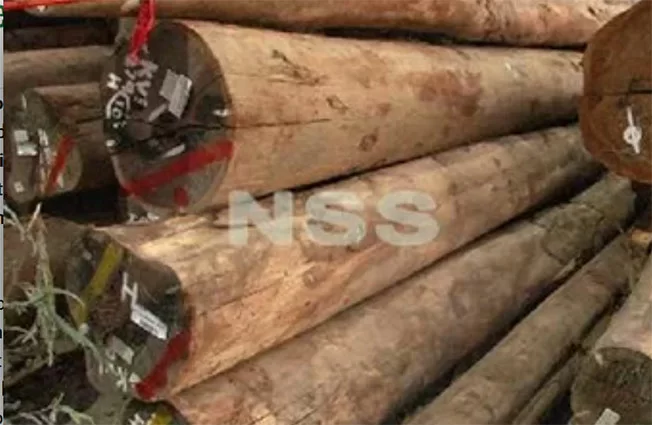
    A controversial court ruling in Suriname has compelled the state to issue phytosanitary certificates for timber shipments that demonstrably contradict their declared contents, creating both legal and administrative turmoil. Presiding Judge Robert Praag’s decision explicitly permits international non-compliance despite available alternatives, prioritizing economic interests over regulatory integrity.

    The judgment reveals the court’s awareness of the core issue: the certificates do not match the actual shipments. This represents not merely an interpretive discrepancy or administrative oversight, but objectively incorrect documentation. Nevertheless, the state must now issue these certificates under penalty of a SRD 1 million per hour fine.

    Historical context demonstrates this is not a sudden development. As early as August 2022, previous leadership at the Ministry of Agriculture, Livestock and Fisheries (LVV) and the National Plant Protection Organization (NPPO) identified systematic export of different wood species under the trade name ‘Mora roundlogs’ to India, violating both international phytosanitary regulations and India’s explicit import requirements. Internal correspondence shows the technical authority (NPPO) opposed issuing certificates for incorrect shipments, with international partners explicitly rejecting a proposed six-month ‘grace period’ in 2022.

    The court had several legally defensible alternatives: upholding international obligations as paramount, redirecting economic damages to civil proceedings against the state for years of failed policy, or providing temporary relief without legitimizing incorrect documentation. Instead, the ruling accepts the factual inaccuracy of the certificates based on the argument of irreversible economic damage.

    This decision shifts the burden of years of failed governance onto the technical integrity of the NPPO, Suriname’s international reputation, and its relationship with India. Phytosanitary certificates represent legal-international instruments rather than commercial documents, making deliberate issuance of incorrect documentation institutional falsehood rather than pragmatism.

    India’s perspective differs significantly from Suriname’s internal discussions. Indian authorities have repeatedly clarified that trade names are insufficient, only correct botanical names are permitted, and deviations are unacceptable regardless of internal problems in exporting countries. A national court ruling does not alter these requirements.

    The judgment has postponed rather than resolved the underlying issue. While exports remain largely on hold and inventories accumulate, the core problem persists: structural non-compliance cannot be normalized through judicial order. The LVV ministry has complied with the ruling under protest while simultaneously filing an appeal, recognizing that in a constitutional state, law should never be exchanged for convenience—not even once.

  • Zonnige perioden afgewisseld met regen

    Zonnige perioden afgewisseld met regen

    The persistent rainy season continues to dominate weather patterns, creating warm and humid conditions across the region. Daytime temperatures are expected to range between 29-31°C (84-88°F), while evening and overnight hours will see temperatures dropping to approximately 23-24°C (73-75°F).

    Morning conditions will feature sunny intervals with light cloud cover across many areas. As the day progresses, cloud coverage is forecast to gradually increase. During afternoon and early evening hours, scattered rain showers and thunderstorms may develop throughout the country, with the highest precipitation probability occurring in inland regions. Coastal areas remain susceptible to isolated showers as well.

    Moderate northeastern winds will provide temporary relief from the heat, though high humidity levels may still create muggy and oppressive conditions. During storm activity, winds may become gusty and unpredictable, potentially reducing visibility temporarily. The combination of elevated humidity and intermittent rainfall characterizes typical weather patterns for this phase of the rainy season.

    Residents and visitors should prepare for rapidly changing conditions, particularly during afternoon hours when thunderstorm activity is most likely. Those with outdoor activities planned should monitor weather developments and consider alternative arrangements when precipitation occurs.

  • Senaat beperkt Trumps militaire acties in Venezuela

    Senaat beperkt Trumps militaire acties in Venezuela

    In a significant bipartisan move, the U.S. Senate has advanced measures to curtail President Trump’s military authority regarding Venezuela. The procedural vote of 52-47 saw several Republicans joining Democrats to consider a resolution prohibiting further military deployment without congressional approval.

    This development coincides with Venezuela’s announcement of releasing a substantial number of political prisoners—both Venezuelan and foreign nationals—on Thursday. Jorge Rodríguez, a leading Venezuelan politician, described this as a unilateral peace gesture, addressing a long-standing opposition demand. However, human rights organizations emphasize that hundreds remain detained, with local monitoring group Foro Penal documenting 863 political prisoners including leaders, activists, and journalists.

    President Trump, expressing surprise at the Senate vote, criticized supporting senators for ‘diminishing presidential power to protect the United States.’ Meanwhile, in a New York Times interview, Trump indicated U.S. control over Venezuela and regulation of oil revenues could extend ‘well beyond a year,’ discussing rebuilding Venezuela ‘in a very profitable manner.’ He noted his relationship with interim President Delcy Rodríguez, an ally of deposed leader Nicolás Maduro, was ‘very good.’

    On the regional front, Trump’s stance toward Colombia appears softening. Following previous tensions, he invited President Gustavo Petro to Washington after a telephone conversation described as ‘a great honor’ by Trump, who praised Petro’s diplomatic tone.

    Economically, Trump announced plans Tuesday to refine and sell up to 50 million barrels of Venezuelan oil currently under U.S. blockade. Venezuela possesses the world’s largest proven oil reserves yet suffers a profound economic and humanitarian crisis that has driven millions to flee. The White House has scheduled a Friday meeting between Trump and executives from ExxonMobil, ConocoPhillips, and Chevron—companies with Venezuelan experience—to discuss increasing the country’s oil production, though none have yet commented.

    The resolution faces legislative challenges requiring House approval and a two-thirds majority in both chambers to override any presidential veto. Nevertheless, it represents rare Republican resistance to White House policy as Venezuela’s complex situation continues evolving with rapid political, military, and economic developments.

  • Column: Wanneer geld het recht gijzelt

    Column: Wanneer geld het recht gijzelt

    A recent confrontation between Surinamese authorities and timber exporters has revealed profound systemic failures in the nation’s regulatory enforcement framework. What initially appeared as an isolated incident involving wood exports to India has instead exposed fundamental weaknesses in rule-of-law implementation.

    In late October 2025, Agriculture Minister Mike Noersaliem issued a stern warning to all timber companies, explicitly stating that non-compliant operations would no longer receive mandatory phytosanitary certifications from the Ministry of Agriculture, Livestock and Fisheries (LVV). This action came after discoveries that several exporters had been shipping wood without meeting national and international standards.

    Six timber enterprises have positioned themselves as victims of what they term ‘sudden government intervention,’ claiming the minister’s directive introduced unexpected new requirements. This argument proves both legally and factually untenable. Phytosanitary certification constitutes a legal obligation derived from national legislation and international treaties, not merely policy preferences of individual ministers. Established exporters have operated under these requirements for years.

    The ministry’s communication represented not the introduction of novel regulations but rather enforcement of existing mandates—a crucial distinction. In any rule-of-law society, businesses cannot legitimately appeal to ‘established practice’ when knowingly operating in violation of requirements, whether dealing with timber, fish, rice, gold or any other export commodity.

    The central inquiry therefore shifts from why Minister Noersaliem enforced regulations to why previous administrations apparently did not. If current timber shipments failed compliance standards while previous exports received certification, only two conclusions emerge: systematic regulatory neglect or active complicity in rule-breaking. Both scenarios indicate serious governance failures where systematic non-compliance creates fertile ground for corruption, conflicts of interest and political manipulation.

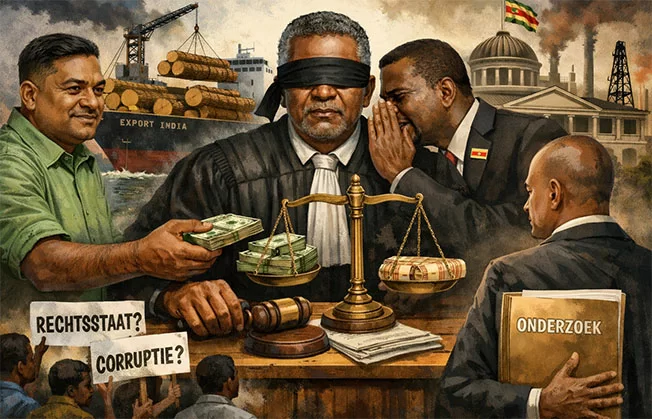
    Most alarmingly, judicial intervention has compounded these concerns. The cantonal judge avoided addressing the core issue of regulatory compliance, instead prioritizing arguments about irreversible financial damage. This establishes a dangerous legal precedent suggesting that those who act quickly, ignore regulations, and subsequently threaten financial claims can force the state into retroactive authorization.

    The implications extend far beyond timber. Rice exporters investing in certification, fisheries undergoing international audits, gold companies struggling with compliance, and vegetable exporters meeting strict European standards now face distorted incentives. Why maintain strict adherence when precedent demonstrates that violation pays?

    At the strategic level, Suriname’s credibility faces imminent jeopardy as the nation approaches large-scale oil and gas production. These industries fundamentally depend on certification, compliance and local content requirements. Surinamese businesses must demonstrate adherence to international standards regarding safety, environment, quality and governance—not as paper formalities but as verifiable practices.

    How credible appears Suriname’s commitment to compliance if certificates can be coerced under pressure? How convincing becomes our narrative to international partners and investors if regulations prove negotiable for the sufficiently powerful? In petroleum industries, reputation constitutes everything. A single perception of flexible regulations could cost millions in investments and exclude local companies from participation.

    This case transcends six timber companies versus the state. It represents societal injustice where economic power hijacks legal principles, where influential entities place themselves above the law and, worse, manipulate legal frameworks to their advantage. Unless the state establishes clear political and judicial boundaries, we risk legitimizing an economy where compliance becomes optional and integrity subordinate to pressure.

    Should the National Assembly refrain from launching parliamentary investigations and the Public Prosecutor’s Office neglect examining potential criminal offenses, they effectively confirm that capital outweighs justice in Suriname. Such outcome represents not governance but organized lawlessness.
  • Internationale spanningen slaan door naar Caribisch gebied; Suriname kwetsbaar

    Internationale spanningen slaan door naar Caribisch gebied; Suriname kwetsbaar

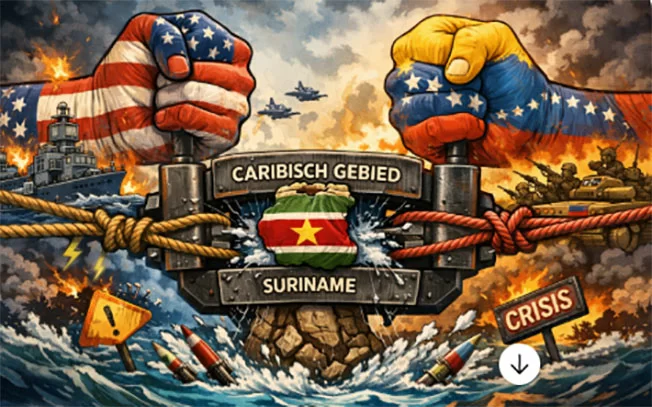
    The Caribbean region, including Suriname, faces heightened economic vulnerability as global geopolitical tensions trigger ripple effects across energy markets, trade routes, and financial systems. Unlike larger economies with diversified production bases, Caribbean nations operate as highly open economies dependent on imports, foreign investment, and external demand, making them particularly susceptible to international shocks.

    Suriname exemplifies this structural fragility, relying heavily on imported fuel, food, and consumer goods while deriving export revenues predominantly from limited sectors like gold and oil. This narrow economic base leaves the country exposed to external price fluctuations and market volatilities beyond its control.

    Energy markets have become a primary transmission channel for global instability. Geopolitical tensions involving oil-producing nations and stricter international sanctions drive uncertainty, elevating transportation and insurance costs even without dramatic oil price surges. These increases directly impact fuel prices and electricity production costs, cascading into higher transport expenses, elevated production costs, and mounting consumer price pressures throughout Suriname’s economy.

    Although less tourism-dependent than many Caribbean island nations, Suriname still faces risks through aviation disruptions and regional instability. International tensions can trigger flight cancellations, higher airfares, and traveler hesitancy, potentially reducing regional trade and service demand even for non-tourism-focused economies.

    The region’s heavy reliance on maritime shipping for essential goods means trade route disruptions or stricter controls immediately translate to higher import costs and extended delivery times. In Suriname, this manifests as rising prices for food and basic necessities, disproportionately affecting lower-income groups and complicating inflation management.

    Structurally, Caribbean governments operate with limited fiscal space due to high debt levels and dependence on external financing. During periods of international uncertainty, borrowing costs rise and investors grow cautious, forcing policymakers to balance budgetary discipline, social protection, and growth investments within shrinking margins.

    While some regional variations exist—such as Guyana’s current oil-driven growth surge—the broader Caribbean remains collectively vulnerable to external developments. This economic reality shapes diplomatic approaches, with regional governments demonstrating reluctance to openly confront major powers like the United States, given its role as crucial trade partner, tourism market, and financial aid source.

    The situation underscores the urgent need for economic diversification, enhanced regional cooperation, and prudent macroeconomic policies as international instability increasingly becomes the norm rather than the exception.

  • Speelfilm ‘Onder de Paramariboom’ wordt in februari opgenomen in Suriname

    Speelfilm ‘Onder de Paramariboom’ wordt in februari opgenomen in Suriname

    Suriname’s film industry is poised for significant growth as international production ‘Under the Paramariboom’ prepares to commence filming in February. The feature film adaptation of Johan Fretz’s acclaimed novel brings together Dutch production company KeyFilm and local foundation Stichting The Back Lot, with Safi Graauw serving as director.

    The ambitious project will involve 22 shooting days across Suriname, employing approximately 60 cast and crew members comprising both international professionals and Surinamese talent. The production team spans various disciplines including acting, direction, production, cinematography, sound engineering, technical support, and facility management.

    Economic impact assessments project substantial benefits for Suriname’s local economy through intensive collaboration with domestic hotels, hospitality businesses, transportation services, and various service providers. The production will generate increased demand for accommodations, catering services, transportation, and logistical support, creating temporary employment opportunities and stimulating economic activity.

    Beyond immediate economic benefits, the production promises long-term developmental advantages for Suriname’s audiovisual sector. The collaboration facilitates crucial knowledge transfer and practical experience sharing between international and local professionals, creating lasting value that will persist long after production concludes.

    The production team is currently seeking Surinamese acting talent for various roles, inviting both experienced performers and emerging actors to participate through an open casting call. This inclusive approach ensures authentic representation while providing opportunities for local artists to gain international exposure.

    This cinematic project represents a significant milestone in Suriname’s cultural development, potentially positioning the country as an attractive destination for future international productions while strengthening its domestic film industry capabilities.

  • Santoe, nieuwe directeur wil verval NV Surzwam aanpakken

    Santoe, nieuwe directeur wil verval NV Surzwam aanpakken

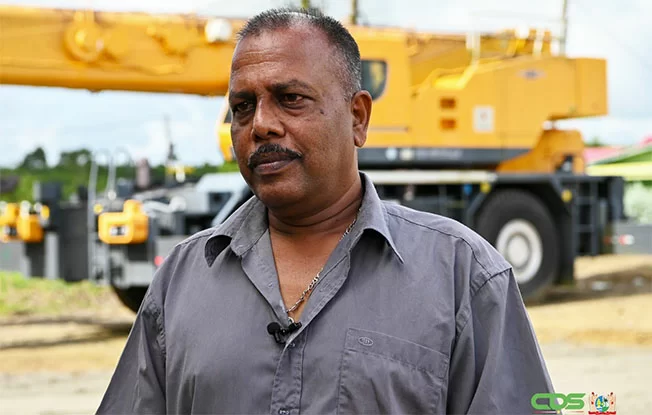
    Suriname’s state-owned heavy equipment company, NV Suriname Zwaar Materieel (Surzwam), has appointed Shyamkoemar Santoe as its new director with an urgent mandate to rescue the financially distressed enterprise. Santoe immediately identified the restoration of the company’s severely neglected machinery fleet as his top priority, alongside enhancing service delivery to the agricultural sector.

    The newly appointed director revealed that Surzwam is currently operating in a concerning state of disrepair. A significant portion of its heavy equipment is either defective or completely out of service, severely limiting operational capabilities. Santoe emphasized that conducting a comprehensive inventory assessment and systematic screening of all machinery represents the essential first step in the recovery process.

    Operating under the Ministry of Agriculture, Livestock and Fisheries, Surzwam plays a critical role in national water management, drainage systems, emergency response, and agricultural production support. Despite current challenges, Santoe confirmed the company will maintain its primary focus on serving farmers through affordable pricing structures, with particular attention to supporting smaller agricultural producers.

    The new director reported productive collaboration with both the Ministry and the Board of Commissioners, noting understanding of the current operational crisis. Santoe anticipates that necessary resources will be made available shortly to restore the machinery fleet, especially with the upcoming rainy season approaching. Additionally, expansion into road construction and other national development projects is being considered as part of Surzwam’s future operational scope.