标签: Suriname

苏里南

  • Melkcentrale wijzigt naam nieuw product na maatschappelijke kritiek

    Melkcentrale wijzigt naam nieuw product na maatschappelijke kritiek

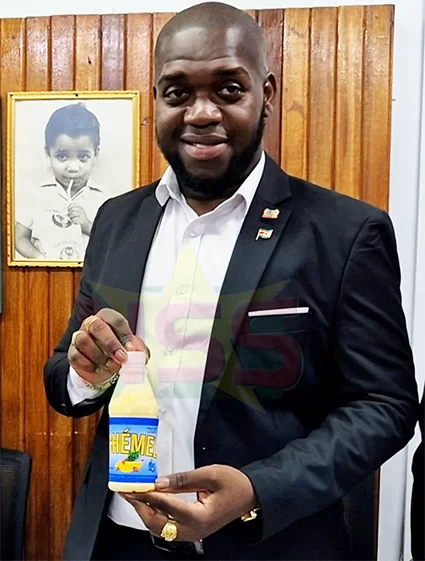
    In a swift reversal following public criticism, Melkcentrale NV has announced it will rename its newly launched dairy product originally called ‘Monchémel’ after CEO Monché Atompai. The product will now be marketed under the name ‘Tropimel’, with only the first 100-unit batch retaining the director’s namesake branding.

    The company revealed the strategic pivot through its official Facebook page just one day after the product’s unveiling. According to the statement, attaching the CEO’s name to the initial limited edition serves as a symbolic gesture recognizing Atompai’s dedication and leadership within the organization.

    During Tuesday’s press conference, management had presented the product exclusively as Monchémel without disclosing the planned name change or limited production scale. Executives initially claimed staff had collectively chosen the name as gratitude for their director. ‘The entire staff selected this name as thanks to our director. He deserves it,’ management stated during the presentation.

    CEO Atompai expressed surprise and honor during the event, noting: ‘They indicated it relates to how I’ve worked recently. They say I came as a hero, which is why they chose to give such a name to a product.’

    The subsequent clarification emphasizes that Tropimel’s introduction marks a significant corporate milestone. Melkcentrale’s statement elaborated: ‘Linking the first batch’s name to our director symbolizes our appreciation for the hard work, dedication, and team spirit characterizing our organization.’

    Following the initial 100 units, all subsequent production will carry the Tropimel branding when the product launches commercially on February 11th.

  • President Simons: digitalisering moet leiden tot banen en betere dienstverlening

    President Simons: digitalisering moet leiden tot banen en betere dienstverlening

    Suriname has embarked on an ambitious digital transformation journey with the inaugural Suriname Silicon Valley (SSV) Summit, convened on Tuesday at the Royal Torarica Ballroom. President Jennifer Simons delivered a keynote address emphasizing that digitalization should serve as a means to tangible outcomes—job creation, enhanced efficiency, and improved public services—rather than an end in itself.

    The summit, orchestrated by the Father Mother Figure (FMF) Foundation, brought together government representatives, private sector leaders, and academic institutions to address the nation’s technological lag. The event was structured around four core thematic tracks: Talent and Skills Development, Cybersecurity, Business-IT Alignment, and Governance, complemented by hands-on workshops designed to translate theory into practice.

    President Simons endorsed the initiative, noting its alignment with both global digital trends and national government strategies aimed at modernizing public services and optimizing organizational processes. ‘Digitalization must be rational, timely, and future-oriented,’ Simons stated. She urged young professionals and entrepreneurs to actively leverage the opportunities presented by such platforms.

    Henk Redmond, founder of FMF and chief architect of the summit, outlined a decentralized vision for the Suriname Silicon Valley. Instead of a single geographic hub, the initiative will establish multiple innovation centers across various districts to ensure broader accessibility. ‘Proximity to communities is essential to ensure easy access to these hubs,’ Redmond explained. The model integrates living, learning, and working within cohesive environments to stimulate growth in the ICT sector.

    Practical outcomes from the summit included the development of solution frameworks for pressing challenges, such as building a robust ICT ecosystem, establishing special economic zones, and designing fiscal incentives to attract investment. Additionally, the event facilitated direct connections between employers and job seekers, with several companies offering on-the-spot recruitment opportunities. Emphasis was placed on reducing barriers for marginalized groups through apprenticeships and business coaching for nascent entrepreneurs.

    President Simons highlighted the critical role of civic engagement in national development, asserting that progress stems not solely from government but from citizens and civil society organizations. She concluded by expressing gratitude to all participants and voicing optimism that the collaborations forged would catalyze sustainable growth in Suriname’s digital economy.

  • China breidt invloed in Bangladesh uit terwijl relatie met India verslechtert

    China breidt invloed in Bangladesh uit terwijl relatie met India verslechtert

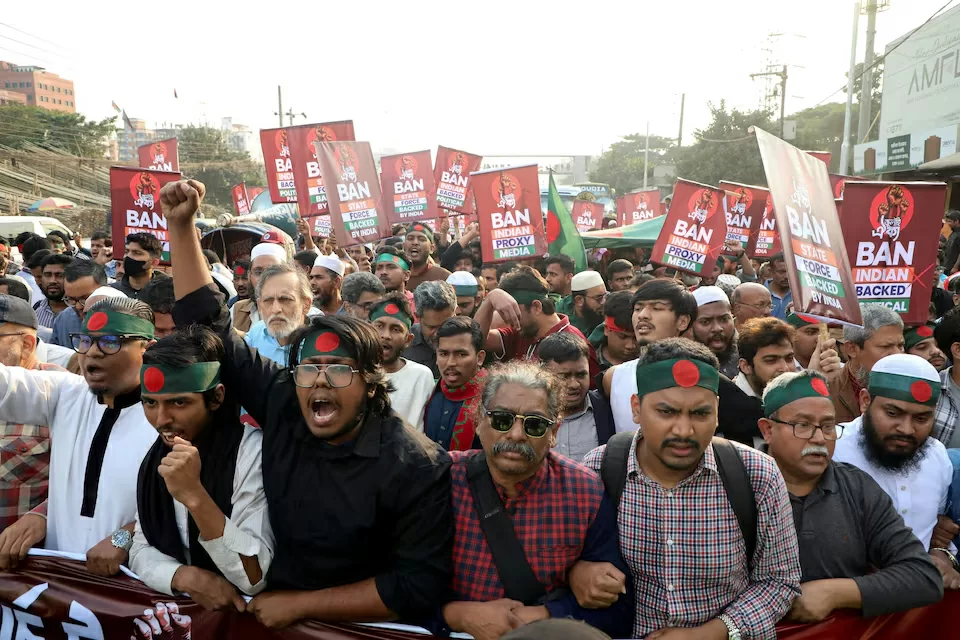
    Bangladesh stands at a critical geopolitical crossroads as its February 12th elections approach, with China rapidly expanding its influence following the 2024 ouster of pro-India leader Sheikh Hasina. While analysts anticipate Beijing’s sway will further intensify after the elections, they simultaneously emphasize that India—as Bangladesh’s massive neighbor—cannot be entirely sidelined from the regional equation.

    The two primary parties vying for power, the Bangladesh Nationalist Party (BNP) and Jamaat-e-Islami, historically maintained cooler relations with India compared to Hasina’s Awami League, which governed for 15 consecutive years before being banned. Hasina herself now resides in self-exile in New Delhi after being sentenced to death by a Bangladeshi court for allegedly ordering the violent suppression of a rebellion that reportedly claimed 1,400 lives—a charge she denies.

    China has aggressively capitalized on the political shift, elevating investments and diplomatic engagement in Dhaka. Recent developments include signing a defense agreement to construct a drone factory near the Indian border. Chinese Ambassador Yao Wen maintains vigorous communications with Bangladeshi politicians, officials, and journalists, discussing billion-dollar infrastructure initiatives.

    According to Humaiun Kobir, advisor to leading prime ministerial candidate Tarique Rahman of BNP, many Bangladeshis perceive India as complicit in Hasina’s alleged crimes. Nevertheless, Rahman stresses his commitment to friendly relations with all nations while prioritizing Bangladesh’s sovereign interests.

    Bilateral tensions between Dhaka and Delhi have recently deteriorated, exemplified by a cricket controversy where a prominent Bangladeshi player was excluded from the Indian Premier League following pressure from Hindu groups. Bangladesh retaliated by banning league broadcasts and requesting relocation of their World Cup matches to Sri Lanka—a proposal rejected by international cricket authorities.

    Both nations have implemented reciprocal visa restrictions, and official dialogues have become scarce since Hasina’s departure. Notably, Indian Foreign Minister S. Jaishankar did visit BNP leader Rahman in December to offer condolences following the passing of his mother, former Prime Minister Khaleda Zia.

    Economically, China has been Bangladesh’s largest trading partner for over a decade, with annual trade reaching approximately $18 billion. Chinese enterprises have invested hundreds of millions since Hasina’s exit, while Indian corporate expansions—including projects by the Adani Group—have stalled.

    Experts attribute China’s expanding influence to deteriorating India-Bangladesh relations and receding American engagement in the region. Beijing positions itself as a reliable economic partner avoiding entanglement in minority controversies that strain Delhi-Dhaka relations.

    Despite deepening Sino-Bangladeshi cooperation, analysts caution against overlooking India’s enduring significance. “Bangladesh requires both China and India,” observes Lailufar Yasmin from the University of Dhaka. “Regardless of election outcomes, completely ignoring India would be imprudent.” Bangladesh remains geographically encircled by India and dependent on its neighbor for trade, transit routes, and security.

    Although India assisted Bangladesh’s independence struggle in 1971, persistent tensions surrounding water sharing, border incidents, and Hasina’s political legacy continue to complicate relations. Emerging political forces like the National Citizen Party adopt hardened stances against India, presenting substantial challenges for future diplomatic engagement.

  • LVV waarschuwt telers Commewijne en Marowijne voor cassaveziekte

    LVV waarschuwt telers Commewijne en Marowijne voor cassaveziekte

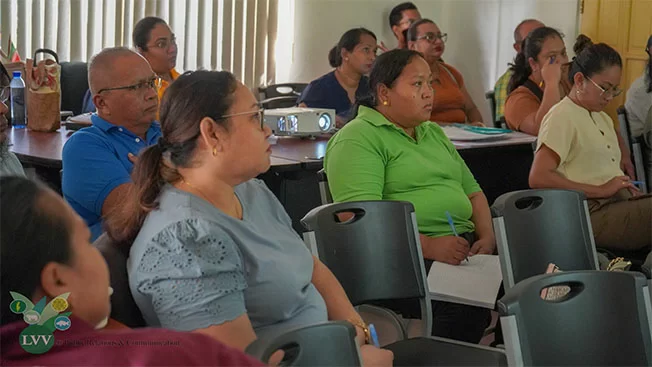
    The Ministry of Agriculture, Animal Husbandry and Fisheries (LVV) in Suriname has escalated its educational outreach across eastern regions to combat the further spread of Cassava Witches’ Broom Disease. Specially trained agricultural advisors are now deployed to provide timely guidance to farmers on managing this devastating crop infection.

    This aggressive plant disease causes severe growth abnormalities in cassava plants, resulting in stunted development and significantly reduced yields. Infected specimens exhibit distinct deformities across leaves, stems, and root systems. Given cassava’s critical role as a staple food source, LVV officials have identified the pathogen as a dual threat to both national food security and agricultural livelihoods.

    The comprehensive awareness campaign currently focuses on regions including Commewijne and Marowijne, where field technicians educate cultivators on symptom identification and contamination containment strategies. The program incorporates analysis of the disease’s sector-wide impact while integrating practical insights from farming communities.

    Current containment protocols emphasize regular plantation monitoring and strict prevention of plant material transportation from infected zones. Upon confirmation of infection, authorities recommend immediate burning of affected cassava stems to prevent pathogen transmission.

    Farmers and concerned citizens can access additional information and support through regional LVV offices across Suriname.

  • Van der San: Synchronisatie leidt tot forse inkomensstijging rechterlijke macht

    Van der San: Synchronisatie leidt tot forse inkomensstijging rechterlijke macht

    A controversial judicial compensation law in Suriname has triggered alarm over its substantial fiscal implications, according to administrative expert Eugène van der San. The Judicial Position Act, intended to regulate the financial status of the judiciary as mandated by the Constitution since 1975, has instead created unprecedented salary structures that threaten state finances.

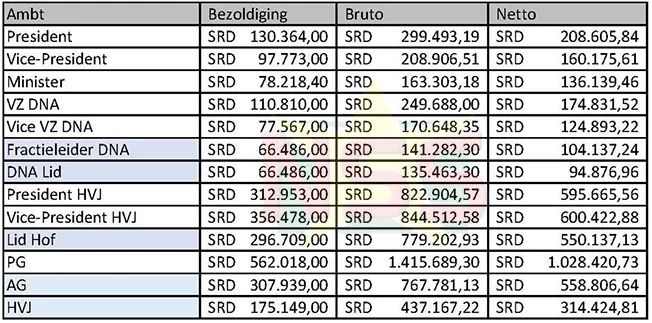
    Van der San’s detailed analysis reveals that the legislation has effectively merged both sitting magistrates (judges) and standing magistrates (prosecutors) under a single compensation regime with exceptionally high income percentages. Most notably, the Prosecutor General now receives approximately SRD 1 million net monthly income – a figure that far exceeds previous compensation norms.

    The critical shift occurred when the new law abandoned the traditional practice of linking judicial salaries to percentages of presidential compensation (typically 70-80%) and implemented a system allowing incomes to reach 95% of presidential salary, excluding allowances. The most concerning aspect, according to Van der San, is the allowance regime that permits supplementary payments reaching 150-170% of base salary, all tax-free.

    This creates an anomalous situation where tax-free allowances exceed taxable base salaries, violating fundamental principles of sound governance. The arrangement establishes long-term budgetary obligations without consideration for the country’s economic capacity, as the law automatically applies to both judicial branches including prosecutors and the Prosecutor General.

    Van der San emphasizes that the timing of implementation – after elections – obscured the financial impact during legislative consideration. He characterizes the situation as a ‘financial time bomb’ beneath the national budget and calls for immediate correction by President Jennifer Simons. His proposed solution involves repealing the current law and creating separate regulatory frameworks: one constitutional arrangement for sitting magistrates and a more modest, separate system for standing magistrates.

  • Acht jaar procederen, geen teruggave: beslag 19,5 miljoen euro blijft

    Acht jaar procederen, geen teruggave: beslag 19,5 miljoen euro blijft

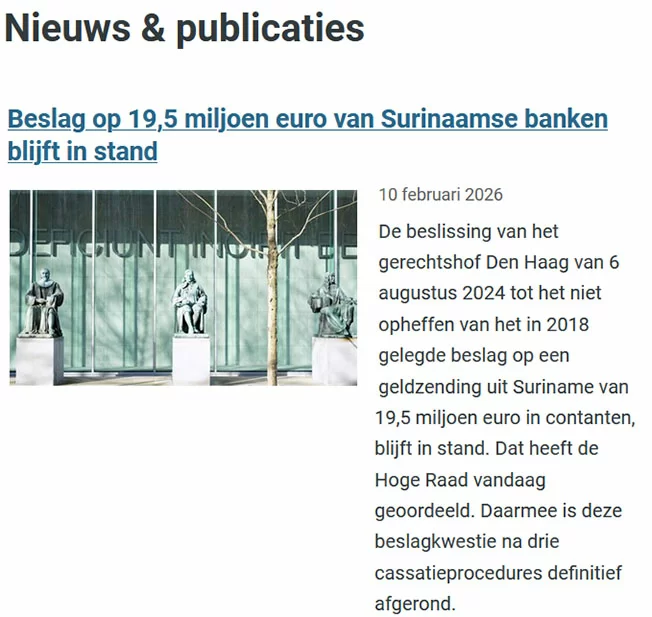
    In a definitive ruling that concludes an eight-year legal battle, the Netherlands’ Supreme Court has upheld the seizure of €19.5 million in cash transported from Suriname. The decision affirms The Hague Court of Appeal’s August 2024 judgment, bringing finality to a complex international asset forfeiture case that began on April 17, 2018.

    The funds were initially intercepted by the Dutch Fiscal Information and Investigation Service (FIOD) at Amsterdam’s Schiphol Airport on suspicion of money laundering. The currency shipment, which arrived by air from Suriname, was owned by three commercial banks: De Surinaamsche Bank, Hakrinbank, and Finabank. The Central Bank of Suriname (CBvS) acted as the formal shipper for the consignment, which was destined for China.

    Legal challenges were mounted by both the commercial banks and CBvS against the seizure. Throughout previous proceedings, the Supreme Court had twice ruled that decisions ordering the funds’ return were insufficiently motivated. The Hague Court of Appeal ultimately dismissed these complaints in 2024, allowing the seizure to remain in effect.

    The appellate court determined that CBvS could not claim immunity under international customary law, finding insufficient evidence that the seized funds constituted Central Bank property or were being utilized for its core functions of monetary policy and currency management. The court characterized CBvS’s role as merely facilitative and noted it was not ‘highly improbable’ that criminal courts would eventually order forfeiture of the funds.

    The Central Bank and commercial institutions subsequently appealed to the Supreme Court, contesting the immunity rejection, the legal framework applied to seizure assessments, and the proportionality of maintaining the asset freeze.

    In December 2025, the Advocate General recommended upholding the appellate decision. The Supreme Court adopted this advisory opinion and dismissed the appeals under Article 81 of the Judiciary Organization Act, indicating the complaints lacked grounds for reversal and raised no novel legal questions requiring substantive consideration.

    This ruling concludes a internationally monitored case that has drawn significant attention to cross-border financial enforcement. The funds remain seized pending ongoing criminal investigations.

  • Nieuwe brug verbetert bereikbaarheid Bende Kondre

    Nieuwe brug verbetert bereikbaarheid Bende Kondre

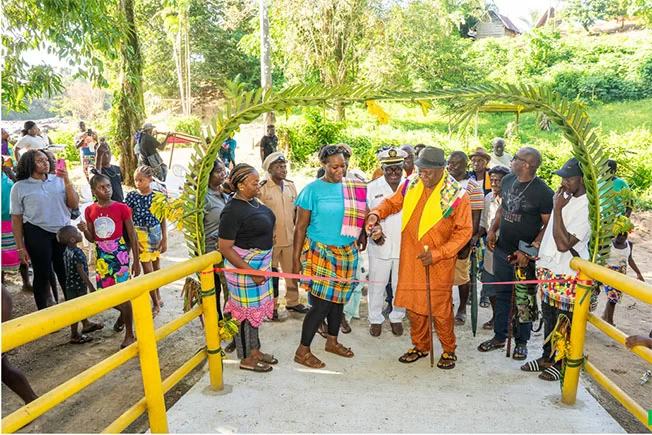
    In a significant infrastructure development for Suriname’s interior regions, Minister of Regional Development Miquella Huur officially inaugurated a new concrete bridge in Bende Kondre, Boven Suriname on February 10th. The 16-meter long and 3-meter wide structure spans a heavily utilized creek that serves as a vital transportation route for residents of Bende Kondre and surrounding villages.

    The newly completed bridge represents a major enhancement to regional connectivity and safety standards. Prior to its construction, residents faced considerable challenges crossing the waterway, particularly during adverse weather conditions. The infrastructure project directly addresses these mobility constraints while facilitating improved access to essential services and economic opportunities.

    Minister Huur expressed satisfaction with the project’s completion, emphasizing her ministry’s ongoing commitment to nationwide community development. “While we cannot fulfill all requests simultaneously,” Huur stated, “this bridge demonstrates our sustained dedication to improving living conditions across all regions of Suriname.” The minister extended gratitude to both the construction contractor and local residents whose collaborative efforts ensured the project’s successful realization.

    District Commissioner Humphry Jeroe appealed to the community to maintain the infrastructure properly, highlighting the importance of local stewardship in preserving public assets. Granman (paramount chief) Albert Aboikondo conveyed appreciation for the government’s development efforts, acknowledging the bridge’s transformative potential for the region. Community members echoed this sentiment, expressing hope that the project would catalyze further developmental initiatives in the area.

    The inauguration ceremony signifies the Surinamese government’s continued focus on addressing infrastructure disparities in remote communities, potentially setting a precedent for similar projects in other underserved regions of the country.

  • Cuba voert noodmaatregelen in vanwege brandstoftekort

    Cuba voert noodmaatregelen in vanwege brandstoftekort

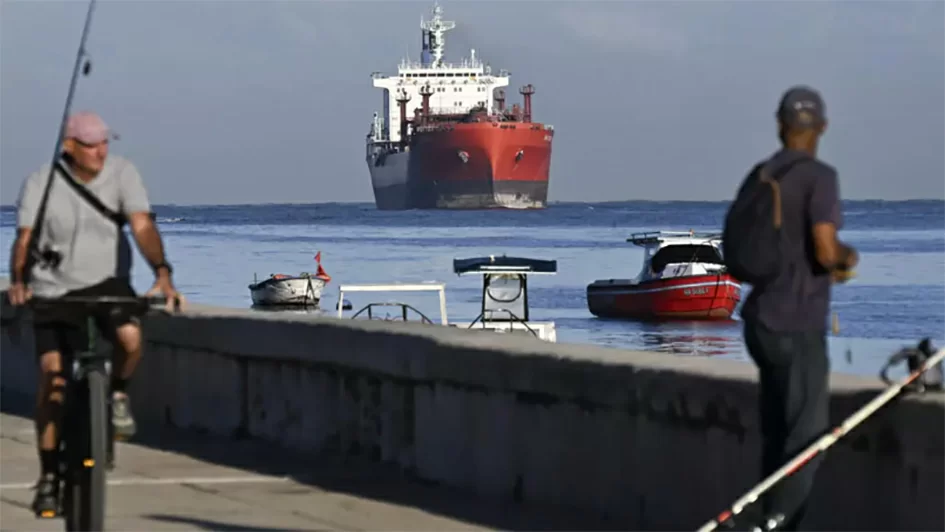
    Cuba has enacted urgent fuel conservation measures in response to a crippling US energy blockade that has severely disrupted daily life across the island nation. The Cuban government announced Monday that international airlines would no longer have access to aircraft fuel starting Tuesday, prompting Air Canada to immediately suspend all flights to Cuba.

    The streets of Havana fell unusually quiet as the emergency protocols took effect, designed to preserve rapidly diminishing fuel reserves. In response to what officials describe as economically paralyzing pressure from the Trump administration, the government has implemented reduced work weeks for state enterprises, curtailed school hours, and restricted fuel sales to essential services only.

    Additional austerity measures include the closure of hotels with low occupancy rates and the consolidation of tourists into fewer accommodations. Popular resort destinations such as Varadero and other provincial areas are experiencing hotel shutdowns, according to anonymous tourism industry professionals.

    The fuel shortage has created widespread uncertainty among Cuba’s 9.6 million residents. Public transportation has been drastically reduced, while taxi operators have significantly increased fares. Many citizens now face extended waiting periods for transportation, complicating daily routines and economic activities.

    This latest crisis compounds Cuba’s longstanding economic challenges, which have persisted under a US trade embargo since 1962. The situation deteriorated further when Venezuela—formerly Cuba’s primary oil supplier—ceased deliveries following last month’s US intervention that resulted in the abduction of Venezuelan President Nicolás Maduro. The Trump administration has threatened tariffs against any nation continuing to supply Cuba with petroleum products.

    The looming fuel shortages threaten to trigger large-scale power outages across the island. Officials confirmed Sunday that Cuba cannot refuel long-haul flights for at least one month, severely impacting international connectivity.

    Cuban Foreign Minister Bruno Rodríguez condemned the US blockade as “cruel aggression” designed to break the political will of the Cuban people. While reaffirming Cuba’s openness to dialogue, Rodríguez emphasized that any discussions must occur on Cuba’s own terms.

    Mexico, previously Cuba’s second-largest oil source after Venezuela, has expressed support for Cuba and initiated diplomatic talks with the US to resume oil exports. President Claudia Sheinbaum warned of an impending humanitarian crisis but stated Mexico cannot expose itself to US tariffs. Mexico recently dispatched over 800 tons of humanitarian aid to Cuba.

    The Russian government has also denounced US measures as “suffocating” and is collaborating with Cuba to provide assistance during the crisis.

  • Column: Samen voelen? Dan eerst samen inleveren

    Column: Samen voelen? Dan eerst samen inleveren

    A profound disparity in compensation between Suriname’s political elite and its public sector workers has ignited widespread social discontent. While teachers with 35 years of experience barely net SRD 13,000 monthly, nurses remain systematically underpaid, and civil servants survive on minimal allowances, members of De Nationale Assemblee enjoy compensation packages increasingly indefensible to the populace they represent.

    The controversial legislation enabling these benefits was passed in the previous parliament shortly before May 2025 elections. The National Democratic Party (NDP), then in opposition, stood alone in principled opposition, condemning the increases as unjust, antisocial, and irreconcilable with the nation’s economic reality. Today, that same party sits in the coalition government, not only accepting but defending the very law they once rejected.

    Financial disclosures reveal staggering figures: The President receives SRD 130,364 monthly, while the Assembly Chairperson gets 85% of that amount (approximately SRD 110,000). Regular assembly members earn 60% of the presidential salary (roughly SRD 66,485 gross), but with additional allowances and provisions, their net monthly income approaches SRD 95,000—totaling approximately SRD 132,000 gross.

    Beyond base compensation, parliamentarians receive comprehensive medical coverage for themselves and their families—including dental, vision care, and overseas treatment when necessary. Additional benefits include vehicle, housing, communication, and representation allowances; travel and accommodation expenses; domestic travel reimbursements including vehicle rentals; VIP airport facilities; diplomatic passports; and potentially a forthcoming 20% management allowance.

    This privileged existence contrasts sharply with a nation where parents struggle to afford public transportation for their children, where healthcare and education sectors must repeatedly strike to be heard, where many work two or three jobs to stay afloat, and where consecutive economic reforms have decimated the middle class.

    Proponents argue that assembly members must maintain full-time availability—a reasonable requirement in principle. While formally barred from holding additional government positions, they face virtually no restrictions on private sector activities. Many serve as entrepreneurs, exporters, or consultants, while others enjoy continuous income from previous ministerial, advisory, or civil service roles. The emerging portrait reveals a political class securing itself while demanding sacrifices from the rest of society.

    Poetini Atompai (NPS) during the election campaign pledged to amend this law—a promise he now renews with commitment to legislative initiative. While positive, words alone no longer suffice. Society has moved beyond trusting intentions to demanding action: submit the proposal, gather co-sponsors, place it on the agenda, force a vote, and show the nation who supports correction versus who clings to privileges at the treasury’s expense.

    Labor unions observe closely while negotiating, recognizing that calls for wage restraint ring hollow while leadership makes no concessions. Negotiations concern not merely percentages but exemplary conduct. Officials frequently claim “no space” exists for increasing civil servant salaries, yet apparent abundance remains for luxury, official travel, and expanding benefits for those in power—a contradiction the public both sees and remembers.

    Social media anger appears raw and sometimes unrefined but not unfounded. Terms like “puppet show,” “theater,” and “self-enrichment” emerge from years of disappointment. Cynicism isn’t innate but learned through repeated behavioral patterns.

    Nobody claims assembly members should serve without compensation, but remuneration must correspond to level, responsibility, performance, and social context. Those receiving top compensation must deliver excellence: substantive work, attendance, legislation, oversight, and integrity.

    “Feeling together,” asserts Atompai—a powerful phrase. But feeling together without sacrificing together constitutes rhetoric, not solidarity. If seriousness exists, it must begin where power resides, not with the populace. Submit the amendment law. Place it on the agenda. Demonstrate who truly wishes to feel together—and who merely wishes to enjoy together.
  • Politie kondigt ontruiming goudgebied aan, Sampie pleit voor dialoog

    Politie kondigt ontruiming goudgebied aan, Sampie pleit voor dialoog

    Surinamese law enforcement authorities have declared that the territory spanning from New Koffiekamp’s border to the Royal Hill mine, including the Redi Bergi sector, must be completely evacuated by 08:00 hours on Friday, February 13th. This zone falls within the legally sanctioned concessions of ZiJin Rosebel Gold Mines.

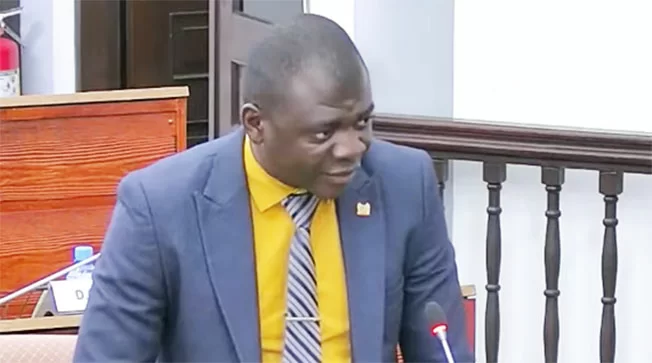
    Assembly representative Edgar Sampie (ABOP) has raised serious concerns regarding the potential societal repercussions of forced evacuations. According to Sampie, numerous artisanal miners have operated in this region for years, making substantial financial investments in their operations.

    The official police notification mandates immediate departure of all individuals from the designated area, requiring dismantlement of encampments and removal of personal possessions. Failure to comply will trigger joint enforcement operations between police and national military forces without additional warning, executed under prevailing legal statutes. This directive carries formal legal validity.

    “Many miners have constructed permanent dwellings, acquired heavy machinery, and depend on this work as their primary livelihood,” Sampie explained to Starnieuws. Their mining earnings support family sustenance, educational expenses, debt settlements, and future planning, with some having committed to vehicle installment plans and housing construction projects.

    While acknowledging Zijin’s legal concession rights, the affected miners seek governmental clarity regarding post-eviction scenarios. The central question remains: what becomes of these individuals after displacement? How will they be supported during transition?

    The parliamentarian emphatically advocates for diplomatic engagement and compromise solutions. He proposes tripartite negotiations between government authorities, mining corporation representatives, and artisan miner delegates to establish sustainable resolutions. “Removing this workforce without alternative provisions risks escalating criminal activities not merely in Paramaribo but throughout Suriname’s interior regions,” Sampie cautioned.

    Highlighting the historical context, Sampie noted New Koffiekamp’s existence predating Rosebel and Zijin’s operational presence, urging consideration of this temporal precedence despite current legal concessions.

    Although lacking direct authority to halt evictions, the ABOP legislator intends to lobby Justice & Police and Natural Resources ministers to convene consultations with miner representatives. “Government must demonstrate willingness to hear these citizens’ concerns and collaboratively develop mutually acceptable solutions,” Sampie concluded, emphasizing dialogue-based conflict prevention over coercive measures.