标签: Suriname

苏里南

  • Onderzoek vervolging ex-ministers legt spanning bloot tussen politiek en rechtsstaat

    Onderzoek vervolging ex-ministers legt spanning bloot tussen politiek en rechtsstaat

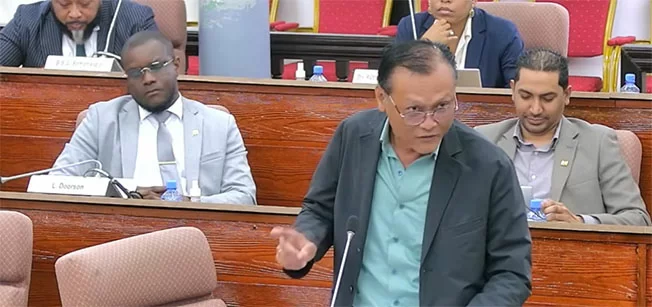
    Suriname’s National Assembly has established a parliamentary investigation committee to examine impeachment requests against three former ministers, initiating a process with profound legal and political implications. This preliminary phase has already evolved into a critical test for both parliamentary credibility and the nation’s rule of law.

    The committee’s formation revealed underlying coalition tensions when ABOP faction leader and Assembly Vice President Ronnie Brunswijk insisted on chairmanship, declaring he could not function under NDP’s Ebu Jones. Ultimately, NDP faction leader Rabin Parmessar was appointed chair instead.

    Comprising seven assembly members with twelve permanent observers, the committee convenes Monday to examine the Prosecutor General’s case against former ministers Bronto Somohardjo, Riad Nurmohamed, and Gillmore Hoefdraad. While formally an exploratory phase without substantive judgments, the committee will conduct hearings and analyze documents.

    In reality, the stakes are considerably higher: this committee must demonstrate that political interests won’t override a process touching the core of judicial integrity. Additional members include Dew Sharman (VHP), Xiabao Zheng (PL), Jennifer Vreedzaam (NDP), Mahinder Jogi (VHP), Ivanildo Plein (NPD), and Ebu Jones (NDP).

    The chairmanship debate highlights the sensitivity of these proceedings. Brunswijk’s exclusion from leadership was institutionally appropriate given his previous vice presidency alongside Somohardjo and Nurmohamed in the former coalition, which would have created apparent conflicts of interest.

    However, ABOP’s complete absence from the committee—providing neither members nor permanent observers—complicates matters politically and institutionally. While the party could contribute during public deliberations, its absence from preparatory work undermines broader decision-making legitimacy.

    Coalition unity remains elusive regarding the Prosecutor General’s request:
    – Pertjajah Luhur: Faction leader Somohardjo publicly supports prosecution, including in his own case
    – NPS: Advocates allowing the Prosecutor General to proceed with investigations
    – ABOP: Maintains ambiguous positioning
    – NDP, A20, and BEP: Have not established formal stances

    This lack of consensus increases the likelihood that political considerations may outweigh legal arguments.

    The opposition VHP party has notably positioned itself in favor of granting the prosecution request, despite Nurmohamed being a prominent party member.

    At the heart of the tension lies Article 140 of Suriname’s Constitution, which establishes a special procedure for political officials unlike ordinary citizens subject to direct criminal prosecution. This provision requires parliamentary approval before prosecution can proceed, effectively making politics the gatekeeper of judicial process.

    This constitutional framework creates three fundamental implications:
    – Inequality before the law for political officials
    – Political considerations influencing criminal prosecution
    – Judicial process dependency on parliamentary decision-making

    Growing criticism suggests Article 140 may require amendment or abolition as it conflicts with fundamental principles of legal equality.

    Current developments reveal systemic vulnerabilities. The chairmanship debate, coalition partner absence, and internal divisions reinforce perceptions that political interests could influence proceedings, shifting focus from substance to process integrity. The coming weeks will prove decisive not only for three former ministers but for Suriname’s entire judicial system.

    Should the process:
    – Proceed meticulously and convincingly → it will strengthen public trust
    – Descend into political conflict → it will damage judicial integrity

    The investigation committee has transcended technical exercise to become both a political test for parliament and a mirror reflecting the functionality of Suriname’s rule of law. Beyond three former ministers, this process will inevitably reveal how power, decision-making, and conflict of interest have operated in practice—questioning not only individual accountability but broader political structures.

    One certainty emerges: this process will have consequences. As facts sharpen, multiple heads will inevitably roll—political, administrative, or otherwise. The central question becomes not only who faces prosecution, but who remains standing when the full picture emerges.

  • Iran ‘raakt’ Amerikaanse AWACS-vliegtuigen en tankvliegtuigen

    Iran ‘raakt’ Amerikaanse AWACS-vliegtuigen en tankvliegtuigen

    In a significant escalation of the ongoing US-Israel military campaign against Iran, Tehran has demonstrated formidable asymmetric warfare capabilities by successfully targeting critical American air defense assets across the Middle East. According to multiple defense sources, Iranian forces have damaged or destroyed radar systems, THAAD missile defenses, and Reaper drones at US bases in Saudi Arabia, UAE, Bahrain, Jordan, and Kuwait throughout February and March.

    The most devastating strike occurred Friday at Prince Sultan Air Base in Saudi Arabia, approximately 96 kilometers southeast of Riyadh. Iranian rockets and drones reportedly damaged multiple KC-135 aerial refueling tankers and an E-3 Sentry AWACS (Airborne Warning and Control System) aircraft. Air & Space Forces Magazine confirmed the attack left at least 15 American personnel wounded, with five in serious condition, though neither US military officials nor Saudi authorities have formally commented.

    Satellite imagery published by Iran’s Press TV appears to show extensive damage to aircraft at the base following the attacks. If verified, this represents the second assault on the facility within a week, following a March 13 incident that damaged five KC-135s according to Wall Street Journal sources.

    Military experts emphasize the strategic significance of targeting the E-3 Sentry, a modified Boeing 707/320 aircraft that serves as the US Air Force’s primary airborne battle management system. Retired Colonel John Venable told WSJ the attack “harms the US ability to see what’s happening in the Gulf and maintain situational awareness.” Heather Penney, former F-16 pilot and research director at Mitchell Institute for Aerospace Studies, noted the loss “is incredibly problematic given how crucial these battle managers are for everything from de-escalating airspace conflicts to targeting and delivering lethal effects.”

    The AWECS platform, operational since 1977, provides surveillance across all altitudes and weather conditions with a radar range exceeding 375 kilometers. With only 16 E-3s in service, the US had deployed six to bases in Europe and the Middle East during the current conflict.

    Beyond aerial attacks, Iran has effectively blockaded the Strait of Hormuz—transit point for 20% of global oil shipments—driving crude prices above $100 per barrel, a 40% increase since hostilities began. The Pentagon is reportedly preparing a $200 billion supplemental budget request to replace damaged systems amid concerns about dwindling missile inventories.

    Casualty estimates indicate at least 13 US military fatalities and approximately 200 wounded since the conflict began one month ago. Iranian health authorities report at least 1,900 killed and over 18,000 wounded nationally.

  • Man aangehouden na dreiging met ‘vuurwapen’ op terras horecagelegenheid

    Man aangehouden na dreiging met ‘vuurwapen’ op terras horecagelegenheid

    A swift response by judicial authorities prevented a potential tragedy at Mr. L.J. Rietbergplein on Sunday morning when a 49-year-old man brandishing what appeared to be a firearm threatened self-harm and violence against bystanders.

    According to official police reports, the suspect identified as R.R. entered a hospitality establishment’s terrace at approximately 10:30 AM while holding what witnesses believed to be a lethal weapon against his head. The individual reportedly declared intentions to end his own life while suggesting possible harm to present patrons.

    The situation was immediately de-escalated when a member of the Dutch Judicial Intervention Team, who happened to be on-site, initiated crisis negotiation protocols. This critical intervention allowed numerous terrace visitors to safely evacuate the premises during the tense confrontation.

    Law enforcement intervention became necessary when the suspect redirected the weapon toward responding officers. With assistance from security personnel, the individual was successfully subdued, restrained, and taken into custody without physical injury to any parties involved.

    Subsequent forensic examination revealed the weapon to be a gas-powered air rifle loaded with metal projectiles, though its appearance closely resembled an actual firearm. The device has been confiscated as evidence in the ongoing investigation.

    The suspect has been transported to police headquarters for processing and presented to an assistant prosecutor. Criminal charges include attempted manslaughter and making credible threats, with additional charges potentially pending as the investigation continues.

  • Pakistan: Vierlandenoverleg om VS en Iran naar diplomatie te bewegen

    Pakistan: Vierlandenoverleg om VS en Iran naar diplomatie te bewegen

    Islamabad has emerged as the epicenter of a rapidly evolving diplomatic initiative aimed at de-escalating hostilities between the United States and Iran. On March 29, 2026, foreign ministers from Turkey, Saudi Arabia, Egypt, and Pakistan commenced a two-day ministerial meeting in the Pakistani capital, signaling the most intensive diplomatic movement seen in years regarding the ongoing conflict.

    The talks follow Pakistani Prime Minister Shehbaz Sharif’s second telephone conversation with Iranian President Masoud Pezeshkian within five days—a 90-minute discussion focused exclusively on de-escalation and confidence-building measures. President Pezeshkian emphasized Tehran’s precondition for direct dialogue: concrete trust-building actions following what Iran characterizes as two previous attacks during nuclear negotiations that severely damaged confidence in Washington.

    This diplomatic mechanism represents an institutionalized effort originating from earlier discussions during a broader conference of Muslim and Arab nations in Riyadh. Pakistan’s central role as mediator between Washington and Tehran became evident when the meeting venue was shifted from Ankara to Islamabad, reflecting Pakistan’s active facilitation of backchannel communications.

    China has formally endorsed Pakistan’s mediation efforts and encouraged Iranian participation, indicating growing great-power engagement with this regional initiative. While the immediate objective isn’t to enforce a ceasefire, diplomats are working to harmonize regional positions and establish foundations for potential direct US-Iran negotiations. For the first time, discussions have moved beyond theoretical possibilities to concrete documents awaiting implementation.

    Speculation suggests that talks between US Secretary of State Marco Rubio and Iranian Foreign Minister Abbas Araghchi could occur within days, potentially in Pakistan, with Vice President JD Vance also mentioned as a possible participant. These prospects remain contingent on fluctuating conditions, including a temporary pause in US attacks to meet Iran’s confidence-building demands.

    Tehran’s requirements for dialogue include cessation of hostilities, compensation payments, guarantees against future attacks, and recognition of its strategic influence in the Strait of Hormuz. President Pezeshkian recently warned of Israeli attempts to expand the conflict while expressing concerns about attacks originating from foreign territories.

    Pakistan maintains that dialogue requires an atmosphere of mutual respect and an end to killings of Iranian officials and civilians. Islamabad has condemned Israeli attacks while showing solidarity with Gulf states regarding Iranian infrastructure attacks, revealing growing divergence between regional powers and Washington’s military approach.

    The situation is further complicated by increased involvement of Iran-backed Houthi rebels in Yemen, whose escalated attacks on Saudi Arabia and other regions create additional security concerns and strengthen Iranian alliances.

    The next 48-72 hours will prove decisive in determining whether this diplomatic initiative culminates in actual US-Iran meetings. Having consulted with Iran, hosted regional powers, and conveyed proposals, Pakistan has completed its intermediary role. The outcome now depends on decisions in Washington and Tehran.

    Should this mediation effort fail due to persistent distrust and continuing violence, the regional conflict risks escalating into a significantly larger war.

  • Reactie op: Noodzaak van een Algemene Wet Bestuursrecht

    Reactie op: Noodzaak van een Algemene Wet Bestuursrecht

    In a significant development within Suriname’s political landscape, Assembly Member Asis Gajadien (V.H.P. faction leader) has ignited crucial discussions regarding the nation’s pressing need for comprehensive Administrative Law legislation. This call for legal reform comes amid growing concerns about governmental transparency and citizen rights protection.

    The constitutional foundation for such legislation dates back to 1975, specifically Article 135(1) of Suriname’s Constitution, which empowers the assignment of non-civil legal disputes to administrative judges. Despite this longstanding constitutional provision, Suriname has consistently failed to establish uniform and enforceable administrative regulations throughout its history as an independent nation.

    Eugène van der San, Chairman of the Administrative Appeals Institute (ABI) within the President’s Cabinet, revealed that substantial preparatory work has already been undertaken regarding administrative law formulation. However, he expressed disappointment that experienced parliamentarians like Gajadien have only recently recognized this necessity, particularly given the extensive period during which these same politicians held governing authority.

    The current legal vacuum creates substantial challenges for citizens, who face ambiguous procedures, insufficient transparency, and limited avenues to effectively contest government decisions. This regulatory deficiency fundamentally undermines public trust in state institutions—a concern that van der San claims to have raised repeatedly without response until now.

    Political observers suggest the timing of this initiative may connect to ongoing proceedings involving the potential indictment of political officeholders. The fundamental structural issue in Suriname appears to be the tendency of politicians to evaluate even formal constitutional matters through partisan lenses rather than objective legal frameworks.

    Historical context reveals that even the Netherlands, whose legal system influenced Suriname’s, required extensive development before establishing its General Administrative Law Act (AWB) in 1994. Previous legislation including the Administrative Decisions Appeal Act (Wet BAB) and Administrative Jurisdiction Act (Wet Arob) gradually built toward comprehensive administrative law codification.

    Under the concordance principle, political leaders since independence in 1975 bore responsibility for developing administrative law in accordance with constitutional mandates. While Article 135(2) institutionally enables administrative appeals through judicial collaboration, the absence of comprehensive legislation creates uncertainty regarding the consistent application of proper governance principles.

    Both van der San and Gajadien now advocate for expedited parliamentary consideration of administrative law legislation, recognizing that existing transparency laws alone cannot ensure legal certainty or prevent administrative arbitrariness. This bipartisan recognition of legal deficiency may signal potential progress toward strengthening citizen rights protections and governmental accountability in Suriname.

  • Internationale markten reageren nerveus; druk op brandstofprijs in Suriname neemt toe

    Internationale markten reageren nerveus; druk op brandstofprijs in Suriname neemt toe

    International financial markets are exhibiting heightened volatility as escalating energy costs and persistent inflation concerns create widespread economic uncertainty. This global phenomenon, fueled by geopolitical tensions and climbing oil prices, is now manifesting as tangible local economic pressure in nations like Suriname.

    Recent oil price increases have prompted cautious investor behavior worldwide. Growing apprehensions about resurgent inflation may compel central banking institutions—including the European Central Bank and the Federal Reserve—to reconsider their current monetary policies. This climate of uncertainty has triggered notable market fluctuations and a strategic shift from optimistic investment toward risk aversion.

    For Suriname, the consequences extend beyond financial markets into daily living expenses. The international oil price surge directly impacts the local economy, where fuel plays a critical role across virtually all economic sectors.

    The current government-imposed price cap of SRD 53 per liter of fuel—established after oil companies previously advocated for an increase to SRD 60—is becoming increasingly difficult to maintain. As global market prices continue their upward trajectory, import costs rise and currency pressures persist.

    Initial effects are already visible through rising prices of goods and services, particularly within the transportation sector. Transport operators are passing increased costs to consumers, resulting in more expensive food items and generalized price increases across retail establishments and markets. This inflationary pressure is no longer solely driven by external factors but has developed distinct local characteristics.

    Economic analysts emphasize that the current situation is unsustainable long-term. Artificially suppressed fuel prices can only be maintained temporarily while international oil prices continue climbing. Subsidies or price caps inevitably create mounting pressure on government finances and profit margins for importers and distributors.

    The question for Suriname is not if fuel prices will increase, but when. Consumers are anticipated to face pump prices of SRD 60 per liter or potentially higher, depending on future oil price developments and government policy responses.

    Thus, international market nervousness finds direct expression in Suriname’s economic reality. While global investors respond to abstract risks, local households confront concrete cost increases, demonstrating that the divide between worldwide economic developments and daily life has never been narrower.

  • Terwijl de oorlog woedt, dringen Iraanse politici aan op vertrek uit het kernwapenverdrag

    Terwijl de oorlog woedt, dringen Iraanse politici aan op vertrek uit het kernwapenverdrag

    Iran stands at a critical geopolitical crossroads as hardline politicians push for the nation’s withdrawal from the Treaty on the Non-Proliferation of Nuclear Weapons (NPT), responding to intensified US-Israeli strikes on civilian nuclear sites, steel complexes, and academic institutions. The escalating confrontation has triggered parliamentary action that could fundamentally reshape Iran’s nuclear posture and international alliances.

    Ebrahim Rezaei, spokesperson for the Iranian parliament’s national security commission, declared Friday that continued NPT membership ‘has yielded no benefits’ for Iran. His statements on social media platform X coincided with lawmaker Malek Shariati’s announcement that a priority bill had been submitted through parliamentary channels to facilitate Iran’s exit from the treaty. This legislative move would also revoke nuclear restrictions tied to the defunct 2015 nuclear agreement and establish new international partnerships with aligned nations including Shanghai Cooperation Organization and BRICS members for peaceful nuclear technology development.

    The parliamentary push comes amid devastating airstrikes that have targeted Iran’s critical infrastructure. US-Israeli forces conducted intensive bombardments on Friday, hitting a yellowcake facility in Yazd, the Khondab Heavy Water Complex near Arak, and areas surrounding the Bushehr nuclear power plant—prompting International Atomic Energy Agency (IAEA) warnings about potential radiological catastrophe. Simultaneous attacks crippled Iran’s major steel complexes in Isfahan and Ahvaz, threatening billions in non-oil export revenue and thousands of jobs amid an existing economic crisis featuring 70% inflation and severe energy shortages.

    Iran’s leadership has accused IAEA Director Rafael Grossi of complicity in the attacks, with senior advisor Mohammad Mohkber labeling him an accomplice to bloodshed. Parliamentary member Fada-Hossein Maleki further accused Grossi of months of ‘instigation’ to please US President Donald Trump, describing nuclear bomb remarks as ‘provocative acts contrary to all international norms.’

    The conflict has plunged Iran into information darkness, with the Islamic Republic maintaining a complete internet shutdown for over one month—affecting 90 million citizens—while heavily armed forces patrol cities to prevent protests. State media continues broadcasting coerced confessions, including a recent video of a blurred-face girl arrested for sharing strike footage with foreign media.

    As Tehran endures its most severe bombardment nights, with airstrikes illuminating skies orange and causing temporary blackouts, the parliamentary bill awaits review by the Guardian Council—a powerful 12-member constitutional body—before potential implementation, marking a potential point of no return in Iran’s nuclear diplomacy.

  • Beloningsstructuur en organisatie rechterlijke macht worden herzien

    Beloningsstructuur en organisatie rechterlijke macht worden herzien

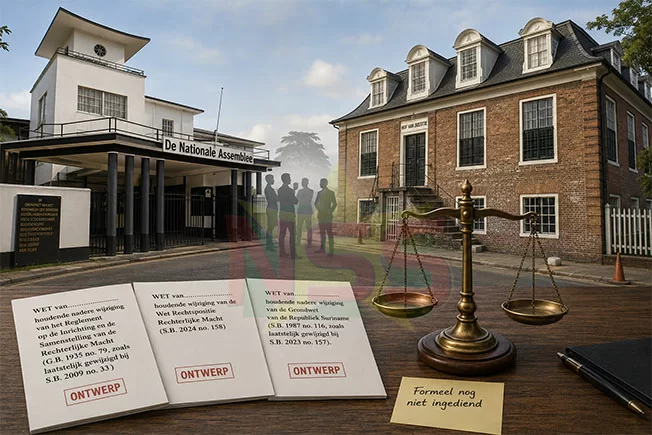
    Suriname’s National Assembly has initiated comprehensive revisions to the Judicial Position Act, targeting both compensation structures and organizational frameworks within the nation’s judiciary. According to NDP parliamentarian Ebu Jones, the preparatory phase involves extensive exploration of various options to enhance the judicial system’s functionality and independence.

    The proposed amendments extend beyond mere salary adjustments for judges, encompassing the entire judicial chain—from the President of the Court of Justice to prosecutors and court clerks. This holistic approach aims to align responsibilities with appropriate remuneration while reinforcing the rule of law. Jones emphasized that the reforms seek to make judicial positions both attractive and independent, addressing systemic vulnerabilities.

    Structural reforms constitute a critical component of the overhaul. One key proposal involves establishing dedicated administrative bureaus for both the Court of Justice and the Public Prosecutor’s Office. These entities would assume responsibility for personnel management, financial processing, and other administrative duties that currently fall under senior judicial officials.

    This strategic separation aims to shield top judicial figures—including the Court President and Attorney General—from potential conflicts of interest and public speculation regarding appointments and budget management. By relieving judges of administrative burdens, the reforms intend to prevent the judiciary from being drawn into political or managerial positions, thereby safeguarding its integrity and independence.

    The legislative review also examines a previous decision by former President Chan Santokhi that granted judicial leadership autonomy in organizing internal structures. Jones referenced Parliament’s operational model as an ideal framework, where a dedicated bureau handles administrative and financial matters, allowing lawmakers to focus solely on their core legislative duties.

    While specific adjustments to these powers remain undetermined, multiple scenarios are under consideration. The coming period will determine the concrete implementation of these proposals and the ultimate direction of Suriname’s judicial modernization efforts, all oriented toward strengthening both the position and performance of the judicial branch.

  • Japan viert 50 jaar diplomatie met Suriname met traditioneel fluitconcert

    Japan viert 50 jaar diplomatie met Suriname met traditioneel fluitconcert

    In a significant cultural demonstration marking five decades of diplomatic relations between Japan and Suriname, the Japanese Embassy hosted a captivating Shakuhachi concert in Paramaribo on Friday. The event, organized in collaboration with the Chamber of Commerce and Industry, Suriname Conservatory, and Spice Quest, showcased Japan’s rich musical heritage through the mesmerizing sounds of the traditional bamboo flute.

    The evening’s centerpiece featured renowned Japanese Shakuhachi master and composer Yosuke Irie, whose performance transported attendees into a meditative soundscape characteristic of Japan’s ancient musical traditions. Irie’s masterful interpretation created an atmosphere of profound tranquility and cultural appreciation among the diverse audience.

    Following his performance, Irie engaged directly with attendees, providing detailed explanations of the instrument’s historical significance and demonstrating specialized playing techniques. In a symbolic gesture strengthening cultural ties, the artist personally presented a Shakuhachi flute to Charmain Belfor, Director of the Suriname Conservatory, facilitated by Japanese Ambassador Akima Umezawa.

    The embassy emphasized that this cultural initiative underscores the continuing importance of artistic exchange in fostering mutual understanding between the two nations. Officials expressed strong commitment to further developing such collaborative cultural programs, recognizing them as essential components of international diplomacy and cross-cultural appreciation.

  • Suriname en China markeren 50 jaar diplomatieke banden met reeks activiteiten

    Suriname en China markeren 50 jaar diplomatieke banden met reeks activiteiten

    The Chinese Embassy in Suriname has unveiled comprehensive plans to commemorate the 50th anniversary of diplomatic relations between China and Suriname, established on May 28, 1976. Ambassador Lin Ji announced a multifaceted celebration program beginning with a specially produced documentary series that explores the nations’ shared history and future prospects.

    The inaugural documentary, ‘Roots and Legacy: Echoes Across a Century,’ premiered today on ATV and SCTV, marking the start of five films examining bilateral relations. The documentary series, produced through collaboration between Chinese diplomatic channels and local Surinamese media companies, was officially launched at the Chinese Embassy last Friday.

    Ambassador Lin Ji revealed that the documentary collection explores five thematic areas: historical exchanges dating back to 1853 when the first Chinese immigrants arrived in Suriname; high-level bilateral engagements over the past five decades; cooperative efforts within China’s Belt and Road Initiative; cultural integration between the two nations; and future-oriented perspectives on Sino-Surinamese relations.

    The ambassador emphasized that additional anniversary activities will include increased official exchanges at all governmental levels, a formal reception commemorating 50 years of diplomatic ties, and organized visits to China for Surinamese friends and mainstream media representatives. The celebration will further feature large-scale ‘Experience China’ events designed to showcase Chinese technology, trade opportunities, and cultural offerings to Surinamese society, alongside singing competitions that promote cultural exchange.

    Lin Ji described the documentary series as highlighting the ‘unbreakable friendship between China and Suriname that has endured across mountains, oceans, and changing eras,’ noting that the films emphasize the deep people-to-people connections that have developed between the two nations over centuries.