标签: Guyana

圭亚那

  • T’dad gov’t shrugs off Ali’s position on CARICOM S-G’s appointment process

    T’dad gov’t shrugs off Ali’s position on CARICOM S-G’s appointment process

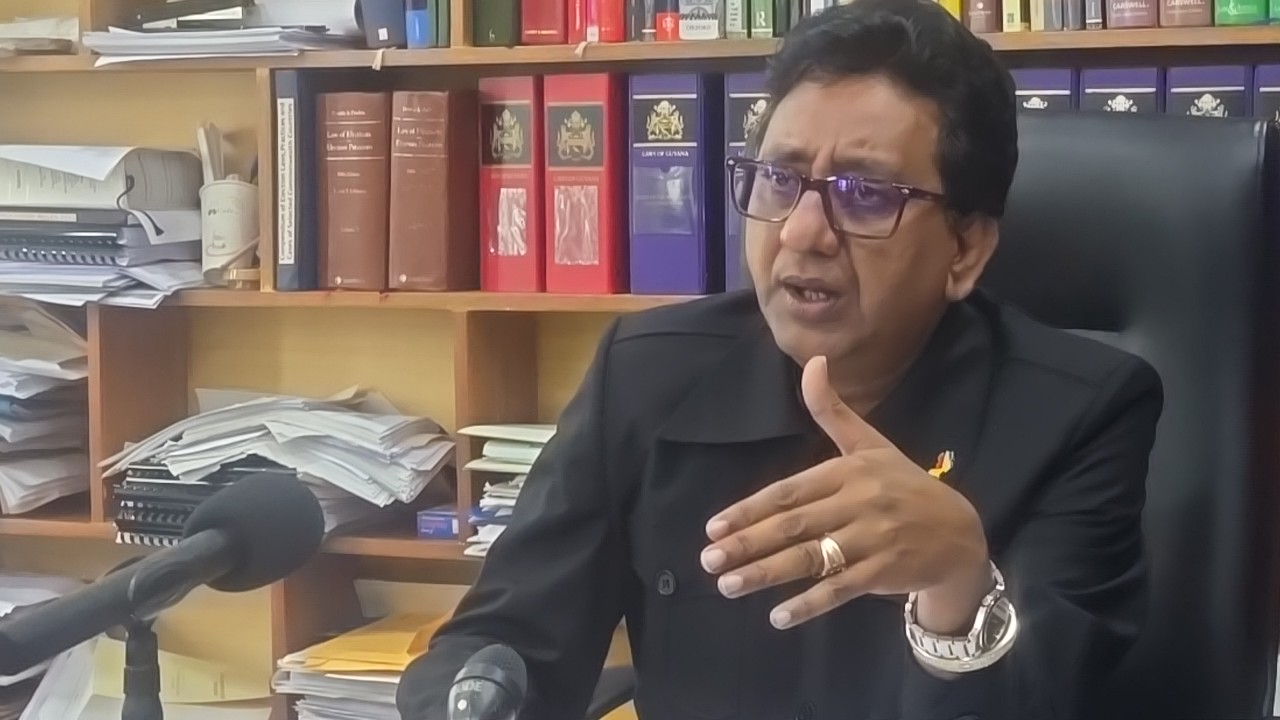
    A growing procedural dispute over the reappointment of Caribbean Community (CARICOM) Secretary-General Dr. Carla Barnett has opened a rift among regional member states, with Trinidad and Tobago’s top diplomat doubling down on claims that proper governance rules were violated during the February 2026 summit. In a press conference held Thursday, April 9, 2026, Foreign Affairs Minister Sean Sobers pushed back against public claims from Guyanese President Irfaan Ali, who has defended the reappointment process as consistent with protocol used for Barnett’s first appointment five years earlier, and asserted he was satisfied with her performance in office.

    Sobers stopped short of an open public confrontation with Ali, emphasizing respect for the sovereignty of fellow CARICOM member states. “I respect His Excellency Dr. Mohamed Irfaan Ali and his own positions adopted. He is a President of a sovereign country and his views are his own, our views are our own. We’re a sovereign nation as well,” Sobers told reporters.

    The minister directed his sharpest criticism at two public figures who have questioned Trinidad and Tobago’s position: former St. Vincent and the Grenadines Prime Minister Dr. Ralph Gonsalves, and former Trinidad and Tobago Foreign Minister Amery Browne of the previous People’s National Movement (PNM) administration. Gonsalves recently claimed Sobers skipped a key summit retreat meeting on the island of Nevis because he suffered from sea sickness and was unable to make the short boat trip from neighboring St. Kitts.

    Sobers dismissed that claim as a deliberate distraction from the core procedural violation at the heart of the dispute, labeling both Gonsalves and Browne as “political has-beens” seeking to divert attention from the real issue. He emphasized that the reappointment of the Secretary-General never appeared on any official meeting agenda, was not flagged for discussion on the morning of the leadership retreat, was never referenced in the summit’s final communique, and was not mentioned during the post-summit press conference. These omissions, he argues, directly contradict CARICOM’s foundational governing document, the Revised Treaty of Chaguaramas.

    “Don’t cast any red herrings here for people to hold on to and then forget about what the real issue is which is that the procedure was not followed, which is that it was not an agenda item that was listed… That’s the real crux of the matter,” Sobers said.

    He further detailed that after the heads of government of Trinidad and Tobago, Antigua and Barbuda, and The Bahamas departed the summit, foreign ministers serving as heads of national delegations were formally excluded from the closed leadership retreat, despite having participated in earlier caucus discussions. This detail, he noted, has been confirmed by both CARICOM’s Secretary-General and the Chef-de-Cabinet of the organization.

    Sobers added that member states could have been formally notified if the reappointment had been raised under “any other business,” and the issue could easily have been tabled for discussion at a future leaders’ meeting, a step that was never taken.

    Five weeks after the February 24–27 2026 CARICOM Summit concluded in the region, CARICOM Chairman and St. Kitts and Nevis Prime Minister Dr. Terrance Drew issued a public statement confirming Barnett had been reappointed by the “required majority” of regional leaders. Sobers confirmed that Drew has since responded to formal correspondence from the Trinidad and Tobago government, which has raised objections to the process.

    The minister noted that the current Kamla Persad-Bissessar-led administration remains dissatisfied with the process to date, and that Trinidad and Tobago’s Cabinet must first review and approve the government’s official response to Drew’s correspondence before any further details are released. He added that the outcome of ongoing clarification efforts will determine whether Trinidad and Tobago participates in two upcoming CARICOM gatherings: a virtual summit scheduled for April 2026, and an in-person summit planned for July 2026 in St. Lucia.

  • Digital traffic offender registry to speed up driver licence revocation

    Digital traffic offender registry to speed up driver licence revocation

    On Thursday, April 9, 2026, Guyana’s Attorney General and Minister of Legal Affairs Anil Nandlall announced a sweeping set of government-led reforms aimed at boosting public safety, improving road traffic regulation, and addressing widespread quality-of-life complaints across the South American nation. The centerpiece of the initiative is the creation of a first-of-its-kind digital national registry that will log data on both accused and convicted road traffic offenders, a tool designed to streamline the process of suspending or revoking dangerous drivers’ licenses.

    Nandlall explained in an official statement that the centralized digital database will remove long-standing barriers to enforcing existing road safety legislation, particularly the country’s Demerit Point System. That system currently allows authorities to suspend or revoke driving privileges for repeat or severe offenses, including drunk driving and motor vehicle manslaughter, but a lack of accessible, centralized criminal traffic records has hampered consistent enforcement. Currently, magistrate courts often lack immediate access to a defendant’s prior traffic charges or convictions, a gap that Nandlall says has undermined the effectiveness of existing penalties. “That stultifies the enforcement of these important measures,” he noted.

    Per a directive from President Irfaan Ali, Nandlall will lead the cross-agency project to develop and populate the new registry. Partner stakeholders include the Ministries of Home Affairs, Public Service and Government Efficiency, the Guyana Police Force, the National Data Management Authority, and other relevant government bodies. The database will store critical information on road users, including full licensing details, records of past charges, and any convictions for traffic-related offenses. Multiple state institutions will be granted secure digital access to the registry, including the courts and judiciary, the Office of the Director of Public Prosecutions, the Guyana Prison Service, the Probation Department, and the Guyana Revenue Authority, enabling cross-agency coordination on enforcement.

    Beyond the digital registry, the government is also moving forward with a package of amendments to Guyana’s Motor Vehicle and Road Traffic Act and connected legislation to address persistent public nuisances that have disrupted communities nationwide. Top among these concerns is excessive noise pollution from motor vehicles, particularly the widespread practice of operating motorcycles without properly functioning mufflers. “Guyanese are bombarded with obnoxious emissions of noises at unbearable decibels, emanating, in particular, from motor vehicles,” Nandlall said, adding “We can’t continue with this system of uncivilised behaviour.”

    The legislative updates will also introduce new legal frameworks to crack down on unauthorized littering and illegal dumping of waste, a practice that has clogged critical main drainage canals across Guyana, increasing flood risk in vulnerable communities. While existing provisions targeting both noise pollution and littering are already on the books under the Environmental Protection Act, Nandlall indicated that updating the Motor Vehicle and Road Traffic Act will give law enforcement more targeted tools to address these vehicle-related and public space violations.

    Nandlall emphasized that both the digital registry and the legislative amendments are part of the administration’s ongoing commitment to upgrading public safety across Guyana’s roadways and shared public spaces, delivering tangible improvements to daily life for all citizens.

  • Venezuela hopes to use Grenada as gateway to Caribbean- Rodriguez

    Venezuela hopes to use Grenada as gateway to Caribbean- Rodriguez

    On Thursday, April 9, 2026, Delcy Rodriguez, the interim president of Venezuela, made her first international visit to the Caribbean island nation of Grenada since assuming leadership of the oil-rich South American country. During the trip, she held high-level talks with Grenadian Prime Minister Dickon Mitchell in St. George’s, Grenada’s capital, and outlined her administration’s goal of using enhanced bilateral cooperation with Grenada as a stepping stone to deepen ties across the entire Caribbean region.

    Speaking to reporters through an interpreter alongside Mitchell, Rodriguez noted that the planned bilateral cooperation agenda spans multiple key sectors, including educator exchange programs, public health collaboration, maritime and air transportation infrastructure development, domestic food production expansion, bilateral and regional trade initiatives, hydrocarbon development, and maritime boundary negotiation. Neither leader shared specific timelines or financial details of the proposed partnerships during the public briefing.

    A key bilateral matter on the meeting’s agenda was the negotiation of the two nations’ shared maritime boundary, a pressing issue as Grenada moves forward with plans to restart offshore oil and natural gas exploration in its territorial waters.

    The visit comes against a dramatic geopolitical backdrop: earlier this year on January 3, former Venezuelan President Nicolas Maduro was detained by U.S. forces and transported to New York to face trial on charges of drug trafficking and weapons trafficking. Rodriguez emphasized that her new administration favors resolving all international disputes through diplomatic and peaceful channels. She also added that the Venezuelan government seeks constructive diplomatic engagement with the United States and other global powers to assert the fundamental right of all nations to pursue autonomous development. Notably, U.S. sanctions targeting Rodriguez over previous allegations of anti-democratic activity have now been lifted.

    Rodriguez used the platform to speak out against ongoing oil sanctions imposed on both Venezuela and Cuba, stressing that unilateral coercive measures have inflicted severe harm on ordinary civilian populations in both nations. She reaffirmed that Venezuela’s long-standing close relationship with Cuba remains fully intact, and called for an immediate end to the decades-long U.S. blockade of the island nation. “The people of Venezuela as well as the people of Cuba have a right to live free of sanctions,” she stated.

    At the same time, Rodriguez highlighted that Caracas is currently opening new channels of cooperation with the United States across multiple sectors, and expressed hope that the entire Latin American and Caribbean region can advance collectively through collaborative engagement.

    The long-standing diplomatic ties between Caracas and several Eastern Caribbean states date back to the governments of Hugo Chavez and later Nicolas Maduro. Countries including Grenada, Dominica, St. Lucia, St. Kitts and Nevis, and Antigua and Barbuda have maintained close relations with Venezuelan administrations for decades, and the new Jennifer Geerlings-Simons administration in St. Vincent and the Grenadines, which took office last year, is also broadly viewed as sympathetic to Caracas.

  • Border patrol units engaging civilians do not diminish army role – Ali

    Border patrol units engaging civilians do not diminish army role – Ali

    On Monday, April 6, 2026, Guyanese President Irfaan Ali addressed public speculation surrounding the newly launched Border Patrol Unit (BPU), emphasizing that the community-centered initiative is designed to complement—not undercut—the Guyana Defence Force (GDF), the country’s primary military body tasked with defending national borders and airspace against external threats.

    Ali, who also serves as Guyana’s Minister of Defence and Commander-in-Chief of the Armed Forces, made clear that core national defence and security responsibilities will remain firmly with the GDF, which continues to receive sustained investment and capability upgrades. “This is not an either-or situation,” the President told Demerara Waves Online News in an interview. “The BPU works in support of the GDF, drawing on local knowledge and existing community infrastructure that the military cannot easily replicate.”

    The core advantage of the new unit, Ali explained, is its reliance on hyper-local human intelligence gathered from residents living directly along Guyana’s lengthy border regions. By centering community participation in border protection, the administration aims to create a more responsive, visible security presence that leverages indigenous residents’ intimate knowledge of remote terrain.

    Leading the new BPU is Daniel Seeram, a retired GDF captain with prior experience as Chairman of the Region Four (Demerara-Mahaica) Council. Ali first publicly announced Seeram’s appointment as BPU Coordinator during a community gathering in Kurutuka, Rupununi last week, noting that Seeram’s professional security background made him the ideal candidate for the role. Seeram will report directly to the President in his new position.

    The rollout of the BPU will begin in three priority border communities, which will each receive an all-terrain vehicle to support patrol operations. The administration is building the initiative on the existing foundation of Guyana’s Community Policing Groups, particularly in remote Indigenous communities that make up much of the country’s borderlands. Over time, the unit will be expanded to additional high-priority border regions.

    Integrated fully into Guyana’s broader national security architecture, the BPU will work in close coordination with local police, GDF personnel, and the National Intelligence Security Agency (NISA) to collect and share intelligence. Ali noted that the new structure will speed up information flow, increase on-the-ground presence, and expand situational awareness across both Guyana’s land borders and its Exclusive Economic Zone, with planned investments in surveillance technology to boost these capabilities.

    When asked whether BPU members would be armed, Ali declined to comment, but confirmed that all personnel will receive training in technology use and standardized reporting protocols, and the unit will be fully outfitted with necessary transportation assets.

    The appointment of Seeram has drawn quiet attention due to his recent political trajectory: he was elected to the Region Four chairmanship on a ticket from the opposition A Partnership for National Unity+Alliance For Change (APNU) coalition, backed by coalition lead the People’s National Congress Reform, before later aligning with the incumbent People’s Progressive Party Civic (PPPC) administration while refusing to step down from his regional post. Ali pushed back against any implicit criticism of the pick, reiterating that the appointment was based solely on Seeram’s relevant security training and professional skill set, not political affiliation.

  • Internal probe of “confrontation” between police rank and civilian

    Internal probe of “confrontation” between police rank and civilian

    On Monday, April 6, 2026, Guyana’s top law enforcement leadership launched an immediate internal investigation into a reported altercation involving an off-duty senior police officer, following the circulation of a viral video on social media platforms that captured the incident. Police Commissioner Clifton Hicken has ordered the force’s Office of Professional Responsibility to launch a full review into the details and context surrounding the confrontation, according to an official statement released by the Guyana Police Force (GPF).

    The viral footage, which the GPF confirmed in its public announcement, shows an unidentified man alleged to be the off-duty assistant superintendent threatening another individual with a deadly threat, stating clearly “I would kill you”. Two uniformed on-duty police officers were also recorded on camera intervening to de-escalate the conflict and calm both parties involved. While the GPF has formally acknowledged the incident and the video’s authenticity, the agency has not released the name or any additional personal details of the off-duty officer under investigation at this stage of the probe.

    In its statement, the GPF emphasized that every member of the force, regardless of rank or duty status, is required to adhere to strict standards of professional conduct, emotional restraint, and public accountability. “Any behaviour found to be inconsistent with the standards of the Force will be addressed in accordance with the law and established disciplinary procedures,” the statement read. The agency also committed to updating the public with new details as the investigation progresses, and reassured citizens that it remains dedicated to upholding the highest levels of professional practice and maintaining public trust. All allegations of officer misconduct, the GPF noted, are treated with the full level of seriousness they deserve.

    Alongside the announcement of the new investigation, the GPF also indirectly addressed an ongoing high-profile case involving another senior officer. Senior Superintendent Himnauth Sawh, who was sanctioned by the United States Treasury Department’s Office of Foreign Assets Control (OFAC) in June 2025 over allegations of involvement in international narcotics trafficking, remains on administrative leave from the force. Sawh was serving as the Commander for Region One (Barima-Waini) in September 2024 when a joint operation conducted by the Customs Anti-Narcotics Unit (CANU) and the Guyana Defence Force (GDF) discovered 4.4 tonnes of cocaine buried underground near an unapproved airstrip on the outskirts of Mabaruma. No additional updates on Sawh’s status or the related investigation were provided alongside the announcement of the new probe.

  • Private university faces closure if Critchlow Labour College Inc wins possession court battle

    Private university faces closure if Critchlow Labour College Inc wins possession court battle

    A looming legal battle over property rights has pushed a private Guyanese higher education institution to the brink of permanent closure, with its top leader warning that an unfavorable court ruling would immediately end all operations. As of Monday, April 6, 2026, Stanley Paul, President of the University of Excellence, Management and Business Inc. (UEMBI), confirmed the private university is set to wind down operations by December 2026 if the High Court rules against it in the ongoing possession dispute over the Critchlow Labour College (CLC) building in Georgetown.

    The core of the legal conflict centers on the validity of a 15-year commercial lease agreement UEMBI signed with former CLC principal Ivor English in June 2025. The lease, which grants UEMBI access to the Woolford Avenue property originally leased to CLC by the Mayor and City Council of Georgetown in 1968, was struck at a time when Critchlow Labour College Inc. (CLCI), the legal entity behind the college, had been struck off Guyana’s Companies Register. CLCI was removed from the register in November 2013 and only restored in November 2025, months after the lease was signed. CLCI argues that English never held authorization as a director or officer of the institution to sign the lease, making the entire agreement a legal nullity.

    In its court filings, CLCI is seeking multiple court orders: an injunction barring UEMBI from any construction activity on the property, a formal ruling that UEMBI’s continued occupancy constitutes trespassing, and compensatory damages totaling GY$3,106,000 per month dating back to September 2025 for unlawful possession. CLCI also adds that UEMBI’s ongoing construction work violates Georgetown’s municipal building bylaws, as no legally approved construction plan was ever secured. Paul, however, has staunchly defended the lease’s validity, noting he had no prior notice of CLCI’s struck-off status or English’s alleged lack of authority, and that English openly represented himself as an authorized agent for the institution during negotiations. Per the terms of the agreement, Paul says UEMBI paid GY$4 million in advance rent, with monthly rent set at GY$1 million starting September 1, 2025, and the agreement includes an automatic renewal clause after the initial 15-year term.

    Complicating UEMBI’s position ahead of the scheduled April 7, 2026 hearing, the institution has now lost its fourth consecutive legal representative, after attorney Joelle Harmon-Alstrom withdrew her representation effective April 1, 2026. Paul told reporters the split stemmed from disagreements over case strategy: Paul pushed to highlight new, critical points raised in CLCI’s latest court submissions, while Harmon-Alstrom opted not to proceed with that framing. To date, Paul says UEMBI has spent GY$2.5 million on legal representation across four different lawyers, and he remains dissatisfied with all of the work the firm has provided.

    Paul confirmed that following Harmon-Alstrom’s withdrawal, he notified enrolled students of the planned December 2026 closure, but added that the shutdown is contingent on two key outcomes. First, the closure will only move forward if the High Court rules to eject UEMBI from the property. UEMBI’s accreditation is explicitly tied to its current location, meaning the university cannot relocate or continue operations elsewhere if it loses the building. Second, Paul says the university remains open to a transfer arrangement if a qualified, credible buyer steps forward before the end of 2026 to take over operations, a provision included to protect student interests and maintain continuity of education. The National Accreditation Council of Guyana has responded to Paul’s closure notice, calling for him to issue a more clear, definitive plan rather than attaching caveats to the proposed shutdown.

    Ahead of Tuesday’s hearing, Paul says he intends to request additional time from Justice Fidela Corbin-Lincoln to secure new legal representation, as well as permission to file a newly drafted reply affidavit. The final outcome of the ruling will determine the future of the private university and its student body, with one of Guyana’s newer private higher education institutions facing complete dissolution over the disputed property agreement.

  • Guyana secures 3rd place in EU-backed Caribbean maritime security competition

    Guyana secures 3rd place in EU-backed Caribbean maritime security competition

    On Monday, Guyana’s Customs Anti-Narcotics Unit (CANU) announced that the country has earned third place in the 2026 Joint Maritime Control Unit (JMCU) Caribbean Competition, held under the European Union-funded Seaport Cooperation Project (SEACOP), a regional initiative focused on countering maritime illicit trafficking.

    The annual competition is designed to benchmark and elevate the capabilities of Caribbean law enforcement teams to carry out high-risk vessel inspections for contraband, most notably illegal narcotics, while adhering to global safety and procedural standards. It brings together maritime enforcement agencies from across the Caribbean region to test practical skills, share best practices, and strengthen cross-border cooperation against transnational organized crime.

    Guyana’s delegation was made up of personnel from three leading national security agencies: CANU, the Guyana Police Force (GPF), and the Guyana Defence Force (GDF) Coast Guard. The team scored 72 out of a total 80 possible points, equal to a 90% overall rating. This result tied Guyana with Saint Kitts and Nevis for third place, trailing only regional leaders Barbados and Trinidad and Tobago, which scored 75 points (94%) to claim the top two positions.

    Assessments for the competition were conducted against a strict 80-point evaluation framework that graded teams across multiple core competency areas. Judges evaluated operational safety protocols, tactical search methodologies, internal communication, inter-agency teamwork, decision-making during high-pressure scenarios, adherence to legal and procedural rules, professional conduct, and command effectiveness.

    In its official statement, CANU emphasized that Guyana’s strong performance reflects the nation’s growing and robust maritime interdiction capacity, built through sustained investments in targeted training, improved inter-agency coordination, and intelligence-led enforcement operations. The result also cements Guyana’s commitment to collaborative regional security, as participating nations work collectively to shut down illicit trafficking routes that span Caribbean waters.

    Alongside Guyana, Barbados, Trinidad and Tobago, and Saint Kitts and Nevis, the competition drew participants from a range of Caribbean nations including Suriname, Jamaica, and Antigua and Barbuda, demonstrating the widespread buy-in for coordinated regional security action across the bloc.

    CANU noted that the SEACOP JMCU Competition serves as a critical developmental platform for Caribbean maritime law enforcement, helping agencies align operational standards, improve interoperability during joint operations, and adopt proven best practices from peer nations. For Guyana, the third-place finish confirms the country’s position among the top tier of regional maritime interdiction units, with clear room to advance to the top of the rankings through continued refining of operational protocols and training.

  • Shipping assn chief rubbishes Suriname’s proposed exemption system for vessels plying Corentyne River

    Shipping assn chief rubbishes Suriname’s proposed exemption system for vessels plying Corentyne River

    A cross-border trade dispute over new steep shipping levies on the shared Corentyne River has intensified in early 2026, with the top shipping industry leader in Guyana rejecting Suriname’s proposal for selective cargo vessel exemptions and pushing for full diplomatic negotiations to scrap the fees entirely.

    Komal Singh, Chairman of the Shipping Association of Guyana (SAG), has publicly pushed back against Suriname’s suggestion that the Guyanese government submit a formal diplomatic request to exempt additional Guyanese cargo vessels from the recently implemented charges. Speaking to Demerara Waves Online News, Singh explained that a piecemeal exemption framework would create an unfair, uneven playing field by allowing selective benefit allocations.

    “The Corentyne River sees constant, mixed movement of goods and people: Guyanese carriers ship construction materials, timber and tourism traffic to domestic destinations along the waterway, while Suriname moves its own supplies west into Guyana. We cannot draw arbitrary lines to prioritize some shippers over others. That is no way to maintain a fair cross-border trade ecosystem,” Singh said.

    Suriname’s current Jennifer Geerlings-Simons administration has already noted that vessels operating on behalf of the Guyana Sugar Corporation have held a long-standing exemption from the river tariffs, and has encouraged Guyana to pursue additional exemptions through official diplomatic channels. To date, Guyana’s Ministry of Foreign Affairs has declined to comment publicly on the ongoing negotiations.

    Singh, however, argues that no Guyanese vessels moving cargo originating from Guyanese operations along the upper Corentyne should be charged at all. He joined a growing chorus of Guyanese private sector groups calling for high-level diplomatic talks to resolve the dispute entirely, and has called on Suriname to implement an immediate moratorium on the new levies to restore free cross-border trade.

    “This waterway has always operated as an open shared resource, with no tariffs impeding movement. This is not a one-sided arrangement: both nations’ economies and communities benefit from the commercial activity that takes place here every day,” Singh added. In a separate formal statement, SAG reaffirmed its commitment to supporting multi-stakeholder dialogue and collaboration to ensure the Corentyne River remains an equitable shared asset that delivers mutual economic benefits for both countries.

    The new levies carry steep costs for Guyanese shippers, according to details released by the Upper Corentyne Chamber of Commerce and Industry (UCCI). Shippers are currently charged a $2,500 pilot license fee per trip, plus broker fees ranging from $1,000 to $1,500 per voyage. Multiple industry sources have confirmed additional tonnage-based fees for quarried products, running between $1.00 and $1.50 per tonne for vessels carrying 1,000 tonnes or more of aggregate.

    UCCI President Krishnand Jaichand noted that Guyanese vessels have historically paid a small licensing fee to traverse the Corentyne, a timeline that is corroborated by Surinamese legal expert and former ambassador Aashna Kanhai. Kanhai told Suriname’s LIM FM that the underlying authority to charge fees dates back to the Desi Bouterse presidency in Suriname, and that past exemption requests confirm Guyana has long acknowledged the baseline requirement for fees.

    Singh has indicated he is open to exploring a small, flat nominal fee for river access, but stressed that any such proposal would require rigorous review to confirm it would not drive up costs for end consumers in Guyana. For his part, Jaichand argues the sharp increase in fees is intended to protect two Surinamese stone aggregate exporters that do not face the same tax burden when selling into Guyana, putting local Guyanese producers at an unfair disadvantage. “Our local stone producers simply cannot compete with the imported product under these new cost structures,” Jaichand said.

  • Ali, CARICOM Chairman mourn passing of former CARICOM secretary general Rainford

    Ali, CARICOM Chairman mourn passing of former CARICOM secretary general Rainford

    The Caribbean Community (CARICOM) is in mourning this weekend following the death of former Secretary-General Roderick Rainford, who passed away Saturday afternoon at his home in Jamaica. Leaders across the 15-nation bloc have paid tribute to the Jamaican diplomat, whose decades of service laid critical groundwork for the regional integration project that defines CARICOM today.

    Guyana’s President Irfaan Ali, whose country hosts the CARICOM Secretariat, joined CARICOM Chairman and St Kitts and Nevis Prime Minister Terrance Drew in honoring Rainford’s legacy on Sunday. Ali highlighted Rainford’s transformative leadership at the helm of the Secretariat during one of the most volatile eras for regional cooperation, noting his central role in advancing the Caribbean Single Market and Economy (CSME) — the framework that created a single market for goods, labor, and capital across member states.

    “His consequential role in laying the foundation for the Caribbean Single Market and Economy, in strengthening regional institutions, and in preparing the Caribbean for a future shaped by trade and economic liberalisation is part of his outstanding service to regionalism,” Ali said of Rainford, who led the organization from 1983 to 1992 after previously serving as Deputy Secretary-General.

    Drew recalled that Rainford assumed the top post at CARICOM amid a period of significant global upheaval: sky-high global oil prices, intensifying Cold War tensions that rippled through the Western Hemisphere, and the 1983 military invasion of Grenada that tested regional unity. In the face of these cascading challenges, Drew said Rainford’s calm demeanor, sharp analytical mind and deep diplomatic expertise allowed him to keep regional integration on a stable, forward trajectory.

    That steady leadership ultimately paved the way for the 1989 Grand Anse Declaration, the landmark policy document that formally set the course for the CSME by establishing the bloc’s Common External Tariff. Beyond trade and economic integration, Drew highlighted a long list of lasting achievements from Rainford’s tenure: the early framework for a regional stock exchange, negotiated terms for the Caribbean Investment Fund, the revival of the Caribbean Festival of Arts (CARIFESTA), and a sharpened regional focus on environmental stewardship.

    Under Rainford’s direction, CARICOM developed the bloc’s first uniform building code to standardize construction and infrastructure standards across member states, and consolidated or established key regional institutions including the Caribbean Environmental Health Institute (CEHI) and the Caribbean Disaster Emergency Response Agency (CDERA, now renamed the Caribbean Disaster Emergency Management Agency, CDEMA).

    A lifelong advocate for deepening economic and functional integration to lift living standards for all Caribbean people, Rainford was awarded the highest honor of the bloc, the Order of the Caribbean Community, in 2024 in recognition of his decades of public service.

    “Mr Rainford’s patience, equanimity, team spirit and analytical skills are fondly remembered by those who worked with him in the CARICOM Secretariat and across the Region,” Drew said. “Our community is stronger for his dedication and service. CARICOM conveys deepest condolences to his wife, Nesha, other family members and all who mourn his passing.”

  • Big refrigerator for Rupununi to push food supply – Ali

    Big refrigerator for Rupununi to push food supply – Ali

    Following the official inauguration of the upgraded Karasabai Airstrip in Guyana’s remote Region Nine on Saturday, President Irfaan Ali has announced a suite of targeted investments designed to turn the Rupununi region into a high-output agricultural hub, addressing long-standing logistical barriers that have stifled local economic growth for decades.

    The airstrip, which serves roughly 1,200 local residents, received a total investment of GY$1.53 billion for its expansion and modernization. Beyond enabling improved access to remote communities, the upgraded infrastructure is the cornerstone of the government’s plan to boost large-scale commercial agriculture in the area, which has already shown promising early output. President Ali confirmed that a 20-tonne industrial blast freezing refrigerator will be deployed to the region in the coming months to preserve fresh produce, meat, and other perishable goods before they are transported via air and road to markets in Georgetown and other population centers across Guyana.

    “Our goal is to maximize the economic value this new airstrip delivers to local communities,” Ali explained during the commissioning ceremony. “This 20-tonne unit will blast-freeze even locally produced meat, helping us build the cold storage capacity we need to reliably move fresh goods from Rupununi to national markets.”

    The government’s agricultural expansion strategy focuses on scaling up production of high-value crops including coffee, peanuts, ginger, and onions, in close partnership with smallholder farmers across Karasabai and surrounding areas. President Ali noted that the administration is actively facilitating private sector partnerships with local small farmers to turn agriculture into the region’s primary economic driver, unlocking sustained value from the upgraded airstrip infrastructure.

    Early results from existing commercial production in Rupununi already point to major untapped potential. Local Toka region is renowned for its large, high-quality watermelons: one farm produced 100,000 watermelons for shipment to Georgetown last year alone, with another 4,000 units shipped out just last week. Local tomato production has also hit industrial-scale output, reaching 20 kilogrammes of tomatoes per plant. For onion production, which Guyana first attempted to scale in the interior roughly 50 years ago, transportation bottlenecks have long derailed past efforts. Today, President Ali confirmed that full approval has been granted for large-scale onion cultivation, as long as local villages commit large tracts of land to the project. The government will centralize regional logistics and invest in purpose-built transportation vehicles to move onion harvests from Rupununi to national markets.

    “We’re not asking for anything more than for local villages to commit to production,” Ali said. “Follow the example of the successful watermelon farms and scale up output – that’s all we need to make this work.”

    Beyond agricultural development, the upgraded airstrip will also deliver critical public benefits to the remote region. President Ali announced that the government has reached an agreement with Jag’s Aviation to launch once-weekly scheduled commercial passenger flights to Karasabai, improving connectivity for residents. The expanded runway is also engineered to accommodate delivery drones, which will be used to transport emergency blood supplies from Lethem to Karasabai, cutting response times for critical medical emergencies.

    At the same time, the announcement leaves one key outstanding question unanswered: it remains unclear how large-scale agricultural operations will be protected against the widespread severe flooding that regularly impacts large swathes of the Rupununi region, a recurring natural challenge that could threaten crop stability and long-term output.