标签: Grenada

格林纳达

  • Temporary road closure: Balthazar Bridge, St Andrew

    Temporary road closure: Balthazar Bridge, St Andrew

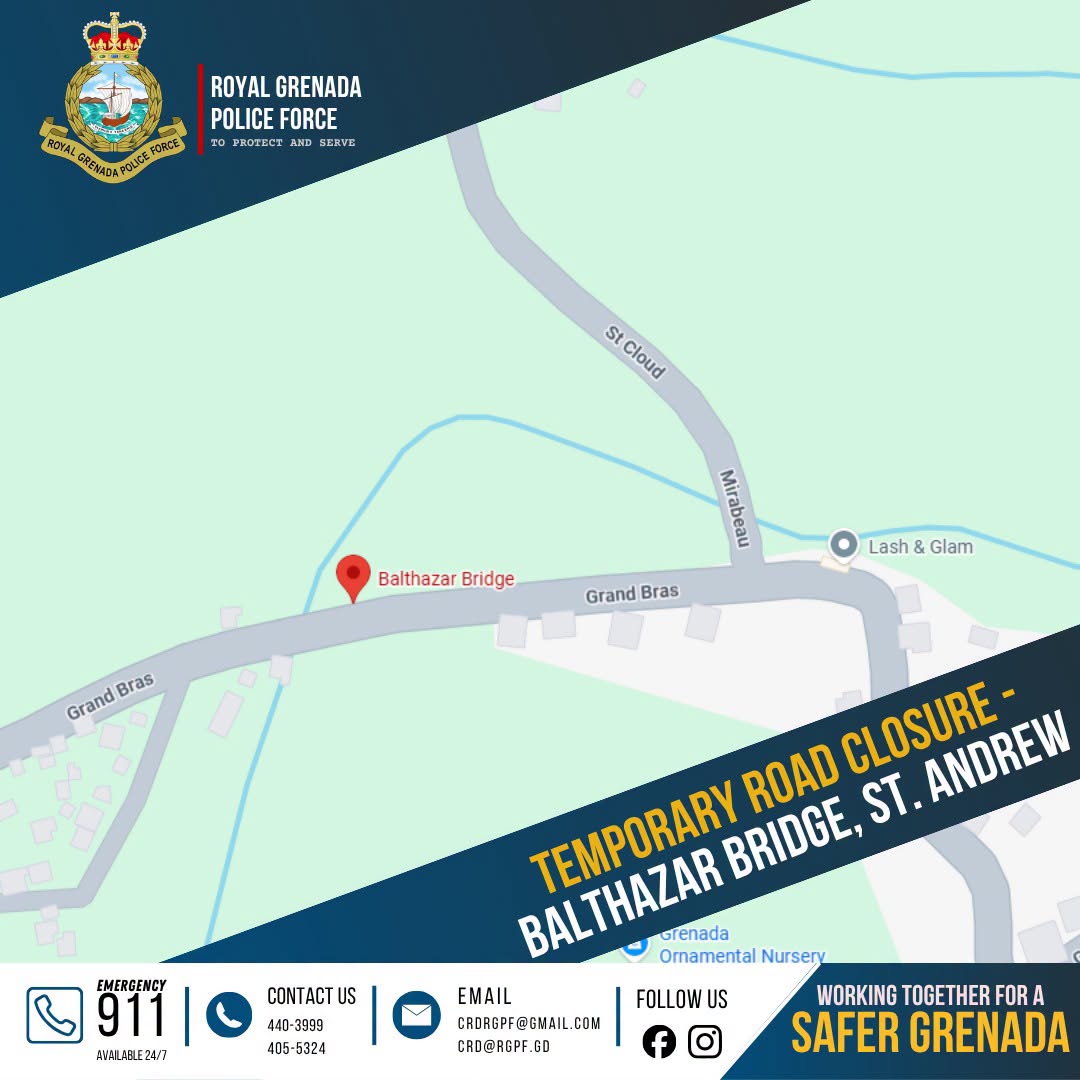
    Drivers and local residents across Grenada are now receiving advance notification of an upcoming extended closure of a critical transport link, Balthazar Bridge, announced by the Traffic Department of the Royal Grenada Police Force (RGPF). The full suspension of all vehicle access to the crossing will go into effect on Monday, September 7, 2026, and the structure will remain closed to traffic until an official re-opening notice is issued.

    Authorities have confirmed that the closure is not a temporary traffic adjustment, but a mandatory requirement to enable comprehensive restoration work on the bridge, which will be carried out as part of the broader national Grenada Resilience Improvement Project. This infrastructure initiative is focused on upgrading key public facilities across the country to boost their long-term durability and resilience to natural and wear-and-tear damage.

    To minimize disruption to daily travel across the affected region, RGPF traffic officials have mapped out formal alternative diversion routes tailored to different travel directions, alongside targeted restrictions for certain vehicle types. For all private and commercial vehicles traveling from the capital St George’s toward Grenville, the designated detour requires a right turn onto Upper Capitol Road, passing through the St James area before exiting onto Grand Bras Public Road. Drivers traveling from Grenville in the direction of Birchgrove will follow a separate route: they will turn right onto St Cloud Public Road, pass through the Bylands district, and exit onto La Force Road.

    Notably, Zone 6 bus operators, which provide critical public transit service connecting communities in the area, have received special permission to use both of the approved diversion routes for all trips to and from Grenville, to keep public transit running during the construction period. However, the alternative routes are not designed to accommodate large, heavy construction equipment, so operators of these oversized and heavy vehicles have been instructed to avoid the detours and use the Eastern Main Road for all cross-region travel instead.

    The Royal Grenada Police Force has issued a formal appeal to all road users to exercise caution during the closure period, urging all motorists to strictly follow all posted directional signage along the diversion routes and comply with any instructions from on-duty traffic wardens stationed along the new travel paths.

    In closing, the RGPF extended a formal apology to all residents and road users for the unavoidable travel disruption that the bridge closure and restoration work will cause, while noting that the agency counts on the full cooperation and compliance of all those traveling through the area for the duration of the project. This official notification comes directly from the Office of the Commissioner of Police of Grenada.

  • Traffic arrangements: National Library, St George’s

    Traffic arrangements: National Library, St George’s

    Motorists and residents in Grenada’s capital St. George’s have been notified of upcoming temporary traffic changes to accommodate scheduled construction or maintenance work at the National Library building. The new adjustments, announced by the Traffic Department of the Royal Grenada Police Force (RGPF), will go into effect exclusively on Sunday, September 6, 2026, running from 8:30 a.m. through 4:00 p.m.

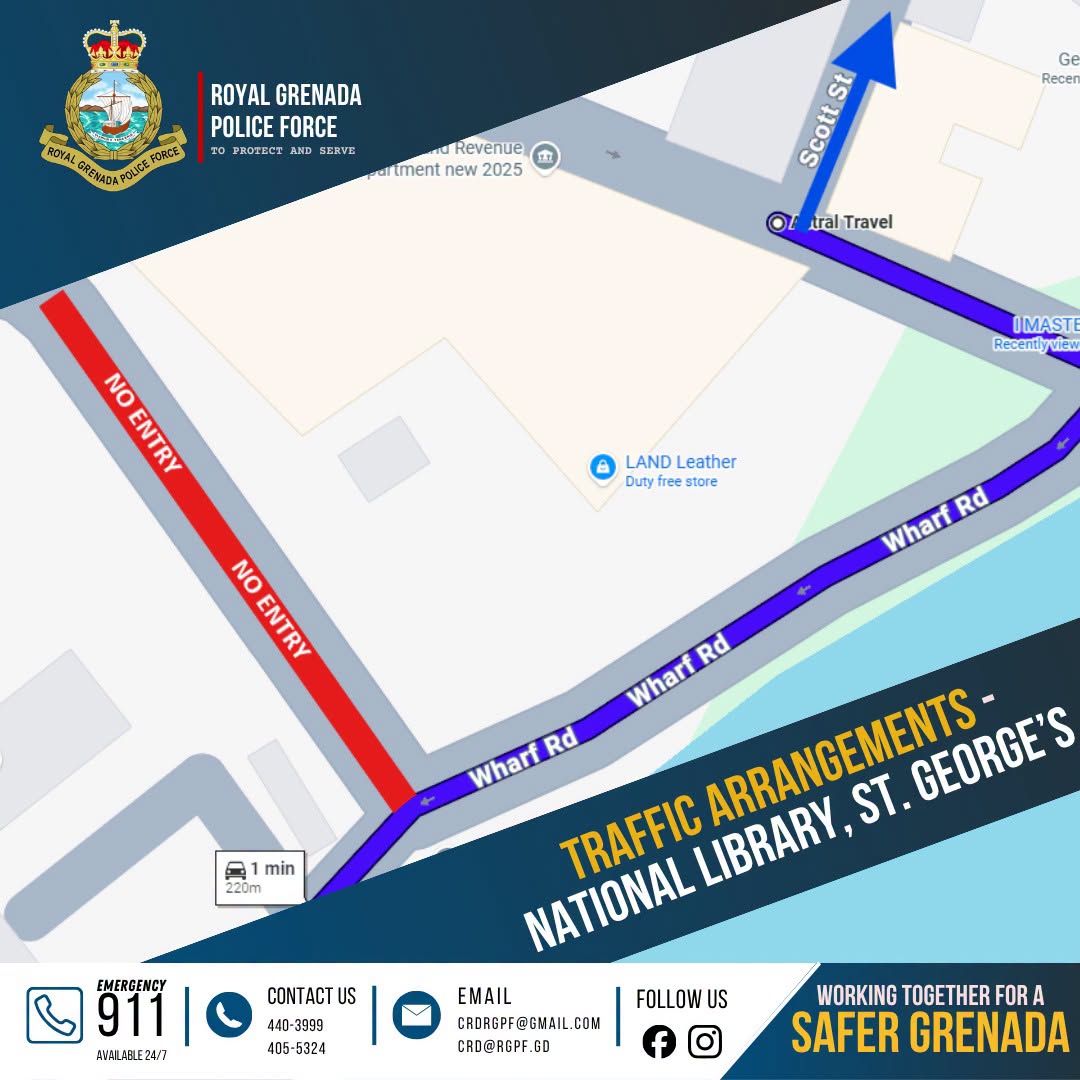
    Multiple access restrictions will be implemented during the work window to keep both workers and road users safe. The most significant change prohibits all vehicles from turning right onto Matthew Street at its junction with The Carenage. To clearly redirect drivers, a permanent temporary “No-Through Road” sign will be installed at the intersection of The Carenage and Young Street to mark the blocked through route.

    To prevent gridlock and keep traffic flowing through the downtown area, authorities have outlined two official alternative routes for vehicles traveling along The Carenage toward central St. George’s. The first option allows drivers to turn right onto Young Street, then connect directly to Scott Street to continue their journey. The second alternative directs motorists to stay on The Carenage, before moving onto Marine Villa Road and eventually joining Grand Etang Road to reach their destination.

    In addition to through-traffic restrictions, a full no-parking rule will be enforced across three nearby zones to clear space for work activities and maintain clear access for emergency vehicles. No vehicles will be allowed to park directly in front of the National Library, along the full stretch of Monckton Street between Courts Grenada and the Grenada National Museum, or anywhere on Matthew Street for the duration of the work period.

    The RGPF has issued a formal apology to the public for any disruptions or travel delays that these temporary changes may cause, and has thanked residents and commuters in advance for their patience and cooperation as the improvement work at the National Library is carried out.

    This announcement was officially released via the Office of the Commissioner of Police. NOW Grenada notes that it is not responsible for third-party contributor content, and invites users to report any abusive content via the platform’s official reporting channel.

  • EC$310.9 million supplemental appropriation raises fiscal concerns

    EC$310.9 million supplemental appropriation raises fiscal concerns

    A heated debate has unfolded in Grenada’s parliament over a proposed EC$310.9 million supplementary appropriation request, as opposition leaders push for a full commission of inquiry into Hurricane Beryl recovery spending and government ministers defend their fiscal and recovery priorities. The bill, which has already passed the Lower House and is set to go before the Upper House in the coming days, sits against a backdrop of growing tensions over the country’s fiscal health and transparency of post-disaster spending more than two years after the storm hit.

    Finance Minister Dennis Cornwall, who tabled the 2026 Supplementary Appropriation Bill, laid out the core justifications for the additional funding. He told lawmakers the extra allocation is required to speed up work on the administration’s key priority projects, address unforeseen challenges that arose after the 2026 national budget was finalized, wrap up ongoing Hurricane Beryl recovery work, and deliver targeted support to vulnerable households and impacted communities. The single largest share of the supplementary budget, EC$161 million, is designated for a design-finance-build infrastructure arrangement. Cornwall also outlined the breakdown of financing for the request: approximately EC$3.6 million will come from international grants, EC$29.8 million from concessional loans, and the remaining EC$277.5 million from domestic financing sources.

    Beyond recovery and existing priority projects, the supplementary budget also allocates funding to purchase a plot of land adjacent to the Hall of Justice development in Mt Wheldale, which will house the newly established Eastern Caribbean Citizenship by Investment Regulatory Authority. A portion of the request — EC$20 million specifically earmarked for continued Hurricane Beryl recovery — has drawn the sharpest criticism from opposition leader Dr. Keith Mitchell, who questioned why the government is still requesting new recovery funds more than two years after the hurricane made landfall.

    Mitchell pointed out that the administration has already spent EC$211.3 million on Beryl-related efforts to date, a figure that does not include the EC$28 million already allocated for recovery in the 2026 budget, nor the new EC$20 million request now before parliament. He noted that government ministers previously publicly stated all Beryl recovery spending would be completed by June 2025, and called for a full explanation of why additional funds are required, as well as clarity on whether the 2026 allocated recovery funds have already been exhausted. Citing these inconsistencies and broader concerns over fiscal management, Mitchell formally called for an independent commission of inquiry to audit all Beryl recovery expenditure and ensure full public accountability.

    Responding directly to the calls for an inquiry, Tevin Andrews, Minister for Carriacou and Petite Martinique Affairs — the two islands hardest hit by Hurricane Beryl — issued an open challenge to opposition critics, stating he has “absolutely nothing to hide” and would welcome any formal investigation. “If anybody wants to bring on any commission of inquiry or any inquiry at all, bring it on. I’m ready because I have absolutely nothing to hide,” Andrews told the Lower House Wednesday.

    Andrews went on to detail the progress of recovery work across his constituency over the past two years, pushing back against claims of mismanagement or unspent funds. He told parliament that the government has already completed construction on, or is currently building, 159 new resilient “Build Back Better” homes for displaced residents. To date, 255 families have received direct labor support for home repairs, nearly 4,000 homeowners have been granted assistance for building materials, and more than 100 displaced residents have benefited from rental assistance while their homes are rebuilt.

    Beyond direct household support, Andrews emphasized that recovery spending has acted as an economic stimulus for local communities, generating consistent work and income for local hardware retailers, independent contractors, truck and heavy machinery operators, and maritime workers who support reconstruction across the two islands. He added that independent expert assessments estimate total reconstruction costs for Carriacou, Petite Martinique, and northern Grenada will top EC$600 million, making the additional EC$20 million request an essential requirement to keep recovery work on track.

    The minister also rejected opposition claims that fishermen and farmers in the affected islands did not receive adequate support after the storm, noting that the government has already spent far more than the EC$11.6 million payout from the Caribbean Catastrophe Risk Insurance Facility (CCRIF) that was earmarked for these sectors. The Beryl-focused portion of the supplementary budget also includes EC$2 million for ongoing upgrades to Petite Martinique’s main road and other road infrastructure across Carriacou, EC$200,000 for improvements to Limlair Farm, and funding for the Hillsborough Enhancement Project, which aims to modernize public spaces and boost long-term development in the town.

    The EC$310.9 million supplementary request has also amplified broader opposition concerns about Grenada’s overall fiscal position, which is already carrying a projected EC$309.8 million deficit — equal to roughly 7.3% of GDP — in the government’s record EC$1.96 billion 2026 national budget. Mitchell argued that the size of the unbudgeted supplementary request signals deep financial instability for the country. “Now we are asking for a supplemental of literally EC$310-plus million…based on the information provided, I could only project that Grenada is facing serious financial problems in meeting the responsibilities of managing the affairs of the country,” he said.

    Mitchell drew a direct contrast between the current fiscal outlook and the position left by his previous administration, claiming he left office with a surplus of more than EC$500 million and a balanced budget where recurring expenditure was fully matched by recurring revenue, eliminating the need for deficit financing. As the bill moves to the Upper House for approval, the government’s spending priorities, transparency around post-hurricane recovery, and long-term fiscal strategy remain under intense public and political scrutiny.

  • VAT-Free weekend draws crowds and traffic

    VAT-Free weekend draws crowds and traffic

    Grenada’s first ever two-day VAT-free shopping event, held on August 28 and 29, has wrapped up with strong consumer turnout that delivered a major boost to local retailers, but also raised questions about actual savings for shoppers and left major commercial hubs grappling with unexpected traffic gridlock. The initiative is a core component of the government’s EC$18 million Cost of Living Assistance Programme, designed to ease household financial strain while stimulating stagnant activity in the country’s retail sector.

    Under the terms of the policy, the standard 15% value-added tax that registered businesses normally collect on behalf of the government is waived for a select list of goods during the designated event weekends. Many retailers opted to go a step further, layering their own additional discounts on top of the VAT exemption to draw more foot traffic, amplifying potential savings for consumers. Unlike regular shopping periods, the event attracted unprecedented crowds to supermarkets, hardware stores, appliance retailers and other commercial outlets across the island.

    Salim Rahaman, the private sector’s representative in Grenada’s Upper House of Parliament, framed the inaugural event as a clear success, noting that any early operational and logistical challenges faced by participating businesses were quickly resolved. Rahaman pointed out that VAT-free shopping periods are a well-established cost-of-living relief tool, having been deployed for more than a decade in countries including the United States. Looking ahead, he confirmed that additional retailer-driven discounts could become a regular feature of future events, telling reporters “we would see more of that in the upcoming VAT-free days.”

    The massive turnout, however, came with a notable downside: severe traffic congestion in the island’s busiest commercial districts, particularly downtown St George’s and the popular tourist hub of Grand Anse. Rahaman compared the crowded conditions to the peak traffic seen during Grenada’s annual Christmas shopping season or Carnival celebrations, with supermarkets and hardware stores recording the largest influx of visitors.

    When reached for comment on the traffic situation, the Community Relations Department of the Royal Grenada Police Force (RGPF) confirmed it had not put in place any special traffic management measures to accommodate the increased vehicle traffic during the event. The RGPF redirected all inquiries about traffic planning to the Grenada Transport Commission (GTC), and as of press time, multiple requests for comment from the GTC have gone unanswered. It remains unclear whether the commission implemented any extra mitigation measures, and how the weekend’s congestion compares to typical traffic volumes on regular Friday and Saturday shopping days.

    Early feedback from participating businesses has been largely positive. M&N Hardware, one of the island’s major suppliers of building and home improvement goods, reported a sharp uptick in customer foot traffic and called the overall execution of the event “well executed.” Foodland Supermarket, another major retail player, extended its operating hours to 10 pm on the event’s second day to accommodate the continued flow of shoppers.

    For consumers, experiences with the promised savings have been sharply divided. Shoppers making large purchases of eligible goods, such as building materials, appliances and bulk groceries, have reported substantial savings. One shopper who bought a large volume of construction supplies told reporters they saved as much as EC$2000 through the VAT exemption. But other consumers have raised red flags, noting that some retailers did not appear to adjust prices at all to reflect the waived tax, and a small number even reportedly increased base prices on some goods ahead of the event, erasing any potential benefit for shoppers.

    These contrasting experiences have underscored the importance for consumers to compare pre-event prices and check itemized receipts to confirm they are actually receiving the full benefit of the VAT exemption. The event also carries a tangible cost for the Grenadian government, which forgone all VAT revenue on eligible goods sold during the weekend. The Inland Revenue Division under the Ministry of Finance is expected to release an official figure for the total revenue lost from the inaugural event in the coming weeks.

    Rahaman acknowledged that the policy cannot be made permanent due to its impact on government revenue, noting that “it’s not something that the government would offer all time because they are giving up revenue, but it is a targeted measure, and I believe it was very successful.” Two more two-day VAT-free shopping events are already scheduled for later this year: one on September 25 and 26, and a second on October 30 and 31. These upcoming events will give policymakers and stakeholders a chance to further evaluate consumer demand, retailer participation, the actual impact on household savings, and the full fiscal cost of the programme. While the first event has already confirmed strong consumer interest and a clear boost to retail sales, the full scope of its benefits and shortcomings will not emerge until official data on revenue and savings is published.

  • Islands in Dialogue: The 9th Grenada Contemporary

    Islands in Dialogue: The 9th Grenada Contemporary

    Against a growing push to strengthen creative connections across Caribbean island communities, curators Susan Mains and Asher Mains have launched the 9th Grenada Contemporary initiative, a community-focused arts program designed to give local Grenadian artists access to immersive, collaborative skill-building opportunities with creators from neighboring islands.

    The centerpiece of this year’s program is a four-day intensive painting workshop led by veteran Trinidadian artist Edward Bowen, set to run from September 8 to 11, 5 PM to 8 PM daily at the Art House 473 venue located in Calliste, St. George. Bowen has framed the workshop as a deep experimental exploration of painterly practice, spanning a total of 9 to 10 contact hours over the four-day run. Participants will dive into hands-on work with a range of materials including ink, acrylic, and collage, while integrating personal memory and conceptual thinking to create new work. The workshop is structured to leverage both individual creative energy and group collaboration to help artists push past familiar boundaries and develop entirely original visual narratives and styles. Uniquely, the opportunity is open to creatives at all skill levels, from absolute beginners taking their first steps in painting to established professional artists looking to refresh their practice.

    Following the conclusion of the workshop, the program will continue on September 12 with a special free screening of *Fortune For All*, a feature-length narrative film directed by Trinidadian filmmaker Dr. Yao Ramesar. The 70-minute drama, rated 16+, centers on the fractured Fortune family, offering a nuanced, intimate portrait of Caribbean middle class life that centers the unique cadence and cultural richness of regional Caribbean language. The film’s plot unfolds around a series of devastating losses that draw estranged siblings back together: when the eldest Fortune sibling passes away, the remaining family members gather at their ancestral coastal estate for a period of isolation and bereavement, while their grieving mother stays behind at the family’s nearby farm. Each sibling carries their own unresolved struggles: Addo Fortune, already reeling from the earlier loss of his father and fiancée, has spent years stuck trying to finish his second novel. Kessie Fortune, the youngest sister and a rising star in the legal field, navigates the tension between her demanding professional career and personal life, while working to mediate ongoing conflict between her warring brothers. The youngest sibling, Adom Fortune, is in the middle of his first political campaign, fighting to manage public fallout from allegations made by his soon-to-be ex-wife and the resulting media firestorm. Through the quiet, charged days of their shared bereavement, the film unpacks long-silenced rifts and shared family history.

    Both events are available to attend entirely free of charge, made possible through financial and in-kind sponsorship from three local partners: the Susan Mains Gallery, Blue Horizons Garden Resort, and Art House 473. Interested attendees must complete pre-registration to secure a spot. Registration for Edward Bowen’s painting workshop can be completed through the Art House 473 website at https://arthouse473.org/9th-grenada-contemporary-islands-in-dialogue/, while registration for the *Fortune For All* screening is available at https://arthouse473.org/9th-grenada-contemporary-yao-ramesar/.

  • Grenada’s next major export could be technology

    Grenada’s next major export could be technology

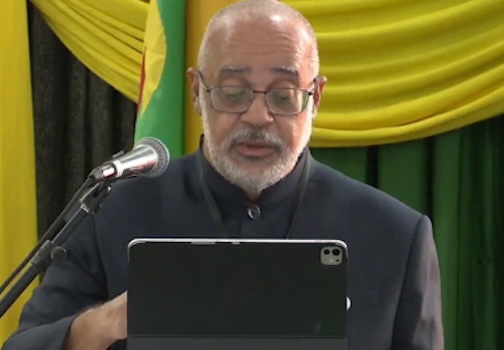
    As small island economies across the Caribbean look to diversify their revenue streams and build long-term, resilient economic growth, one Grenadian tech leader is making the case that the nation is primed to unlock massive potential through digital innovation. Speaking at a high-profile panel during the 22nd Caribbean Internet Governance Forum (CIGF) and the 5th Caribbean Youth Internet Governance Forum (CYIGF), Cameron Philbert, Managing Director and Co-Founder of local creative technology firm Digital Growth Inc., laid out a clear vision for how information and communications technology (ICT) can transform Grenada’s economic landscape.

    Philbert shared the stage with fellow regional tech leaders Clevon Noel of Metarelic, Chad Fraser of Sonover, and Oluwatosin (Tosin) Ishmeal of Datanexis Technologies for the discussion titled *Beyond Connectivity: How ICT Companies Can Drive Digital Innovation, Cyber Resilience and Economic Growth in Grenada*. The panel focused on moving past the foundational goal of expanding internet access across the region to harnessing that connectivity for tangible, inclusive economic gains.

    In his remarks, Philbert pushed back against the common misconception that small nations cannot compete on the global technology stage. “There is no reason the next major technology success story, even the next tech unicorn, couldn’t come from Grenada. Our size does not have to determine the size of the opportunity,” he told attendees.

    For aspiring local tech founders, Philbert offered targeted, actionable advice that prioritizes impact over trendy ideas. He emphasized that emerging entrepreneurs should center their work on solving pressing, real-world problems rather than building products solely for their novelty or excitement. He also urged new founders to adopt a regional, export-focused mindset from the earliest stages of product development, rather than limiting their ambitions to Grenada’s small domestic market. “Building the technology is only half of the challenge. We have to deliberately build the channels that get that technology into other markets,” Philbert explained.

    To turn early ideas into sustainable, scalable businesses, Philbert argued that Grenada needs more structured support systems for young entrepreneurs and growing ICT firms. He called for expanded investment in dedicated support pathways including business incubators, structured mentorship programs, pilot testing opportunities, and partnerships that let emerging companies test their solutions with established local and regional organizations. These ecosystems, he noted, are critical to bridging the gap between a promising concept and a revenue-generating business.

    For established Grenadian businesses that have yet to fully embrace digital transformation, Philbert highlighted a untapped opportunity to boost efficiency and profitability by integrating targeted technology solutions. To help organizations identify these opportunities, Digital Growth Inc. is currently offering a complimentary digital assessment for businesses. The assessment analyzes current operations, customer engagement strategies, and growth potential, outlining clear recommendations for how technology can deliver measurable, bottom-line improvements.

    Founded in Grenada, Digital Growth Inc. specializes in creative technology and digital transformation services, supporting public and private organizations across the region to leverage technology to streamline operations, build custom digital solutions, and unlock new avenues for sustainable growth.

    This report was featured in NOW Grenada, which notes it does not take responsibility for contributor opinions, statements, or shared media, and provides a formal channel for reporting abusive content.

  • First VAT-free weekend: Rush, relief and lessons for next round

    First VAT-free weekend: Rush, relief and lessons for next round

    Grenada’s inaugural two-day VAT-free shopping initiative, held August 28-28 as a core component of the national Cost of Living Assistance Programme, delivered a noticeable surge in commercial activity across the country, while also exposing unanticipated challenges related to transportation infrastructure, public awareness of eligibility rules, and potential price manipulation ahead of the event. The government has already scheduled two additional VAT-free weekends for late September and October, and is currently collecting public and stakeholder feedback to refine the policy ahead of the next rounds.

    The temporary 0% Value Added Tax policy only applies to qualifying goods sold at registered, VAT-compliant businesses, with pre-existing zero-rated products excluded from the additional relief. As retailers across the main island of Grenada and the smaller island of Carriacou prepared for the expected rush, many reported far higher foot traffic and sales volumes than standard weekends, even as operational issues tested their planning.

    At Foodland Supermarket located in St. George’s Market Square, manager Elon Regis shared that the outlet invested heavily in pre-event preparation, bringing in roughly 25 staff to restock shelves the Thursday before the initiative launched, with teams returning after closing on Friday to prepare for the second day. The event got off to a delayed start however, when an internet and server outage disrupted the technical systems required to process VAT-free transactions. Even after resolving the issue and extending operating hours to recoup lost time, persistent gaps in public transit service left many shoppers stranded late in the evening. “Stores open, but where is the bus?” Regis noted, explaining that many potential late purchases were abandoned due to the lack of transportation, though the gap did create unexpected extra business for local taxi operators, who stepped in to offer rides at competitive rates for both customers and staff. Regis added that the event drove a clear shift in consumer behavior, with many shoppers holding off on non-urgent purchases in the weeks leading up to the weekend to take advantage of the tax break, while others stocked up on bulk goods they had planned to delay purchasing for months.

    Local law enforcement at St. George’s Melville Street Bus Terminal confirmed severe congestion throughout the weekend, with morning hours proving particularly hectic and long queues building by midday for buses departing for the St Joseph’s Convent neighborhood. Compounding the traffic issues were unregulated street vending, illegally parked vehicles, and a surge in pedestrian foot traffic along St John’s Street, where vending operations blocked critical walkways. Local stakeholders have put forward a series of recommendations for future events, including banning street vending along high-traffic stretches of St John’s Street and adding a marked pedestrian crossing near Maloney Street to improve safety for crossers.

    On the island of Carriacou, the event far outpaced expectations, with Kim’s Plaza Supermarket owner Kimberlain Mills describing the turnout as a “massive, massive rush” and dubbing the weekend “Christmas in August.” Mills said his team planned extensively for increased demand, keeping shelves fully stocked throughout the two days, and he projected that the sales surge would translate directly to higher quarterly profits. Even so, Mills noted that widespread consumer confusion around eligibility persisted: many shoppers arrived expecting every item in the store to be tax-free, and had to be reminded that only specific qualifying goods qualified for the 0% rate, while other products were already permanently zero-rated and saw no additional discount.

    Experiences varied across different retail segments, however. At Purcell’s Hardware in St. George’s River Road neighborhood, floor supervisor Nicola Baptiste confirmed the event also delivered a welcome sales boost that improved the outlet’s monthly financial performance, but the store opted not to hire additional staff or extend operating hours beyond its regular schedule, matching demand without extra overhead. Like at other outlets, many customers had held off on large purchases ahead of the tax break, though some popular specific items – including a specialty grade of plywood used for custom cabinetry – sold out entirely ahead of the weekend. Baptiste said the outlet would adjust its stock levels ahead of the next VAT-free event to accommodate demand.

    For individual shoppers, timing heavily shaped their event experience. Lani Cato, a local teacher who took advantage of the tax break to purchase higher-priced items she had previously put off buying, visited the Market Square shortly after 8 a.m. on opening day and encountered almost no crowds, while her daughter reported massive congestion when she visited later that weekend. Cato noted that most shoppers waited until the second day to shop, leading to far busier conditions on Saturday. While Cato welcomed the VAT-free initiative as a helpful cost saving measure, she argued that more permanent relief would be more impactful than periodic tax-free weekends, suggesting the government consider lowering the standard VAT rate to a range of 10-12% rather than only eliminating it twice a year.

    Beyond logistical issues, multiple shoppers reported concerns about potential price gouging ahead of the event: several consumers who checked prices on specific items days in advance returned to find that some retailers had raised base prices ahead of the VAT elimination, erasing most or all of the consumer discount. This has sparked calls for more rigorous price monitoring and enforcement before and during future VAT-free weekends, to prevent retailers from capturing the tax relief as extra profit rather than passing savings on to consumers.

    Overall, the first VAT-free weekend has provided valuable on-the-ground data for both the government and participating retailers, showing that the policy drives strong consumer demand and commercial activity, but also requires adjustments to logistics, public outreach, and price regulation to deliver maximum benefit. Even with pre-event guidance published by the government outlining eligible goods, many shoppers and even some frontline retail staff still lacked clear understanding of the rules at the point of sale, indicating that additional public education will be needed ahead of future events. Following the inaugural weekend, the government has formally issued a public call for feedback from both shoppers and businesses to address the identified gaps before the next VAT-free days in September.

  • Grenada: Don’t make the mistake the rest of the world is now trying to undo

    Grenada: Don’t make the mistake the rest of the world is now trying to undo

    As a 30-year veteran educator, I have spent years sponsoring Grenadian secondary students to access the textbooks they need to succeed. This year, however, I encountered a stark shift: nearly all core learning materials have moved exclusively to digital platforms. The surprise of this transition left me stunned. Today, Grenada is rushing to join a global trend of putting a personal laptop in every student’s hand — a policy that many early adopter nations are already hastily reversing after witnessing its negative impacts on learning.

    This sudden push toward full digitalization brings my own CXC exam preparation days into sharp focus. I still remember Teacher Henry leading a group of us to Pope Paul’s camp in Palmiste, the site that later became NEWLO, for a weekend of intensive, book-based study ahead of our national exams. Another year, a larger cohort camped overnight at Saint Rose Secondary School, each of us toting 6 to 7 physical textbooks, working through past exam papers until the concepts clicked into place. In those days, A-level students organized their own study groups, meeting in whatever small space they could find — a kitchen corner, a family veranda — to work through course material together. One former student I spoke with put it plainly: “When I sat my A-levels in sociology, it was physical textbooks that got me through. I wrote every essay by hand. If I made a mistake, my teacher caught it, and I rewrote the entire piece from scratch until I got it right.”

    This global reversal of full classroom digitalization is not rooted in nostalgia alone; it is backed by rigorous research and evidence-based policy change. A 2023 Norwegian research study confirmed that handwriting practice builds far greater neural connectivity in the brain regions specifically tied to memory retention and learning, a finding that has already prompted policy shifts across Europe. In February 2024, Sweden rolled back its national digital-first education strategy, allocating hundreds of millions of kronor annually to restore printed textbooks and school library resources, and mandating that all primary and secondary schools become completely phone-free by autumn 2026. This reversal came after pediatricians and neuroscientists sounded the alarm on the harms of early overexposure to screens, prompting the government to overrule the education agency’s original digital-first agenda. The Netherlands implemented a full ban on phones, tablets, and smartwatches in classrooms starting in January 2024, and Finland passed identical restrictions the same year. In Madrid, regional education authorities have introduced age-based caps on classroom screen time, limiting the youngest primary students to just one hour of screen use per week — a policy that impacts more than 500,000 students across the region. These are not trivial, marginal policy adjustments; they are deliberate, data-driven course corrections by national and regional governments that have already lived through the costs of full digitalization.

    We do not need to look across the Atlantic for evidence of the risks of unfettered digital learning. The Caribbean Examinations Council (CXC), the governing body that accredits Grenadian students’ secondary exam results, announced in July 2025 that it will phase out School-Based Assessments (SBAs) for most subjects. The reason? Generative AI, easily accessible via personal laptops and digital devices, has irreparably compromised the academic integrity of student work. For decades, the SBA was one of the most well-designed components of the CXC syllabus: students selected their own research topics, conducted independent inquiry, wrote up their findings, and defended their work before their teachers. Today, widespread access to digital tools has made it far too easy for students to skip the entire learning process and submit AI-generated work they never created, forcing the regional exam board to rebuild the entire assessment model from the ground up.

    Grenada’s own universal laptop program, which includes e-textbooks and a free Microsoft 365 account for every student, began rolling out to Form One and Form Two students in September 2025, covering all core subjects from mathematics and English to geography, science, agriculture, home economics, and foreign languages. Government officials say parents who prefer physical textbooks can still purchase them independently. While this may hold true on paper, my own trip to local bookstores told a different story: the entire education system has already shifted to prioritize digital materials, with physical textbooks now an afterthought that requires extensive searching to locate, rather than the default learning tool every student receives.

    The nations now reversing course — Sweden, the Netherlands, Finland, Madrid — are not speaking from abstract theory. They tested universal laptop access for every student, measured the damage to students’ reading proficiency, writing skills, attention spans, and critical thinking abilities, and are now investing significant public funds to undo the policy. This leaves Grenada with a unique advantage these nations did not have: we have not yet locked in this mistake. We can learn from the experience of other countries’ students instead of learning the same hard lesson through our own children’s suffering.

    This is not an argument to ban computers from Grenadian classrooms entirely — digital tools certainly have a valuable role to play in modern education. But that role is as a dedicated subject on the school timetable, just like English, mathematics, agriculture, or social studies. Students should have scheduled computer lab periods where they learn explicit, structured skills: typing proficiency, coding, ethical research practices, and how to use generative AI responsibly. That is where laptops earn their place in education. They should not replace the physical textbook students carry into every other class, nor replace the hands-on practice of handwriting, in-person classroom discussion, and the slow, deliberate work of reading a physical page and developing an independent opinion on its content.

    Every one of the nations rolling back full digitalization is fighting to return to the model Grenada already maintains. Right now, Grenada could be a global leader in evidence-based education: we could stand firm in keeping physical books in students’ hands, and other nations could look to our example. Instead, we are rushing in the opposite direction, heading straight for the exact policy failure the rest of the world is now desperate to escape.

    I am calling on Grenada’s Ministry of Education and on parents across the country to examine closely the 15 years of costly lessons Sweden has learned, and the urgent fixes our own regional exam board is already implementing. Move laptops to the dedicated computer lab where they belong. Put physical textbooks back in every child’s hands, where they have always supported strong learning. If we move forward with putting a personal laptop in every child’s hands today, we are not playing catch-up — we are taking a massive step backward, straight into the mistake the rest of the world is already spending billions to undo. We have a rare opportunity to avoid this mistake entirely, instead of living through it and paying to fix it decades later, just like every other nation that rushed into this policy.

  • OECS governments urged to provide crown lands to farmers on transparent terms

    OECS governments urged to provide crown lands to farmers on transparent terms

    Against a backdrop of a fracturing global order that has left small island developing states increasingly economically vulnerable, the top leader of the Organisation of Eastern Caribbean States (OECS) is calling on sub-regional governments to remove one of the most persistent barriers to agricultural revitalization: unequal access to land.

    Speaking at the opening ceremony of the OECS Youth and Women in Agriculture Symposium hosted in Grenada on Tuesday, OECS Director General Dr. Didacus Jules pushed for governments to open up crown lands to emerging farmers through transparent, accessible long-term leasing frameworks. Specifically, he proposed 10-year payment arrangements that would be recognized as valid collateral by lending institutions, arguing that secure land access is the foundational requirement for any other agricultural development intervention to succeed.

    “Every other intervention we make is diminished if a young person has nowhere to stand,” Jules told attendees, emphasizing that inclusive agricultural development must be structural, not just ceremonial. He noted that people with disabilities had registered for the symposium in significant numbers, and called on organizers and policymakers to design programming, training and financial tools that accommodate disabled participants from the start, rather than adding them as an afterthought.

    The three-day gathering, organized by the Castries-based OECS Commission in partnership with Grenada’s Ministry of Agriculture, Lands and Forestry, is designed to equip participants with actionable skills across key areas: agribusiness development, climate-smart farming practices, digital agricultural innovation, leadership capacity building, and strategies for accessing financing and regional and global markets. Core priority themes for the symposium include climate-resilient production, upskilling for agri-entrepreneurs, removing barriers to capital and market access, and strengthening regional networking and policy alignment.

    Jules challenged attendees not to let the event end with only vague goodwill, calling for concrete progress on long-stalled initiatives. Most notably, he pushed for the proposed OECS Agriculture Forum for Youth to transition from a planning document to a formal, fully functional institution that is owned and led by youth stakeholders, even as it receives institutional support from the OECS Commission and the Inter-American Institute for Cooperation on Agriculture (IICA). He also called for delegates to agree on a firm target launch date for a new centralized agricultural information portal, which will be co-managed by the OECS and IICA to connect farmers with resources.

    In his opening address, Jules laid out the urgent context driving the push for agricultural reform in the Caribbean: the sub-region is facing accelerating global instability that is eroding the security of small states. The post-WWII global order that Caribbean nations relied on for trade, development assistance and multilateral arbitration is unraveling faster than new inclusive frameworks can be built. Unilateral trade rule rewrites, escalating trade disputes, the use of tariffs as political coercion, and cuts and politicization of development assistance have all compounded existing challenges for small island economies, where shipping and insurance costs rise with every more intense hurricane season, and core multilateral institutions are facing unprecedented strain.

    This unstable environment has left the Caribbean heavily dependent on food imports, which cost the region $658 million annually. Every dollar spent on imported food leaves the regional economy permanently, Jules explained, increasing national vulnerability and diverting funds that could be invested in domestic public services like education while giving foreign actors undue leverage over regional food systems.

    “We are not here because agriculture is a nice idea for young people,” Jules said. “We are here because in a fracturing world, the capacity to feed ourselves is the most concrete expression of sovereignty available to a small state. If you cannot feed yourself, you’re dead.”

    Compounding this urgency is the region’s aging farming population: Jules warned that domestic food production capacity is just one generation away from being lost entirely without intentional investment in new, young farmers. He highlighted a landmark decision taken by OECS agricultural ministers at a special October 2024 council meeting in St. Vincent and the Grenadines, which folded women into the sub-region’s youth in agriculture program on the grounds that women and young farmers face the same systemic barriers: lack of access to land, limited access to financing, lack of professional recognition, and exclusion from decision-making tables. That policy shift is what enabled the joint focus on youth and women at this symposium, a change Jules said deserves formal recognition.

    He also commended the active participation of organizations representing people with disabilities, pointing to a successful aquaponics venture in St. Lucia run entirely by three disabled entrepreneurs: one wheelchair user, one person who is blind, and one paraplegic, as proof that disabled producers can drive thriving agricultural enterprises when given access to resources and opportunity.

    The symposium is the culmination of more than a year of targeted regional planning and capacity building. In May 2025, OECS agriculture ministers gathered in Costa Rica with support from IICA and the European Union to finalize a strategic roadmap for sub-regional agricultural development. Since that meeting, the OECS has hosted workshops in St. Lucia on climate-smart agriculture and sustainable entrepreneurship, covering emerging tools including artificial intelligence, data analytics, drone technology, small-scale mechanization, soil and water management, business planning, and financial literacy. In October 2024, an OECS delegation traveled to Spain to study cooperative and social economy models for agri-food and fisheries sectors, a knowledge-sharing trip that has already delivered tangible benefits for small producers in Dominica and Montserrat.

    Even with these early wins, Jules acknowledged that key barriers remain. Securing affordable access to land is still the biggest unmet demand for emerging farmers, and high interest rates at regional financial institutions remain largely unaddressed. The centralized one-stop information portal that farmers have requested, which would combine access to grants, land listings, market connections and technical guidance in one place, is still under development. A planned agricultural scholarship program and an agribusiness diploma for youth and women are still being finalized, with talks scheduled between OECS and IICA next month to wrap up the diploma program design.

    Judes closed by urging delegates to deliver tangible outcomes from the symposium, reminding attendees that food sovereignty cannot be achieved by official declaration alone. “It becomes secure, food secure, one farm, one cooperative, one young woman, one differently-abled entrepreneur with a business plan at a time,” he said.
  • RGPF celebrates 49th Passing Out Ceremony of Recruit Class 2026

    RGPF celebrates 49th Passing Out Ceremony of Recruit Class 2026

    On a formal occasion steeped in institutional tradition, the Royal Grenada Police Force (RGPF) marked a key milestone in its public service mission with the 49th Passing Out Ceremony, celebrating the successful graduation of Recruit Class 2026 after months of rigorous preparation. The event, hosted at Camp Salines, drew a distinguished cross-section of attendees, including Grenada’s Governor-General Her Excellency Dame Cécile La Grenade, Prime Minister and National Security Minister Honourable Dickon Mitchell, senior government representatives, top RGPF command, and the proud family members of the graduating recruits. These new officers have completed intensive training designed to prepare them for their core mission: serving and protecting all residents across Grenada, Carriacou, and Petite Martinique.

    The centerpiece of the ceremony was a precision parade that put the new recruits’ skills on full display, showcasing their command of drill protocols, peak physical conditioning, meticulous attention to detail, and calm professionalism. Their performance bore clear testament to the long-held high standards and institutional traditions that define the RGPF.

    In his keynote address to the graduating class, RGPF Commissioner of Police Randy Cannaught extended warm congratulations to the new officers, while issuing a clear call to uphold the core values of integrity, accountability, and unwavering excellence across every stage of their careers. “This passing out ceremony is not simply the end of a training programme; it is the beginning of a lifelong commitment to public service,” Commissioner Cannaught told the assembled graduates. “The citizens of Grenada place their trust in you. Wear the uniform with pride, serve with compassion, and lead by example. As you progress through your careers, I expect you to become leaders, not simply because you acquire rank, but because people can look to you for guidance, discipline, mentorship and sound judgment.”

    The Commissioner also took the opportunity to recognize the hard work and dedication of the RGPF training staff and instructors, whose relentless guidance and hands-on mentorship shaped the recruits into capable, confident law enforcement officers prepared to tackle the evolving, complex challenges of modern policing.

    A standout moment of the celebratory event came during the awards segment, where top-performing recruits received honors for exceptional performance across five key categories: academic excellence, drill proficiency, physical fitness, leadership, and overall outstanding recruit.

    As the new graduates marched onto the parade square in formation, their family members and supporters watched on with visible pride, marking a moment that reflected months of personal sacrifice, steady perseverance, and unwavering determination from every recruit. Event organizers explicitly acknowledged the ongoing encouragement and support of the graduates’ loved ones as a critical factor in the cohort’s overall success.

    Beyond celebrating individual achievement, the 49th Passing Out Ceremony also reaffirmed the RGPF’s long-term commitment to building a professional, modern, and community-centered police service. As the newest officers take their formal oath of office and assume their posts across the country, they join a decades-long legacy of dedicated men and women committed to protecting lives, preserving public peace, and serving the nation with honor. Recruit Course #49 of 2026 now steps into its next chapter, carrying forward the core values of courage, discipline, and selfless service that have defined the Royal Grenada Police Force for generations.