Located in Calliste, Grenada, independent art hub Art House 473 has continued to anchor institutional-level Caribbean art programming following the conclusion of its 9th annual Grenada Contemporary exhibition series, themed ‘Islands in Dialogue’. Founded under the umbrella of the Susan Mains Gallery in 2014, Art House 473 has grown from a small exhibition space to a core platform connecting local and international contemporary artists. By the 2025 edition of the Grenada Contemporary, more than 106 creators from across the globe have showcased their work here, and the space maintains its longstanding commitment to allowing artists to explore creative concepts outside the constraints of Grenada’s small local art market.
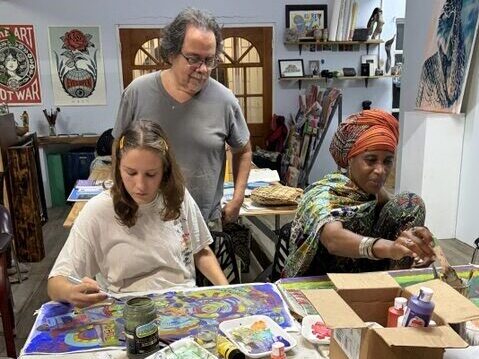
For the 2026 iteration of the event, organizers pivoted from the traditional open-call exhibition format to a five-day immersive professional development program led by two visiting artists from Trinidad: painter Edward Bowen and filmmaker Yao Ramesar. Bowen, who previously represented Grenada at the Grenada National Pavilion during the Venice Biennale, led a four-day foundational painting workshop that introduced emerging local creators to core studio practices. Throughout the sessions, Bowen wove together his decades of professional experience in the global art space with critical discussions on the unique identity and role of Caribbean art on the international stage. Joined by Art House 473 resident director Asher Mains, conversations dug into pressing questions for regional artists: how to build audiences, navigate market dynamics, root work in local context, and maintain relevance amid shifting global artistic trends.
The program culminated on its final evening with a public screening of *Fortune for All*, award-winning filmmaker Ramesar’s acclaimed work, followed by a lively question-and-answer discussion. Like Bowen, Ramesar centered his talk on centering a Caribbean perspective in creative production, highlighting a simple yet impactful example: how regional filmmakers can leverage Grenada’s abundant natural local light for on-location shoots, rather than relying on the artificial, standardized lighting setups common to large international studio productions. This core idea of telling authentic local stories through locally rooted creative practices tied together all five days of programming.
The ‘Islands in Dialogue’ theme itself was designed to highlight the interconnectedness of Caribbean artistic communities, creating a space for knowledge-sharing between Grenadian and Trinidadian creators that expands the ongoing regional conversation. Beyond facilitating exchange, Grenada has positioned itself as a key promoter of artistic talent from other Caribbean islands on global platforms, with almost every artist that has represented Grenada at the Venice Biennale having previously participated in the Grenada Contemporary program.
One notable example is Barbadian artist Russell Watson, whose work is currently on display at the Venice Biennale as part of Grenada’s national pavilion, titled ‘The Poetics of Correspondence’. The pavilion’s title draws inspiration from the late curator Koyo Kouoh’s work *In Minor Keys*, and emphasizes the intangible but deeply impactful connections that bind regional artistic practices together when creators engage in open dialogue. Italian curator and art critic Valentina Minniti notes that Watson’s practice has long centered the intersection of the human body, Caribbean ecologies, and metaphorical transformation, creating works that sit between subtle sensory experience and clear representational imagery—a ‘in-betweenness’ that resists literal categorization, and captures the nuanced identity of Caribbean art.
As a central hub for this regional conversation, Art House 473 also maintains an extensive archive of catalogs and exhibition materials from Grenada’s nine appearances at the Venice Biennale, alongside documentation from other international exhibitions. The space also hosts regular community programming including life drawing classes, small-scale workshops, and rotating exhibitions that nurture the growth of Grenada’s local art ecosystem. Uniquely, Art House 473 operates entirely independent of government or external institutional funding; all its programming is supported through art sales by Susan Mains and Asher Mains. The 2026 edition of the 9th Grenada Contemporary received additional support from Blue Horizons Garden Resort and the Susan Mains Gallery.