
In a collaborative initiative between the Kingdom of Morocco and the Government of Grenada, Moroccan authorities have opened applications for fully funded undergraduate and graduate scholarship opportunities for Grenadian citizens to study at Al Akhawayn University in Ifrane (AUI) for the 2026–2027 academic year. Administered through Morocco’s official national agency, the program covers nearly all student expenses, removing financial barriers for qualified Grenadian applicants seeking high-quality English-medium higher education.
标签: Grenada
格林纳达
-

Temporary road closure to facilitate We Pan Fest — The Carenage, St George’s
Organizers and law enforcement in Grenada are putting advance traffic arrangements in place ahead of the upcoming We Pan Fest, with the Royal Grenada Police Force (RGPF) officially releasing a public advisory outlining a temporary vehicular road closure that will take effect in June 2026.
Per the official announcement from the Office of Commissioner of Police, the section of The Carenage public road running from its intersection with Hughes Street toward Sendall Tunnel will be closed to all non-emergency motor vehicle traffic on Sunday, June 28, 2026, between the hours of 3:00 p.m. and 11:00 p.m. This temporary restriction is being implemented to clear space for the We Pan Fest event, allowing organizers to host activities safely and comfortably for attendees.
Crucially, the closure order does not apply to emergency response vehicles of any kind. RGPF stressed that full, unimpeded access must be maintained for emergency vehicles across the affected stretch of road for the entire duration of the event, to preserve public safety and enable rapid response if any urgent incident occurs.
For all other private and commercial motorists, the full traffic restriction will remain in place throughout the 8-hour closure window. The police force is urging all drivers who regularly travel along this route to plan their journeys in advance, and make use of marked alternative routes during the closure period to avoid unnecessary delays or congestion.
In closing the advisory, RGPF expressed gratitude to the Grenadian public, local residents, and road users for their understanding, patience, and ongoing cooperation as law enforcement works to balance two key priorities: upholding public safety across the island, and enabling community events like We Pan Fest to run smoothly and successfully.
Disclaimer: NOW Grenada does not take responsibility for the opinions, statements, or third-party contributed media content featured in this public advisory. Users may click the designated reporting link to submit any claims of content abuse.
-

Grenada strengthens digital resilience
Against a backdrop of growing climate-driven natural hazard risk across the Eastern Caribbean, Grenada is advancing its digital transformation and public safety goals through active participation in the Regional Cell Broadcast Emergency Warning System (CB-EWS) initiative, a collaborative regional project designed to strengthen disaster preparedness and community protection via cutting-edge telecommunications infrastructure.
In June 9–10, 2026, Grenada welcomed senior officials and technical experts from across the region to a landmark Validation Workshop for the CB-EWS project, co-hosted alongside regional partners. Attendees included delegations from five participating Eastern Caribbean nations: Dominica, St Lucia, St Kitts and Nevis, St Vincent and the Grenadines, as well as representatives from regional intergovernmental bodies and international technical specialists.
Opening the official proceedings, Grenada’s Minister for Digital Transformation Hon. Ron Redhead extended a welcome to all gathered participants, and reaffirmed the Grenadian government’s unwavering commitment to harnessing digital innovation to upgrade public services, boost national resilience against crises, and protect both civilian lives and critical property.
The regional CB-EWS initiative is led jointly by the International Telecommunication Union (ITU) and the World Bank, with regional coordination managed by the Caribbean Telecommunications Union (CTU). It forms a core component of the ITU’s global contribution to the Early Warnings for All (EW4All) initiative, an ambitious global effort that aims to deliver universal coverage of effective multi-hazard early warning systems for every population on Earth by 2027.
The two-day Validation Workshop marked a key milestone in the project timeline, giving participating member states the opportunity to review and sign off on the proposed technical, regulatory, and operational framework for rolling out the unified regional cell broadcast system. A core guiding principle baked into the framework preserves full national sovereignty over domestic emergency alert issuing processes, ensuring no country cedes authority over its own crisis response.
Globally, cell broadcast technology is widely recognized as one of the most rapid and reliable methods for delivering mass emergency alerts to the public. Unlike conventional SMS alerts, which are routed individually to each device, cell broadcast pushes simultaneous alerts to every compatible mobile device connected to cell towers within a defined geographic area. Because alerts transmit directly from the cellular infrastructure, messages reach recipients in seconds—even during peak network congestion that often occurs in the immediate aftermath of major disasters, when communication demand surges.
The system is engineered to deliver fast, targeted warnings for a full spectrum of threats, from hurricanes, tsunamis, earthquakes, volcanic eruptions and floods to hazardous material releases, public safety emergencies and other events requiring immediate public action. A key accessibility feature of the technology is that it requires no action from end users: there is no need to subscribe to a separate alert service, download a dedicated mobile application, or share personal contact information with authorities. Cell broadcast also upholds strict user privacy protections, as the technology does not collect or process any personal user data, including phone numbers, subscriber identities, or individual location data.
Another major advantage of the system is its geotargeting capability. Alerts are only delivered to mobile devices located within the boundaries of the affected area, allowing emergency managers to share accurate, timely, location-specific information with at-risk communities without triggering unnecessary panic or disruption in adjacent unaffected regions. The system also automatically reaches travelers and tourists roaming on local cellular networks, regardless of their home country, closing a critical gap in emergency outreach that many legacy alert systems leave unaddressed.
Workshop discussions confirmed broad, cross-regional buy-in for the initiative, and aligned participating nations on a set of core guiding principles that will shape the project’s implementation phase.
Attendees reached a consensus that the authority to issue national emergency alerts will remain exclusively with each country’s officially designated national emergency management body, aligned with existing domestic legislation and institutional mandates. While regional coordination mechanisms will be established for transboundary hazards that impact multiple nations simultaneously, all alert authorization will remain a core national responsibility.
Delegates from national telecommunications regulatory commissions further emphasized requirements for the system to be secure, resilient, and built on open international standards. Particular priority was placed on robust cybersecurity safeguards, strong authentication protocols for alert originators, clearly documented operational protocols, and vendor-agnostic technology standards that avoid lock-in to proprietary systems while ensuring long-term cross-border interoperability between all participating member states.
Workshop sessions also addressed practical long-term considerations, including sustainable operational funding, regional hosting arrangements, regulatory preparedness across national jurisdictions, and alignment of the system framework with evolving regional data protection laws.
For Grenada, the CB-EWS project represents a major milestone in the country’s multi-year Digital Transformation Agenda. The initiative demonstrates how digital innovation can deliver dual benefits: advancing economic development and modernizing government services, while also strengthening national crisis resilience and protecting civilian lives.
The project integrates seamlessly with Grenada’s broader digital transformation portfolio, which includes expanding resilient broadband infrastructure, upgrading national cybersecurity capacity, modernizing digital public services, rolling out national digital identity systems, enhancing critical communications networks, improving national disaster risk management frameworks, and building an inclusive, secure digital economy.
Recent regional events, including the devastating impact of Hurricane Beryl and other recurring natural hazards across the Caribbean, have underscored the urgent need for resilient communications infrastructure that can reach all segments of the population within seconds of a crisis unfolding. The CB-EWS will become a core component of Grenada’s national resilience framework, ensuring that both residents and visitors can access timely, trusted, actionable emergency information whenever lives are in immediate danger.
Looking ahead, the next phase of the project will see each participating country conduct detailed national assessments of technical, legal, regulatory, and operational requirements for implementation. National telecommunications regulators will continue collaborating with national disaster management offices, national governments, local mobile network operators, and regional partners to finalize system design and roll out arrangements.
The Government of Grenada has publicly expressed its gratitude to all stakeholders involved in the initiative, including the ITU, the World Bank, the CTU, participating OECS member states, national disaster management agencies, national telecommunications regulators, mobile network operators, and other contributing partners whose collaborative effort is advancing emergency preparedness and digital resilience across the Eastern Caribbean.
As Grenada continues working toward its goal of becoming a modern, digitally connected nation, the CB-EWS initiative illustrates a core truth about intentional digital transformation: it is about far more than rolling out new technology. It is about leveraging innovation to build safer, more resilient communities, protect vulnerable lives, and improve quality of life for all citizens.
-

Shane David–Joseph, of Grenadian heritage, shines in world premiere of ‘Driftwood’
As Britain swelters through a record-breaking June heatwave, with temperatures hitting a new all-time June high of 36.7°C, London audiences are escaping the heat in air-conditioned comfort while diving into a searing, immersive tropical story at Kiln Theatre. The sold-out hit *Driftwood*, Trinidadian writer Martina Laird’s first professionally produced full-length drama, has been drawing packed houses to its world premiere run, which wraps up on July 4, 2026.
Boasting a stellar cast led by *Bridgerton* star Martins Imhangbe, the play centers on Imhangbe’s character Diamond, a restless, resourceful man who travels from his rural hometown in Mayaro to Trinidad’s capital Port of Spain to confront Pearl, the mother who abandoned him as an infant. Set within the walls of ALMA, a gritty Port of Spain gentleman’s club that leans more into downtown rum shop energy than traditional British elite drinking culture, the venue doubles as the home of Pearl and her daughter Ruby. The aging Pearl spends most of her nights away at political rallies for independence leader Eric Williams, who would go on to become the first prime minister of independent Trinidad and Tobago, leaving the sharp, charismatic Ruby to host ALMA’s wealthy guests. Ruby, alongside her ally Seldom – an Indo-Trinidadian police officer with a penchant for off-the-books side work – runs clever honey traps for intoxicated foreign visitors… until Diamond’s unexpected arrival upends their fragile routine.
Seldom, played by Grenadian-British actor Shane David-Joseph, emerges as the play’s quiet moral core, a charming, quick-witted figure who operates in gray areas but adheres to a quiet code of honor even as every other character pursues their own self-serving ends. David-Joseph, whose family roots span both sides of Grenada, shared what the role meant to him as an artist of Caribbean heritage: this marks the first time in his career he has gotten to bring a fully realized Caribbean character to a major UK stage, delivering lines in the regional patois he grew up hearing from his family, who moved to the UK as part of the Windrush generation. For David-Joseph, the opportunity to portray an Indo-Caribbean character – a group underrepresented in mainstream British media – makes the role even more meaningful.
“I am honoured to be playing Seldom, in Martina Laird’s wonderful play *Driftwood*. This is the first time in my career I’ve had the opportunity to bring a Caribbean character to life on stage. And it feels great. To speak these words and phrases that I’ve been blessed to hear all my life, on a stage in the UK is amazing. On top of this, being able to portray someone from the Indo-Caribbean community, a community that doesn’t always get depicted in mainstream media, is also wonderful. I hope I’ve done my family, Grenada, and the whole of the Caribbean community proud,” David-Joseph said.
Beyond its intimate family drama, *Driftwood* layers in sharp geopolitical commentary that echoes modern Caribbean politics. When American soldier Tom, invited to ALMA by Diamond, convinces Diamond to let him install undisclosed “equipment” in the venue’s back room – a move that echoes the 2025 agreement by the Trinidad and Tobago government to allow U.S. military radar installation at Tobago’s airport, and the widespread public protests that greeted a similar U.S. request in Grenada late last year.
Laird, who wrote the script years before these real-world events, cleverly frames ALMA as a metaphor for colonial Trinidad itself, with the property still owned by a British elder who reaps all its profits, mirroring colonial extraction. Tom’s cozy relationship with the British landowner nods to the U.S.-UK “special relationship” that has long shaped geopolitics in the Caribbean, and the play’s slow unspooling of disaster from the secret equipment serves as a quiet warning about the dangers of foreign powers using Caribbean nations as their backyard, echoing the Monroe Doctrine without ever naming it explicitly.
Produced by the Royal Shakespeare Company in partnership with Kiln Theatre, after an initial run at RSC’s The Other Place in Stratford-Upon-Avon, *Driftwood* has earned universal acclaim for its sharp writing, flawless ensemble performances, and incisive blend of personal and political storytelling. The run closes on July 4, 2026 – a date that carries its own irony, coming on the U.S.’s 250th Independence Day, making it a particularly timely must-see for audiences of all backgrounds, from Caribbean communities in London to American and British visitors eager to engage with a nuanced, unflinching take on Caribbean history and its ongoing legacy.
-

Skinny Banton has all that’s needed for another epic Spicemas experience
As the annual Spicemas carnival season gets underway in Carriacou, Grenada, one local artist is turning seasonal celebration into a year-round artistic mission. Shirlan George, known professionally as Skinny Banton, has launched seven brand new singles in 2026, bringing his signature high energy, upbeat vibe and narrative songwriting to audiences gearing up for another iconic Spicemas experience.
For the acclaimed soca artist, Grenada’s one-of-a-kind Jab culture serves as the core inspiration for his work. Previous hits including *Soak It Good* and *Wrong Again* earned him widespread recognition across the Caribbean and global soca audiences, and this season his highly anticipated *The Jambalasse* project stands out as one of his most culturally significant releases to date. The project centers on a revamped version of *Jambalasse Rule*, a 1991 track from Moss International widely regarded as one of Grenada’s first original Jab Jab songs.
“With this project, we’re working to preserve the history while celebrating the present day,” Banton explained. Updating the original track’s riddim, the artist aims to shine a global spotlight on his country’s authentic cultural heritage, carrying that mission with him on every stage and every release. Banton emphasized his commitment to keeping Grenada’s traditional cultural practices alive, noting that he understands his unique role as an artist in advancing that work. “No matter what challenges we face as artists in this space, we stay true to our mission,” he said. Beyond Spicemas, he already has plans to share fan-favorite track *Pain* with audiences at Trinidad and Tobago’s 2027 Carnival.
Beyond his solo work, Banton has made supporting emerging talent a core part of his 2026 release slate. His new tracks include collaborative cuts: *Carnival Traffic* features Jamaican artist I Octane, *My Behaviour* pairs him with rising star Tonic X, and *Water Line Burst* was created alongside up-and-comer Nicki Akull. Banton says collaborating with emerging artists holds personal meaning: when he was an up-and-coming artist himself, breaking through and connecting with established names felt nearly impossible, a daunting experience he has not forgotten.
That experience drives his commitment to lifting the next generation of Caribbean entertainers. “Nobody takes you seriously when you don’t have a foot in the door — they refuse to embrace you because you are not known,” he said. “This was just my way of giving them strength and encouragement. I want them to keep pushing after this.” The other three tracks in Banton’s 2026 release slate are *When Yuh Eating*, *Right Up*, and *Black Fuh Juvay*.
The artist is moving full steam ahead with promotional plans for the new releases, with music videos already completed and uploaded for *Black Fuh Juvay* and *My Behaviour*. For *Water Line Burst*, the collaboration with Akull came together after three years of consistent outreach from the young artist, with Banton saying Akull’s persistence and dedication ultimately brought the track to life. Even with seven new tracks out, Banton shows no signs of slowing down: he is actively seeking new collaborations with artists across the Caribbean diaspora, and aims to expand his footprint in the global soca community.
Navigating the modern music industry’s shift toward social media, Banton shared thoughtful perspective on balancing online promotion with artistic integrity. As more artists prioritize viral social content over substantive songcraft, he warns that good music should be able to stand on its own, regardless of promotional content. “Content creation online should not take away from artists creating and delivering great music, because without the content, the music should still stand on its own, and with the content, the people still need the music,” he argued.
He noted that many viral trends today stem from artists cultivating an online persona rather than releasing lasting, substantive music: artists may earn quick attention for outrageous posts, but the songs themselves often lack the substance to maintain long-term relevance. For young artists just starting out, Banton offered encouraging advice: stay focused on your craft, ignore online naysayers, and build a business model that works for your unique artistic path, since every artist’s journey looks different.
Widely recognized as a thoughtful, intentional and immensely talented voice in the Caribbean creative scene, Banton closed by thanking the fanbase and industry partners that have supported his career. “People who’ve been supporting from day one and continue to support, as well as the new supporters I’ve gotten along the way — thank you,” he said. “To the DJs and radio personalities, I appreciate you. One hand doesn’t clap. Thank you for keeping my songs on rotation, and I hope you all continue to support me.”
-
CRFM Scientific Conference Technical Papers and National Reports
The Caribbean Regional Fisheries Mechanism (CRFM), a leading regional body dedicated to sustainable fisheries management across the Caribbean basin, has announced a major milestone for marine science and policy research in the region: the complete proceedings from its 20th Anniversary Scientific Conference are now accessible to the public via the organization’s official digital platforms.
The released material is structured into two distinct, comprehensive volumes to support easy navigation for researchers, policymakers, industry stakeholders, and students. Volume 1 compiles peer-reviewed technical papers covering cutting-edge research on fisheries ecology, stock assessment, sustainable harvesting practices, climate change impacts on marine ecosystems, and innovative aquaculture development across the Caribbean. Volume II gathers in-depth national reports submitted by member states, documenting on-the-ground status of fisheries and aquaculture sectors, regulatory updates, and ongoing conservation initiatives.
Among the national reports available for individual download is the full *National Report on the Status of Fisheries and Aquaculture in Grenada*, which is hosted directly on the CRFM’s website for dedicated access. Both the full two-volume special publication and individual research papers are listed on CRFM’s official publications page, allowing users to access content in open-access formats.
A standard content disclaimer notes that NOW Grenada does not take responsibility for the viewpoints, statements, or third-party contributed media featured in the conference proceedings, and provides a channel for users to report any content that violates community guidelines or terms of use.
-

PM’s statement on Venezuela earthquakes 24 June
A powerful earthquake that hit west of Caracas, Venezuela on the previous evening has left a trail of widespread devastation, destroyed critical infrastructure, injured hundreds, and claimed multiple lives, prompting an outpouring of international sympathy from neighboring Caribbean nations.
In an official statement released following the disaster, Hon. Dickon Mitchell, Prime Minister of Grenada, shared his deep sorrow over the disaster’s catastrophic impacts, and extended heartfelt condolences on behalf of the Government and people of Grenada, as well as in a personal capacity, to all families who have lost loved ones in the seismic event.
Mitchell acknowledged that the long road to recovery and reconstruction after a disaster of this magnitude will present immense, long-term challenges for the South American nation. Even so, he expressed firm confidence that the well-documented resilience and unyielding fortitude of the Venezuelan people will be a driving force that speeds and strengthens the rebuilding effort.
The Prime Minister emphasized that the Government and people of Grenada stand in full solidarity with the Venezuelan people and their leadership through this difficult period. He specifically highlighted the affected community of La Guira, voicing hope that local residents will be able to rebuild their daily lives and livelihoods with sustained determination and a positive outlook, laying a solid foundation for a full and successful recovery.
Mitchell closed his statement by affirming that the thoughts and prayers of all Grenadians remain with the people of Venezuela as they begin to navigate the aftermath of the disaster and work toward recovery.
The statement was published via local media platform NOW Grenada, which included a standard disclaimer that it does not take responsibility for the content or opinions shared by contributing parties, and provides a channel for users to report any abusive content linked to the publication.
-

Grenada welcomes returning nationals
Grenada has officially kicked off its highly anticipated 2026 Diaspora Homecoming initiative, opening the multi-week event with an intimate ceremonial Welcome Reception hosted at the iconic Belmont Estate. The gathering was led by Hon. Joseph Andall, the island nation’s Minister for Foreign Affairs, Trade and Export Development, who greeted hundreds of returning Grenadian nationals and invited international guests.
The Welcome Reception marks the official start of Grenada Diaspora Homecoming 2026, a landmark national government-led program crafted to rebuild and strengthen bonds between Grenadians living across the globe and their home country. Structured around five core pillars—cultural exchange, community engagement, investment discussion, professional collaboration, and inclusive national development—the initiative aims to turn diaspora connections into tangible long-term value for the island.
Set against the backdrop of Belmont Estate, a site steeped in Grenada’s history and cultural heritage, the opening evening brought together a diverse cross-section of attendees: diaspora members from North America, Europe, and beyond, senior government officials, local business and community partners, civil society representatives, and key national stakeholders. The entire event centered on three shared guiding themes: reconnection, collective belonging, and unified national purpose.
In his opening address to attendees, Minister Andall emphasized the outsize role that Grenada’s global diaspora plays in driving the country’s ongoing growth and progress. He noted that even thousands of miles from the island, Grenadians living abroad remain deeply tied to the nation’s cultural identity, developmental trajectory, and future vision. “Grenada’s diaspora has always been an integral chapter of our national story,” Andall stated. “This Homecoming initiative gives us a formal opportunity to welcome our nationals back not just with celebration, but with clear intention. It allows us to deepen the relationship between Grenadians at home and abroad, reinforce the shared ties of identity and belonging, and explore how this connection can continue to advance Grenada’s development in meaningful, lasting ways.”
Terrance Forrester, Grenada’s Ambassador for Diaspora Affairs, expanded on the broader mission behind the Homecoming program, noting that it extends far beyond a traditional homecoming celebration. “Grenada Diaspora Homecoming is about more than return. It is about reconnection with purpose,” Forrester explained. “Our diaspora represents an extraordinary global network of untapped talent, influence, professional expertise, and untold possibility. When we create intentional spaces for Grenadians at home and abroad to gather, exchange ideas, and experience the new Grenada together, we open the door for meaningful collaboration, catalytic investment, global advocacy, and long-term national value that benefits all of our people.”
Beyond official speeches and networking, the opening reception gave visiting guests an early chance to experience the legendary hospitality, vibrant local culture, and close-knit community warmth that forms the foundation of the entire Homecoming program. The event also set a collaborative tone for the full slate of activities scheduled across the 15-day program, which includes immersive cultural experiences, community development projects, guided island excursions, the annual Diaspora Forum and Marketplace, National Spice Replanting Day, and additional events spread across Grenada’s main island, as well as the sister islands of Carriacou and Petite Martinique.
Grenada Diaspora Homecoming 2026 will run from June 21 through July 5, 2026, with two full weeks of programming anchored by the core values of reconnection, national celebration, cross-sector collaboration, business development, and national pride. The initiative is coordinated by the Grenada Office of Diaspora Affairs.
-
Minister Cornwall at OPEC Fund Development Forum
Grenada’s top finance official has embarked on an international diplomatic mission to one of Europe’s leading development policy gatherings, bringing the urgent priorities of climate-vulnerable small island nations to a global stage. On Sunday, June 21, 2026, Minister of Finance Dennis Cornwall left the country, accompanied by Tonia Adams Samuel, head of the Ministry of Finance’s Macroeconomic Policy Unit, to represent Grenada at the 2026 OPEC Fund Development Forum hosted in Vienna, Austria.
Scheduled to take place June 23 at Vienna’s iconic Hofburg Palace, this year’s forum convenes a diverse cross-section of global stakeholders: heads of state, cabinet ministers, senior policymakers, leaders from multilateral development finance institutions and top private sector executives. The gathering is framed as a collaborative space to design actionable, real-world solutions to the most intractable development challenges confronting low-income and climate-vulnerable nations worldwide.
Organized under the overarching theme “A Transition That Empowers Our Tomorrow”, the forum’s core working agenda centers on three foundational goals: fortifying cross-border collaborative partnerships, unlocking large-scale capital flows for high-priority development projects, and advancing progress toward sustainable, inclusive growth that builds resilience against climate shocks. At the top of the discussion list is the widening development financing gap that disproportionately impacts countries most exposed to climate change, with critical sectors including water access, public education, and healthcare bearing the brunt of insufficient funding. For many of these nations, persistent structural barriers including exorbitant borrowing costs, constrained fiscal policy space, unsustainable sovereign debt loads, and inflexible financing frameworks that fail to account for climate vulnerability continue to stall progress.
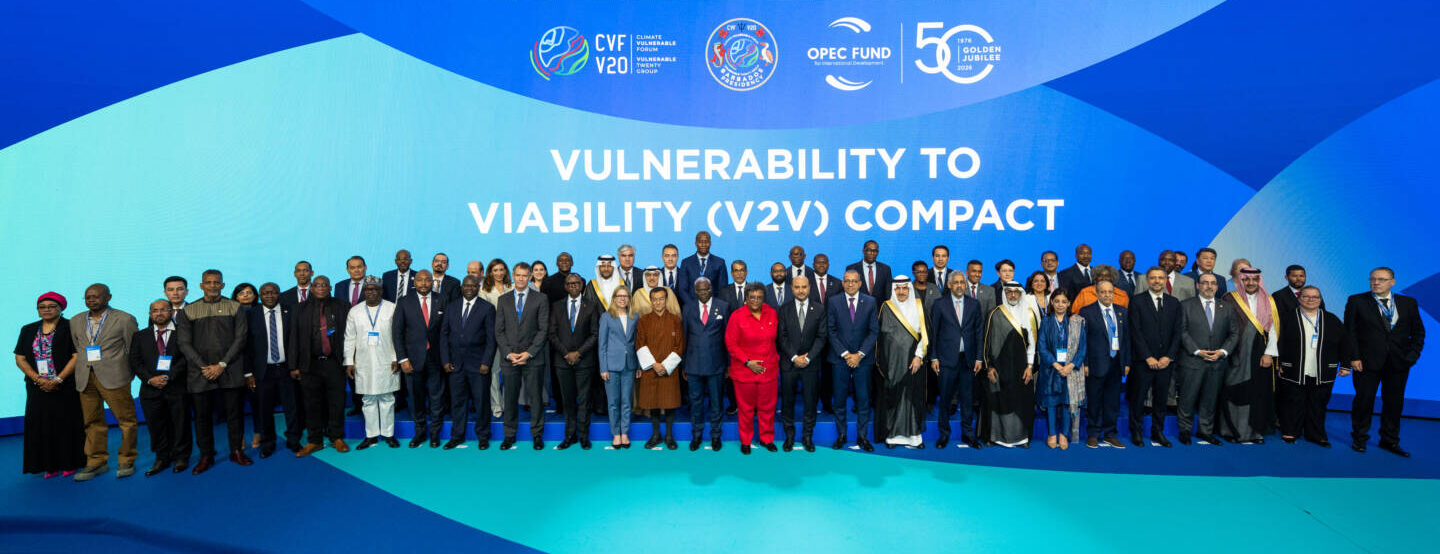
Another key agenda item is moving forward negotiations on the Vulnerability to Viability Compact, a landmark joint initiative led by the OPEC Fund for International Development, the Government of Barbados in its capacity as chair of the Climate Vulnerable Forum (V20), V20 finance ministers, and a cohort of participating development finance institutions. The compact is specifically designed to improve access to affordable, predictable and effective development financing for all 74 nations that make up the CVF-V20 bloc. Its work is structured around four central pillars: expanding access to concessional, low-interest financing; catalyzing new investment from private sector and philanthropic sources; strengthening national ownership of domestic development priorities; and scaling up debt and financing tools that can respond rapidly to climate and economic shocks.
Forum participants will also delve into a suite of innovative financing mechanisms designed to buffer vulnerable nations against crisis, including blended finance models, risk guarantees, local currency lending solutions, political risk mitigation tools, debt suspension clauses for disaster events, and emergency liquidity facilities. These tools are intended to help countries maintain access to core public services in the aftermath of natural disasters and sudden economic disruptions.
For Grenada, participation in the forum represents a critical opportunity to elevate the unique perspective of Small Island Developing States (SIDS), a group that faces disproportionately high risk of catastrophic climate disasters while operating with extremely limited fiscal flexibility and constrained borrowing capacity. The delegation’s engagement aligns with the Grenadian government’s ongoing priorities: securing affordable, long-term sustainable financing for national development projects, strengthening domestic fiscal and climate resilience, and building global partnerships to support investment in core public services and productive economic sectors.
Going into the forum, the Grenadian Ministry of Finance reaffirmed its longstanding commitment to advocating for reform of the international financial architecture, pushing for a system that acknowledges the unique structural vulnerabilities of small island states and delivers more equitable access to long-term development financing.
-
WINDREF: Invitation for Prequalification of Contractors
The Windward Islands Research and Education Foundation (WINDREF), based at St. George’s University in Grenada, has secured grant financing from the Caribbean Biodiversity Fund (CBF) to advance the transformative Telescope’s Living Shoreline (TLS) Project, a coastal resilience initiative focused on stabilizing eroding shorelines in Grenada’s Grenville Bay Area. As the project’s lead implementing agency, WINDREF has opened a prequalification round for contractors bidding to deliver the project’s core construction works, ahead of a full tender invitation expected in July 2026.
Located along the shores of Little Bay in the Telescope community, the TLS project centers on implementing nature-centered and hybrid shoreline stabilization measures to protect the vulnerable coastline from erosion and storm damage. While final design work is still underway as part of an ongoing parallel design review and optimization consultancy, the core construction scope is already outlined. The works will impact approximately 550 metres of coastal shoreline, covering activities including in-water and intertidal marine construction, installation of armour stone structures both onshore and offshore, excavation works and toe stone placement, coastal zone backfilling, temporary access road and stockpile area development with full post-construction restoration, and comprehensive quality control for all construction materials including boulders, structural blocks and fill sediment.
The prequalification process follows the formal regulations set out in Grenada’s 2014 Public Procurement and Disposal of Public Property Act and 2015 accompanying regulations, and is open to all eligible contractors, whether applying as individual firms or as joint venture (JV) partnerships. WINDREF explicitly encourages regional construction firms to partner with international specialists in both grey and green infrastructure to meet project requirements, and particularly promotes joint ventures that combine local marine construction expertise with specialized global experience in ecosystem restoration.
To qualify, bidders must meet strict financial, experience and compliance criteria. For joint venture partnerships, the lead partner is required to satisfy at least 50% of the combined financial and experience requirements, with the full JV team required to meet 100% of all standards. Financially, bidders must demonstrate a minimum average annual turnover of EC$5.4 million (equivalent to approximately US$2.0 million), calculated over the top five years of the last seven full operating years, as well as verifiable accessible cash flow or credit lines totaling at least EC$1.1 million (US$400,000).
In terms of relevant experience, bidders must have served as prime contractor on at least two similar coastal or marine construction projects completed to at least 80% progress within the last seven years, with each project valued at a minimum of EC$3.6 million (US$1.3 million). Preference will be granted to teams that can demonstrate prior experience integrating Nature-Based Solutions (NbS) such as mangrove habitat rehabilitation, vegetation-fueled dune stabilization, or eco-engineered marine infrastructure into their work. Bidders must also provide a minimum of two professional reference letters from past clients for successfully completed similar projects, a signed declaration confirming no major environmental or social compliance breaches, regulatory fines, or project suspensions related to E&S non-compliance over the last five years, and documented proof of a dedicated Health, Safety and Environment (HSE)/Safeguards Officer with prior experience implementing environmental management plans in sensitive marine coastal ecosystems.
Interested contractors can request additional project information from co-project managers Kendon James and Carol Forbes between 8 am and 4 pm Grenada local time, Monday through Friday, via the contact emails listed in this announcement. All prequalification submissions must be prepared in English, delivered exclusively via email in PDF format (with a maximum total file size of 30MB), and received by 2 pm local Grenada time on July 20, 2026. The email subject line for submissions must follow the format: “[Company Name or Abbreviation] — TLS Prequalification Documents”.
WINDREF notes that the burden of proof for confirming successful submission receipt falls to the bidding party, and a simple read receipt or sent folder confirmation from the bidder’s email system will not be sufficient to confirm delivery. The organization also reserves the right to accept or reject any late submissions, cancel the prequalification process at any stage, and is not required to provide reasoning for any prequalification outcomes. WINDREF will not cover any costs incurred by bidders during the preparation and submission of prequalification materials.