标签: Dominican Republic

多米尼加共和国

  • Dominican Republic and Hungary advance air transport cooperation agreements

    Dominican Republic and Hungary advance air transport cooperation agreements

    In a pivotal step toward deepening cross-continental cooperation, the Dominican Republic and Hungary have made substantial progress in negotiating a new bilateral aviation agreement designed to strengthen air connectivity and unlock expanded economic and tourism links between the two nations.

    The latest round of negotiations took place on April 27 at the headquarters of the Dominican Civil Aviation Board in Santo Domingo, where delegations from both countries finalized work on a preliminary memorandum of understanding. This document paves the way for the future signing of a comprehensive formal Air Services Agreement, a framework that promises to reshape air travel between the two regions.

    Under the proposed terms of the agreement, participating airlines will gain significantly greater flexibility in managing their operations. Carriers will be able to set routes, adjust flight frequencies, and determine ticket pricing based on actual market demand, rather than being constrained by restrictive bilateral regulations that have limited connectivity to date.

    The Dominican negotiating delegation was led by Héctor Porcella, head of the Dominican Civil Aviation Board, while the Hungarian team was headed by Dr. Máté Lőwinger, a senior official from the Hungarian Civil Aviation Authority. Both sides confirmed that the current initiative builds on technical discussions that were first launched back in 2019, and the renewed momentum comes in response to steadily growing travel demand between the two countries.

    Official data from the Central Bank of the Dominican Republic underscores the untapped potential of expanded air links. Between 2019 and February 2024, roughly 52,000 Hungarian tourists traveled to the Dominican Republic, a popular Caribbean vacation destination. Authorities on both sides project that a more flexible air transport agreement will not only boost tourism flows but also create new opportunities for expanded bilateral trade and cross-border investment between the two nations.

  • Mining sector leads Dominican economic growth with 7.7% expansion

    Mining sector leads Dominican economic growth with 7.7% expansion

    SANTO DOMINGO — The Dominican Republic’s mining industry emerged as the fastest-growing segment of the national economy in the first quarter of 2026, posting a 7.7% year-over-year expansion that outpaced broader economic gains, according to Energy and Mines Minister Joel Santos. Preliminary figures released by the Central Bank of the Dominican Republic put the country’s overall first-quarter economic growth at 4.1%, marking the mining sector’s outperformance by more than 3.5 percentage points. Minister Santos attributed the sector’s robust growth to elevated extraction volumes of key commodities including gold, silver, and construction-grade materials, a trend that has cemented mining’s standing as one of the nation’s leading export-driven industries. The sector closed 2025 on a strong note, with total export values exceeding $2.5 billion, and total tax contributions to the national government hitting roughly 45 billion Dominican pesos, providing substantial support to public coffers. Alongside the strong performance of mining, the minister also reported solid 3.4% growth for the broader energy sector across the first three months of 2026. This expansion has been fueled by rising domestic and commercial demand for electricity, paired with ongoing large-scale upgrades to the Dominican Republic’s national power infrastructure. Since 2020, the country’s total installed power generation capacity has jumped significantly, climbing from just 4,921 megawatts to more than 7,100 megawatts by the end of 2025. Renewable energy projects account for a large portion of this new capacity buildout, advancing the country’s goal of energy market diversification. Minister Santos highlighted ongoing strategic projects that are shaping the future of the nation’s energy sector, including the Manzanillo Power Land initiative and the rollout of expanded battery energy storage systems. These investments are designed to boost grid reliability, reduce dependence on single energy sources, and create a more resilient national power network. Looking ahead, Santos emphasized that both the mining and energy sectors will remain core pillars of the Dominican Republic’s economic strategy, continuing to draw foreign and domestic investment, shore up public finances, and support long-term, sustained economic growth across the country.

  • CUSEP reports traffic accident involving presidential advance team in Puerto Plata

    CUSEP reports traffic accident involving presidential advance team in Puerto Plata

    A Monday morning traffic collision on the Maimón-Puerto Plata highway in the Dominican Republic has left three people injured, including two members of the presidential advance security detail and one civilian, according to an official statement from the Presidential Security Corps (CUSEP). The incident was logged at 8:56 a.m. local time, involving a government-issued vehicle assigned to the presidential security unit and a privately owned civilian car that were both traveling along the same corridor at the time of the crash.

    At the time of the accident, the advance team was en route to the coastal city of Puerto Plata to finalize on-the-ground logistics preparations for an upcoming official tourism-focused event in nearby Sosúa. Dominican President Luis Abinader was scheduled to attend that event, but CUSEP officials have explicitly confirmed that the head of state was not part of the traveling convoy and was not present on the highway when the collision occurred.

    First responder and emergency medical teams mobilized rapidly to the crash site immediately after receiving the distress call. They administered on-site first aid to all injured parties before transporting them to local medical facilities for further care. As of the latest update, all three affected individuals remain under medical observation at these health centers.

    Preliminary reviews of nearby surveillance camera footage indicate that the official sport utility vehicle lost steering control, exited the paved roadway, and then struck the civilian passenger vehicle. Local law enforcement and transport authorities have opened a formal investigation to pinpoint the root cause of the crash, and have announced that additional updates on both the investigation progress and the health status of the injured will be released once more information is confirmed.

  • More than 1,000 attend debate on Islam in the Dominican Republic

    More than 1,000 attend debate on Islam in the Dominican Republic

    A controversial public forum hosted by a local Christian movement in the Dominican Republic has drawn over 1,000 attendees to Santo Domingo, centering discussion on the expansion of Islam in the country and neighboring Haiti, alongside calls for new state oversight of Islamic religious practice. The event, titled “Islam: A Threat to the Church and to the Dominican Republic?”, was held at Mahanaim Miraflores Church and organized by the Trinitarios movement, a group that frames its public advocacy around Christian and nationalist perspectives.

    The gathering brought together a cross-section of prominent Christian leaders and a sitting national legislator to unpack the topic. Heading the event were organizers Isaac B. Colón, Víctor Medina, and Robert Martínez, with a featured panel that included senior and junior pastors Ezequiel Molina Rosario, Ezequiel Molina Jr., and Junior Ponciano. Sitting Congressman Elías Wessin Chávez also joined the panel, alongside guest speaker Daniel Blanco, a former Muslim who converted to Christianity and shared his personal conversion story with attendees.

    Over the course of the forum, speakers outlined their concerns about the rising footprint of Islam in both the Dominican Republic and Haiti, warning that this growth could create unaddressed cultural and religious challenges for the Dominican national identity and the country’s majority Christian establishment. Attendees unanimously expressed public support for a draft legislative proposal put forward by Wessin Chávez that would introduce new government regulations on the practice of Islam across the nation.

    This event is not an isolated initiative, but rather part of a broader campaign by the Trinitarios movement to foster public debate on key national issues through the lens of Christian faith and Dominican patriotism, organizers confirmed. The forum’s provocative framing, which explicitly questions whether Islam poses a threat to national and religious institutions, has brought heightened attention to growing religious tension in the Caribbean nation.

  • AEI welcomes approval of real estate intermediation law

    AEI welcomes approval of real estate intermediation law

    In Santo Domingo, the Dominican Republic’s real estate sector has reached a key legislative milestone, after the national Senate gave first-reading approval to a long-awaited bill that would formalize and regulate real estate intermediation services across the country.

    The Association of Real Estate Agents and Companies of the Dominican Republic (AEI), the nation’s leading industry body for real estate professionals, has hailed the approval as a transformative step forward for the local property market. Industry leaders say the new regulatory framework will address longstanding gaps in oversight, boosting transparency, formalizing legal standards, and building greater public confidence in real estate transactions.

    Alberto Bogaert, president of AEI, extended public gratitude to the Dominican Senate for advancing the collaborative proposal. He emphasized that the core mission of the legislation is consumer protection: it will create clear safeguards for both international investors and domestic families investing in property, a demographic that makes up the large majority of participants in the local market.

    Bogaert also noted that the bill moving forward is the product of years of coordinated work between AEI members and other sector stakeholders, built on broad consensus across the organized real estate community. The legislation reflects input from agents, brokerage firms, and consumer advocates to address unregulated practices that have put buyers and sellers at risk in the past.

    Now that the bill has cleared its first reading hurdle, it proceeds to the remaining steps of the Dominican legislative process, including a mandatory second reading and review, before a vote on final approval can be held. AEI has reaffirmed its ongoing commitment to partnering with national legislative authorities, executive branch regulators, and cross-sector stakeholders to refine the bill into a balanced legal framework. The ultimate goal of the framework is to elevate industry-wide professionalism, enforce clear ethical standards for intermediaries, and establish stronger institutional oversight of the real estate brokerage sector, supporting long-term sustainable growth for Dominican real estate.

  • Dominican Republic maintains global leadership in premium cigar production and exports, says Intabaco Director

    Dominican Republic maintains global leadership in premium cigar production and exports, says Intabaco Director

    At the 26th annual Premium Cigar Association (PCA) convention, held recently in New Orleans under the banner “PCA 26: Back in the Big Easy”, a top Dominican industry official has reaffirmed the Caribbean nation’s unrivaled standing in the global premium cigar market. Speaking to industry stakeholders from around the world, Iván Hernández Guzmán, director of the Dominican Republic’s Tobacco Institute, outlined the robust production and export metrics that underpin the country’s decades-long leading position.

    Hernández Guzmán revealed that the Dominican craft cigar sector churns out more than 196 million handmade premium cigars each year. The vast majority of these luxury products are shipped to international markets, reaching consumers across 148 different countries. Among these global destinations, the United States continues to dominate as the single largest importer and consumer of Dominican premium cigars, remaining the country’s core trading partner for the high-value product.

    The official went on to highlight the key competitive advantages that set Dominican premium cigars apart from competitors around the globe. Unlike mass-produced machine-made alternatives, Dominican premium cigars have earned international acclaim for their time-honored artisanal production methods, carefully controlled aging processes, complex balanced flavors, distinctive aromatic profiles, and wide range of tobacco options.

    This reputation for quality is rooted in the country’s unique agricultural ecosystem, which supports the cultivation of several world-renowned premium tobacco cultivars. These include the iconic Olor Dominicano, Piloto Cubano, and San Vicente varieties, which form the backbone of the country’s thriving cigar manufacturing ecosystem. The sector is home to a diverse roster of established, globally recognized brands, including pioneering Dominican manufacturer La Aurora, industry giant General Cigar Dominicana, and boutique luxury producer La Flor Dominicana.

    Beyond sharing industry data, the convention served as a critical platform for Dominican cigar producers to showcase their latest releases, connect with global distributors and retailers, and expand their footprint in existing and emerging international markets. Industry observers note that the country’s continued output growth and market reach confirm its status as the undisputed global hub for premium handmade cigar production.

  • Abinader inaugurates Bajo Yuna Road Circuit connecting Duarte and María Trinidad Sánchez

    Abinader inaugurates Bajo Yuna Road Circuit connecting Duarte and María Trinidad Sánchez

    Dominican Republic President Luis Abinader has formally opened the transformative Bajo Yuna Road Circuit, a 49-plus kilometer infrastructure project that bridges Duarte Province and María Trinidad Sánchez Province in a long-awaited upgrade for the underserved Lower Yuna region.

    Delivered by the nation’s Ministry of Public Works and Communications, the project comprises 42.8 kilometers of primary highway and an additional 6.2 kilometers of feeder roads connecting local settlements. It links a string of previously disconnected communities—including La Reforma, Las Coles, La Jagua, El Jobo, and La Garza—to critical national transport routes, namely the Juan Pablo Segundo Highway and the Nagua–Samaná road. For more than 20,000 people living in these areas, the new connection cuts travel times and removes long-standing barriers to accessing essential public services, from hospital care to primary and secondary schooling, as well as regional commercial markets.

    Beyond connecting people, the roadway is designed to revolutionize the movement of the region’s key agricultural exports, most notably rice and cocoa. Speaking at the inauguration ceremony, Public Works Minister Eduardo Estrella emphasized that streamlined logistics will directly strengthen the sector’s competitiveness, with rice producers set to see the most significant gains from reduced transit costs and faster delivery times.

    Project planners also prioritized climate resilience in response to the Lower Yuna region’s history of frequent flooding. Custom drainage systems were integrated into the circuit’s design to ensure the route remains passable through heavy rain and flood events, delivering reliable connectivity year-round rather than just during dry seasons.

    Local community leaders have welcomed the infrastructure as a game-changer for the region. They note that the elimination of transport bottlenecks will lift local agricultural productivity, open new economic opportunities for smallholder producers, and lay the foundation for broad-based, sustainable development across the entire Bajo Yuna catchment area.

  • Abinader inaugurates RD$281 million highway project in Las Gordas, Nagua

    Abinader inaugurates RD$281 million highway project in Las Gordas, Nagua

    After more than half a century of unmet community demands, Dominican Republic President Luis Abinader has officially opened the 13.8-kilometer Mata Bonita–Los Memisos highway in Nagua’s Las Gordas district, delivering a transformative infrastructure upgrade to María Trinidad Sánchez Province.

    The new highway, constructed by the Dominican Hydroelectric Generation Company (EGEHID) with a total investment of over 281 million Dominican pesos (approximately US$5 million), delivers connectedness gains to four key rural communities: Los Memisos, Mata Bonita, Los Guayabitos, and Las Catalinas. Beyond improving daily travel for local residents, the route also cuts travel time to the Rosa Julia de la Cruz, commonly known as Boba, hydroelectric power plant, streamlining access for facility operations and maintenance.

    Engineers and construction crews outfitted the highway with a full suite of safety and accessibility features, including full asphalt paving, reinforced drainage networks, culverts for water runoff management, concrete curbs, clear road signage, strategically placed speed bumps, and reinforced slope protection to prevent erosion and landslide risks. These upgrades are designed to reduce accident rates and support smoother, more reliable traffic flow year-round, even during extreme weather events common to the region.

    Speaking at the inauguration ceremony, EGEHID administrator Rafael Salazar emphasized that the project is fully aligned with the administration’s core priorities to uplift underserved vulnerable communities across the country. Salazar noted that improved road infrastructure will strengthen emergency response capabilities for medical and disaster events, cut commute times for students traveling to local schools, and reduce transportation costs for small-scale agricultural producers looking to get their crops to regional markets.

    Local community leaders and residents have praised the initiative, noting that the new highway ends decades of geographic isolation for the area’s rural populations. Stakeholders highlighted that enhanced connectivity will unlock new economic opportunities, attract small business investment, and lay the groundwork for long-term sustainable development across rural María Trinidad Sánchez Province. The completion of the project marks a key campaign promise fulfilled by the Abinader administration, demonstrating its commitment to delivering public infrastructure improvements to underserved regions outside the country’s major urban centers.

  • A trough will generate downpours and thunderstorms across much of the country this Sunday.

    A trough will generate downpours and thunderstorms across much of the country this Sunday.

    On Sunday, the Dominican Institute of Meteorology (Indomet) issued an official update warning that a low-pressure trough will shape nationwide weather conditions, bringing a period of widespread rain that will ramp up through the day and stick around for the coming days.

    The wet weather is set to kick off in the early pre-dawn hours, with gradual building cloud cover and scattered light to moderate showers moving across the northwestern portion of the country by morning. Meteorologists specifically flagged Santiago Rodríguez, Montecristi, and Puerto Plata as the first provinces to see measurable rainfall as the system moves into the country.

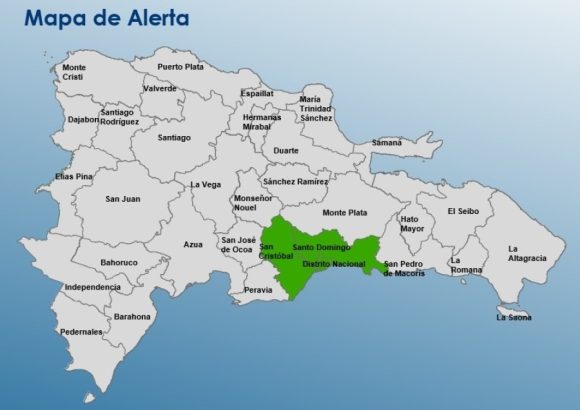
    By mid-afternoon, conditions will worsen thanks to a combination of the existing trough and daytime atmospheric warming, which will supercharge cloud development and precipitation. Forecast models call for widespread thick cloud cover, followed by moderate to heavy downpours, rolling thunderstorms, and sudden gusty winds that will last into the early evening. A long list of provinces across the north and border regions are in the highest-risk zone, including Hato Mayor, Monte Plata, Sánchez Ramírez, Duarte, Hermanas Mirabal, María Trinidad Sánchez, and Espaillat.

    In response to the projected severe weather, Indomet’s National Forecast Center has issued formal weather advisories and alerts across multiple at-risk provinces. The main hazards highlighted are urban flooding, rapid rises in river and stream water levels, and an elevated risk of landslides in vulnerable terrain.

    For the Greater Santo Domingo area, forecasters predict mostly scattered cloud cover through most of the day, though they note that occasional thicker cloud formation and unexpected passing showers can not be completely ruled out. Across the entire country, temperatures will remain unseasonably hot despite the cloud cover and rain, with overnight lows ranging from 22°C to 23°C and daytime highs reaching between 29°C and 31°C.

    Indomet stressed that the weather pattern driven by the trough will not move on after Sunday, and that similar conditions – most notably afternoon rain and thunderstorms – will persist over the coming days. The agency has urged the general public to remain vigilant, keep updated with the latest official weather bulletins, and follow any safety guidance issued by local emergency management authorities.

  • “We are overcoming many challenges”: Government says it is adopting suggestions in the face of the economic crisis

    “We are overcoming many challenges”: Government says it is adopting suggestions in the face of the economic crisis

    Against the backdrop of global economic volatility sparked by escalating tensions between the United States and Iran, the Dominican government has announced that its specially designed economic mitigation plan and targeted measures have delivered positive results, helping the nation navigate a series of mounting economic challenges in recent weeks.

    The announcement came following a closed-door meeting between a government-led commission and representatives of the Dominican evangelical church. Speaking on behalf of the administration, Eduardo (Yayo) Sanz Lovatón, the country’s Minister of Industry, Commerce, and MSMEs, confirmed that the undisclosed strategic plan has driven a 5% expansion of the Dominican economy through the month of March.

    Lovatón emphasized that even amid the broader international crisis, the government’s interventions have performed as intended, producing tangible gains for the national economy. Beyond overall growth, the measures have successfully curbed runaway inflation, shielded domestic production networks from external shocks, and delivered a historic milestone for the country’s trade sector: March 2025 marked the highest monthly export volume in Dominican Republic’s recorded history.

    While acknowledging that policymakers cannot anticipate every future economic shift, Lovatón noted that disciplined implementation of the special measures has already allowed the country to push past multiple unforeseen obstacles. He added that March’s growth rate was the strongest recorded in 17 months, a statistic he says reflects well on the current administration’s crisis management capabilities, even as officials remain committed to proceeding with deliberate caution amid ongoing global uncertainty.

    The intersectoral dialogue commission, operating under direct instructions from Dominican President Luis Abinader, has now held roughly five consultations with stakeholders across all segments of Dominican society, including political opposition leaders, private business association representatives, and religious groups. Throughout these sessions, the commission has collected and reviewed hundreds of policy proposals from participants.

    José Ignacio Paliza, Minister of the Presidency, confirmed that the administration has already integrated a number of these public suggestions into its official crisis response framework. For example, following a previous meeting, stakeholders proposed expanding access to affordable financing for small and medium-sized agricultural enterprises, a policy the government has already begun rolling out. Paliza explained that each consultation brings fresh perspectives and insights that allow the administration to refine its approach, addressing gaps that may have been overlooked in initial planning.

    Going forward, both Lovatón and Paliza confirmed that the inclusive dialogue process will continue. The commission’s next session, scheduled for the following Monday, will bring together leaders from the country’s major labor unions to hear their priorities and proposals. Lovatón noted that the government will maintain its practice of regular consultation with business, political, labor, and religious sectors, and will continue to release public updates on policy adjustments as the administration works to sustain economic progress through the ongoing crisis.