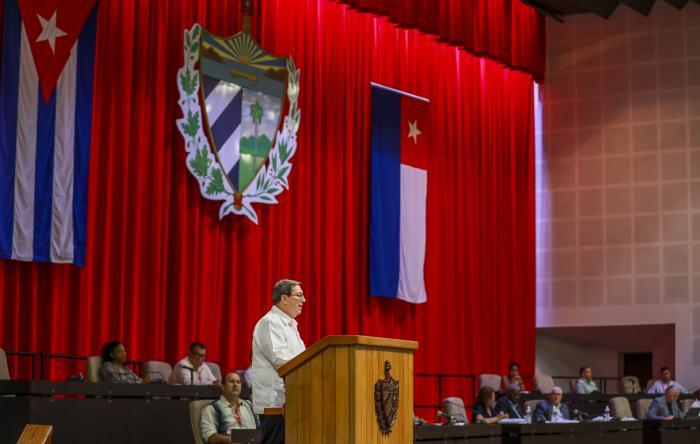
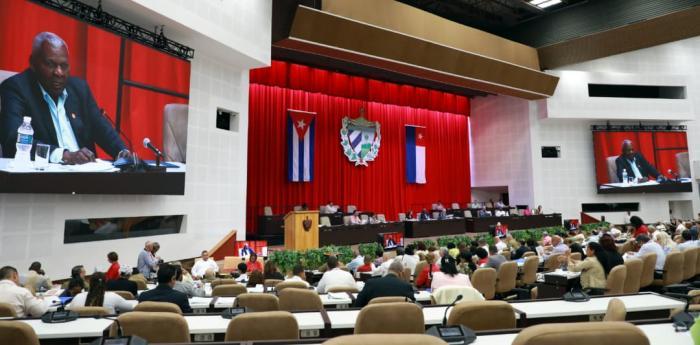
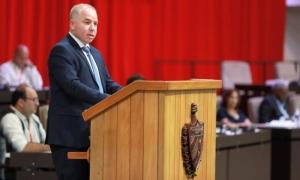
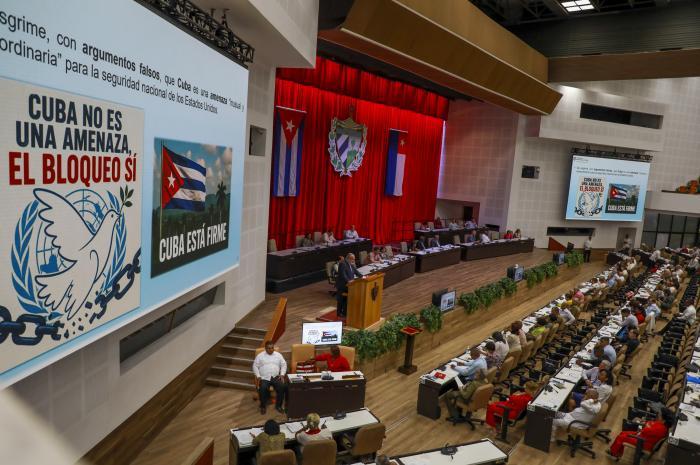
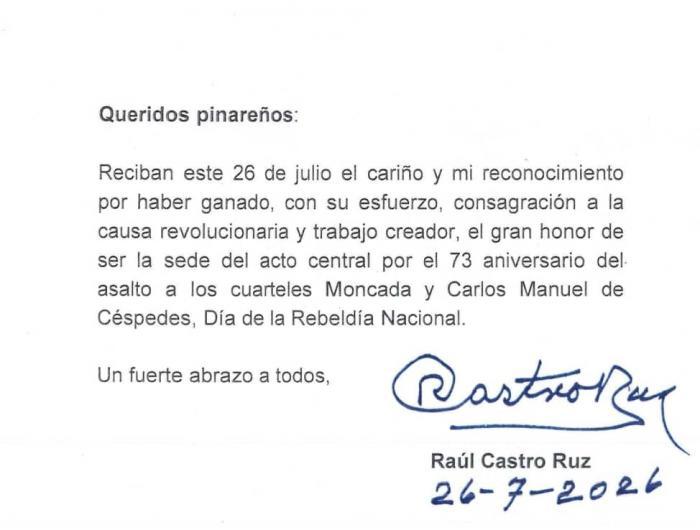
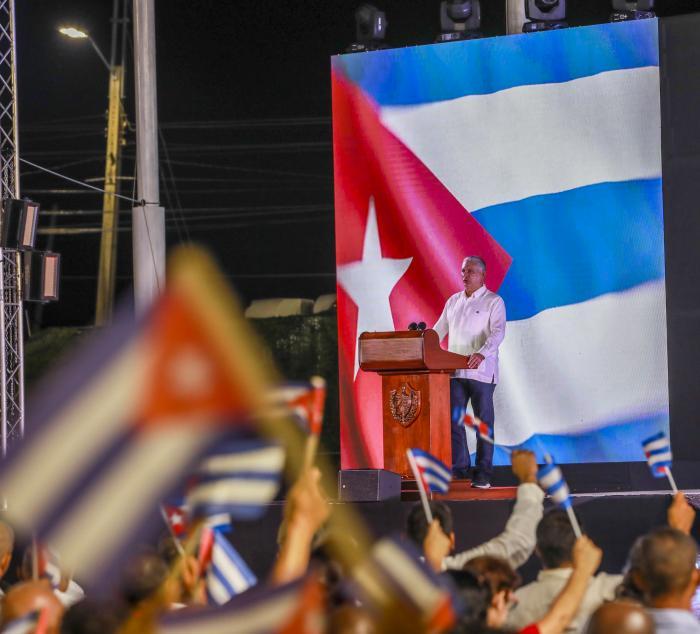
In a formal address delivered July 30 at the 7th Ordinary Session of the 10th Legislature of Cuba’s National Assembly of People’s Power, Cuban Foreign Minister Bruno Rodríguez Parrilla issued a clear, firm statement: Cuba poses no threat to the United States, and has never sought to be an adversary or enemy of the northern power. The address, delivered before senior Cuban leaders including revolutionary leader Army General Raúl Castro Ruz, First Secretary and President Miguel Díaz-Canel, and other top government and party officials, laid out Cuba’s perspective on the deteriorating global geopolitical landscape and escalating U.S. hostility toward the island nation.
Rodríguez opened by noting that President Díaz-Canel’s July 26 address already detailed what he described as the genocidal actions of the U.S. government against the Cuban people, and the July 7 United Nations General Assembly deliberations on the issue had already clarified global sentiment, reducing the need to rehash well-documented points. He praised the National Assembly, its Council of State, the International Relations Committee, and its deputies for their consistent, critical role in advancing Cuba’s foreign policy and expanding the country’s global ties.
The foreign minister emphasized that the international context in which Cuba’s revolution defends the interests of its people has worsened dramatically in recent years. He argued that the U.S. government has intentionally sought to dismantle international law, the United Nations Charter, and the 80-year-old framework of state-to-state relations forged after World War II, which was built on the core principles of sovereign respect and equality between nations.
Rather than abiding by these established norms, Rodríguez said, Washington has leveraged temporary coercive power to force its will on sovereign governments around the world, relying on intimidation, coercion, unilateral sanctions, and punitive trade measures to override constitutional and sovereign rights. He charged that the U.S. has resorted to unprovoked military aggression, unjustified wars, civilian bombing, the abduction of sitting heads of state, political assassination, state-sponsored terrorism, and both overt and cognitive unconventional warfare to achieve its geopolitical goals.
This behavior, he argued, is rooted in a dangerous doctrine the U.S. calls “peace through force” — a philosophy he traced back to the violent conquest, extermination, slavery, ethnic cleansing, and colonial domination that shaped centuries of Western imperial expansion. He drew parallels between this modern doctrine and the violent expansionist ambitions of Nazi Germany in the 20th century, the 19th-century Monroe Doctrine, and contemporary U.S. efforts to redraw the geopolitical map of the Indo-Pacific, Middle East, and expand NATO influence.
In recent weeks, Rodríguez noted, the U.S. has revived the anti-communist witch hunts of the McCarthy era as official government policy, after decades of public condemnation of that period of political repression. He pointed to a hastily summoned summit of dozens of foreign ministers in Washington that was dedicated to launching a new campaign against what Washington frames as a “resurgence of far-left terrorism” — a vague new label that follows previous manufactured constructs such as “narco-terrorism,” which he reminded the audience was used to justify brutal U.S.-backed right-wing dictatorships and Operation Condor across Latin America in the Cold War era.
Shortly after that summit, the U.S. State Department released a sweeping report on Cuba that Rodríguez dismissed as superficial, factually inconsistent, and deliberately dishonest. The report, he said, attempts to frame Cuba as a unique security threat to the United States — a claim he called absurd on its face, given that Cuba is a small island nation facing the world’s largest nuclear military power. Beyond the inherent absurdity of the claim, he argued, the real goal of the report is to criminalize and suppress the widespread solidarity with Cuba that exists across multiple sectors of U.S. society. It also seeks to condemn Cuba’s longstanding support for global justice movements, including civil rights, anti-racism, anti-Zionism, anti-war, and anti-oppression causes, question Cuba’s inherent right to self-defense against imperial aggression, and discredit Cuba’s internationalist and humanitarian work around the world, including its historic efforts to oppose apartheid and support liberation movements across Africa. Ultimately, Rodríguez said, the U.S. labels Cuba a threat simply because it exists as a durable, dignified alternative to unregulated capitalism and imperialism that stands for global social justice.
Rodríguez recalled a 2021 statement from former Mexican President Andrés Manuel López Obrador, who praised Cuba’s 62 years of unbowed resistance to U.S. pressure as a historic feat, calling the island “the new Numantia” and arguing the Cuban people deserved recognition for their unwavering defense of national sovereignty. That example of independent resistance, Rodríguez said, is what the U.S. finds dangerous, amplified by the ongoing thirst for revenge from the descendants and allies of the former Batista dictatorship — a regime responsible for the murder of an estimated 20,000 Cubans, and whose allies included the mercenaries defeated at the Bay of Pigs, and perpetrators of terrorist attacks, biological warfare attempts, and efforts to draw the world into a nuclear conflict over Cuba. He drew a direct line between these anti-Cuban forces and 19th-century Spanish colonial general Valeriano Weyler, who oversaw a brutal reconcentration policy that killed hundreds of thousands of Cubans, and Lester Mallory, the U.S. architect of the blockade policy designed to “provoke suffering and despair” to overthrow Cuba’s revolutionary government.
Today, the U.S. — the world’s largest economic and military power — uses its aggressive posture to force compliance from many nations seeking to conduct their own domestic and foreign policy, Rodríguez said. This coercive power has allowed the U.S. to drastically escalate its decades-long economic war and collective punishment against Cuba, tightening a full energy embargo to strangle Cuba’s ability to trade with third countries and cut the island off from the global economy. Rodríguez rejected U.S. claims that no energy embargo exists, that Cuba previously received free oil, that the decades-long blockade is a myth, or that it does not violate the sovereignty of other nations — calling these claims blatant falsehoods.
While this scenario of escalating pressure is dangerous and unsustainable in the medium term, Rodríguez said, Cuba has no choice but to endure the growing destructive force of U.S. aggression. He echoed President Díaz-Canel’s recent warning that Cuba is currently fighting a historic battle, a “new Moncada” against a genocidal U.S. policy that seeks to suffocate the entire Cuban population to seize control of the country.
Even amid this pressure, Rodríguez emphasized, Cuba maintains broad, deep, and largely friendly cooperative relations with nations across the globe, built on mutual respect even with the small number of countries that hold political differences with Havana. Global public opinion overwhelmingly rejects the U.S. blockade, he noted: the 136-9 vote in favor of debating the blockade at the July 7 UN General Assembly, held despite widespread U.S. intimidation of member states, offers clear proof of where the global community stands.
Recalling the words of Cuban independence hero José Martí, Rodríguez noted that “Whoever rises up for Cuba today, rises up for all time.” Silence, indifference, or the pursuit of narrow self-interest in the face of U.S. aggression against Cuba endangers all of humanity, he warned: any nation could be the next target unless the global community acts collectively to halt this pattern of behavior. If U.S. citizens had access to accurate, unfiltered information about Cuba, he added, they would be able to stop the catastrophe their government is threatening to inflict on the island and the world.
Rodríguez echoed revolutionary leader Raúl Castro’s January 1, 2024 statement that the U.S.’s permanent hostility and blockade policy remains the primary cause of Cuba’s ongoing economic difficulties, a reality the U.S. spends millions of dollars to obscure. Cuban people understand full well that the U.S. is implementing a deliberate, step-by-step plan to cut off Cuba’s access to foreign revenue, global markets, technology, and essential supplies including food and medicine, he said. Since January 2026, this campaign has included a total energy embargo that blocks imports of fuel, electricity generation components, solar panels, and all related inputs and technology for power production.
Cubans also remain acutely aware that the threat of direct U.S. military aggression has not gone away, Rodríguez said. While it is difficult to imagine any plausible pretext for such a criminal, irresponsible act, the anti-Cuban lobby in Washington has shown no limit to its aggressive appetite. These are the same actors, he noted, that celebrate the suffering of Cuban people: a mother losing a child for lack of medical supplies, widespread blackouts, water shortages, uncollected garbage, and disrupted public transportation are all framed as policy wins for the anti-Cuba movement.
Rodríguez emphasized that the U.S. government is fully aware of Cuba’s consistent willingness to resolve bilateral differences through dialogue, based on mutual respect, and that Cuba has exercised extraordinary patience in pursuing diplomatic solutions. He noted that Cuba has even accepted a small U.S. offer of so-called “humanitarian aid,” despite widespread U.S. lies and manipulation, even though the total amount offered only covers five days of the economic and social damage caused by the U.S. blockade. The sum is even smaller than the aid Cuba receives from the World Food Programme — aid the U.S. has repeatedly tried to block. Accepting this aid from a government that is actively working to create a humanitarian crisis on the island demonstrates Cuba’s good faith, he argued.
At its core, the U.S. government’s true intentions are not revealed by offers of dialogue or token aid, but by its relentless coercion and determination to inflict maximum punishment on the Cuban people to force their surrender, Rodríguez said. He repeated his core message: Cuba is not a threat to the United States, and has no desire to be an enemy or adversary. Cuba’s core vocation is peace, a commitment demonstrated by its broad global relations and the 2023 Proclamation of Peace for Latin America and the Caribbean, signed by all regional heads of state and government in Havana.
Cuba’s only commitment is to the Cuban people, and its mandate comes directly from the full and absolute sovereignty of the Cuban nation, he said. Cuba has both the right and the duty to reject and confront aggression that threatens its people, and retains the supreme right to defend itself — including by military means — if it is directly attacked. Rodríguez reaffirmed that Cuba continues to aspire to a respectful, constructive relationship with the U.S. in the long term, and is willing to take steps toward that goal, but only on the basis of full, absolute respect for the sovereign rights of both parties, the standard that governs all normal relations between sovereign states.
Turning to the large community of Cuban compatriots residing in the U.S., Rodríguez said Cuba continues to work to strengthen ties with Cubans living abroad, expand opportunities for them to connect with their homeland and their families. Most government reforms adopted in recent years are designed to support this, he said, based on the shared conviction that Cubans living anywhere in the world can play a valuable role in national development, whether they contribute from abroad or choose to return to Cuba. Ongoing economic and social transformations are expanding these opportunities even further, he added.
Rodríguez closed by expressing profound gratitude for the widespread international solidarity with Cuba from all continents. He thanked governments, parliaments, international organizations, fraternal groups, social movements, political parties, business leaders, solidarity associations, civil society groups, intellectuals, artists, academics, and ordinary people of all political and ideological backgrounds for their unconditional humanitarian aid and support, and their rejection of the injustice being inflicted on Cuba.
Recalling a 1963 statement from revolutionary leader Fidel Castro, four years after the triumph of the revolution, Rodríguez repeated Castro’s promise that Cuba would continue to resist the imperialist blockade for as long as necessary, that the revolutionary flag would never be lowered, and that the Cuban nation would never bow its head. Today, on the centennial of Fidel Castro’s birth, Rodríguez reaffirmed Castro’s vision that a better world is possible — a world without cruel blockades that kill men, women, and children “like silent atomic bombs.” Castro’s vision of a better world built through revolutionary and progressive struggle continues to sustain Cuban optimism, and the certainty of eventual victory, even amid the extreme challenges the country faces today.
Closing with the words of José Martí, Rodríguez repeated that “before giving up the effort to make the Homeland free and prosperous, the South Sea will join the North Sea, and a snake will be born from an eagle’s egg.” He ended with the iconic revolutionary slogans: “Socialism or Death! Homeland or Death, We will prevail!”