标签: Belize

伯利兹

  • Port Immigration Officer Charged with Extortion

    Port Immigration Officer Charged with Extortion

    In a developing law enforcement case out of southern Belize, a serving port immigration officer has been formally charged with extortion following allegations that he extracted a $6,000 bribe from a local shipping agent. The incident unfolded at Big Creek Port, located in the Stann Creek District, with the formal arrest and charges announced in early October 2026.

    According to senior law enforcement officials, the investigation traces back to a complaint filed on September 8 by Daniela Cardenas, a shipping agent based in the nearby town of Independence. Cardenas told investigators that she was directly contacted by the immigration officer, who demanded the $6,000 payment in exchange for processing entry for six crew members who were being held aboard a cargo vessel docked at the port.

    After complying with the demand and transferring the full $6,000 sum to the officer, Cardenas grew suspicious when she was not provided with any official receipt or documentation to confirm the payment. To confirm whether the funds had actually been received by the relevant authorities, she reached out to a separate contact within the port system to verify the transaction, according to Assistant Commissioner of Police Hilberto Romero.

    “She made arrangements and paid an immigration officer six thousand dollars. She then contacted another person to verify if they had received this payment as no receipt had been given to her,” Romero stated in an official press briefing on the case.

    Once Cardenas came forward with her formal complaint, law enforcement launched an immediate undercover investigation, during which investigators obtained surveillance video footage and compiled multiple pieces of corroborating evidence linking the officer to the extortion scheme. That evidence allowed officers to take the suspect, identified as Ruben Requena, into custody and file formal extortion charges against him.

    The case took a more serious turn with additional allegations that Requena threatened Cardenas after she came forward, warning her that retaliation would follow if she moved forward with a formal statement to police. “Requena allegedly threatened Cardenas, telling her that if she made a statement, ‘the matter would not be left like that,’” Romero confirmed.

    Law enforcement officials confirmed Wednesday that investigators are currently following up on this separate intimidation allegation, which could lead to additional criminal charges being filed against Requena as the probe continues. Police have not yet announced whether Requena has retained legal representation, or entered a plea to the existing extortion charge, and the investigation remains active as law enforcement works to uncover any potential links to other corrupt activities at the port.


  • Police Identify Possible Motive For Latest Murder

    Police Identify Possible Motive For Latest Murder

    A multi-day manhunt is underway in Sand Hill Village for a gunman suspected of killing 21-year-old Jahrule Gibson, with local law enforcement confirming a long-running personal rivalry as the likely trigger for the fatal shooting.

    The shooting took place on Friday, October 2, just days before authorities publicly outlined their working theory of the crime on October 5. According to police spokesperson Romero, both the victim and the prime suspect are already known to local law enforcement, though the alleged attacker remains at large as of the latest update.

    Details from the preliminary investigation paint a clear picture of the lead-up to the violence: Gibson had left his home roughly half an hour before the attack, traveling alongside another man on horseback to a local shop. While en route or at the location, a gunman disguised in a black hoodie and dark long trousers opened fire on Gibson before escaping the scene in a silver sport utility vehicle. First responders and crime scene investigators later recovered 13 spent 9mm bullet casings from the area where the shooting occurred, a key piece of evidence for the ongoing investigation.

    Romero confirmed that the attack stemmed from an ongoing dispute between Gibson and the suspect rooted in local tensions in Sand Hill Village. “They had some rivalry in that area, and that is what led to the shooting,” Romero stated in an official briefing to reporters. Police have not released additional details about the suspect’s identity or the exact nature of the rivalry, citing the active status of the manhunt to avoid compromising the investigation.

    Local residents have been urged to contact police with any information regarding the suspect’s whereabouts or the events of October 2 that could help investigators bring the case to a close.

  • Neighbors Tighten Borders After Russian Plague Lab Death

    Neighbors Tighten Borders After Russian Plague Lab Death

    In the wake of the death of a 28-year-old researcher at a Siberian anti-plague research institute, multiple neighboring countries have ramped up public health protocols along their borders with Russia, despite official Russian statements insisting the death had no connection to any dangerous pathogen the scientist worked with, UK outlet The Sun has reported.

    The researcher, identified by The Sun as Daria Shipilova, was employed at the Irkutsk Anti-Plague Research Institute serving Siberia and the Russian Far East. She died on October 2, according to unconfirmed reports that she suffered a fatal infection after accidentally breaking a glass vial holding live plague bacteria. Russian authorities have repeatedly pushed back on these claims, stating that the researcher died from pneumonia with an as-yet undetermined origin. To date, Russian officials have not confirmed the researcher’s name nor verified that any lab accident involving plague pathogens took place.

    In response to widespread public concern over the incident, Central Asian states have moved quickly to implement preventive border measures. Kyrgyzstan has upgraded sanitary inspection protocols at all land border crossings with Russia, while Kazakhstan and Uzbekistan have rolled out targeted precautionary health checks for travelers entering from the affected region. Mongolia, which shares a long northern border with Russia, already maintains heightened health screening in all border adjacent areas, and has kept these precautions active following the news of the researcher’s death.

    Russia’s federal public health watchdog Rospotrebnadzor released an official update over the weekend stating that exhaustive diagnostic testing found no trace of the pathogens the institute studies in the researcher’s samples. The agency has not yet announced a confirmed cause of death, nor has it acknowledged that any infectious disease outbreak linked to the lab is ongoing.

    Biological security expert Dr. Andrew Weber, who has first-hand experience inspecting anti-plague laboratories across the former Soviet Union, told The Sun that global public health agencies should consider proactive screening for travelers arriving from the region, given Russia’s lack of a transparent explanation for the death. “If I were a public health authority in London, I would be monitoring flights and passengers coming from the region and screening them at the airport,” Weber said in his interview with the outlet.

    The United States has also stepped in to monitor developments, with Secretary of State Marco Rubio confirming that Washington is keeping close track of the situation. The Sun reports that the Trump White House issued a brief statement confirming the administration is aware of the reported incident, actively monitoring updates, and assessing what policy or public health actions may be needed going forward.

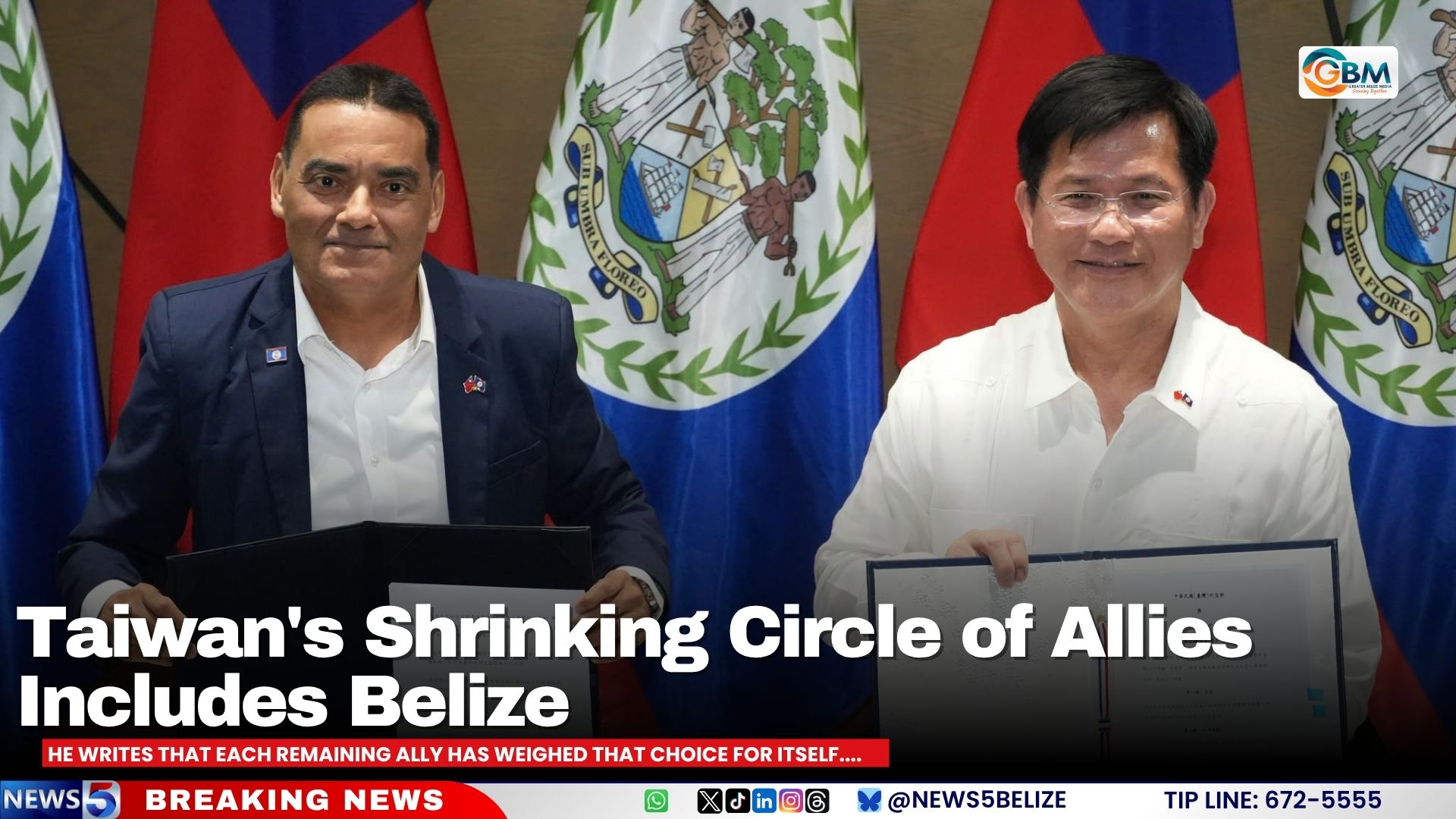
  • Taiwan’s Shrinking Circle of Allies Includes Belize

    Taiwan’s Shrinking Circle of Allies Includes Belize

    A new analysis from United Press International correspondent Thomas R. Field, published October 6, 2026, paints a clear picture of Taiwan’s shrinking network of formal diplomatic partners, with Belize standing as one of the handful of remaining nations that still maintain official ties with the self-governing island.

    As of 2026, only 12 sovereign governments across the globe recognize Taiwan diplomatically, according to Field’s research. Seven of these allies are located across Latin America and the Caribbean, and this bloc has repeatedly pushed for Taiwan’s inclusion in United Nations frameworks in recent months. On September 18, top UN diplomats from Belize, Saint Lucia, Saint Vincent and the Grenadines, Palau, and the Marshall Islands co-signed a formal letter addressed to UN Secretary-General António Guterres, advocating for what they called Taiwan’s “meaningful participation” in global intergovernmental systems. Just one week later, during the annual general debate of the UN General Assembly, three additional allied leaders—Paraguayan President Santiago Peña, Palauan President Surangel Whipps Jr., and Eswatini’s King Mswati III—echoed this call in their plenary addresses to the assembly.

    Beyond Belize, Taiwan’s active diplomatic partners in the Latin America and Caribbean region include Paraguay, Guatemala, Haiti, Saint Kitts and Nevis, Saint Lucia, and Saint Vincent and the Grenadines. This list has shrunk dramatically over the past decade: Taiwan lost formal ties with Panama in 2017, followed by the Dominican Republic and El Salvador in 2018, Nicaragua in 2021, and most recently Honduras in 2023, all of which switched their diplomatic recognition to Beijing in line with the One-China principle.

    Field’s analysis notes that for Belize, the diplomatic relationship with Taiwan has yielded tangible economic benefits. After more than two years of coordinated technical and regulatory negotiations, Taiwan gave formal approval for Belizean shrimp exports to enter its market in July 2025. This access opens a major new opportunity for Belize’s seafood industry: between 2020 and 2024, Taiwan’s annual shrimp imports averaged more than $349 million, creating significant demand for foreign suppliers.

    Across all its remaining regional allies, Taiwan has rolled out a suite of targeted economic and development cooperation projects, organized under a government initiative called the Diplomatic Allies Prosperity Project. Launched in 2024 by Taiwanese Foreign Minister Lin Chia-lung, the initiative spans a range of sectors: it includes semiconductor skills training programs in Guatemala, sustainable rice production projects in southern Haiti, infrastructure and medical support for hospitals and port facilities in Saint Vincent and the Grenadines, and the “Seven Crops Project” in Saint Lucia, which aims to boost local food production and cut the island nation’s reliance on imported food. To expand the initiative’s private sector reach, Taiwan’s foreign ministry launched a dedicated economic and trade office in July 2026, focused on connecting Taiwanese private businesses with investment and market opportunities in allied countries.

    Despite these ongoing cooperation efforts, Field emphasizes that every remaining diplomatic ally of Taiwan faces unavoidable trade-offs. China holds the position of the world’s second-largest national economy, and it is a top trading partner for nearly every country across the Latin America and Caribbean region. Beijing has long enshrined the One-China principle—under which it asserts that there is only one China in the world, and Taiwan is an inalienable part of its territory—as a non-negotiable condition for establishing any formal diplomatic relationship with Beijing. In the end, Field concludes, each of the 12 remaining allies has made a sovereign calculation to continue its formal ties with Taiwan, weighing the benefits of that relationship against the geopolitical and economic trade-offs that come with rejecting Beijing’s One-China condition.

  • Civil Registry Services Restored at VSU Offices, Online Portal Remains Down

    Civil Registry Services Restored at VSU Offices, Online Portal Remains Down

    A cybersecurity incident that disrupted civil registration operations in Belize last week has prompted a partial restoration of services, with in-person access to Civil Registry and Vital Statistics (CRVS) services now available at all Vital Statistics Unit (VSU) offices across the country, while the official online CRVS portal remains offline amid ongoing security assessments.

    The disruption traces back to routine system maintenance conducted last week, during which technical teams detected unauthorized access to the CRVS infrastructure. Immediately following the discovery, officials took the entire online platform offline to conduct a full review of the breach and implement necessary security measures. Officials initially projected that full service restoration would be completed by October 5, 2026, contingent on the successful completion of all security checks.

    In a recent public statement, the Government of Belize confirmed that citizens can now access all standard CRVS services in person, either at the VSU’s main headquarters in Belize City or at any district-level VSU office across the nation. Trained staff are on-site to assist with all public requests, from birth and marriage registration to obtaining official vital documents.

    Meanwhile, the online portal hosted at crvs.gov.bz remains temporarily unavailable as cybersecurity and technical teams continue their comprehensive system assessment, security auditing, and validation procedures. The VSU has stated that it will issue a new public announcement once the assessments are successfully completed and the online portal is cleared for a full restoration of digital services.

    The incident underscores the growing cybersecurity risks facing government digital infrastructure in small developing nations, and officials have emphasized that security takes priority over a rushed restoration of online services to protect sensitive personal citizen data stored in the CRVS system.

  • Bolsonaro Beats Poll Projections as Brazil Heads to Lula Runoff

    Bolsonaro Beats Poll Projections as Brazil Heads to Lula Runoff

    On Sunday, Brazil’s first-round presidential voting concluded with no candidate clearing the 50% vote threshold needed for an outright win, setting the stage for a high-stakes October 25 runoff between incumbent President Luiz Inácio Lula da Silva and Flávio Bolsonaro, the eldest son of former Brazilian president Jair Bolsonaro.

    Together, the two leading candidates captured more than 92% of the total first-round vote, in a result that defied pre-election forecasting: Flávio Bolsonaro far outstripped poll projections, netting a nearly four-point advantage over the first-round performance his father posted in the 2022 election. Running on a platform centered on public safety and economic policy, Bolsonaro secured victory in two of Brazil’s most electorally significant states: São Paulo and Minas Gerais.

    Notably, Minas Gerais holds a decades-long track record of backing the eventual winner of every presidential election held since Brazil’s return to democracy in 1989. For Lula, the first-round results carried clear warning signs: his vote share in Minas Gerais dropped to 43.21%, down from 48.3% he won in the state in 2022. The incumbent also failed to build the commanding lead in Brazil’s Northeast, his traditional political stronghold, that his campaign had targeted ahead of the first round.

    The outcome of the upcoming runoff will likely be shaped by two key blocs of voters: the supporters of the eight minor candidates eliminated in the first round, who collectively captured 7.82% of the vote, the vast majority of whom lean center-right or right, and the roughly 21% of eligible Brazilian voters who abstained from Sunday’s voting. Bolsonaro enters the second round with significant momentum, as his right-wing party and its ideological allies captured a large number of Senate seats and won several key state governorship races across the country.

    International backing for Bolsonaro has already come from two high-profile conservative leaders: former U.S. President Donald Trump and Argentine President Javier Milei. But observers have noted that Trump has kept a noticeably low profile in his support for the candidate recently. Peruvian political analyst Farid Kahhat told CNN this deliberate restraint is likely a strategic move.

    “They’ve noticed that in Brazil, [external interference] might not work the same way as it does in Honduras or Colombia,” Kahhat explained.

    CNN’s political analysis notes that a Flávio Bolsonaro victory in the runoff would deliver a key ideological ally to Trump in Latin America’s largest nation, should Trump win a second U.S. presidential term. Such an outcome would also potentially strengthen the United States’ position as it works to counter China’s growing diplomatic and economic influence across the Western Hemisphere.

  • Police Hunt Gunman Who Killed Jahrule Gibson

    Police Hunt Gunman Who Killed Jahrule Gibson

    A widespread manhunt is ongoing in Belize’s Belize District after a late-night shooting left 28-year-old Jahrule Gibson dead while he cycled through the quiet community of Sand Hill Village Friday evening. Local law enforcement officials have released detailed accounts of the attack, which unfolded along the village’s Salt Creek Road at approximately 10:33 pm on October 2, 2026.

    According to official police briefing, Gibson had departed his family home roughly 30 minutes before the shooting, traveling toward a local neighborhood shop alongside an acquaintance who was moving through the area on horseback. As he made his way along the rural roadway, an unidentified suspect ambushed him, opening fire multiple times at close range before fleeing the scene.

    First responding officers received an emergency call about the shooting just 20 minutes after the incident occurred, arriving at the location at 10:53 pm to find Gibson’s lifeless body lying beside the road, with a single clear gunshot wound confirmed by first responders. Forensic investigators processing the crime scene recovered 13 spent 9mm shell casings from the area surrounding the shooting, evidence that is now being processed to build a case against the perpetrator.

    Witnesses who saw the attack have given police a clear description of the suspect: he is described as a man of slim build, who was wearing a black hooded sweatshirt and dark long pants at the time of the shooting. Immediately after firing on Gibson, witnesses confirm the gunman fled to a waiting silver sport utility vehicle, which he used to escape the area before law enforcement arrived.

    Gibson’s family, friends and community members have been reeling from the violent loss, sharing tributes and messages of grief across local social media platforms. One close family member posted a public message honoring Gibson’s memory, writing, “Rest easy knowing that we will be ok we love you!… you are fine and we will too i know your angry!” As of Monday, no suspects have been taken into custody, and police are asking any members of the public with information about the shooting or the gunman’s identity to contact the Belize District police department immediately to assist with the investigation.

  • “People Will Take Some Convincing”: Deputy PM on March 2027 Elections

    “People Will Take Some Convincing”: Deputy PM on March 2027 Elections

    Ahead of the March 2027 municipal elections in Belize, Deputy Prime Minister Cordel Hyde has issued a stark warning to members and supporters of the ruling People’s United Party (PUP): confidence in the party’s electoral prospects is no substitute for intentional, hard-won voter support.

    Hyde delivered the caution during the PUP’s National Party Council meeting held Saturday in Belize City, an event that marked the official unveiling of the party’s full slate of mayoral and municipal council candidates for the upcoming contests.

    While the PUP has set an ambitious goal of securing victory in all nine of Belize’s municipalities, Hyde emphasized that complacency remains one of the party’s biggest threats heading into the election cycle. He pushed back against the narrative that strong candidate rosters and a history of lopsided wins automatically translate to another victory at the polls.

    Over the past seven years, the PUP has claimed decisive electoral wins in 2018, 2021, 2024, and 2025, a streak that has led many within the party to assume a similar outcome in 2027. But Hyde argued that the current political landscape has shifted dramatically from previous cycles. “It will still take some serious hard work,” Hyde told attendees. “There are some different vibes right now and we have to be real with people.”

    Hyde called on party representatives to ramp up their outreach efforts beyond what the party has done in past elections, urging door-to-door campaigning and intentional, one-on-one conversations with every eligible voter. “We need to do more than ever, work harder than ever, be better than ever, to convince the people more than ever… because people will take some convincing,” he said.

    He also warned against underestimating the opposition, noting that even if the main opposition United Democratic Party (UDP) is not performing at its peak, the PUP cannot assume victory will be handed to it. “Do not take it for granted that because the UDP is less than their best, that we are just going to coast to a win,” Hyde said. “We have to work hard.”

    The UDP launched its official election campaign last week, framing key voter concerns as a national crisis under the slogan “911, It’s a National Emergency.” The opposition party has centered its early messaging on three core issues: rising cost of living, growing crime rates, and inadequate municipal service delivery across the country’s municipalities.

    Despite the warning from his deputy, PUP Party Leader and incumbent Prime Minister John Briceño has maintained an optimistic outlook, publicly predicting another electoral win for the party in March 2027.

  • Meet the PUP’s Mayoral and Council Candidates for March 2027

    Meet the PUP’s Mayoral and Council Candidates for March 2027

    As Belize prepares for its March 2027 municipal elections, the ruling People’s United Party (PUP) has officially launched its full roster of mayoral and city council candidates, marking a major milestone in the country’s upcoming electoral cycle. The unveiling took place on Saturday, October 4, 2026, during the PUP’s National Party Council gathering held in Belize City, an event that doubled as a celebration of the party’s 76 years of political activity in the nation.

    Across all nine of Belize’s municipalities, the PUP has put forward complete candidate slates, mixing first-time contenders with experienced incumbents seeking re-election. In the key race for Belize City mayor, Elude Miller was formally introduced to party members and supporters as the nominee to replace outgoing sitting Mayor Bernard Wagner. Miller will appear on the ballot alongside a 10-person council slate including Kaya Cattouse, Simon Noralez, Sherwin Garcia, Edmund Kwan, Dorian Usher, Darwin Leslie, Stephanne Hamilton, Kirkland Smith, Brendan Bouloy and Kristian Alpuche. Addressing the crowd, Miller emphasized that while internal debate is natural, collective unity around the party’s mission of public service remains the group’s top priority. “We may not always agree on everything, but we must always stand together under the same banner focused on serving our people and sticking to our winning ways,” Miller stated.

    Incumbent mayors lead the PUP ticket in several other municipalities, bringing established track records to their re-election campaigns. In Belmopan, Pablo Cawich is seeking another term leading the capital’s municipal government, running alongside his full sitting council: Christopher Enriquez, Florita Botes, Lawrence Tush, Sanie Cal, Radin Santos and Coretta Banner. Cawich struck a confident tone in his remarks, asserting that the PUP continues to hold the confidence of Belizean voters. “People are talking about a new era, I want everyone to know that this is still the PUP era,” Cawich said.

    In Orange Walk Town, Ladrick Sheppard is leading the PUP ticket for the third consecutive election cycle, with a council team including Doreth Pascasio, Alondra De La Fuente, Joesi Cantun-Castillo, Allen Yu, Cadir Escalante and Fernando Sanchez. Corozal Town will see Rigo Vellos run for a fourth term, calling his council slate – made up of Marleni Tapia, Beldemar Pech, Miguel Montalvo, Otoniel Riveroll, Rodolfo Narvaez and Hugo Gonzalez – “the undefeated team.” On the island of San Pedro, Wally Nuñez returns as the PUP’s mayoral nominee, joined by candidates Adaly Ayuso, Marina Kay, Johnnia Duarte, Gilberto “Gil” Nunez, Steve Bowen, and Faith Edgar, who holds the title of Miss World Belize.

    For the twin towns of San Ignacio and Santa Elena, Aaron Mai leads a council of Edel Espat, Eliu Yacab, Joe Awe, Nasim Lisbey, Nadime Habet and Mathew Preston. In Benque Viejo del Carmen, Jorge Rosales heads the ticket with running mates Edgar Cocom, Ricky Cunil, Jorge Iglesias, Jorge Martinez, Ali Morales and Pio Vacha. Dangriga’s PUP slate is led by Robert Mariano, who issued a bold challenge to the opposition, promising his team of Sharone Ramirez, Hilberto “Hil” Bernardez, Jerris Valentine, Tina Castillo, Morlin Bull and Howard Melendrez would “put a beating on the United Democratic Party.” Rounding out the national slate, Maclovio Ack leads the PUP ticket in Punta Gorda, with council candidates Indira Coleman, Anthony Fuentes, Gloria Avila, Roberto Vairez, Olivia Sho and Kerlin Moreira.

    PUP Leader and Belize Prime Minister John Briceño addressed gathered supporters, reinforcing the party’s message of unity as the campaign period officially gets underway. Briceño acknowledged that internal policy and ideological differences occasionally emerge within the party, but argued that shared commitment to public service keeps the PUP cohesive. “In March 2027, guess what, we are going to win again for the People’s United Party,” Briceño said. “I can tell you that we have been working together, and yes, from time to time we may have different ideas and views, but that does not mean that we are not united, because we are the PUP.”

    The PUP has set an ambitious goal of securing victory in all nine municipalities in next year’s election. The party’s announcement comes one week after the main opposition United Democratic Party revealed its own slate of nine mayoral candidates, setting the stage for a competitive electoral contest across the country.

  • 60+ Coconut Farmers Trained to Spot and Stop Crop Threats. Your District Is Next?

    60+ Coconut Farmers Trained to Spot and Stop Crop Threats. Your District Is Next?

    In a targeted effort to protect Belize’s critical coconut industry, more than 60 small-scale producers from the Belize and Orange Walk Districts have completed hands-on training focused on identifying and mitigating destructive pests and diseases that threaten coconut yields. The successful pilot workshops, held in September 2026, have paved the way for a national expansion of the program, with sessions scheduled to reach coconut farmers across all remaining districts of the country.

    Organized by Belize’s Ministry of Agriculture, Food Security and New Growth Industries, each two-day workshop welcomed more than 30 participants, intentionally including women producers and young emerging farmers to ensure inclusive capacity building across the sector. The training was led by a senior coconut pest and disease specialist from the Food and Agriculture Organization (FAO), with technical and logistical support provided by the ministry’s Fruit Tree Program, Research Unit, and Extension Unit.

    Unlike traditional classroom-only training, the program combined theoretical lectures on pest lifecycle identification and disease symptom recognition with immersive on-site field exercises. This blended approach allowed farmers to practice spotting threats directly on living coconut plants, giving them practical, actionable skills they can apply immediately on their own farms.

    The national training initiative forms part of FAO’s global “One Country One Priority Product” program, an agenda designed to strengthen sustainable, inclusive value chains for high-potential agricultural commodities selected by each participating nation. For Belize, coconut was chosen as the priority product due to its deep cultural roots, significant economic contribution to rural livelihoods, and growing export potential.

    Following the positive outcomes of the pilot workshops in the two northern districts, the Ministry of Agriculture is now finalizing logistics and scheduling for the remaining districts. Coconut producers across Belize who are interested in participating in the upcoming training sessions can register for a spot through their local district agriculture office.