标签: Belize

伯利兹

  • One School’s Journey to Transform Community and Learning

    One School’s Journey to Transform Community and Learning

    Scheduled for publication on May 29, 2026, this feature story from Belize’s *Looking on the Bright Side* profiling a trailblazing campus that is redefining what 21st century education can look like when communities come together. As part of the Ministry of Education’s national MoRE Campaign – an initiative that challenges schools across the country to “be more, do more” by expanding learning beyond four classroom walls and prioritizing growth in technology access, student wellness, and community collaboration – Chapel School in the Orange Walk District has emerged as a gold standard for the movement.

    When a News 5 reporting team led by correspondent Sabreena Daly arrived on campus to profile the school’s work, they were greeted with a vibrant celebration: a student drumline performed at the main gate, under a decorative balloon arch, followed by a traditional student dance performance that set the tone for the story of community transformation unfolding inside the school’s halls. Serving 230 students across all primary grade levels, Chapel School’s standout approach to the MoRE Campaign’s goals centers on a single core mission: closing the long-standing divide between school and home to build a shared investment in student success.

    For parent and Parent-Teacher Association president Gustavo Castaneda, the impact of this approach is visible in his own son Emilio, a Standard 1 student. “Emilio likes the school because everybody is friendly, and, um, everybody gets involved in his education,” Castaneda explained, noting that the warm, inclusive environment has helped his son grow into a more confident learner.

    That intentional culture of inclusion and partnership did not develop by accident, according to Chapel School principal Heidi Tejeda. Tejeda frames the school’s work as a deliberate effort to “bridge the gap” between the school and the surrounding community, repositioning the small Christian campus as a welcoming space for all stakeholders: parents, students, teachers, and local residents alike. “I want the people and the community, to see our Christian school as embracing everyone, embracing the parents, the students, and the teachers, and that we work as a team,” Tejeda said.

    The school’s approach challenges the long-held traditional mindset that education is solely the responsibility of campus faculty and staff. Instead, Chapel School actively integrates parents into every layer of student learning, operating on the principle that responsibility for a child’s growth is shared equally between teachers, families, and learners themselves. “It is very important for us to include our parents because the responsibility is shared among the teacher, the parent, and the student. And the more the parents they come, the more engaged the students are,” Tejeda added.

    This focus on inclusion and shared responsibility has delivered measurable, tangible results: the school has recorded clear increases in both student attendance and academic motivation since rolling out its community-centered model. Beyond parent engagement, Chapel School has also reimagined in-class learning by moving lessons beyond traditional classroom spaces when it supports student growth. A unit on composting, for example, turned into a hands-on school-wide project to build a campus botanical garden. The school offers every student access to coding classes in a fully outfitted computer lab, alongside robust sports and creative arts programs that welcome all participants – including students with disabilities, who are fully integrated into every campus activity. The school has fully adopted competency-based learning frameworks that prioritize individual student growth over one-size-fits-all testing, aligning perfectly with the MoRE Campaign’s vision for education innovation.

    Hector Morales, the Principal Education Officer for the Orange Walk District, highlighted that Chapel School’s work is exactly the kind of transformative practice district officials hope to spread to every campus across the region. “And that’s what we want to do. We want to highlight the kind of activities, kind of work that Chapel is doing, and we want all the schools to do the same, regardless if they are recognized or not,” Morales said.

    Launched to reshape Belize’s national education landscape, the MoRE Campaign has found a standout leader in Chapel School – a campus that has not only met the campaign’s challenge but has set a benchmark for other institutions to follow. What makes the school’s transformation unique, however, is that it has nothing to do with extravagant new infrastructure or high-priced administrative overhauls. The real change has happened in the attitudes of parents and community members, who have shifted from viewing education as a service to delegate to the school to a shared responsibility they all own.

    Castaneda summed up that cultural shift, noting: “Traditionally parents would say, ‘Well, I will hand the school our education, the education of my child,’ which is not so. Education comes from the school as well as from the parent, from us parents, and from the community itself.”

    That collaborative synergy, that shared commitment to “paddling in the same boat,” does more than just give students a place to learn each day. It builds a strong foundation for long-term life success. When a whole community commits to being more inclusive, more engaged, and more invested, it gives children the power to achieve more than they ever could alone. Reporting for *Looking on the Bright Side*, I’m Sabreena Daly.


  • Justice Served: Elmer Nah Found Guilty

    Justice Served: Elmer Nah Found Guilty

    Three and a half years after a senseless act of violence tore apart a family’s New Year’s Eve gathering in Belmopan, Belize, a long-awaited guilty verdict has closed one chapter of a high-profile criminal case that shook the small Central American community. On May 29, 2026, High Court Justice Nigel Pilgrim handed down a ruling finding former Police Corporal Elmer Nah guilty on three counts of murder and one additional count of attempted murder, connected to the deadly December 31, 2022 shooting at the Ramnarace family residence.

    The attack left two members of the Ramnarace brothers, David and Jon Ramnarace, dead at the scene. Jon’s wife, Vivian Belisle Ramnarace, initially clung to life after being shot, but succumbed to her injuries just 15 days later. The only surviving victim of the attack, Yemi Alberto, escaped with his life after the shooting.

    Throughout the high-profile trial, key witness testimony and physical evidence converged to build the case for a guilty conviction. The most critical piece of the prosecution’s argument rested on the pre-death statement provided by Vivian Belisle Ramnarace, who gave her account of the shooting despite suffering fatal wounds. Justice Pilgrim confirmed in his ruling that the court found Vivian to be a truthful and credible witness, noting that her detailed description of the attack was fully corroborated by available video evidence — a alignment he called “remarkable”.

    The court also rejected the alibi Nah had presented to account for his whereabouts during the time of the shooting. Justice Pilgrim ruled that the defendant had intentionally fabricated a false account of where he was when the murders occurred, and this finding was a decisive factor that led the court to reach the guilty verdicts.

    A sentencing hearing, where Nah will learn his punishment for the convictions, has been scheduled for the afternoon of June 18, 2026. The verdict brings a measure of closure to the community and the Ramnarace family after years of waiting for justice following the devastating 2022 attack.

  • “Tensions in The Sarstoon Persist Daily”

    “Tensions in The Sarstoon Persist Daily”

    A newly circulating viral video has pulled back the curtain on long-running frictions between Belize and Guatemala, capturing Guatemalan military personnel chasing soldiers from the Belize Defence Force (BDF) in Belizean territorial waters adjacent to the contested Sarstoon River. The footage, which spread across social media platforms earlier this week, has reignited public concern over the unresolved border dispute that has defined relations between the two Central American neighbors for decades.

    For generations, Belize has officially held that the Sarstoon River marks the legitimate southern border separating its territory from Guatemala. However, Guatemala has continuously rejected this territorial claim, leaving the waterway as a persistent flashpoint for cross-border standoffs.

    In response to public outcry following the video’s release, Francis Usher, Chief Executive Officer of Belize’s Ministry of National Defence and Border Security, spoke out to address the situation. He confirmed that the confrontation caught on camera was far from an isolated event, revealing that such encounters are an everyday reality for security forces operating in the region. “Tensions in the Sarstoon persist daily, but the brave men and women of the Belize Defence Force stand firm and ensure our sovereignty and territorial integrity remain intact,” Usher stated in his informal address.

    Usher added that BDF personnel are not operating alone: the Belize Coast Guard maintains a constant presence near the contested area, positioned to provide immediate backup if required. To adapt to the persistent volatility along the border, security officials have adjusted operational tactics, boosting their presence through the deployment of additional patrol vessels, larger watercraft, and increased personnel numbers to reinforce border security.

    Belize’s defence ministry has also confirmed that it maintains continuous coordination with the nation’s Ministry of Foreign Affairs. Every incident along the Sarstoon is carefully documented, and formal complaints over the incursions are consistently raised through established international diplomatic channels, as the country works to de-escalate tensions and defend its territorial claims through formal international processes.

  • Belize City Couple Charged After Cocaine Found in Home

    Belize City Couple Charged After Cocaine Found in Home

    A joint law enforcement operation targeting illegal narcotics and unregistered firearms across Belize has resulted in felony charges for a local Belize City couple, alongside a major haul of illegal weapons and ammunition seized over a five-day enforcement blitz. The operation, run by coordinated specialized police teams and regional law enforcement units across the country, ran from May 25 through May 29, 2026, with a targeted search in the Kings Park neighborhood of Belize City yielding a key drug bust.

    During the search of a residential property on Vasquez Avenue, officers from the Eastern Division police unit uncovered 154 grams of suspected cocaine, leading to the immediate arrest of the home’s two residents: Corey Ottley and Tricia Ottley. Both have been formally charged with possession of a controlled substance with intent to supply, a charge that indicates authorities believe the pair intended to distribute the narcotic rather than hold it for personal use.

    The Belize City drug arrest was just one outcome of the widespread nationwide enforcement push. Across targeted search operations in three key jurisdictions – Belize City, Corozal, and Belmopan – police also confiscated 10 illegal firearms. Officials report that these recent seizures have pushed the total volume of illegal weapons taken off Belize’s streets since the beginning of 2026 to 116, spanning multiple calibers. Alongside the firearms, law enforcement has seized a total of 3,724 rounds of unregistered ammunition so far this year. To date, 109 individuals have been taken into custody on charges linked to illegal firearms and ammunition possession across the country.

    The crackdown comes as part of Belize’s ongoing efforts to curtail cross-border drug trafficking and reduce gun-related violent crime, which has remained a top public safety priority for law enforcement across the Central American nation. This latest operation reflects a coordinated, multi-regional strategy to target illegal contraband at the local level.

  • Duck Run 1 Gets New Polyclinic, Hurricane Shelter

    Duck Run 1 Gets New Polyclinic, Hurricane Shelter

    On Thursday, a landmark infrastructure project officially opened its doors to residents of Duck Run 1 Village, located in Belize’s Cayo District, delivering a much-needed dual-purpose facility that combines critical primary healthcare access with emergency storm protection. The new polyclinic and hurricane shelter, the product of a collaborative partnership between the government of Belize and the International Organization for Migration (IOM), represents a key milestone in a broad regional development effort focused on boosting climate resilience and upgrading community well-being across western Belize.

    The entire cross-community initiative, branded “Building Climate Change Resilience and Social Integration of Displaced People in Settlements of Western Belize,” was first launched back in February 2022, with core funding of BZ$4.6 million provided by the European Union. Of that total investment, more than $1.5 million was allocated to the construction of the new Duck Run 1 facility, which was formally transferred this week to Belize’s Ministry of Health and Wellness for long-term operation and community use.

    Unlike many single-purpose infrastructure projects, this development delivers dual benefits to local residents: the polyclinic will expand access to routine and urgent primary care services for a community that previously faced longer travel times for basic medical treatment, while the reinforced structure doubles as a hurricane shelter capable of accommodating dozens of local families during extreme weather events that have become increasingly frequent amid global climate change.

    The broader initiative covers six vulnerable communities across western Belize: Santa Familia, Billy White, Los Tambos, and the three Duck Run settlements (Duck Run 1, 2, and 3). Beyond the construction of new healthcare and emergency infrastructure, the program has delivered a suite of complementary upgrades to support long-term community resilience. Project activities include the construction of five combined hurricane shelters and community centers across the target region, improvements to existing potable water systems, upgrades to storm drainage infrastructure to reduce flood risk, the procurement of new firefighting equipment for local emergency response teams, and hands-on training for community health workers to strengthen local care capacity.

    Officials involved in the project note that the initiative addresses two overlapping challenges facing western Belize: the need to improve access to basic social services for local and displaced communities, and the growing urgency of adapting to the impacts of climate change, which has brought more intense and frequent hurricanes to the Caribbean region in recent decades. The handover of the Duck Run 1 facility marks the first of several completed infrastructure projects set to open across the six target communities in the coming months, with organizers saying the development will serve as a model for climate-resilient infrastructure investment across Central America.

  • Officials Say Nicotine Addiction Drives Vape Industry Profits

    Officials Say Nicotine Addiction Drives Vape Industry Profits

    Ahead of the upcoming World No Tobacco Day, health authorities and international public health organizations have convened a national youth-focused forum in Belize to confront the growing public health threat posed by the tobacco and vape industry, calling out the sector’s deliberate business model built on sustaining nicotine addiction to drive repeated profits.

    Hosted jointly by Belize’s Ministry of Health and Wellness and the Pan American Health Organization (PAHO), the National Tobacco Youth Forum held on May 29, 2026, serves dual purposes: it delivers evidence-based education to young people on the severe harms of all tobacco products, especially modern alternatives like vapes and e-cigarettes, and creates a space for youth to share their own experiences and concerns about industry outreach in their communities. This event marks the launch of a nationwide series of public awareness initiatives designed to counter misleading industry marketing.

    Esner Vellos, director of Belize’s National Drug Abuse Control Council (NDACC), condemned the industry’s deceptive marketing tactics that frame vaping products as glamorous, trendy, and socially desirable to hook new young users. He highlighted a particularly worrying emerging trend: a steady rise in tobacco and vape use among young women, a demographic that has become a key target for industry advertising campaigns.

    Misleading promotion across social media has fostered a dangerous misconception among large swathes of Belize’s youth: that vaping is a safer, less harmful alternative to traditional cigarette smoking. Health officials emphasize that this widespread belief is entirely false. Vellos stressed that contrary to popular marketing claims, vapes still contain thousands of toxic chemicals linked to the development of cancer and other life-threatening chronic conditions.

    Dr. Karen Lewis-Bell, PAHO/World Health Organization representative for Belize, expanded on the industry’s strategic targeting of young consumers. Tobacco companies now design vapes with trendy flavors and modern, appealing packaging to deliberately downplay risks and position the products as harmless recreational items for young people. At their core, these products are engineered to leverage the powerful addictive properties of nicotine. “The most addictive substance in cigarettes is the nicotine. And so the vapes now focus on the addictive substance because the industry really wants to get you hooked and get your money over and over and over again,” Lewis-Bell explained.

    Beyond cancer, long-term use of vapes and other nicotine products carries severe chronic health risks, including heart disease, stroke, chronic lung disease, and aggravated asthma, according to public health experts. As the first in a planned series of events, the National Tobacco Youth Forum kicks off a sustained effort to correct misinformation and protect Belize’s younger generation from the predatory practices of the vape and tobacco industry.

  • Oscar Arnold to Take Over as MOFA CEO on June 2

    Oscar Arnold to Take Over as MOFA CEO on June 2

    In an official confirmation made during a public interview on the *Open Your Eyes* program, Belize Prime Minister John Briceño has announced a key leadership transition at the nation’s Ministry of Foreign Affairs (MOFA): veteran diplomat Oscar Arnold will officially take office as the ministry’s new Chief Executive Officer on June 2, with a formal handover ceremony scheduled for the day prior, June 1.

    Briceño shared that Arnold has already begun preparing for his new role by working alongside outgoing CEO Amalia Mai to shadow her day-to-day responsibilities, ensuring a seamless transfer of leadership. The Prime Minister highlighted Arnold’s track record in his previous diplomatic posting as Belize’s ambassador to Mexico, noting that his tenure in that position was widely regarded as a successful one that strengthened bilateral ties between the two nations.

    Contrary to earlier public speculation of a forced leadership shakeup at MOFA, Briceño clarified that the leadership change comes as a result of a mutual agreement between outgoing CEO Amalia Mai and Foreign Minister Francis Fonseca. Mai’s initial one-year contract had already been extended for five years of continuous service at the ministry, and the transition was planned well in advance following the contract’s conclusion. The Prime Minister emphasized that Mai was not dismissed from her position, and she will remain in public service moving forward.

    Following her departure from the MOFA CEO role, Mai will take up a new senior diplomatic posting based in Mexico. In her new capacity, she will hold multiple concurrent credentials, including oversight responsibilities for the Central American Integration System (SICA) and Argentina, as well as serving as non-resident ambassador to Brazil.

    Weeks before the official announcement, the leadership change had been the subject of widespread public speculation. Earlier this month, Foreign Minister Francis Fonseca declined to confirm or deny emerging reports of the impending MOFA shakeup, choosing to defer any official comment to the Prime Minister’s office. In his address, Briceño took the opportunity to publicly commend Mai for her years of service to Belize, praising her consistent diligence and long hours of work advancing the nation’s foreign policy interests.

  • Belize Imports Rise 21 Percent as Exports Dip in April 2026

    Belize Imports Rise 21 Percent as Exports Dip in April 2026

    Newly released external trade statistics from Belize’s national statistics body reveal a striking divergence in the Central American nation’s trade performance for April 2026: total merchandise imports jumped 21% year-over-year, while domestic exports registered a slight quarterly contraction. The Statistical Institute of Belize (SIB) published the full trade report on May 29, 2026, laying out detailed shifts across key import and export categories that point to evolving demand and global market pressures.

    According to the official report, total imports for the month hit $268 million, up $46.4 million from the $221.5 million recorded in April 2025. The most substantial growth came across three core categories: mineral fuels and lubricants, machinery and transport equipment, and assorted manufactured goods. Fuel and lubricant imports rose by $15.9 million to reach $50.2 million, a jump directly tied to upward pressure on global crude and refined fuel prices this year. Imports of machinery and transport equipment grew by $9.9 million to hit $62.6 million, driven by increased inbound shipments of heavy-duty commercial trucks, aircraft components, and residential and commercial air conditioning units. Food and live animal imports also saw a notable uptick, climbing $6.6 million to $29.6 million, reflecting higher volumes of incoming corn seeds and processed cheese to meet domestic demand.

    When looking at the first four months of 2026 as a whole, Belize’s cumulative total imports have reached $1.1 billion, marking a 17.6% increase compared to the same period in 2025. This consistent upward trend signals growing domestic demand for imported goods across multiple sectors of the Belizean economy.

    Against the backdrop of rising imports, domestic exports contracted slightly in April 2026. Total domestic exports were valued at $42.8 million, a 4.1% drop that equals a $1.9 million decline from April 2025 levels. The steepest drop came from molasses exports, which fell from $2.3 million in exports last year to effectively zero shipments in April 2026. Banana exports also declined by $2 million, while red kidney bean exports dropped by $1.3 million due to reduced harvest and export volumes. Smaller contractions were also recorded in formal cattle exports and crude soybean oil shipments.

    Not all export categories moved downward, however. Sugar exports bucked the trend, rising $2.5 million to $21.5 million on the back of increased production and higher export volumes. Marine product exports also grew by $1.9 million, lifted by stronger international sales of processed lobster meat and conch.

    The report also highlights a sharp shift in Belize’s key export market performance for the month. The United States emerged as Belize’s top export destination in April 2026, with total export earnings growing $14.6 million to $19.5 million, a gain fueled almost entirely by increased sugar sales to the U.S. market. In contrast, exports to the United Kingdom plummeted by $17 million, a drop directly linked to reduced sugar and banana shipments bound for the UK.

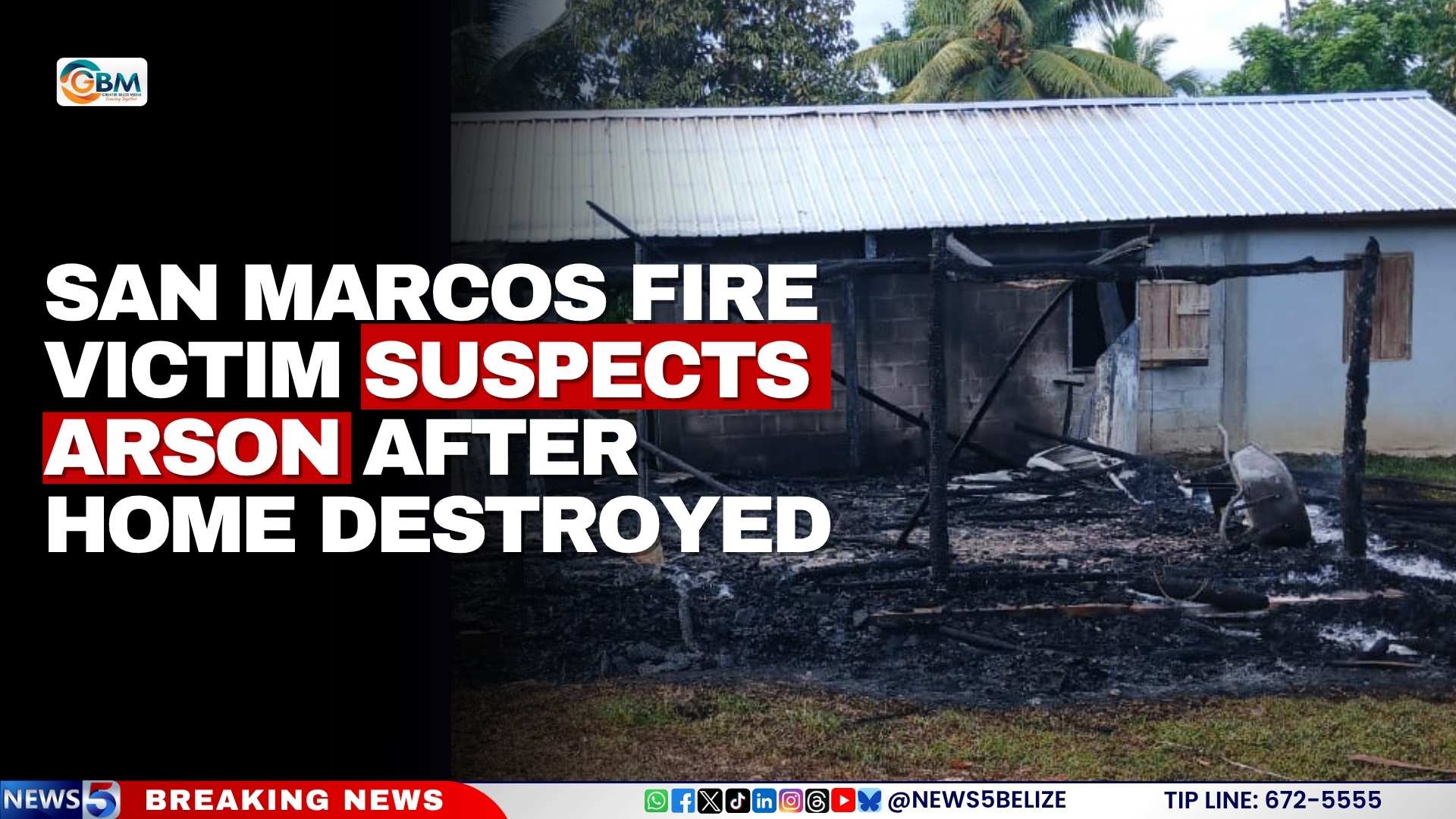
  • San Marcos Fire Victim Suspects Arson After Home Destroyed

    San Marcos Fire Victim Suspects Arson After Home Destroyed

    A devastating late-night fire has destroyed the thatch-roofed home of San Marcos, Toledo District resident Ambrosio Teul, igniting a bitter public dispute between the displaced homeowner and local village leadership over their response to the incident, which Teul claims was a deliberate act of arson.

    According to Teul’s account, the blaze ignited around 10:30 p.m. on Thursday, spreading rapidly across his property. While he successfully evacuated and pulled a portion of his personal belongings out of the burning structure, unforeseen rain left most of the recovered goods water-damaged and unusable.

    Teul is convinced the fire was no accident. He told reporters that the fire began simultaneously on two separate sides of the home, and moments after the blaze took hold, he heard the sound of a motorcycle speeding away from the area. Teul, who says he has no known conflicts with community members that would warrant an attack, expressed confusion over the incident. “I am a good person. I don’t see why they would do something like this to me,” he stated.

    The most significant point of contention for Teul is the lack of immediate response he claims from local authorities and village leadership. He asserts that no police officers, village chairman, or local alcalde arrived at the scene to check on his welfare or investigate the fire in the immediate aftermath. When Teul reached out to the local police station to report the incident, he said he was instructed to travel to the station in person to file the report himself, a requirement he has questioned as inappropriate for a victim who just lost his home.

    This account directly contradicts an official press release issued by San Marcos village leadership in response to local media inquiries. The leadership claims that the village chairman, members of the village council, and the alcalde all rushed to the fire scene the same night after receiving an emergency call about the blaze. In their statement, they also extended gratitude to local community volunteers who worked to extinguish the fire before it spread to neighboring properties.

    Village leaders added that they advised Teul to file a formal police report as a necessary step to launch an investigation into the fire’s cause. They noted that while the San Marcos community is generally defined by peace and order, there are isolated individuals who repeatedly act to disrupt public stability.

    The statement also pushed back against growing criticism of leadership circulating on local social media platforms. Leaders warned that they are documenting all accounts and users spreading what they call false information about the incident, and that they are prepared to pursue legal action against those responsible if deemed necessary. “Going on Facebook to attack leaders and spread false information will not solve anything,” the release read.

    Social media criticism of the response has been sharp, with one San Marcos resident posting online that “there is no more peace in the village, the village leaders are chaotic, corrupt, no action has been taken, people’s lives are jeopardised.” Notably, the village leadership’s official statement did not address Teul’s specific claim that no leader has reached out to speak with him directly since the fire destroyed his home.

    Left without housing after the incident, Teul is currently seeking emergency assistance from any community members or organizations willing to provide support. He can be contacted directly at 652-5864.

  • Trump Weighs Iran Deal as Tentative Agreement Hangs in the Balance

    Trump Weighs Iran Deal as Tentative Agreement Hangs in the Balance

    On May 29, 2026, a high-stakes decision over a potential landmark agreement between the United States and Iran hangs in the balance, as President Donald Trump convenes senior White House advisors in the Situation Room to weigh what he describes as a “final determination” on the deal that could end months of open military conflict and unclog one of the world’s most vital global shipping chokepoints.

    Negotiators from both nations have already struck a tentative framework this week that lays out two core commitments: the full reopening of the Strait of Hormuz, through which roughly 20% of the world’s daily oil supplies pass, and the launch of formal negotiations over Iran’s nuclear program. But the deal remains far from finalized: Trump has not yet given his official approval, and Iranian government representatives have so far declined to issue any public statement on the draft terms.

    Details of the draft memorandum of understanding, shared by anonymous U.S. officials, outline a phased mutual drawdown over a 60-day timeline. Under the proposal, Iran would step by step relax its restrictions on shipping movement through the strait, while the United States would simultaneously wind down its naval blockade of Iranian ports and waterways.

    Iran’s chief negotiator Mohammad Bagher Ghalibaf has offered a cautious, skeptical reaction to the emerging agreement, reflecting longstanding distrust between the two nations. “In negotiations with the United States, we have no trust in guarantees or words — only actions are the measure,” Ghalibaf warned, underscoring Tehran’s insistence on tangible, verifiable steps from Washington before it commits to any deal.

    The push for a final agreement unfolds against an increasingly volatile security backdrop, with fresh clashes breaking out just hours before Trump’s deliberations. Both sides have traded accusations of ceasefire violations in overnight engagements: U.S. forces based in Kuwait were reported to be the target of an Iranian missile strike, while Tehran confirmed it had launched the attack against a U.S. military installation it accuses of carrying out earlier strikes on Bandar Abbas, Iran’s key port city located adjacent to the Strait of Hormuz.

    The current cycle of full-scale military conflict between the two nations traces back to February 28, when the United States and Israel launched a coordinated series of massive joint strikes targeting Iranian military installations, government facilities, and critical national infrastructure, igniting months of sustained fighting that has disrupted global energy markets and raised fears of a broader regional war.