
Two separate disappearance-related cases are drawing public scrutiny in Belize, nearly two weeks after 21-year-old police constable Kenyon Barrow went missing, and one year after the alleged abduction of Joseph Budna. Both cases have highlighted ongoing gaps in investigative transparency and sparked renewed debate over the country’s international human rights obligations.
标签: Belize
伯利兹
-

Celebrations End in Gunfire: Santa Elena Man Critical
A late-evening confrontation that broke out shortly after community celebrations wrapped up in Santa Elena, Cayo District has left a 27-year-old local man fighting for his life in hospital, according to local law enforcement updates shared on September 22, 2026.
What began as a physical brawl involving 27-year-old Marco Vasquez and multiple other attendees quickly escalated into a deadly shooting after a man with a legally held firearms license stepped in to de-escalate the conflict. Assistant Superintendent of Police Stacy Smith, a staff officer with the department, outlined the preliminary findings of the ongoing investigation in a formal statement.
Smith explained that according to initial evidence collected at the scene, Vasquez attacked the intervening licensed gun holder while armed with a machete. In response, the license holder drew his registered weapon and fired two rounds, one of which struck Vasquez. Emergency medical teams quickly transported the injured man to Western Regional Hospital, where he is currently classified as being in stable but critical condition.
Responding officers seized the shooter’s firearm as evidence shortly after arriving at the scene, and also recovered the machete Vasquez was reported to have carried. The licensed gun holder remains in police detention as investigators assemble a full case file to submit to the Director of Public Prosecutions (DPP), whose official guidance will determine what formal charges, if any, will be filed. As of the latest update, law enforcement has not confirmed whether alcohol consumption contributed to the violent confrontation.
This report is adapted from a transcript of an evening television news broadcast, with original Kriol language statements standardized to conventional English spelling for published distribution.
-
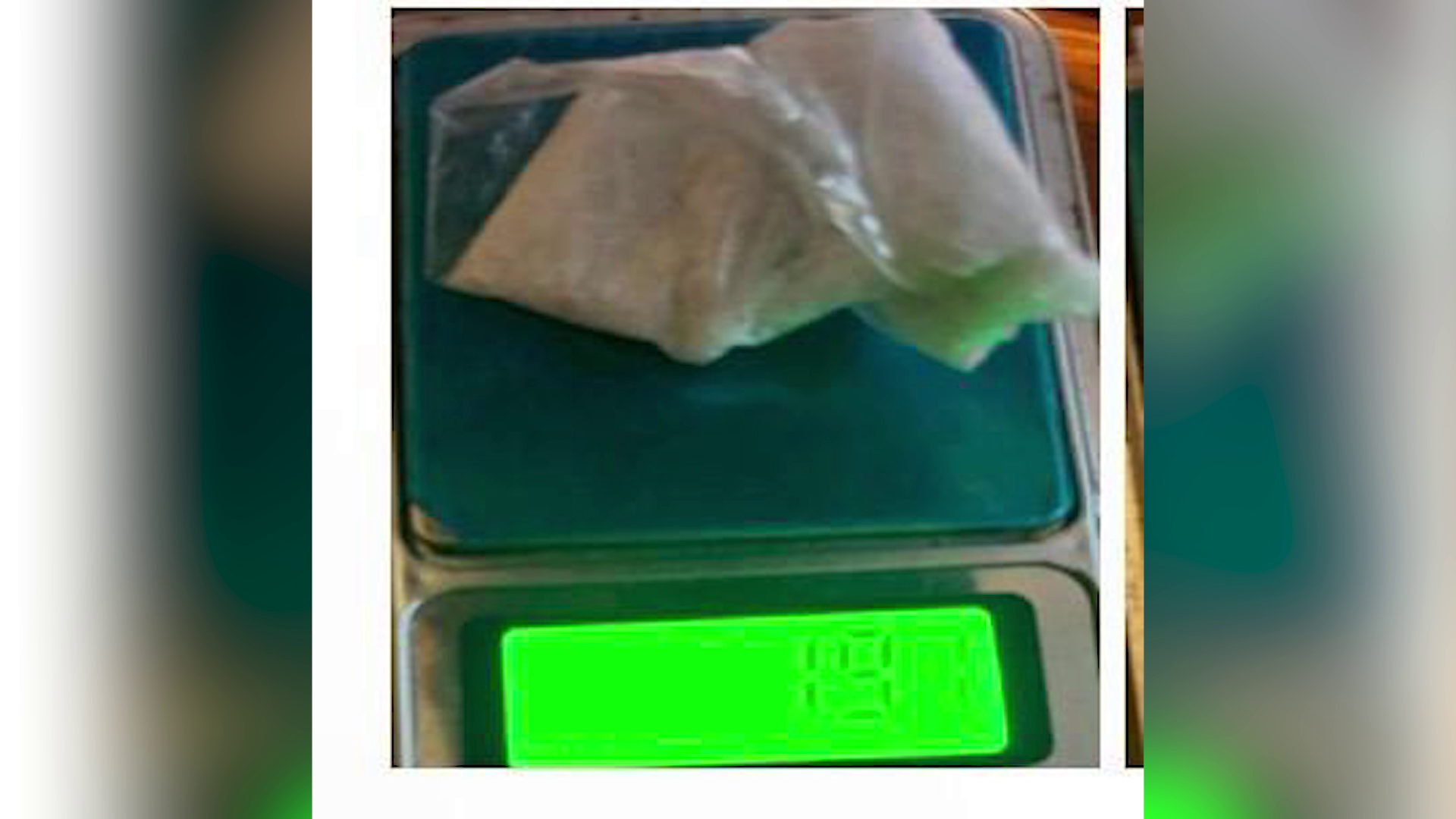
Nationwide Drug Crackdown Nets Five Suspects
A coordinated series of anti-narcotics operations carried out across Belize between September 14 and 19, 2026, has resulted in criminal charges against five individuals and the seizure of multiple batches of cocaine and crack cocaine, law enforcement officials confirmed this week. The busts unfolded across three major population centers: San Ignacio, Belize City, and the popular coastal tourist hub of San Pedro, with investigators executing search warrants on residential properties and moving vehicles to take suspects into custody. In a public breakdown of the operation’s details, Assistant Superintendent of Police Stacy Smith, a staff officer with the department, walked through the sequence of arrests and seizures step by step.
The first arrest came on September 14, when 25-year-old Jose Rash was taken into custody at his San Ignacio home. A court-authorized search of the property turned up 3.3 grams of cocaine, leading to an immediate charge of possession of a controlled substance with intent to distribute. The next day, on September 15, members of the specialized GI3 law enforcement unit pulled over a vehicle driven by Brandon Eze on Coney Drive in Belize City. A search of the vehicle yielded the operation’s single largest seizure: 1,000 grams of pure cocaine, a haul that accounts for more than 98% of all narcotics seized across the week’s operations. Eze was formally arrested and charged the same day.
Three more suspects were taken into custody on September 19 in two separate busts. In San Pedro, local police arrested 75-year-old Dennis Galinas at his residence after a search uncovered 1.91 grams of suspected cocaine. Galinas was immediately charged with possession with intent to supply. Hours later, the Special Tactical Response team executed a search warrant at a shared residence, where they found 2.7 grams of crack cocaine. Three residents of the home — 45-year-old Jaime Gutierrez, 21-year-old Doris Vasquez, and 40-year-old Elvira Mejia — were taken into custody and jointly charged with the same drug trafficking offense, bringing the total number of suspects charged across the week-long crackdown to five. All five suspects remain in law enforcement custody as the judicial process moves forward, with investigations into broader potential drug distribution networks ongoing. This report is adapted from a transcript of an evening television newscast, with original Kriol-language statements standardized to conventional English spelling for this publication.
-
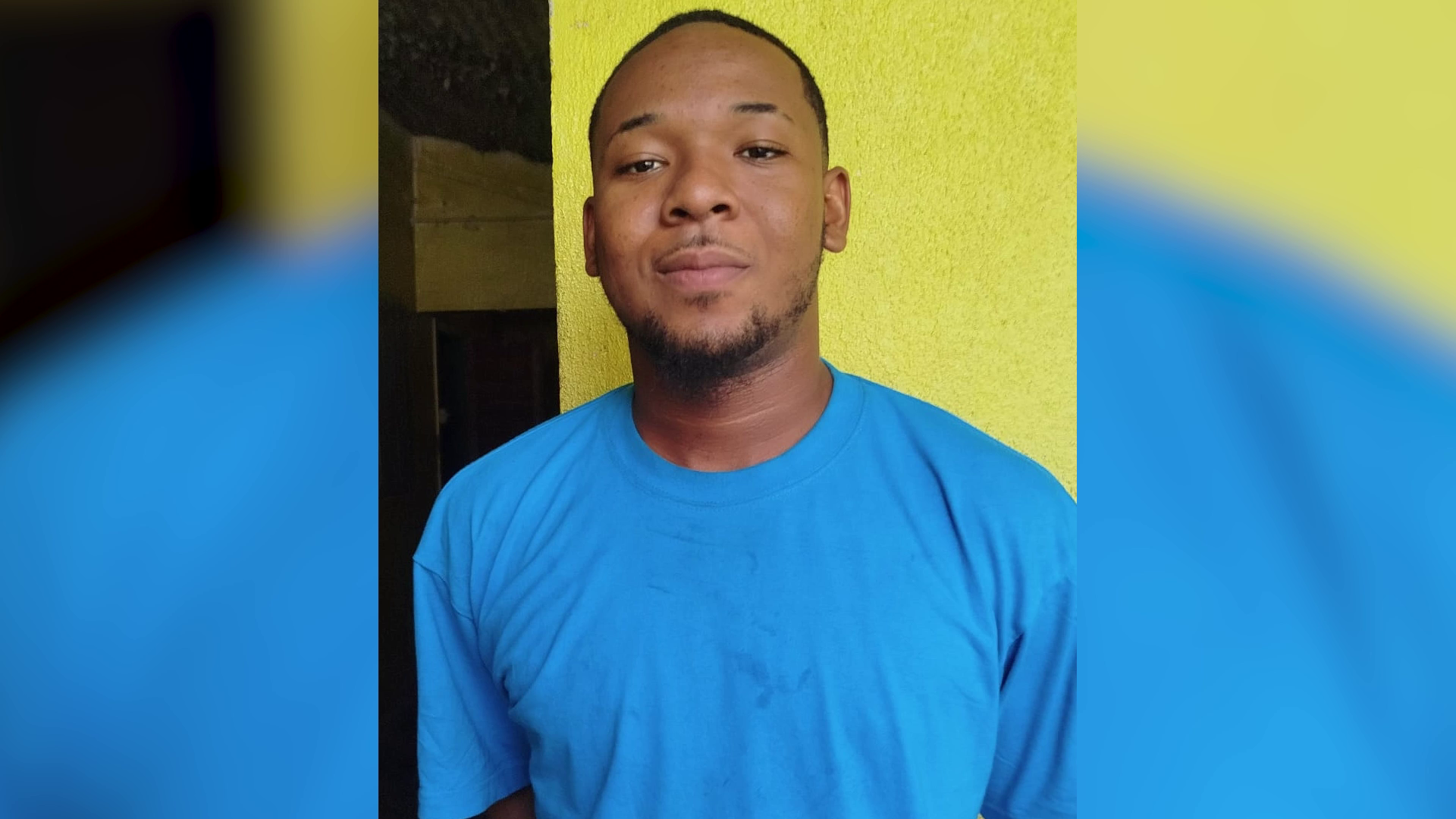
Extended-Magazine Glock Seized at Blackman Eddy
A routine traffic stop conducted by Belizean police on Independence Day unearthed an illegal loaded firearm and ended with four local men behind bars, facing weapons-related charges. The incident unfolded on September 21, 2026 at a standard police checkpoint positioned in Blackman Eddy, Cayo District, when a four-door vehicle carrying four male residents of Roaring Creek Village approached the screening point.
When officers requested the driver to present a valid driver’s license, the man first admitted he did not carry a physical permit, then offered an expired digital version for inspection. As law enforcement personnel engaged with the driver over the invalid documentation, attending officers spotted a handgun being tossed out of the vehicle’s window onto the surrounding terrain.
Responding immediately to the suspicious action, officers detained all four occupants of the vehicle and escorted them to the area where the weapon landed to recover the item. A subsequent inspection of the discarded firearm confirmed it was a Glock 17 pistol modified with an extended ammunition magazine. The high-capacity clip was fully loaded with 22 live 9-millimeter rounds, police confirmed in official statements.
Assistant Superintendent of Police Stacy Smith confirmed that all four men — 19-year-old Christopher Moro, 22-year-old Jaheim Morris, 26-year-old Nelson Nunez, and 31-year-old Edmund Pascasio — have been formally arrested and jointly charged with two firearm offenses: illegal possession of an unlicensed firearm and illegal possession of unlicensed ammunition. The case remains active as it progresses through the legal system, with additional investigative details expected to be released as court proceedings approach.
This report is adapted from a transcript of a televised evening newscast originally published online.
-

A National Legacy Rooted in Mahogany
For centuries, mahogany has stood as more than just a hardwood tree in Belize—it is the backbone of the nation’s history, culture, and evolving relationship with its natural resources. Long before modern tourism and agriculture became the primary drivers of Belize’s economy, this towering “red gold” ruled the land, shaping the development of British Honduras (Belize’s colonial predecessor) and building the foundation of communities across the country. Today, more than 400 years after mahogany first left its indelible mark on Belize, the Central Bank of Belize has honored this iconic species with a feature on its newest limited-edition collectible coin, cementing its status as a core part of Belizean national identity.
The story of mahogany in Belize begins with the arrival of British colonists, who ventured to the region in the 17th century specifically to harvest the valuable timber, quickly turning the mahogany trade into the central pillar of the colonial economy. For generations, the industry defined work, community, and trade for the territory, and it remains etched into the country’s most recognizable national symbols—mahogany already holds a place of honor on Belize’s Coat of Arms, depicted alongside the woodcutters and logging tools that powered the nation’s early growth.
In the 20th century, a Belizean conservationist named Henry Fairweather, a former land surveyor widely known affectionately as the “Mahogany Man”, gave this iconic tree a new, sustainable chapter. Devoted to restoring the species that had been heavily harvested for centuries, Fairweather poured more than $100,000 of his own money into planting more than 100,000 mahogany saplings across 400 acres of land along the Sibun River. Working without a formal textbook guide, he drew on decades of firsthand knowledge of Belize’s forests to execute his vision, with a goal of creating a sustainable mahogany industry that could support future generations of Belizeans without depleting the nation’s natural resources.
“I have no textbook to follow on this. It is just my long knowledge of the forest and my desire to do something for the country,” Fairweather said in a 2000 interview. “I want them to plant enough mahogany for them to sell. And it must be sustainable. That they would be able to grow it continuously and live by that… The business of mahogany is not play business, it is strictly hard work, a lot of sacrifices, a lot of punishment in doing without the things you need.”
Fairweather’s innovative approach to conservation earned him the prestigious James A. Waight Conservation Award for his commitment to balancing environmental stewardship with economic opportunity. But his vision came at a profound personal cost: by 2000, when News Five first interviewed him, his mahogany project was already facing severe financial strain. Because mahogany trees require roughly 20 years to reach maturity, Fairweather never lived to see the profitable, sustainable operation he spent decades building toward.
Even so, his work laid the groundwork for a new era of mahogany stewardship in Belize, and his legacy of working in harmony with nature remains a touchstone for conservation efforts in the country. “Mr. Fairweather, by working in harmony with nature, was able for example, not to cut down the land, but to plant back in the land what has been taken out and to show that it would give you the peace and harmony that we truly need as a nation,” Adalbert Tucker, former coordinator of the Belize River Valley Development Program, noted of Fairweather’s work.
Now, Belize is honoring the tree’s centuries-long legacy with a permanent, collectible tribute: a painted commemorative coin. According to Delroy Rhaburn, Assistant Manager of Currency Management at the Central Bank of Belize, officials considered featuring another iconic Belizean species—the national bird, the toucan—before settling on mahogany. The small size of coins creates strict limits on the number of colors that can be used, and a detailed depiction of a toucan would require eight distinct colors, making an accurate representation unfeasible. Mahogany was also already featured on the country’s largest circulation coin, making it a natural choice.
“The tree is our national tree. We know that it played a big role in Belize’s history. Everybody knows the mahogany tree and the toucan when you think about our national symbols. So we feel like that was an appropriate subject for the painted coin,” Rhaburn explained.
Today, mahogany no longer holds the position as Belize’s dominant economic driver it held for centuries, but its cultural and historical significance remains undimmed. From the forests that fueled colonial development to Fairweather’s vision of sustainable stewardship to the new commemorative coin that celebrates its place in Belizean life, mahogany endures as a powerful symbol of Belize’s heritage, resilience, and national identity.
-

Belizean Masculinity and the Carnival Gender Divide
Every year, Belize’s iconic carnival road march draws thousands of energized spectators and revelers, but a striking gender imbalance has long gone under-examined: while women and girls flood the parade routes, moving to the infectious beat of soca music in vibrant custom costumes, men remain strikingly underrepresented among dancing bands.
Local outlet News Five journalist Shane Williams recently dived into this persistent gender divide to unpack the social and cultural forces that keep many Belizean men on the carnival sidelines, rather than joining the celebration.
At this year’s Orange Walk Carnival, Williams observed the same lopsided dynamic that has become standard across the country: female revelers dominated every participating band, with only a small handful of men stepping forward to dance. Carnival insiders say the gap is not rooted in simple personal disinterest — it grows out of deeply ingrained cultural beliefs about what it means to be a man in Belize. From childhood, boys are taught that public dancing at carnival does not align with traditional ideals of masculinity, creating a barrier that persists into adulthood.
Even for young boys who develop an early love for soca music and the electric energy of carnival, that joy is often cut short by social stigma. Junior revelers like Nile Hamilton, Nelson Maskall and Andre Bradley all spoke of their excitement for carnival: they love the chaotic energy, the packed crowds, the vibrant costumes, and the sense of community that comes with marching alongside bandmates and supportive family members. But for many, that early enthusiasm fades when faced with teasing and ridicule from peers.
Pauline Bradley, band leader for the popular group Soca Massive, explained that harmful stereotypes linking male carnival participation to sexual identity are one of the biggest barriers holding Belizean men back. “We have little boys who want to join, but they are afraid because other boys clown them and call them names [associated with being gay],” she said. Bradley emphasized that this assumption is completely unfounded: she has worked with adult male dancers who started participating in carnival as children, many of whom are straight, proving that a man’s choice to dance says nothing about his identity.
Event promoter John Marsden argues that forcing men to join is not the solution — instead, shifting cultural attitudes will happen organically as more men see carnival as an inclusive space for anyone who loves soca and celebration. “I don’t think we can do anything to make them want to be a part of it,” Marsden explained. “Eventually they’ll see that if it’s fun, it’s a great time and they’ll join it if their heart takes them.” He believes that as more men break the taboo and participate, rigid stereotypes will gradually break down. That sentiment is echoed by the men who already take part in carnival every year, who are actively encouraging other Belizean men to give the celebration a try.
“Y’all come out and y’all try that. If you like it stay, have fun. Carnival is all about having fun okay,” said senior reveler Windell Russell. Fellow participant Kieran Ysaguirre added, “Come out, enjoy yourself. Have fun. That’s carnival for you, just to have fun.” Leroy Smith, another long-time carnival dancer, extended an open invitation to any interested men: “Just look forward to beautiful costumes, pure hypeness. If anybody interested you could always come join the band. We have more space. We are one band, one love.”
Bradley argues that dismantling the stigma starts early, by challenging the rigid, limiting ideas about masculinity that boys learn from childhood. “People are brought up different and I just feel like they need to get out of that negative mentality,” she said. That fear of social judgment remains the single biggest obstacle to greater male participation, but shifting the cultural conversation around what masculinity can look like could eventually open up carnival as a space for all Belizeans to celebrate together.
-
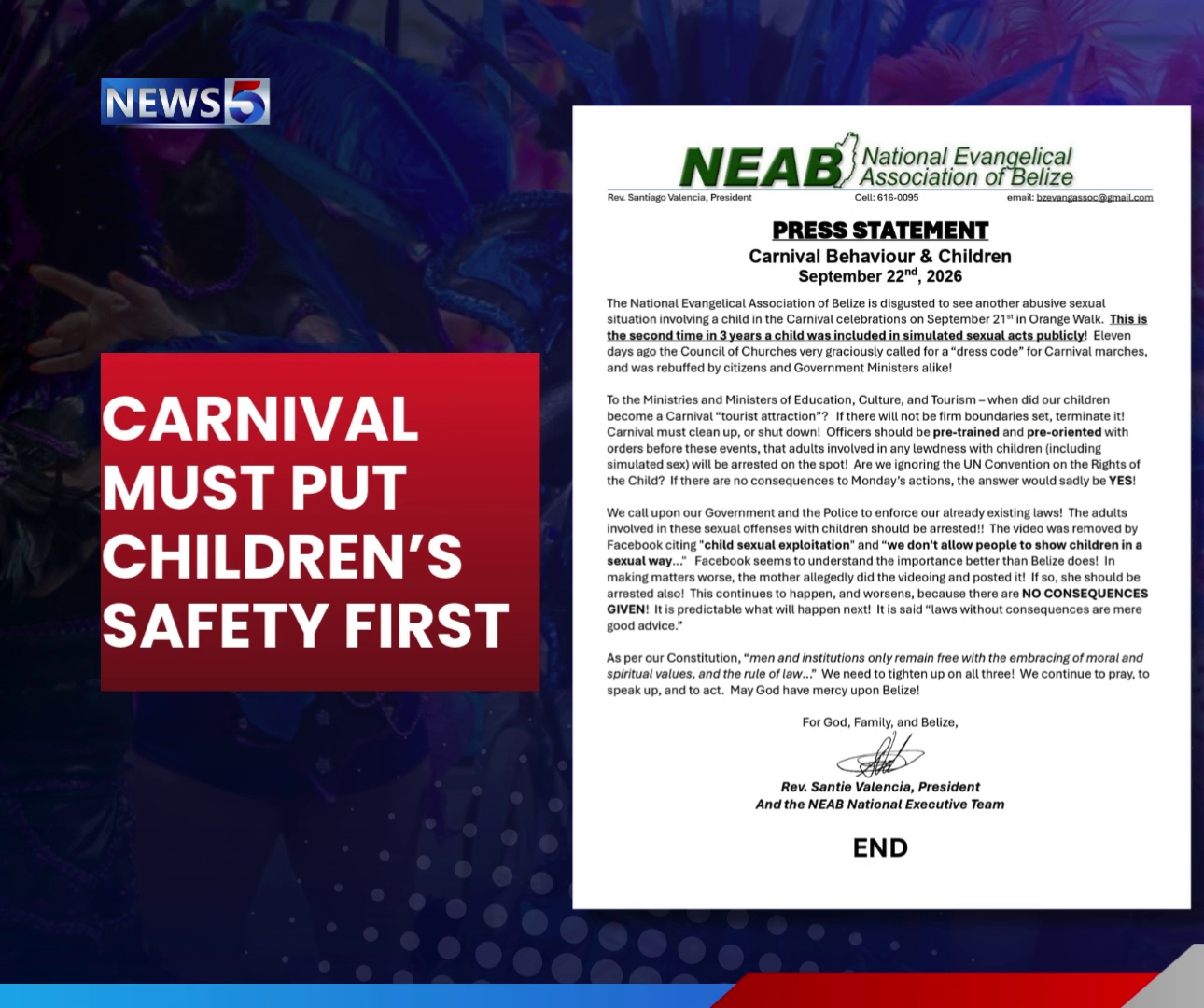
Evangelical Association Demands Carnival Accountability
A fresh controversy has erupted around Belize’s annual Carnival celebrations, after a viral video shot during Monday’s Orange Walk District road march triggered widespread public outrage over the inappropriate involvement of minors in explicit performances.
Led by Senior Reverend Santie Valencia, the National Evangelical Association of Belize (NEAB) has issued a firm ultimatum to national and local authorities, demanding immediate police investigation and stricter regulatory enforcement of public celebration guidelines. The organization stresses that any adult who coerces or allows children to participate in sexually suggestive performances must face swift legal consequences, noting this is not an isolated incident. According to NEAB records, this marks the second time in three years that a child has been captured on film engaging in a simulated sexual act during a public Carnival event.
In a bold challenge to regulatory bodies, the evangelical association argues that authorities can no longer delay setting clear, non-negotiable boundaries for acceptable content at public Carnival events. If officials fail to implement strict safeguards to clean up the celebration and protect minors, the group says the entire event should be canceled indefinitely.
During a Wednesday press briefing held by the Belize Police Department, Assistant Superintendent Stacy Smith, staff officer for the force, addressed public questions around the case, including whether legal action can proceed if a child’s parent opposes intervention. Smith clarified that child protection is not a matter for parental discretion. “Any allegation of child abuse does not leave the decision of whether to pursue action up to the parent,” Smith explained. “We have a dedicated human services department with trained social workers that hold a legal mandate to protect children, just as they intervene in domestic abuse cases where a parent may refuse to press charges against another household member. The best interest of the child is always the paramount consideration in these cases, above any other factor.”
Smith also noted that the incident opens a much broader national conversation about cultural norms, moral values, and what the country of Belize collectively chooses to accept as appropriate in large public celebrations. The viral video has reignited long-running debates over balancing Carnival’s cultural traditions with modern child protection standards, with communities divided over where to draw the line between cultural expression and harm to minors.
-
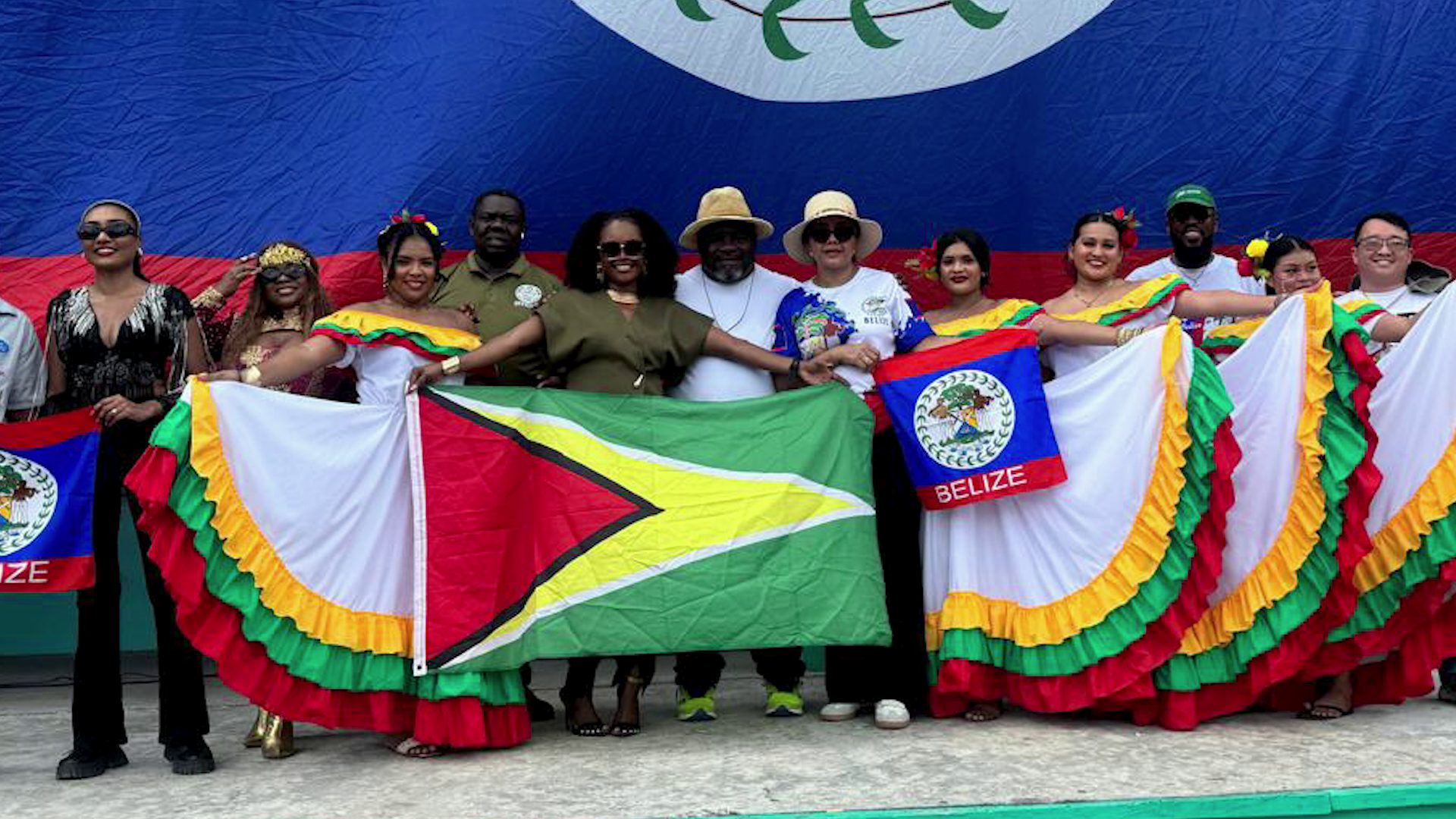
Culture and Courage Unite Belize and Guyana
In September 2026, Belize opened its 45th Independence celebration to a remarkable guest of honor: a joint delegation of military paratroopers and top-tier cultural performers from neighboring CARICOM nation Guyana, turning the national milestone into a powerful showcase of regional solidarity and shared cultural identity.
The centerpiece of Guyana’s contribution to the festivities unfolded at the national flag-raising ceremony in Belmopan, where thousands of spectators gathered to watch a one-of-a-kind aerial display. Members of the Guyana Defense Force parachuted into the celebration, carrying the national flags of both Belize and Guyana in a choreographed demonstration of bilateral partnership. This gesture was no spontaneous addition: Gale Miller, Belize’s Ambassador to Guyana, confirmed the plan was first laid out during Guyanese President Irfaan Ali’s official visit to Belize in February 2026, fulfilling a commitment to mark the historic anniversary with a meaningful gesture of friendship. The delegation also included 14 elite cultural performers handpicked as Guyana’s Cultural Ambassadors, who toured across Belize in the lead-up to the main ceremony.
Before the official national celebration, the cultural troupe brought Guyana’s rich multicultural heritage to communities across the country, stopping in Orange Walk, San Ignacio, and Belmopan to deliver tailored, vibrant performances for diverse audiences. From high-energy dance sets for Belize’s children’s parade to a curated blend of traditional and contemporary work for San Ignacio audiences, the group designed each show to reflect different facets of Guyana’s multi-ethnic identity. Andrew Tyndall, Director of National Events at Guyana’s Ministry of Culture, emphasized that President Ali personally prioritized sending the nation’s most accomplished artists to honor the occasion. “He ensured that he fulfilled his commitment, and he sent the best performers from the country to be a part of this forty-fifth Independence,” Tyndall explained, adding that the entire delegation was overwhelmed by the warmth and hospitality extended by Belizean communities during their tour.
The repertoire of performances highlighted the diverse ancestral roots that shape both Guyana and Belize. Technical Director and Producer Joel Browne noted that the group’s work ranges from original pieces like *Eldorado’s Gold*, which frames the Guyanese people as the nation’s true most valuable resource rather than its mineral wealth, to traditional songs reflecting the country’s Indigenous Amerindian and African heritage. For many members of the delegation, the trip was their first visit to Belize, and they expressed surprise at how much the two neighboring nations share in history, culture, and daily life.
Diana Chapman, a leading singer with the troupe, called the experience unforgettable, saying the warmth of Belizean people and the local cuisine made the trip particularly special. East Indian dancer Swasti Saytoo echoed that sentiment, noting that even in food and cultural traditions, she found clear echoes of her own heritage that made her feel immediately at home. “I was very surprised by the similarity that we have, and our history the way we were brought,” Saytoo said. “I felt at home truly.”
To cap off the visit, Guyana presented Belize with two symbolic gifts to commemorate the occasion: its own national flag and a commemorative plaque honoring 45 years of Belizean independence. Beyond the pageantry and performances, the delegation’s participation has cemented the growing bilateral and regional bond between the two CARICOM nations, rooted in shared culture, mutual cooperation, and collective regional pride. The report was filed by Britney Gordon for Belize’s News Five.
-
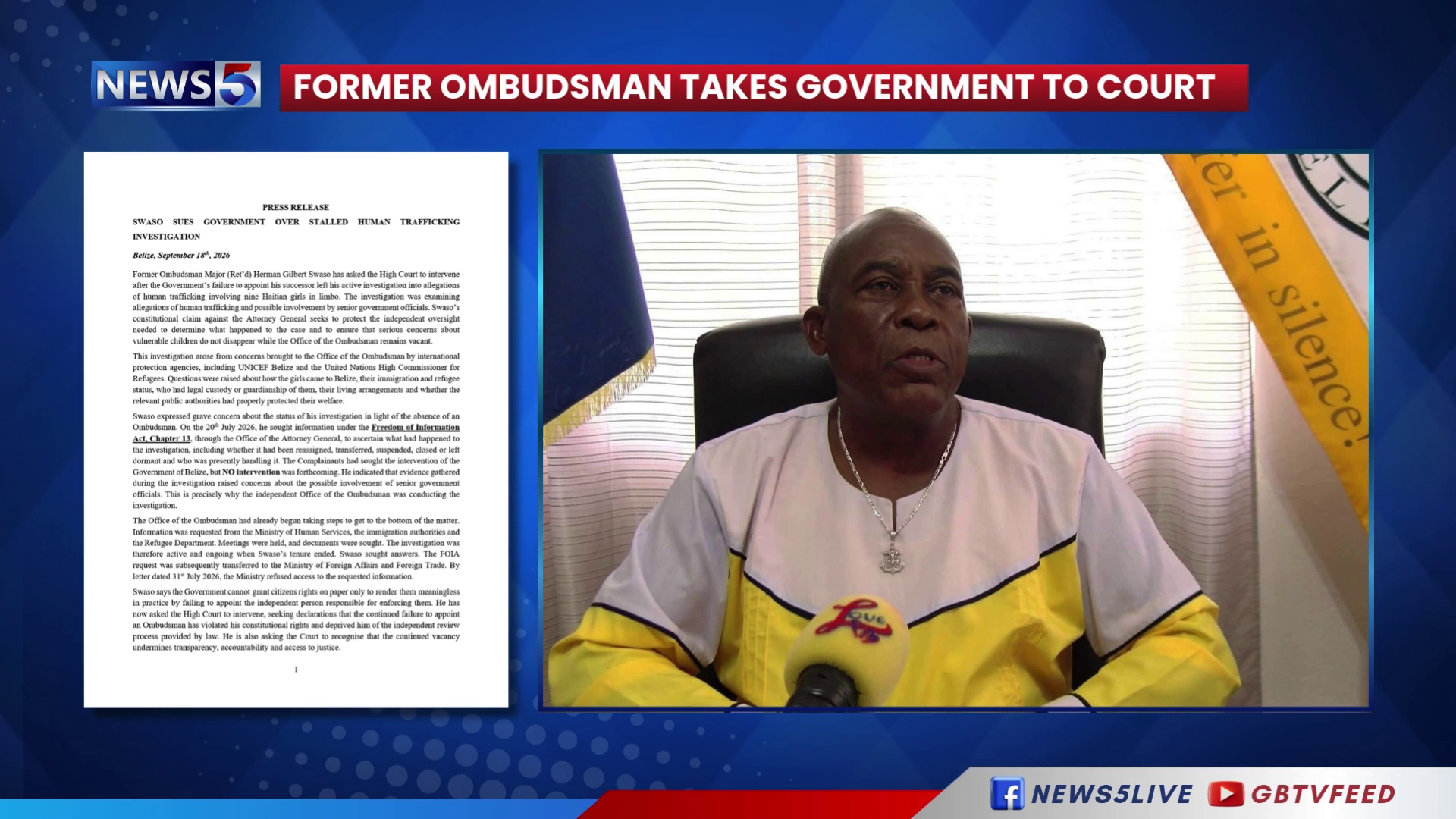
Former Ombudsman Sues Government Over Human Trafficking Case
Nearly two and a half years after a human trafficking case involving nine vulnerable Haitian girls was first lodged with Belizean authorities, the nation’s former top ombudsman has escalated the government’s long-running inaction to the country’s High Court. Retired Major Herman Swaso, who stepped down from the Ombudsman’s role at the end of December 2025 when his contract was not renewed, argues that the prolonged vacancy at the independent watchdog post has left critical, unresolved questions hanging over the case: the immigration status of the nine minor victims, their legal guardianship, and their ongoing access to basic welfare support all remain unaddressed. Most notably, the original complaint includes serious allegations that senior members of the current Belizean government are linked to the trafficking ring.
In comments to local broadcast media, Swaso laid out the timeline of the stalled probe that prompted his legal action. He explained that the complainant first brought the allegations directly to the Government of Belize back in 2023. After two full years of no visible progress or official findings, the complainant turned to the Office of the Ombudsman to demand transparency and answers. The case never moved forward, Swaso says, and after he left office, the investigation fell back into limbo, returning to the stagnant state it was in when it was first reported.
For Swaso, the inaction represents a dual failure: not only has he been denied his legal ability to see the investigation through to completion during his tenure, but the nine young victims, already classified as vulnerable migrants, have been left without accountability or protection. He added that as a signatory to international anti-trafficking treaties, Belize has clear legal and ethical obligations to investigate these claims thoroughly. The stalled probe carries not only significant domestic ramifications for the country’s governance, he warned, but also carries the potential for serious international consequences given its violation of global human protection commitments.
To date, Belize has not appointed a new permanent Ombudsman to fill the role that has sat vacant since Swaso’s departure, leaving the watchdog office without a leader to advance the probe on its own. Swaso’s legal petition is asking the High Court to intervene to force the investigation to move forward, ensuring the case is not quietly swept aside without any official findings or action to support the victims.
This report is adapted from a transcript of an original television newscast, with all quoted material retained and verified in context.
-

Autopsy Revealed Delisha Estrada Was Killed
On September 22, 2026, new forensic findings have upended initial assumptions about the double death discovery at a Santa Elena, Cayo District residence, confirming one death was a homicide while investigations continue into the second fatality.
When first responders arrived at the property, they recovered the bodies of 36-year-old Delisha Estrada and Michael Williams. Early theories suggested the two deaths shared a common cause, but post-mortem examinations have painted a far different picture of the incident.
According to Assistant Superintendent of Police Stacy Smith, lead official on the ongoing investigation, medical examiners have determined Williams’ immediate cause of death was severe pulmonary edema—a life-threatening accumulation of fluid in the lungs. Toxicology screenings are still being processed to identify what underlying trigger caused the fatal condition, and those results are still pending as of the latest update.
For Estrada, however, the autopsy delivered a definitive conclusion: her death was caused by blunt craniofacial trauma from a blow to the head, and investigators have formally classified her passing as a homicide. Smith confirmed that the forensic results have moved the investigation forward significantly, clarifying the distinct circumstances surrounding each death.
“Right now, the inquiry remains active and open,” Smith stated in a press briefing. “The autopsy outcomes have given us a clearer path forward. For Williams, we are waiting on toxicology data to confirm what led to the pulmonary edema that killed him. For Estrada, the evidence confirms blunt force trauma inflicted by another party, which is why we have ruled her death a homicide.”
Local relatives and neighbors of the pair have told reporters that the couple had a long history of repeated domestic conflicts, and Belize police have confirmed that Estrada filed multiple official reports of domestic abuse against Williams in previous years. That history is now a key line of inquiry for investigators working to piece together the events leading up to the discovery of the two bodies.
This report is a transcribed excerpt from an evening television newscast covering the developing investigation, with Kriol-language testimony standardized to conventional written spelling for publication.