In the wake of sensational local reporting and fiery partisan clashes across social media, one unassailable fact has emerged: the small Central American nation of Belize is once again grappling with a direct challenge to its territorial sovereignty.
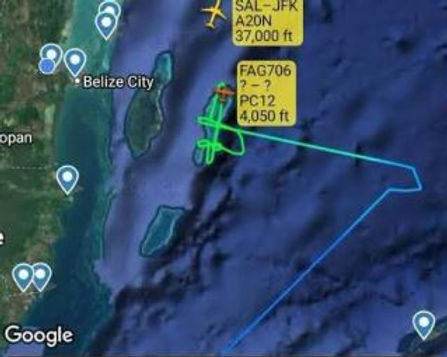
The incident unfolded on the night of September 24, 2026, when Belizean radar operators detected an unauthorised Guatemalan military aircraft penetrating deep into Belizean airspace, according to official reports. The aircraft, registered under tail number FAG 706, reportedly orbited above Lighthouse Reef with its transponder intentionally disabled before retreating back across Belize’s southern border with Guatemala.
Public and political reaction to the incursion was swift and deeply fractured. While some segments of the public have commended the Briceño administration for publicly calling out what they frame as deliberate regional intimidation, others have drawn attention to the glaring disconnect between the government’s uncompromising rhetorical stance and the severe economic vulnerabilities that shape daily life for ordinary Belizeans. This divide opens a core, uncomfortable question: how can Belize demand ironclad defense of its borders when its daily economic survival remains deeply tied to the very neighbor accused of violating those boundaries?
When Prime Minister John Briceño formally brought the incident before the United Nations General Assembly, Guatemalan officials issued an immediate, outright denial. The government in Guatemala City claims the flight never occurred, with President Bernardo Arévalo dismissing publicly available flight tracking data as unreliable consumer-grade information, and urging that the dispute be referred to the Organization of American States for review. However, defense telemetry collected by internationally recognized independent radar systems contradicts Guatemala’s official account.
This discrepancy leads to a far more troubling, broader question: how can a regional military carry out such an incursion with apparent impunity, and what systemic forces allow this persistent power imbalance between the two neighboring states to endure?
Further investigation into the aircraft at the center of the dispute reveals it was not acquired through standard commercial procurement. Declassified defense records show FAG 706 was originally donated to the Guatemalan military by the United States government, which has poured hundreds of millions of dollars into regional security and counter-narcotics initiatives across Central America. These programs deliver military hardware, specialized training, and logistical support to governments tasked with patrolling shared regional borders – yet critical questions remain unanswered about how donor nations monitor the end use of the equipment they provide. If assets supplied to boost regional security are instead deployed to test the sovereignty of a smaller neighboring state, calls for stricter end-use controls can no longer be ignored. Compounding this issue is the conspicuous lack of a clear response from Belize’s traditional international allies.
Guatemala’s strategic defense networks extend far beyond its partnership with Washington. For decades, it has maintained close military, intelligence, and technological cooperation with Israel. By contrast, Belize has carved out a distinctly different diplomatic path: it has positioned itself as a leading voice in support of Palestinian self-determination, formally cut diplomatic ties with Israel, and repeatedly anchored its foreign policy at the United Nations around a commitment to human rights and international law.
This geopolitical divide carries tangible consequences in Central America and the broader Caribbean. Guatemala reaps the benefits of long-standing, deep ties to major Western governments and leading defense suppliers, while Belize counts far fewer traditional military partners, relying instead on diplomatic backing from the Caribbean Community (CARICOM) and Global South nations.
Adding to Belize’s structural vulnerabilities is its complete lack of a domestic military-industrial base. Its armed forces are vastly outmatched by Guatemala’s in both personnel and equipment, leaving the country dependent on external support to maintain even basic deterrence capabilities. Currently, that support rests on two core pillars: a contingent of British military training personnel based at Price Barracks, and a long-running territorial dispute arbitration process ongoing at the International Court of Justice (ICJ). Neither pillar offers a rapid, effective solution to an immediate airspace incursion: military training can improve force readiness, but it cannot close the dramatic capability gap between the two states, while ICJ proceedings may eventually resolve the broader territorial dispute, but they cannot stop unauthorized aircraft from crossing the border in real time.
Historical context is key to understanding the stakes of Belize’s current foreign policy stance. For much of the 20th century, Western intelligence agencies closely monitored and often suppressed progressive anti-colonial movements across Central America, framing independent nationalist voices as security threats rather than legitimate expressions of national self-determination. Belize’s current independent foreign policy grows directly out of this anti-colonial tradition; its UN votes and public stances are designed to signal that the country will not simply align with the preferences of larger global powers. But this commitment to sovereignty also creates unavoidable friction with the same governments and international institutions that Belize relies on for security support.
This external pressure has quickly exacerbated internal political divisions within Belize. Cabinet ministers and parliamentary leaders have publicly clashed over the Briceño administration’s handling of the crisis, while opposition parties have weaponized public anxiety to erode support for the current government. These tensions are amplified when security concerns collide with widespread economic hardship: the government may wish to project unwavering strength, but it cannot ignore the human cost of a full confrontation with Guatemala for Belizean families already struggling to make ends meet.
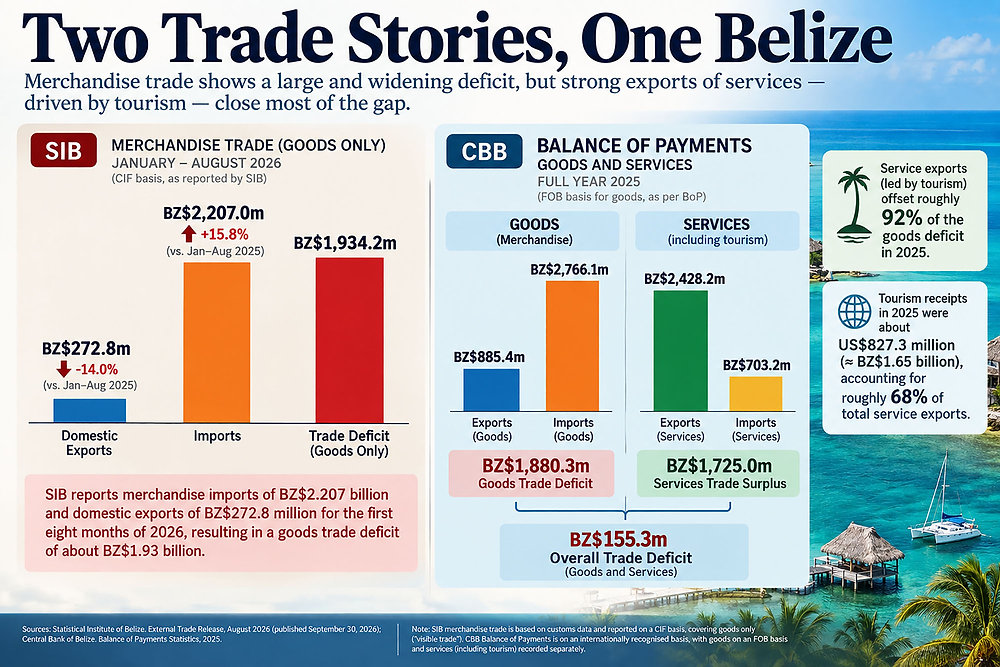
This conflict of interests lays bare Belize’s most intractable political contradiction. Whenever sovereignty is challenged, many Belizean citizens demand aggressive action: economic boycotts, trade restrictions, or a full freeze on bilateral relations with Guatemala. But a quick visit to any local market or fuel station makes clear just how unfeasible those demands are in practice. Belize relies heavily on Guatemala for a wide range of critical goods: refined fuel, agricultural fertilizer, steel, cement, raw agricultural inputs, and basic food staples. While Belize runs a substantial bilateral trade deficit with its western neighbor, it has maintained the trade relationship because alternative supply routes are either slower, more expensive, or both.
Geography leaves little room for ideological rigidity in trade. Goods moving overland across the Belize-Guatemala border reach Belizean markets far faster and at a far lower cost than cargo shipped by sea from North America or other Caribbean nations. The same border that represents a persistent security threat is also one of Belize’s most critical economic lifelines. This deep economic dependence shapes every aspect of the government’s response: it constrains policy space, erodes public support for harsh trade measures, and limits the government’s ability to respond forcefully without triggering widespread shortages or sudden spikes in consumer prices. A boycott may sound like a decisive, principled stand in political rhetoric, but in practice it would drive up fuel costs, disrupt construction and agricultural production, and impose even more financial strain on households already grappling with sky-high living costs.
The Lighthouse Reef incident is far more than a minor border aviation dispute: it lays bare the harsh structural reality facing small sovereign states in a global order defined by stark inequalities of military and economic power. Belize can certainly advocate for its sovereignty in international forums, pursue legal resolution at the ICJ, and call on support from Britain and its regional partners. But none of these steps address the underlying power imbalance that made the incursion possible in the first place.
As long as larger neighboring states continue to receive extensive foreign military support, and as long as Belize remains locked into dependence on Guatemalan supply chains, Belize’s pursuit of full, unconstrained sovereignty will continue to face severe structural limits. The problem is not a lack of national resolve among Belizeans; it is systemic, structural dependence on more powerful neighbors.
This means Belize’s leadership faces a challenge that goes far beyond condemning a single airspace incursion. To address the root of the vulnerability exposed by this event, the country must invest in expanding domestic production, diversify its trade routes to reduce reliance on a single neighbor, upgrade its border surveillance capabilities, and build deeper, more resilient regional security partnerships. Without these foundational changes, every future border challenge will reopen the same dangerous weaknesses.
Until Belize can reduce its structural dependence, every sovereignty test will force the same agonizing choice: stand firm and risk widespread economic harm, or preserve the trade links that keep daily life running, at the cost of territorial integrity. Ordinary Belizeans feel this pressure every time they pay for fuel or purchase groceries: fiery, uncompromising political rhetoric makes for compelling television, but daily life in Belize depends on the steel, fuel, and fertilizer that cross the western border every single day. When leaders deliver tough speeches, ordinary families are left wondering how they will absorb the blow if trade slows even slightly.
That is why every airspace breach feels like a personal threat to Belizeans, not just an abstract territorial dispute. It is not merely a debate over lines drawn on century-old maps or legal arguments in a distant international courtroom. It is a quiet, constant reminder that full national independence comes at a cost, and that cost is paid in daily compromises. Until Belize can build a strong, self-sufficient domestic economic foundation and diversify its international partnerships, that heavy burden will remain.