标签: Belize

伯利兹

  • Family Alleges Autistic Kids Were Discriminated During Graduation Ceremony

    Family Alleges Autistic Kids Were Discriminated During Graduation Ceremony

    A preschool graduation ceremony held at Belize City’s ACC Church has sparked heated accusations of ableism and exclusion, after three young autistic graduates were allegedly pushed out of public view during Friday’s event.

    Relatives of the children, who attend Anglican Diocesan Preschool, say the three students were intentionally separated from their peer group, placed in a hidden seating section far behind the main graduating class block. This positioning left the children completely out of sight for family members, no matter whether relatives were seated in the front rows at the venue or the back sections.

    The aunt of one of the autistic graduates told local reporters that the unusual seating arrangement triggered immediate alarm and frustration among the families. “Right away, I was upset. What are you trying to do here? What message are you sending to parents who have worked so hard to get their children to this milestone? Yes, it is just preschool, but for our families, this is a huge achievement worth celebrating,” she explained in an interview.

    The situation worsened during the traditional graduation march, when other parents stood in the venue aisles to take photos of their own children, creating an additional physical barrier that completely blocked any view of the three separated students. By the time the ceremony reached the seating portion, the children’s positions at the far edge of the venue meant no one in the audience could see them, the aunt added.

    Beyond the problematic seating arrangement at the graduation, the families are also raising broader questions about whether educational institutions in Belize are doing enough to accommodate and support neurodivergent students on the autism spectrum.

    The aunt noted that public discourse has appeared to shift toward greater inclusion in recent years, as autism diagnoses have become more common across the country. But she argues that most schools have failed to keep up with this shift, failing to provide staff with the proper accessibility and neurodiversity training needed to support autistic students.

    What is more, the family claims that the Anglican Diocesan Preschool has repeatedly ignored repeated requests for accessibility accommodations for their child throughout the school year, long before the graduation ceremony controversy.

    Local outlet News 5 has confirmed that it reached out to leadership at Anglican Diocesan Preschool to request a response to the allegations, and as of this reporting, no official statement from the school has been released.

  • The “Ants Nest” That Minister Mira Stirred

    The “Ants Nest” That Minister Mira Stirred

    Nearly one month has passed since Belizean law enforcement seized two mobile phones from former United Democratic Party (UDP) chairman Alberto August during a court-authorized search of his Santa Elena residence, and the former party leader is still waiting for authorities to return his property. August is now publicly questioning the justification for holding the devices, which he maintains contain no evidence of criminal activity.

    The search operation, carried out on May 30, was initiated under a High Court warrant that granted police permission to seize electronic devices from August’s home. The operation took an unplanned turn when officers located a firearm on the property; at the time of the search, August was temporarily unable to present the required license for the weapon. This discovery shifted the entire focus of the raid: officers departed the residence with August’s two personal mobile phones and the firearm, opting to leave all other electronic equipment on-site.

    Following the seizure, August’s legal representative, Michael Peyrefitte, submitted a formal letter to the Director of Public Prosecutions calling for the immediate return of the phones. To date, no action has been taken on that request, leaving August without access to critical personal and professional data.

    Notably, August has never attempted to deny authorship of the Facebook post that sparked the entire investigation in the first place. In a recent statement, he reaffirmed his position: “I told them yes, that I made the post and I will stand by that.” This open admission, he argues, makes the continued retention of his devices entirely unnecessary.

    The prolonged absence of his phones has already caused tangible harm to August’s professional operations. All of his business contracts, digital payment systems, and financial receipts are stored on the devices, meaning every additional day the phones remain in police custody creates new losses for his work.

    Beyond the financial harm, August has raised significant constitutional concerns over a growing rumor that authorities have sought technical support from the U.S. Embassy to unlock the encrypted devices. He pointed to a separate high-profile recent investigation in which Belizean police publicly acknowledged requiring American technical assistance to bypass device security, making the prospect of external involvement in his case far from speculative.

    August pushed back hard against any implication of criminal ties, challenging authorities to produce even the smallest shred of evidence of wrongdoing. “There is absolutely nothing of a criminal nature in my phone,” he said. “If the police or the US Embassy can show me even an iota of evidence that I have been in communication with a cartel, a drug trafficker, a plane lander, human trafficking, kidnapping…then I will freely open the phone for them to examine it.”

    In a striking political turn, August argued that the entire investigation stemmed from actions by Minister Mira, and that more thorough pre-raid investigation would have prevented Mira’s current political predicament: Mira has been sidelined from the Cabinet pending the outcome of an official audit into the matter. August summed up the situation bluntly, saying “the honorable minister stirred an ants nest.”

    Despite the political upheaval, August framed the ongoing controversy as a beneficial moment for the people of Belize, calling the revelations a “blessing in disguise.” He closed with a direct appeal to the officials leading the Cabinet audit, urging them to prioritize uncovering the full truth, no matter what political fallout may follow.

  • PSU: Mira’s Leave Sends ‘Wrong Message’ to Public Officers

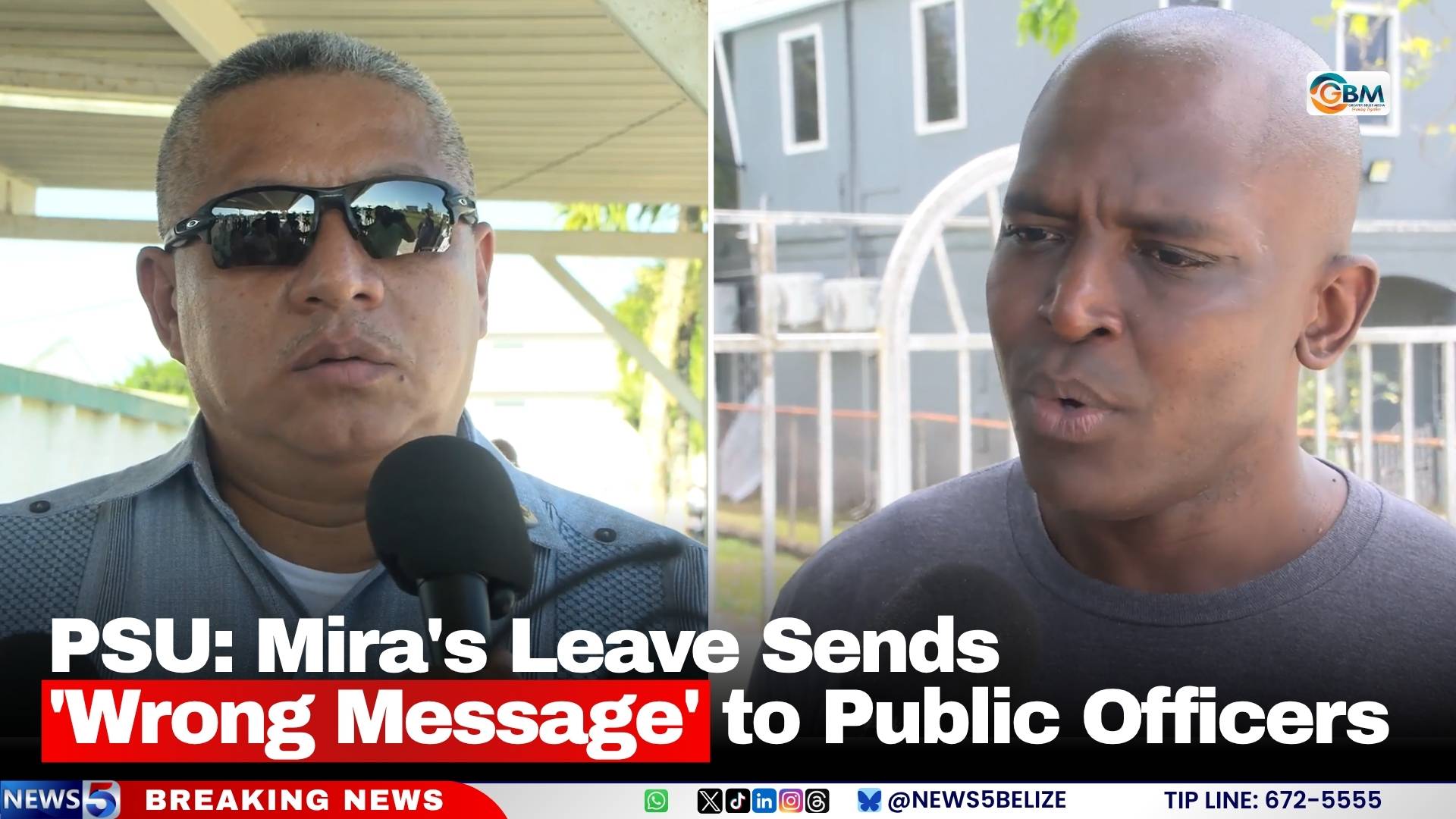
    PSU: Mira’s Leave Sends ‘Wrong Message’ to Public Officers

    A developing political controversy is roiling Belizean politics, centered on how the national government has managed the ongoing formal probe into procurement practices at the Ministry of Defence. At the heart of the dispute is Belmopan Area Representative Oscar Mira, who has entered a paid leave of absence as the audit gets underway — a move that the nation’s largest public sector union, the Public Service Union (PSU), has condemned as inappropriate, and criticized Prime Minister John Briceño for his handling of the situation.

    PSU President Dean Flowers has publicly pushed back against the prime minister’s response, arguing that the arrangement sets a dangerous precedent for all public servants across Belize. In his remarks on the controversy, Flowers questioned what signal the government is sending to civil servants: that when allegations of misconduct emerge and accountability is expected, officials can simply request and receive paid leave to avoid oversight. He also pushed back against Briceño’s framing of the leave as a voluntary, responsible step, noting that the prime minister should have taken decisive action to order Mira’s recusal himself rather than waiting for the sitting representative to initiate the leave process.

    For his part, Prime Minister Briceño has defended the arrangement, framing Mira’s choice to step aside as an act of good faith that deserves public praise. Speaking to reporters on Monday, Briceño explained that Mira reached out voluntarily to offer to step back from his duties to create an unimpeded path for the Auditor General to complete the procurement audit. The prime minister emphasized that Mira’s willingness to stand aside was the correct call, and it should be commended by the public.

    In the wake of Mira’s departure, the government has appointed Infrastructure Development and Housing Minister Julius Espat to serve as interim Minister of Home Affairs in addition to his existing cabinet responsibilities. Espat has adopted a wait-and-see approach to the controversy, noting that full details of the audit investigation have not yet been made public. He acknowledged that Mira has faced unrelenting public scrutiny in recent weeks, adding that the outcome of the audit and Mira’s political future remain uncertain at this early stage.

    The formal audit is projected to take roughly three months to complete its review of Defence Ministry procurement practices. In a parallel development on the same day the leave was announced, Edward Broaster, a leading figure in Belize’s opposition United Democratic Party (UDP), filed a formal corruption complaint against Mira with the country’s Integrity Commission, escalating the political pressure on the sitting People’s United Party government.

  • Who Signs Off Government Money? FinSec Breaks Down the System

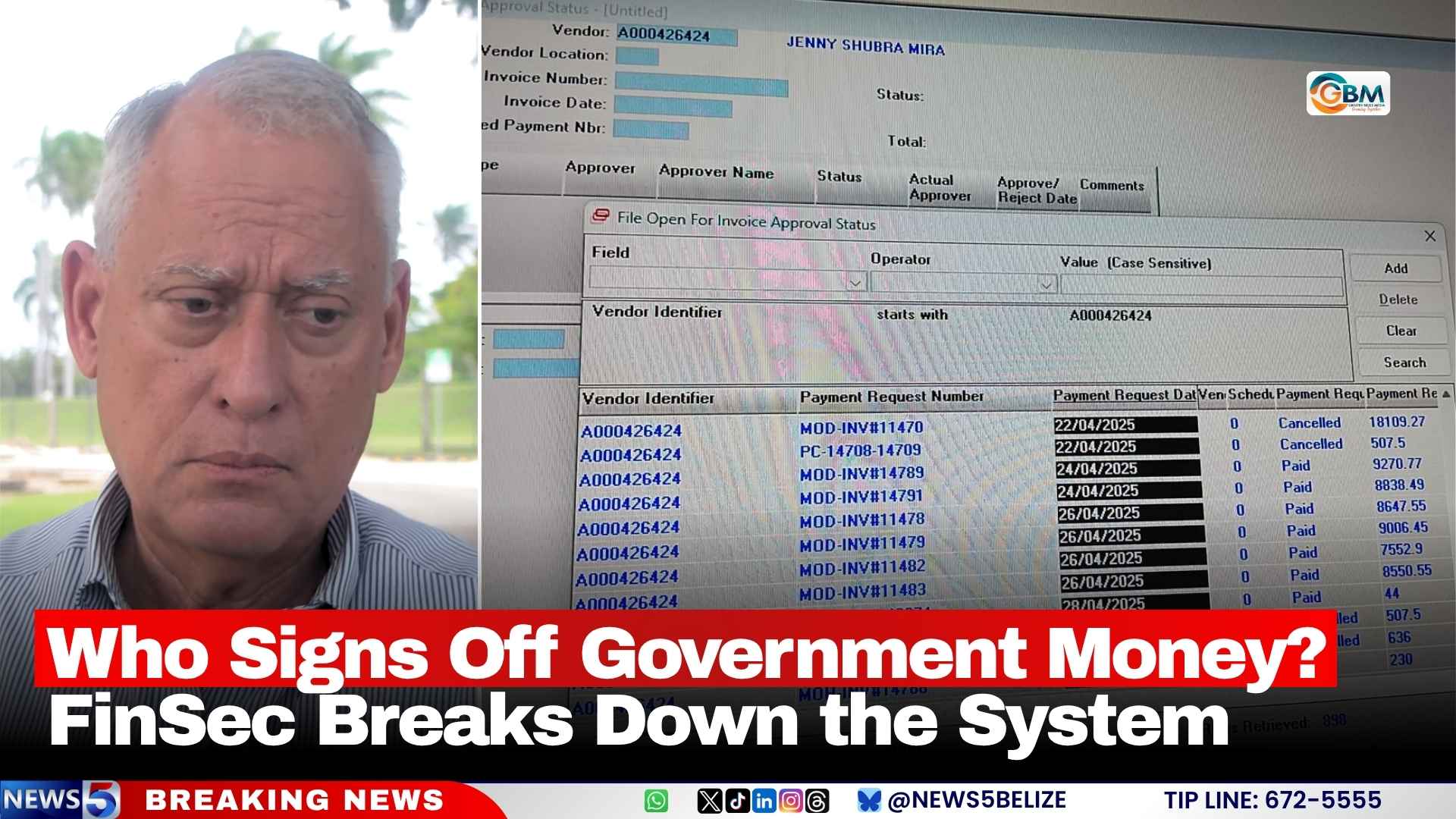
    Who Signs Off Government Money? FinSec Breaks Down the System

    A formal audit into questionable procurement and payment practices at Belize’s Ministry of Defence, linked to the so-called “Mira millions” controversy, is now underway, and top financial officials have laid out the full chain of oversight for public spending to clarify how such transactions are processed. Speaking on the ongoing investigation, Financial Secretary Joseph Waight confirmed that any determination of personal liability for improper spending will wait for the independent audit process to reach its final conclusions.

    Waight walked through the standard tiered approval process for all government payments, starting with the initial data entry phase. A junior government clerk is responsible for first inputting invoice details into the national SmartStream public payment management system. From there, a senior clerk reviews the entry to confirm its accuracy before passing it along to a ministry financial officer for a second, more rigorous check. That step is designed to verify that all supporting documentation for the transaction is complete and compliant with government rules.

    The approval structure adds an extra layer of oversight for large transactions: any payment exceeding $10,000 requires a mandatory additional review and sign-off from the national Treasury before funds are disbursed. Contrary to common assumptions that political leaders sign off on every major transaction, Waight noted that minister involvement in individual payment approvals is extremely rare. The core function of reviewing tendering and procurement decisions, he explained, falls to internal committees, chief executives, designated accounting officers and dedicated financial teams, rather than political appointees.

    When pressed about the status of the financial officer who oversaw approvals during the period under investigation, Waight said the government will hold off on any disciplinary action until the full audit results are published. He did acknowledge that the Mira millions controversy has shone a light on potential gaps in existing government financial oversight, signaling that targeted regulatory and procedural reforms are likely once the probe wraps up.

    Two key reform proposals are already under discussion, Waight confirmed. The first is the creation of a centralized national procurement office, a policy initiative first proposed by Prime Minister John Briceño that would consolidate oversight of all government purchasing to reduce gaps in accountability. The second is the revival of random, unannounced spot checks of ministry financial accounts, a practice that Waight said was common in past decades but has fallen out of use. “In the old days, you used to have spot checks. Treasury used to send out surprise surveys,” Waight said. “We need to do those again.”

    Waight also addressed calls for greater public transparency around SmartStream payment records. While he agreed that taxpayers have an inherent right to know how public funds are allocated and spent, he argued that reasonable privacy protections must remain in place for private suppliers and individual partners that participate in government contracts. On the broader question of whether similar oversight gaps exist across other large government departments that manage multi-million dollar budgets, Waight said only targeted investigation can uncover potential issues. “When you stay behind your desk for too long, you get a little detached from what is happening out there,” he said. “But it requires interrogation to find out. I don’t know if it’s going on in the rest of the government. Big ministries spend big money.”

  • “Nobody Has said That There is Fraud Yet…But It Looks Suspicious”

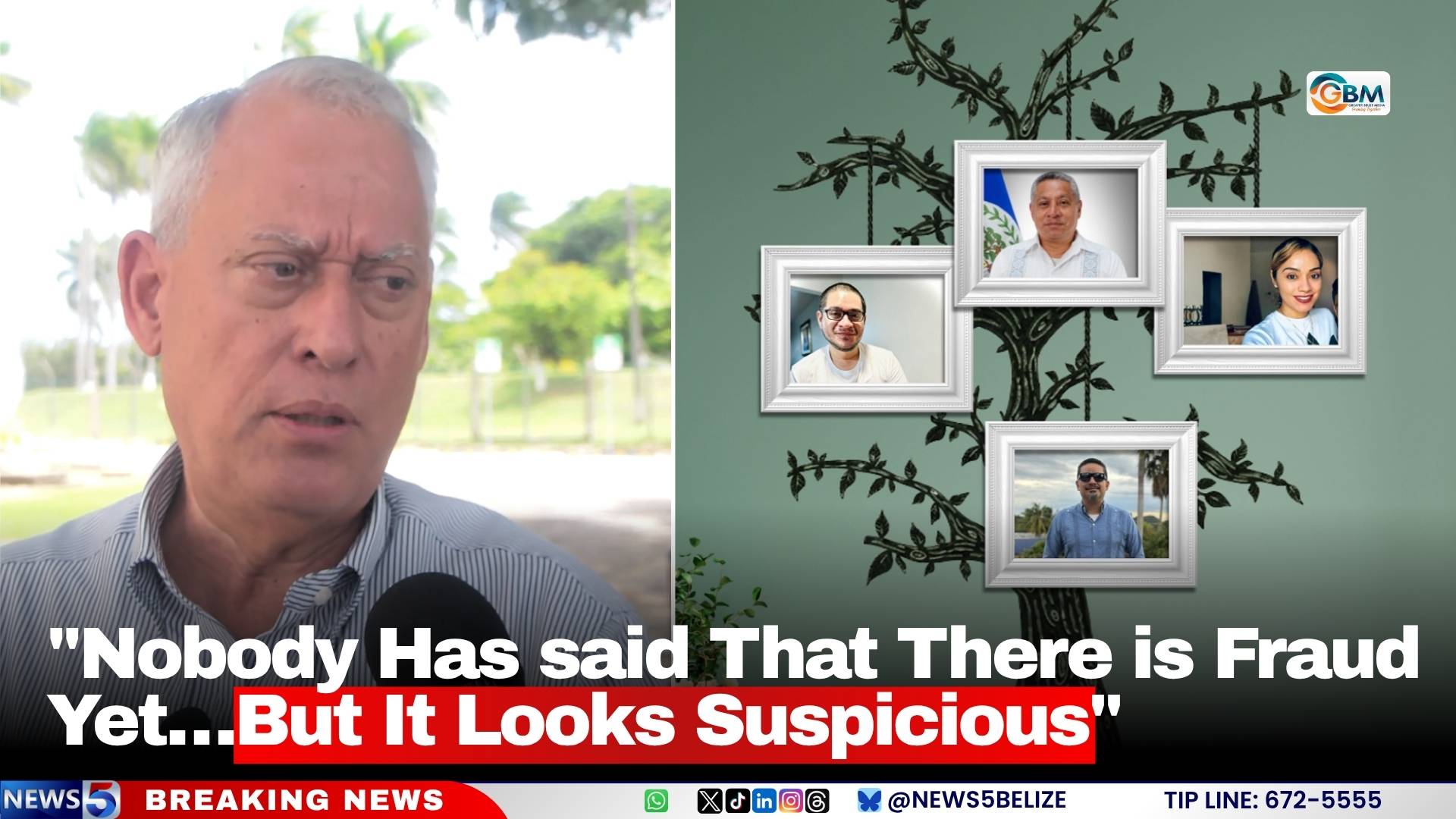
    “Nobody Has said That There is Fraud Yet…But It Looks Suspicious”

    A growing public controversy over potential government procurement misconduct has emerged in Belize, after the nation’s top financial official acknowledged that questionable payments to firms linked to a sitting cabinet minister’s family should have triggered immediate oversight alerts. In a candid interview with local outlet News 5, Financial Secretary Joseph Waight opened up about irregularities uncovered through leaked procurement documents from the SmartStream system, confirming that the transactions in question deviate sharply from established government financial protocols.

    Waight, the country’s top civil servant for public finance management, pointed to a clear failure in the existing oversight framework. “Clearly there was a breakdown in the system. It wasn’t intended to work this way,” he told reporters, adding that the irregular pattern could stem from anything from severe negligence to deliberate collusion between parties involved in processing the payments. “Either somebody dropped the ball, fell asleep, or worse, they moved together on it.”

    At the heart of the scandal are hundreds of thousands of dollars in public funds disbursed by the Ministry of Defence to private suppliers owned by immediate and extended relatives of Minister of Defence Oscar Mira. Multiple sources familiar with the investigation confirm that nearly all of these transactions were processed for amounts just under $10,000 — the statutory threshold that requires mandatory additional review and approval from the national Treasury Department.

    When asked directly if this structured pattern of small-value transactions was a deliberate tactic to evade official Treasury oversight, Waight did not mince words. “It is possible. It looks as if there was some wilful intention there to dodge on that,” he said. While Waight acknowledged that splitting large contracts into incremental instalments is a standard and legal practice in some public procurement scenarios, he emphasized that the current batch of scrutinized transactions does not meet the criteria for legitimate instalment payments. “But not in this case,” he said. “This case looks cute to me.”

    Waight also drew attention to another anomalous practice uncovered during initial reviews: the existence of unregistered “ghost dots” in official supplier account records, a feature he described as highly unusual and unorthodox. “First time I saw that…It took a certain amount of creativity,” he noted, adding that any trained financial officer reviewing the transaction log should have immediately flagged the irregular pattern for further investigation. “It should have raised an eyebrow,” he admitted.

    Of particular note to investigators is a single day of transactions that saw more than $400,000 in total payments disbursed to the family-linked suppliers, all split into chunks below the $10,000 oversight threshold. That lumpy, concentrated pattern has deepened concerns about intentional misconduct.

    Thus far, no formal allegations of fraud have been filed, and an official audit ordered by Prime Minister John Briceño is currently underway to determine whether any existing financial regulations or national laws were broken. Waight stressed that until the audit process is complete and all evidence is compiled, he will avoid making definitive claims of wrongdoing or assigning blame to individual officials. Still, the top financial official made clear that the circumstances surrounding the payments raise serious red flags. “Nobody has said that there is fraud yet,” he said. “But it looks suspicious.”

  • Hormuz Reopens, But What Did Iran Really Promise?

    Hormuz Reopens, But What Did Iran Really Promise?

    Nearly a week after the Strait of Hormuz reopened to global maritime traffic, a sharp public discrepancy between U.S. and Iranian officials has cast major uncertainty over the future of fragile peace talks aimed at ending their ongoing conflict. The standoff began when former President Donald Trump, who led the U.S. negotiating team, publicly claimed Tehran had made sweeping concessions to resolve the nuclear crisis, including full, unfettered access for international inspectors to all Iranian nuclear facilities. In exchange for this commitment, Trump said, the U.S. had agreed to lift its naval blockade of the strategic chokepoint, a move that has already calmed global energy markets in the short term.

    In a post to his social media platform Truth Social, Trump doubled down on his claims, insisting that without Iran’s acceptance of long-term nuclear inspection protocols, no further negotiations would have been possible. “If they did not agree to this, there would be no further negotiations,” he wrote.

    But Iranian leaders quickly pushed back against Trump’s characterization of the preliminary agreement, flatly denying that any commitment for unrestricted International Atomic Energy Agency (IAEA) inspections of sites damaged in last year’s U.S. airstrikes had been made. Foreign Ministry spokesperson Esmail Baghaei clarified that the only points Tehran had formally agreed to are a full end to offensive military operations, the immediate reopening of the Strait of Hormuz, and a 60-day window to continue negotiations toward a binding, final peace deal. Iranian President Masoud Pezeshkian echoed that pushback, warning that public statements misrepresenting the agreed text only undermine progress toward a lasting resolution.

    The conflicting accounts are playing out as technical negotiations continue behind closed doors in Switzerland, where negotiators are working through a complex set of sticking points: sweeping sanctions relief for Iran, permanent nuclear monitoring frameworks, post-conflict reconstruction for both sides, and long-term security guarantees for the Strait of Hormuz, which carries roughly 20% of the world’s daily oil supplies.

    Beyond the diplomatic gridlock, the Trump administration is facing growing pushback on Capitol Hill over its request for additional war funding. According to reporting from the Associated Press, the Pentagon has asked Congress for roughly $80 billion in supplemental funding to cover ongoing costs of the Iran conflict, a request that comes on top of the administration’s already proposed $1.5 trillion national defense budget. Lawmakers from both major U.S. political parties have already expressed skepticism over the massive new spending request, even as the administration frames it as critical to securing a stable peace.

    Adding to the already tense atmosphere, fresh violence has erupted in southern Lebanon despite a recently brokered ceasefire between regional armed groups. The resurgence of conflict in the neighboring country has stoked new fears that any agreement between Washington and Tehran could fail to deliver on its core promise of broader regional stability, leaving the Middle East once again teetering on the edge of a larger regional war.

  • Guatemala Says U.S. Won’t Be Fighting Gangs on Its Soil

    Guatemala Says U.S. Won’t Be Fighting Gangs on Its Soil

    In a firm rebuke of proposed U.S. military action within its borders, Guatemalan President Bernardo Arévalo has publicly ruled out allowing American troops to conduct anti-gang and counter-narcotics operations on Guatemalan territory.

    Arévalo made the clarification in an interview with Agence France-Presse on the sidelines of the Organization of American States summit held in Panama, confirming that while Guatemala actively seeks and welcomes international collaboration on security issues, its national constitution explicitly prohibits joint military operations with foreign armed forces.

    The president’s statement was issued in direct response to recent remarks by U.S. Defense Secretary Pete Hegseth, who told CBS News that the U.S. was considering launching targeted strikes against transnational criminal gangs and drug trafficking networks in both Guatemala and Ecuador.

    While Arévalo did not challenge the existence of existing bilateral security cooperation between the two nations, he emphasized clear legal and operational boundaries to that partnership. According to the Guatemalan leader, Washington’s involvement is restricted to three core areas: training for local security personnel, tactical planning support for anti-criminal raids, and cross-border intelligence sharing. All armed operations against domestic criminal organizations, he stressed, remain the exclusive responsibility of Guatemala’s own national security forces.

    The exchange comes amid a broader expansion of U.S. military activity across Central and South America under the Trump administration’s renewed anti-drug offensive. Earlier this month, U.S. forces carried out a cross-border raid in Venezuela that resulted in the death of Hector Rusthenford Guerrero Flores, leader of the violent transnational Tren de Aragua gang, who carried a $5 million U.S. bounty on his head. President Trump later publicly shared footage of the operation on his social media platforms.

    Beyond targeted raids on gang leaders, the U.S. has also launched a series of airstrikes against suspected drug smuggling vessels in the Caribbean Sea and Pacific Ocean. Official data from regional security sources indicates that more than 200 people have been killed in these air operations to date.

  • What Are “Synchronised Factories” and Could They Bring Jobs to Belize?

    What Are “Synchronised Factories” and Could They Bring Jobs to Belize?

    On a recent Friday in June 2026, high-level delegations from Belize and Mexico gathered at the Santa Elena border crossing to advance discussions on transformative cross-border economic cooperation, with a novel proposal of synchronized factories taking center stage. This ambitious framework would split manufacturing processes across the two nations’ border regions, pairing Belize with Mexico’s Quintana Roo state to leverage each side’s unique comparative advantages. Under the plan, complementary production and processing activities on both sides of the border would deliver finished goods to the CARICOM single market, creating a streamlined cross-border supply chain tailored to regional demand.

    Beyond the innovative factory model, the two delegations also explored infrastructure connectivity that could unlock broader economic growth. A key priority on the agenda is linking Belize’s transport network to Mexico’s flagship Tren Maya rail system, opening up new efficient routes for both cargo shipments and passenger travel between the two countries. During the talks, working groups also identified four high-potential sectors ripe for collaborative industrial development: agribusiness, agro-processing, manufacturing, and energy, all of which are seen as holding significant untapped opportunity for both nations.

    The Belizean delegation brought together senior leaders from across key government and economic development bodies, including Narda Garcia, CEO of the Prime Minister’s Office; Neri Ramirez, CEO of the Corozal Free Zone; Lincoln Blake, Director of Investment Policy and Compliance; plus senior representatives from the Economic Development Council, Ministry of Foreign Affairs, and the Belize Trade and Investment Development Service (BELTRAIDE). On the Mexican side, the negotiating team included senior officials from the federal Secretariat of Foreign Relations and the Quintana Roo state government, headed by Carlos Imanol, Director General for Central America and the Caribbean, and Paul Carillo, Quintana Roo’s Secretary of Economic Development. If advanced, the proposal could reshape regional manufacturing dynamics and bring new employment opportunities to Belize, addressing long-standing economic development goals for the small Central American nation.

  • ‘Hundreds of Payments’: Formal Corruption Complaint Filed Against Mira

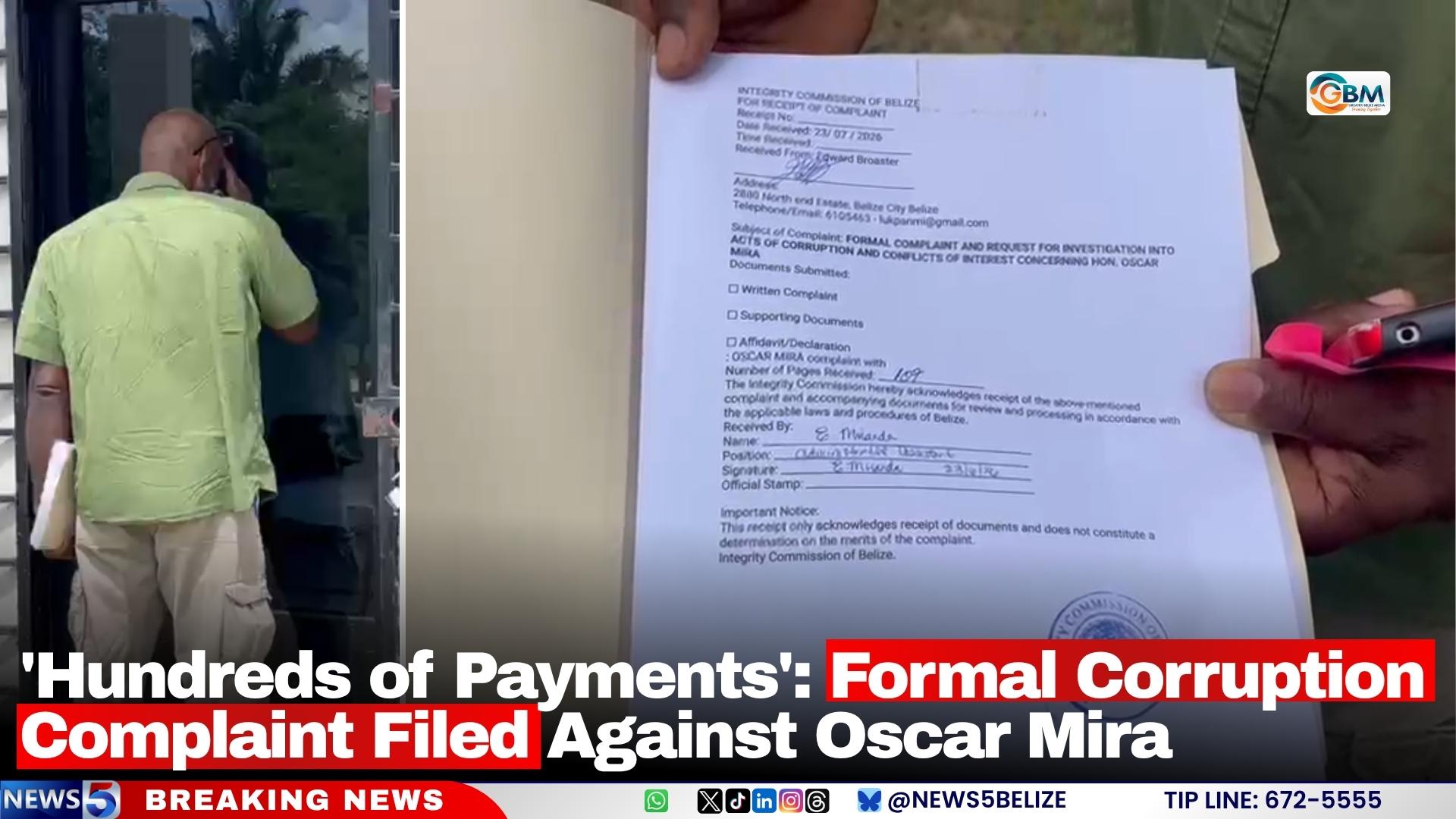
    ‘Hundreds of Payments’: Formal Corruption Complaint Filed Against Mira

    Political and legal pressure has mounted sharply on Oscar Mira, the Area Representative for Belmopan in Belize, after a formal corruption complaint was submitted to the country’s Integrity Commission on June 23, 2026, calling for a full probe into allegations that he misused his official authority to direct millions of public dollars to family members and their linked business ventures.

    The complaint was brought by Edward Broaster, caretaker for the United Democratic Party (UDP) in Belize Rural Central, filed under Section 34 of Belize’s Prevention of Corruption Act. Broaster’s filing outlines three core accusations against Mira: conflict of interest and unlawful personal gain, failure to disclose private interests tied to government contracts, and abuse of public office to deliver improper financial benefits to close relatives.

    In the complaint, Broaster wrote: “I have reasonable grounds to believe that Hon. Oscar Mira, a ‘person in public life’ under Section 2 of the Act, is in breach of the provisions of this Act.” He anchored his filing in Section 34(1) of the Prevention of Corruption Act, Chapter 105 of Belize’s Substantive Laws.

    At the heart of the allegations are two entities tied directly to Mira’s family: Jenny Mira, the lawmaker’s sister, and MP Farms, a business controlled by his brothers Stanley and Brian Mira. Internal government records pulled from the country’s Smart Stream procurement system include dozens of screenshots showing more than 100 individual payments made to the two vendors between 2020 and 2025, with the majority of funds originating from the Ministry of Defence, a portfolio Mira previously led.

    Documented in the records is a single-day transfer of nearly $400,000 in public funds to MP Farms, while Jenny Mira received thousands of dollars across hundreds of separate smaller payments. Additional funding came from other government agencies including the Ministry of Health, the National Emergency Management Organization (NEMO), and the Belize Coast Guard.

    A particularly troubling detail highlighted in the complaint is the consistent pattern of structuring payments to fall just below the $10,000 threshold that triggers heightened oversight from the national Treasury, a practice widely recognized as a method to avoid regulatory scrutiny. This pattern has already drawn significant criticism from the Belizean public.

    Broaster is calling on the Integrity Commission to launch a complete investigation, cross-reference the claims against Mira’s official sworn asset and income declarations, appoint an independent special investigator, and refer the case to the Director of Public Prosecutions for criminal charges if evidence of unlawful activity is uncovered.

    This latest development comes exactly one week after Opposition Leader Tracy Panton submitted a Freedom of Information (FOI) request seeking the full documentation trail for all contracts connected to Jenny Mira, MP Farms, and four other linked entities dating back to 2020.

    In her statement announcing the FOI request, Panton laid out a series of unanswered public questions: “We want to know to whom were these contracts issued, what was the value, what tenders were publicly advertised, who evaluated the bids, who approved the contracts, were procurement procedures followed, were conflicts of interest declared, were payments structured to avoid scrutiny, were the goods and services actually delivered, and did the Belizean people get value for money?”

    After weeks of public silence, Mira broke his silence on the allegations for the first time on June 17, one day after Panton submitted her FOI request. The lawmaker has denied any personal involvement in procurement decision-making, noting that tender oversight committees fall under the jurisdiction of the Ministry of Finance, and that he has never served on or attempted to influence any of these panels.

    Mira argued: “Tenders are published in the newspaper. Any interested person can apply. They go through a lengthy process. I had no say; I was not part of those committees.” When asked about the pattern of below-threshold structured payments, Mira acknowledged the public’s concern but stopped short of admitting any wrongdoing, stating: “I do not think that anyone wouldn’t be concerned. But was anything illegally done? I do not know. I believe that in every crisis, you learn from it, and I myself am trying to make sure that I learn from this.” Mira also denied having any knowledge of his relatives’ business transactions with the government.

    Last Friday, the Integrity Commission issued a preliminary statement confirming that any member of the public with evidence of corruption can file a formal complaint that will be processed in accordance with Belizean law. Broaster formally submitted the complaint in person at the Integrity Commission’s Belmopan office on June 23, but the filing process was marked by unusual friction. After leaving the commission’s offices, Broaster told local outlet News 5 that commission staff were visibly hesitant to accept the complaint.

    “I never seen jumpier people than that yet, everything they make calls, they didn’t even want to take the complaint,” Broaster said. He also criticized the recent decision to grant Mira a three-month leave of absence, noting that the current Prime Minister has publicly stated zero tolerance for corruption and called for corrupt officials to be imprisoned. “So, giving Oscar Mira a three-month leave, is far cry from what he has been advocating for. I just hope that he will uphold the standards and rhetoric that he has been pushing.”

    Broaster has pushed back against claims that the complaint is a partisan political maneuver, insisting he is acting on behalf of all Belizean residents to protect public funds: “this is not a political move on my part, but rather on behalf of the poor people of Belize, the public purse.”

  • Protected Fish Found Skinned Near Trap in San Pedro Waters

    Protected Fish Found Skinned Near Trap in San Pedro Waters

    In a development that has raised alarms among marine conservation groups and fishing industry stakeholders in Belize, the remains of a skinned permit fish (Trachinotus falcatus) — a legally protected species in the country — were discovered earlier this week in the waters off San Pedro Town. The Belize Flats Fishery Association (BFFA) confirmed that one of the organization’s experienced fishing guides found the carcass on Monday, located within a quarter-mile of an unregulated fish trap placed in the area.

    Permit fish hold dual importance for Belize: ecologically, they play a key role in maintaining the balance of coastal marine ecosystems, and economically, they are a cornerstone of the nation’s lucrative catch-and-release flats fishing sector. This industry supports thousands of livelihoods across the country, from local fishing guides to small tourism business owners and entire coastal communities that rely on recreational fishing visitors.

    Following the discovery, the BFFA has officially notified the Belize Fisheries Department of the incident, and is calling on regulatory authorities to launch a full, thorough investigation to identify those responsible and hold them accountable under Belize’s marine protection laws. The association has also issued a public appeal, urging all residents and visitors to report any suspicious activity that involves the catching, killing, trading, or unauthorized possession of protected marine species.

    In a statement following the discovery, the BFFA emphasized that protected species are granted legal protection for clear, pressing reasons. The group reiterated that ongoing conservation of these vulnerable marine populations is not just an environmental priority, but a critical requirement to preserve Belize’s marine ecosystems and secure the long-term viability of the recreational flats fishing industry that supports so many local livelihoods.