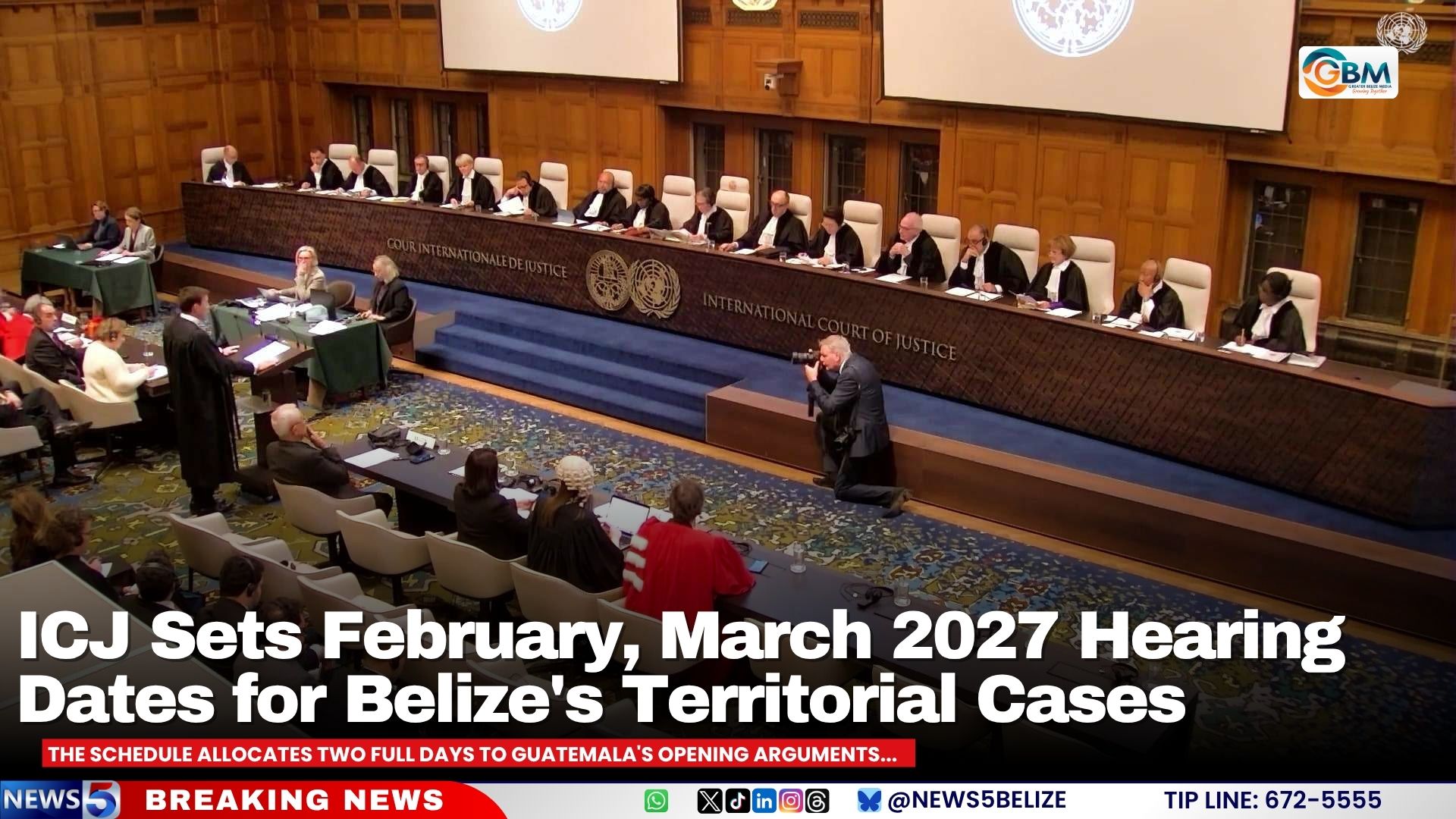
In a formal announcement dated September 17, 2026, the International Court of Justice (ICJ) has locked in hearing dates for two long-running territorial disputes involving Belize, setting the stage for binding international adjudication of competing claims to Central American land and maritime territory. The UN’s highest court for inter-state disputes will hold hearings on Guatemala’s broad territorial, insular and maritime claim against Belize in late February 2027, followed by a separate hearing on sovereignty over the Sapodilla Cayes archipelago the following month.
The scheduling details, laid out in two official letters from ICJ Registrar Santiago Villalpando, outline a tightly structured timeline for the first dispute. Opening arguments in the Guatemala claim case will kick off on Monday, February 22, 2027, and conclude five days later on February 26. Under the ICJ’s allocated schedule, Guatemala will get two full consecutive days to lay out its opening position, after which Belize will have two full days to present its initial counter-arguments. The final day of the hearing will be split evenly between the two parties, allowing each to deliver their closing second-round arguments.
The second territorial dispute, centered on sovereignty over the Sapodilla Cayes (known as Cayes Zapotillos to Spanish-speaking claimants), brings Belize and Honduras as primary parties, with Guatemala granted status as an intervening state in the proceedings. Per the ICJ’s scheduling, this hearing will run from Monday, March 1 through Friday, March 5 2027, starting with Belize’s opening round of oral arguments. Honduras will follow with its own first-round presentation, after which Guatemala will deliver formal oral observations relevant to its intervening interest in the territory. The hearing will close with second-round closing arguments from both Belize and Honduras.
Both official communications from the ICJ were addressed to Assad Shoman, Belize’s designated Agent before the court, with copies sent to Co-Agent Alexis Rosado. The court noted that the allocated hearing windows represent the maximum time each party will be permitted to present its legal and factual arguments. Additional procedural details, including logistical arrangements for delegates and legal teams, will be distributed to all parties separately in the lead-up to the 2027 hearings.
Guatemalan officials have previously framed the ICJ process as the most viable path to a permanent, peaceful resolution of the long-standing territorial frictions between the three Central American nations, which have lingered for decades with occasional localized tensions.