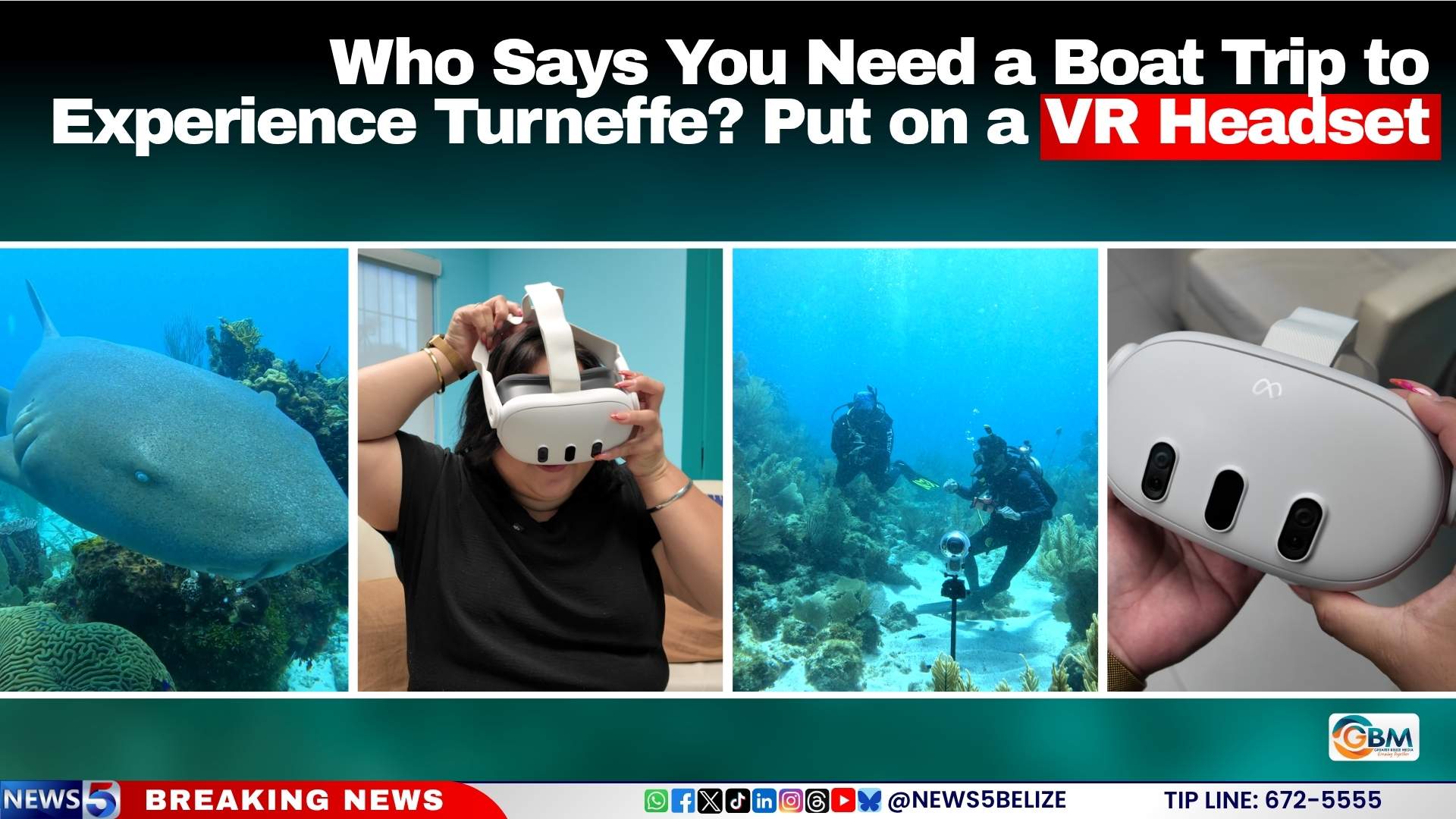
For generations, accessing the extraordinary natural beauty and ecological diversity of Belize’s Turneffe Atoll has remained out of reach for countless people—from local schoolchildren who lack the resources for a costly, logistically complex boat trip offshore, to non-swimmers and non-divers who cannot venture beneath the atoll’s crystal-clear surface. Today, a pioneering new project from the Turneffe Atoll Sustainability Association (TASA) is breaking down those barriers, using immersive virtual reality technology to bring the full splendor of Belize’s largest marine protected area directly to communities, classrooms, and people who have never been able to visit in person.
Unlike artificial, AI-generated simulations, the project features two custom VR experiences built from high-resolution 360-degree footage captured on-location by professional underwater videographer Duarte Dellarole, who spent a full week documenting the atoll’s varied landscapes. The first 4-minute film takes viewers on a seamless journey through five interconnected, ecologically critical habitats: the tangled root systems of coastal mangroves, sprawling seagrass beds, shallow reef flats, vibrant living coral reefs, and the dramatic, deep-water drop-off wall that defines Turneffe’s outer edge. The second VR experience centers on the Wit Wreck, a sunken vessel that has been reclaimed by the ocean and transformed into a thriving artificial reef teeming with tropical marine life.
For TASA, the VR initiative is far more than a tourist attraction—it is a targeted educational tool designed to connect Belize’s young people to their country’s natural heritage. Many Belizean students grow up learning about the country’s world-famous barrier reef system in textbooks, but few get to experience it firsthand, due to the extensive planning, funding, and logistics required to organize a full-class boat trip to Turneffe, which sits between one and one and a half hours offshore. By bringing the atoll into classrooms, TASA hopes to inspire the next generation of conservation leaders, sparking interest in careers ranging from marine biologists and conservation officers to divemasters and sustainable tour guides.
The VR project is just one part of a broader, technology-driven conservation strategy that TASA has rolled out over the past three years to protect the ecologically rich atoll while cutting operational costs. The organization has installed new radar systems with geofencing capabilities at Mauger Caye and Caye Bokel, deployed thermal surveillance drones, and built a centralized data management platform called the Spatial Monitoring and Reporting Tool (SMART).
Before these upgrades, conservation patrol teams were forced to launch boats on routine missions regardless of whether illegal activity was detected, wasting fuel and resources across the atoll’s vast expanse. Today, radar systems automatically send real-time alerts when any vessel lingers in a restricted protected zone, and drones are deployed first to verify activity before patrol boats are dispatched to the specific target. This targeted approach has already made patrols far more efficient, reducing the frequency of unnecessary missions. TASA’s long-term goal is to cut the reserve’s annual patrol fuel costs, which currently run around $150,000, by 50 percent— a milestone the team is working toward incrementally.
The entire VR initiative, including both headsets and on-location footage capture, cost roughly $10,000, with full funding provided by the Protected Areas Conservation Trust. TASA has already begun expanding access through partnerships with local educational institutions: Itz’at STEAM Academy, which already maintains its own fleet of VR headsets, has partnered with TASA to host the Turneffe experience for its students, and the organization hopes to build more of these partnerships with educational and community groups across Belize.
While technology has opened new doors for accessibility and conservation, TASA leaders note that expanding these initiatives will require sustained financial support from a range of stakeholders, including international donors, local communities, and visitors. Even so, the project represents a groundbreaking model for combining digital innovation, environmental education, and ecological protection. TASA Executive Director Valdemar Andrade emphasized that the atoll is a shared natural and cultural heritage for all Belizeans, and the VR project ensures that every person, regardless of their ability to travel offshore, can experience and connect with this irreplaceable global treasure.