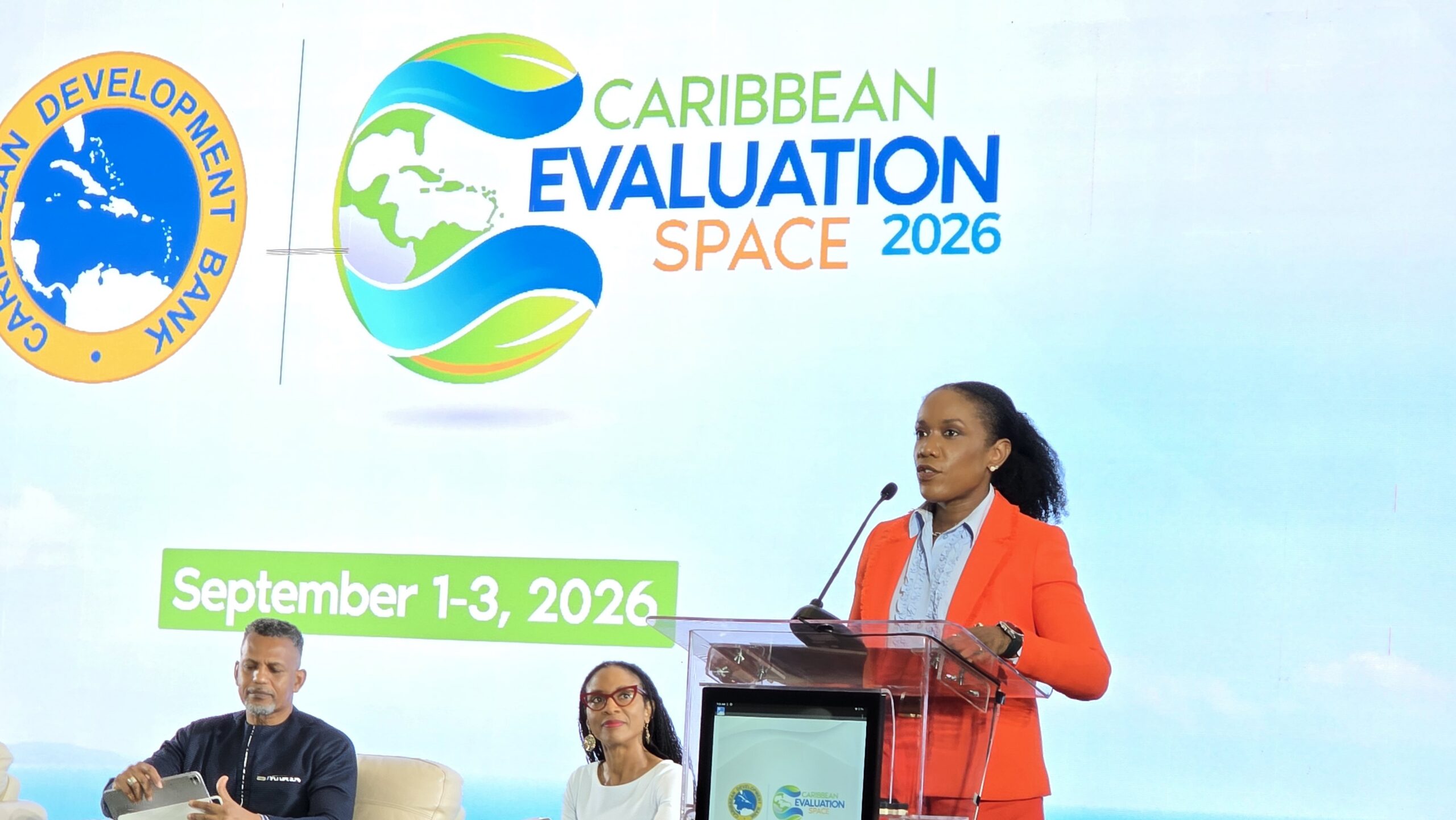
At the inaugural Caribbean Evaluation Space 2024 held at Wyndham Grand Barbados, Sam Lord’s Castle this Tuesday, Minister of Economic Affairs & Planning Marsha Caddle delivered a pressing call for the Caribbean region to develop custom monitoring and evaluation frameworks aligned with its unique economic and geographic realities, rejecting one-size-fits-all models imported from larger, wealthier nations.
Caddle emphasized that small island developing states (SIDS) in the Caribbean face distinct structural vulnerabilities that global metrics designed for major economies fail to capture. A wholesale copy-paste of results frameworks from G20 finance ministries, she argued, would ask misaligned questions that do not account for the region’s small, highly interconnected populations and deep exposure to external shocks. “We are entitled, and obligated, to build monitoring and evaluation systems that are honestly ours, not borrowed frameworks we only hope will fit,” Caddle told attendees.
A core critique from Caddle centered on the overreliance on GDP per capita as a primary measure of economic health. She noted that this common indicator offers no insight into the catastrophic risk Caribbean nations face from extreme weather events, where a single hurricane can erase a quarter of a country’s annual GDP in a single afternoon. Beyond natural disaster exposure, Caddle added that standard international metrics also fail to account for the unique constraints small island states face when adapting to rapid technological change. For decades, Caribbean nations have fought to have these unique vulnerabilities recognized by global institutions, from narrow economic bases to debt structures shaped by repeated borrowing to rebuild storm-damaged infrastructure. Without regionally developed resilience metrics, Caddle warned, the region will continue to be assessed and funded based on outsiders’ misaligned definitions of vulnerability and progress, distorting reporting against the United Nations’ Sustainable Development Goals (SDGs).
As the 2030 deadline for SDG achievement approaches, Caddle laid out two equally urgent priorities for the regional evaluation community. First, she called for rigorous, honest evaluation of current progress toward SDGs, even when the resulting evidence challenges prevailing narratives or exposes unmet needs. Second, she urged the long-term, intensive work of building measurement tools explicitly designed for small, open, climate-exposed Caribbean economies.
Caddle also emphasized the critical importance of regional cooperation, warning that duplicating separate monitoring systems, data infrastructure and resilience indexes across dozens of small individual states is wasteful and inefficient. “It is distinctly unhelpful to have a dozen or more small Caribbean states each trying to replicate the same institutional endeavour separately, when a shared one would serve us all better,” she said. Instead of each nation building independent evaluation training programs and isolated data systems from scratch, Caddle called for a cohesive regional evaluation community that shares methodologies, expertise, and hard-won lessons. A collaborative approach would allow successful frameworks from one jurisdiction to be adapted rather than reinvented across the region, enable skilled evaluators to support neighboring states, and position the Caribbean as a global model of context-appropriate resilience measurement, rather than just a collection of separate national efforts.
Beyond structural and regional design, Caddle outlined key principles for effective evaluation. She argued that assessment should not stop at checking whether individual projects meet their immediate outputs; it must also examine whether the underlying systems that deliver those projects are built for consistent, reliable performance. A results framework that only evaluates single projects will only highlight successes, she explained, while leaving fragile underlying institutional systems unaddressed. Caddle also stressed that data collection must be tied directly to actionable policy, warning that unactionable indicators are merely decorative. “Every indicator in a national evaluation framework should be able to answer the question: If this number comes back bad, what am I going to do about it? If nobody can answer that, the indicator is decoration, not evidence,” she said. Finally, she called for all evaluation frameworks to incorporate an explicit equity lens, noting that measuring whether a program was delivered on time and on budget tells stakeholders nothing about whether it actually reached the marginalized communities it was intended to serve.