标签: Bahamas

巴哈马

  • Henfield questions cost of London worker

    Henfield questions cost of London worker

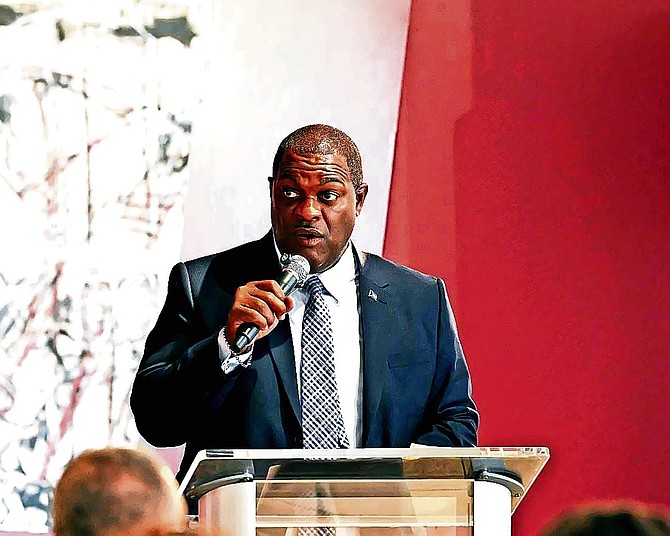
    A sharp political dispute has erupted in the Bahamas over proposed foreign service reforms, with former Foreign Affairs Minister Darron Henfield publicly questioning the fiscal responsibility and policy logic of the Davis administration’s provisions, centered on a controversial high-cost junior posting in London.

    At the core of Henfield’s critique is a young male government employee assigned to the Bahamian mission in London, who he says drains more than $200,000 annually from public taxpayer funds. The former minister’s attack comes in direct response to current Foreign Affairs Minister Fred Mitchell’s push for the 2025 Foreign Service Act, legislation that would convert most contract-based diplomatic positions into permanent, pension-eligible roles and implement new protections to bar political dismissals of non-partisan staff.

    Mitchell has positioned the reforms as a critical modernization step for the Bahamas’ diplomatic corps, designed to end the decades-long pattern of mass job cuts for junior contract officers that followed the 2017 transition of government. But Henfield argues Mitchell’s framing is deliberately misleading, dismissing the narrative that incoming administrations recklessly purge foreign service staff as disingenuous. He insists that reviewing existing overseas staffing contracts and recalling unnecessary personnel is a standard, routine governance function, and that the current government’s rhetoric is stoking unneeded anxiety among both permanent public servants and contract workers across the foreign ministry.

    While Henfield says he supports job security for public employees in principle and rejects the “cannibalization” of staff rolls purely for political gain when new administrations take power, he accuses the current Progressive Liberal Party government of blatant hypocrisy. He points out that when the PLP returned to office, the administration itself dismissed dozens of workers—including young women and single mothers who were the primary earners for their households—despite now campaigning for sweeping job protection laws for diplomatic staff.

    Defending the staffing cuts his own administration implemented, Henfield explained that a comprehensive review of Bahamian overseas missions when he took office revealed severe budget pressures caused by bloated staffing levels left by the previous government. He said his team immediately found that most overseas posts were facing major budget shortfalls directly tied to unnecessary over-hiring, which was costing Bahamian taxpayers more than $1 million annually in wasteful spending.

    Among the most egregious examples, Henfield cited so-called liaison officer positions that paid over $150,000 per person annually for little more than greeting visiting Bahamian officials at airports and arranging basic travel logistics. He also raised longstanding concerns about the qualifications of many contracted overseas staff, noting multiple cases where diplomatic officers lacked even basic academic credentials required for their roles. In response, his administration recalled roughly seven employees that were deemed either unqualified or unnecessary, and redirected resources toward recruiting and training a new cohort of professional, qualified foreign service officers.

    Notably, despite his pointed criticism of the current government’s approach, Henfield stopped short of rejecting foreign service reform entirely. He acknowledged that his own administration had worked to advance similar structural updates to the diplomatic corps, and agreed that formalized foreign service regulations bring valuable benefits—including creating clear frameworks for disciplinary action and establishing formal systems to recognize outstanding service with awards and honors. His core objection remains to the permanent entrenchment of costly, unneeded postings that he says represent an unfair burden on Bahamian taxpayers, leaving open the question of whether future administrations will be forced to carry the financial weight of such politically connected contracts if the reforms pass.

  • NCL fined for environmental violations at Great Stirrup Cay

    NCL fined for environmental violations at Great Stirrup Cay

    Bahamian regulators have issued financial penalties against Norwegian Cruise Line over multiple environmental infractions at Great Stirrup Cay, the private Caribbean island the company owns and operates. At the same time, a high-stakes labour dispute stemming from a whistleblower’s termination is moving toward a conciliation process, with both investigations remaining in progress with no firm completion dates.

    Bahamas Environment Minister Zane Lightbourne confirmed that enforcement action followed a full regulatory probe into activity on the island. The penalty structure includes a $20,000 base fine plus additional undisclosed financial penalties. While the company has been granted a legal grace period to submit payment, no funds have been processed by regulators as of the latest update. Lightbourne added that investigators uncovered more violations than had previously been reported publicly, and full details will be released in an upcoming official government assessment. He declined to share unconfirmed specifics ahead of the report’s publication, noting that official findings would be published once the review wraps. “We’ll put an official report on that, but we would not like to, at this time, indicate any specifics outside of the official report,” he said in a statement to local media.

    The case is tied to allegations from Daylland Moxey, a former assistant safety manager at the Great Stirrup Cay facility, who claims he was wrongfully fired from his role in early March. Moxey has alleged his termination was retaliation for raising formal concerns about unaddressed environmental and safety risks at the site, including an unsanctioned fire at a waste disposal location and improper management of hazardous materials. He also claims the company still owes him unpaid wages from his tenure. Howard Thompson, Director of the Bahamas Department of Labour, confirmed that the unfair termination claim filed by Moxey will be referred to an independent conciliator for negotiation, though no hearing date has been scheduled due to limited staffing for such cases.

    Thompson explained that the labour department has delayed launching its own full investigation to allow the environmental review to conclude first, as findings from the environmental probe will provide critical context for the labour team’s work. “Once environmental do what they need to do, they will let me know, and then my team will move in,” Thompson said. Once the environmental assessment is complete, the labour department will conduct a two-phase investigation: first reviewing overall occupational health and working conditions on the island, and second investigating Moxey’s claims of unfair treatment and retaliatory discharge.

    Thompson characterized the case as unusually complex due to the broad scope of Moxey’s allegations, noting that environmental investigators’ confirmation of unaddressed violations would heavily support Moxey’s claim that his dismissal was retaliatory. While the labour department does not hold the authority to order a shutdown of operations at Great Stirrup Cay, Thompson noted the agency can issue mandatory correction notices for workplace violations and impose its own fines if issues are not remediated. To date, neither officials from Norwegian Cruise Line nor representatives for Moxey have issued additional public comment on the cases, and no firm timeline has been set for either the release of the full environmental violation report or the scheduling of the conciliation hearing.

  • Pastor Mario Moxey elected new Christian Council president

    Pastor Mario Moxey elected new Christian Council president

    In a decisive electoral outcome for one of the Bahamas’ most influential faith-based organizations, Pastor Mario Moxey has been voted in as the new president of the Bahamas Christian Council, wrapping up a competitive selection process with a clear mandate to lead the group through the next three years.

    Final vote counts released to local media confirm Moxey earned 169 votes, while his challenger Apostle Raymond Wells garnered just 58, delivering a landslide victory that solidifies broad support across the council’s membership. Moxey will succeed outgoing president Bishop Delton Fernander, who has steered the interdenominational body since 2017, and will hold the presidency for the 2026 to 2029 term.

    In his first public address following the announcement of the results, Moxey made unifying the nation’s diverse Christian communities and strengthening collective national collaboration the cornerstone of his upcoming leadership.

    “Our first and foremost priority is securing unity in the body of Christ across all denominations,” he said. “Beyond the church, we also aim to build unity across civic, religious and governmental spheres, so that all groups can work together toward the common good of the Bahamian people. This vision is summed up in our leadership theme: One Voice. One Church. One Nation.”

    Moxey noted that he will first convene his newly elected executive team to map out concrete policy priorities aligned with available organizational resources, before rolling out new initiatives. In an official statement confirming the election results, the Bahamas Christian Council formally endorsed Moxey’s appointment and the unity-centered mandate that will guide the body’s work over the next three years.

    “It is both a privilege and a calling to serve God by serving the people of The Bahamas, and in particular the Christian Churches that span our nation,” the council’s statement read. “The Church represents the largest block of citizenry across every sector of society, with approximately 90 percent of our population identifying as Christian. This is not merely a statistic — it is a profound responsibility.”

    Expanding on the council’s strategic direction under his leadership, Moxey emphasized that the Church is positioned to act as a core unifying force in Bahamian public life, rather than a marginal interest group.

    “The Church is not a minority voice trying to be heard. We are the majority voice that must choose to be the unifier,” he said. “As we unify the Church, we position ourselves to help unify the nation, offering spiritual leadership, moral clarity, and a renewed sense of purpose for our people.”

    A 16-year veteran of the Bahamas Christian Council, Moxey most recently served as the body’s vice president prior to his election. He said his decades of involvement with the organization have been rooted in a longstanding commitment to public service for his home country.

    “I’ve always had a desire to serve my country. That’s the reason why I was in the Christian Council, because I felt as though I needed to serve, I needed to contribute,” he explained. “Just as a result of tenure and being there, it’s time for natural elevation to take place, to serve at a higher level. It’s my privilege to represent the Christian community at this season.”

    Alongside Moxey’s appointment, the council announced the full slate of its new executive leadership team, which includes representatives from a wide cross-section of Christian denominations across the Bahamas, reflecting the body’s commitment to inclusive representation of the nation’s diverse faith community.

  • PLP hands out over $200k in gift cards

    PLP hands out over $200k in gift cards

    A pre-election controversy has erupted in The Bahamas over more than $200,000 in Hurricane Dorian relief gift certificates distributed to Abaco residents, after the head of the issuing company directly linked the funding to the national Ministry of Finance. Chris Lleida, chief executive officer of Premier Importers — the local firm that produced and will honor the vouchers — made the claim publicly this week, opening a fierce debate over whether public funds have been misused to influence voters just two weeks ahead of the country’s general election, more than six years after Dorian devastated Abaco.

    According to Lleida, the finance ministry requested his company issue the gift certificates as part of long-delayed post-hurricane relief, with individual vouchers ranging in value from $200 to $500, for a total sum exceeding $200,000. He confirmed that his firm’s role is limited to producing and honoring the certificates, with all distribution responsibility held by the ministry and the third parties it designated. When pressed on the unusual timing of the rollout, coming years after the disaster and just weeks before voters head to the polls, Lleida acknowledged the obvious question: “Why didn’t this happen two years ago?”

    Physical copies of the certificates obtained by The Tribune show they bear the signatures of two Bahamas Progressive Liberal Party (PLP) figures: Bradley Fox Jr., the PLP candidate for Central and South Abaco, and Preston Roberts, the party’s campaign coordinator and a sitting member of the Disaster Reconstruction Authority board. To date, no clear information has emerged about how many certificates have been distributed, what criteria were used to select recipients, or how the distribution process is being managed.

    Lleida’s explosive claim has been forcefully rejected by senior PLP leadership. Valentine Grimes, a PLP trustee, stated that the party would never misuse public funds for this type of initiative, insisting that all materials distributed by party candidates are covered either by the party’s own budget or the candidate personally. “Anything that candidates give out to people, anything, is paid out by the party or the candidate,” Grimes said. When asked whether the distribution so close to an election constituted vote buying, Grimes acknowledged that similar practices occur across all political groups in the country — a longstanding unaddressed open secret in Bahamian politics. He argued that there is nothing improper about assisting vulnerable residents, even near an election, and that any interpretation of motive is up to individual voters.

    Other PLP figures have offered conflicting accounts of the funding source. Roberts, whose signature appears on the certificates, said he believed the funds came from the party’s own private relief donations, fulfilling a years-old promise to Dorian survivors made after the 2019 storm. He explained that distribution is still ongoing, with plans to expand the program to North Abaco, and that vouchers are targeted to residents still recovering from storm damage — including single mothers and elderly residents, who receive higher-value certificates to cover needs like roofing, cabinetry, and bathroom repairs. Fox, the candidate whose signature also appears on the vouchers, declined to answer direct questions about the funding source or vote buying allegations, only offering a biblical quote in response to reporters.

    Lleida pushed back against claims of partisan favoritism, noting that he has worked for years with cross-party lawmakers who use their constituency budgets to assist residents with home repairs and other needs. He added that while the current request was larger than usual, it was not out of the ordinary for his firm, and that he supports assistance reaching all eligible residents regardless of political affiliation. For local building supply businesses like his, he noted, the initiative also provides welcome economic support at a time when the local construction market remains sluggish.

    Requests for comment from the Office of the Prime Minister went unanswered by press time. The controversy has thrown a sharp spotlight on a longstanding gap in Bahamian election law: the country still lacks a comprehensive, enforceable campaign finance framework, with no clear mandatory disclosure rules for political spending or binding regulations governing the use of public resources during election periods. Both major political parties have repeatedly pledged to implement comprehensive campaign finance reform over the years, but no such policy has been enacted to date, leaving the door open for questions about the intersection of government relief and political campaigning ahead of this month’s vote.

  • Candidate slammed on crown land deeds

    Candidate slammed on crown land deeds

    Weeks before Bahamas’ hotly anticipated general election, a Progressive Liberal Party (PLP) candidate’s explosive claim about holding Crown Land title deeds for distribution has ignited fierce political debate and thrown a spotlight on long-simmering questions about the integrity of public land allocation processes.

    At a well-attended PLP campaign rally held in West End on April 13, Dr. Monique Pratt, the party’s candidate for East Grand Bahama, made the unorthodox announcement to assembled supporters. In remarks captured on video and later circulated publicly, Pratt pushed back against claims from rival political groups that they would deliver Crown Land to constituents, asserting that she already held the long-awaited deeds in her personal possession.

    “I’m proud to say that I have in my possession your long-awaited deeds to your crown land, and I’ve been given the instructions from our prime minister to release them to you,” Pratt told the crowd. A subsequent social media post from the candidate showed her at a party event calling out the names of East Grand Bahama residents who were purportedly marked as recipients of the allocated public land.

    Pratt’s comments immediately triggered widespread scrutiny, as observers and political opponents questioned why official government title deeds would be transferred to a sitting political candidate rather than being processed through standard, formal government administrative channels.

    When reached for comment by reporters on Monday, Pratt declined to address questions directly, referring all inquiries to PLP party leadership, noting that senior officials were aware of the controversy and would issue a formal response. Latrae Rahming, communications director for both the Office of the Prime Minister and the PLP, later confirmed to local outlet The Tribune that Prime Minister Philip Davis—who holds direct ministerial responsibility for Crown Land management—would address the matter personally during an upcoming press interaction.

    The opposition Free National Movement (FNM) has already seized on the controversy to attack the incumbent government, with FNM chairman Dr. Duane Sands launching sharp criticism over the incident, arguing it raises serious red flags about procedural fairness, governmental transparency, and adherence to the rule of law in Bahamian public land administration.

    “Crown Land is not a political reward, it is a sacred national patrimony, held in trust for all Bahamians,” Sands stated in his response. He questioned how official title deeds ended up in the custody of a political candidate rather than government agencies, and raised explicit concerns that land allocations are being weaponized for political patronage ahead of the election.

    “The issuance of title deeds is a formal governmental function, not a political favour to be dispensed from a campaign platform,” Sands added. He also called for direct answers from Prime Minister Davis, demanding clarification on whether Davis personally issued the instruction to deliver the deeds to Pratt for campaign distribution. Sands emphasized that the incident raises “significant legal and ethical questions” and pushed for full accountability and radical transparency in the ongoing administration of Crown Land.

  • PM warns Pintard to drop ‘crazy antics’ ahead of vote

    PM warns Pintard to drop ‘crazy antics’ ahead of vote

    As the Bahamas approaches its April 30 advanced poll, political tensions between the ruling Progressive Liberal Party (PLP) and the opposition Free National Movement (FNM) have escalated sharply, with Prime Minister Philip Davis publicly calling on Opposition Leader Michael Pintard to abandon disruptive political tactics that threaten the integrity of the upcoming election process.

    Speaking to an energized crowd of PLP supporters at a rally hosted at Thomas A Robinson Stadium, Davis emphasized that the unrest that marred two recent by-elections must not be repeated on election day. He acknowledged that cultural expressions like traditional Junkanoo dancing have their place, but drew a clear line at actions designed to upend democratic voting procedures. “There is no need for constant commotion, physical conflict, and unruly behavior,” Davis told attendees. “We share one Bahamas, and we owe it to our country to conduct ourselves with dignity. At the end of the day, all parties should be prepared to accept the result gracefully.”

    Davis’ remarks come in direct response to the FNM’s recent moves to raise formal concerns over the accuracy of the national voter register and formally request international observers to monitor the election. The prime minister has already criticized Pintard for bypassing established domestic protocols to directly appeal to the United States for observation, labeling that move a breach of standard political procedure.

    To back up his warnings about potential opposition disruption, Davis referenced the 2023 Golden Isles advanced polling, which devolved into chaos after FNM and Coalition of Independents supporters blocked the removal of ballot boxes amid a dispute over transportation protocols for election materials. That incident, he argued, is a preview of what the opposition could bring to the upcoming national vote.

    Beyond warnings over electoral conduct, Davis launched pointed critiques of the FNM’s key campaign pledges, casting the opposition as unprepared to govern and arguing that an FNM election victory would roll back the progress the PLP has made in office and return the country to political instability and partisan conflict.

    The prime minister specifically dismissed the FNM’s promise to construct 5,000 new affordable homes, noting that the party has not delivered on large-scale housing development projects in more than 15 years. He called out an opposition candidate from the Garden Hills constituency who secured Crown land for a planned development of environmentally friendly affordable housing years ago, but has yet to break ground on a single unit.

    Davis also criticized the FNM’s proposal to provide a $200 monthly stipend to single mothers, dismissing the policy as a hollow, surface-level gesture that lacks the comprehensive support single-parent households actually need. He pointed out that the opposition has put forward no parallel plans to expand maternity leave protections, reduce the cost of essentials like diapers and groceries, or improve maternal health services in public hospitals. “It’s just a small monthly check to pretend they’re delivering for people, when they’re ignoring the root challenges these families face,” Davis said.

    The prime minister saved his final sharp rebuke for the FNM’s proposal to launch a national lottery. He argued that the plan would effectively turn the national treasury into a private gambling house, allowing connected private operators to pocket profits while offering little benefit to the general public. Davis questioned what the FNM was not disclosing about the plan, suggesting that unreported insider benefits would flow to the party’s wealthy political backers. “What they don’t tell you is which of their rich friends is actually going to walk away with the biggest jackpot,” he added.

  • Customs flags six fraud cases a month as 103 recruits join

    Customs flags six fraud cases a month as 103 recruits join

    Customs agencies in the Caribbean archipelago of the Bahamas are detecting as many as six fraudulent import cases every single month, with the vast majority involving importers deliberately misstating the value or volume of incoming goods to cut down on required duty payments, Comptroller Ralph Munroe confirmed publicly this week. The announcement coincided with a formal induction ceremony for 103 newly hired officers, a key step in the department’s multi-phase push to tighten enforcement of trade and tax regulations across the country’s sprawling network of ports.

    During an interview with local outlet the Tribune, Munroe detailed the most common forms of fraud the agency encounters on a regular basis. “The most widespread issue we see is fraudulent invoicing: an importer knows they paid $1,000 for a shipment, but they declare just $500 or $600 on their official paperwork,” Munroe explained. “When our officers cross-reference the stated prices against supplier records and current online market rates, the discrepancy is immediately obvious.”

    To identify these irregularities, the department has invested heavily in specialized training for frontline personnel, teaching officers how to spot inconsistencies by cross-checking declared invoice values against supplier documentation and prevailing industry price benchmarks. Munroe added that the agency also benefits significantly from informal intelligence sharing within the local business community, where competing companies often tip off authorities to suspicious low declarations from their rivals.

    “Competing businesses have the clearest insight into what market rates actually are, so when one competitor is bringing in goods at a declared value far below what everyone else pays, that’s a red flag that they’re very quick to report to us,” Munroe noted. “That community partnership has become one of our most effective tools for rooting out fraud.”

    Unlike many regulatory violations that require lengthy court proceedings, the vast majority of confirmed customs fraud cases are resolved through administrative channels, a process that the comptroller says cuts down on delays and reduces backlogs for the country’s court system. Under existing Bahamian law, the Comptroller of Customs is granted explicit authority to issue financial penalties or seize undervalued goods directly, eliminating the need to go through the judicial system for most cases.

    “In many instances, the comptroller’s office brings far more specialized expertise to these trade fraud cases than a generalist magistrate, which means we can resolve them faster and more accurately,” Munroe argued. “This administrative framework keeps our system efficient and keeps unnecessary pressure off of the overstretched court system.”

    The addition of 103 new frontline officers comes as the department works to address longstanding staffing challenges across its 28 operating ports spread across the Bahamas’ 100,000 square mile maritime territory. Many of these remote ports require 24/7 monitoring to combat smuggling and fraud, stretching existing personnel thin. Munroe emphasized that while the new recruits will ease workload strain for current officers, gaps in staffing still remain a persistent priority for the department.

    As the largest single contributor to the Bahamas’ national revenue, Customs collects approximately 40 percent of the country’s total government income – equal to around $1.5 billion annually – through duties, taxes, and user fees levied on goods entering the country through its ports of entry. Munroe added that the department has also adapted to shifting global trade patterns, increasing monitoring of small-parcel imports through international courier systems, and has not experienced major operational issues beyond temporary volume surges during peak shipping periods.

    Throughout his remarks, Munroe stressed that institutional integrity remains the core foundation of the department’s work, noting that sustained public trust is a non-negotiable requirement for effective enforcement of customs regulations. “We cannot do our job of protecting legitimate businesses and collecting critical revenue for the government if the public does not trust that we are acting fairly and transparently,” he said. “That focus on integrity will guide every expansion of our operations moving forward.”

  • Minister defends privacy amid controversy over public officer’s political clothing

    Minister defends privacy amid controversy over public officer’s political clothing

    A growing political controversy over a top Bahamian public official’s visible partisan activity has put the country’s public service neutrality rules under the spotlight, with top cabinet officials passing responsibility for addressing the situation between government departments.

    Bahamas Foreign Affairs Minister Fred Mitchell said Tuesday he would not offer any public comment on the controversy surrounding Melvin Seymour, his ministry’s Permanent Secretary, who was photographed wearing branded gear of the ruling Progressive Liberal Party (PLP) during Nomination Day at a political rally on Cat Island, an event attended by Prime Minister Philip Davis.

    The incident drew sharp criticism last week from Brensil Rolle, the country’s former Public Service Minister. Rolle argued that Seymour’s public display of partisan affiliation directly violates the government’s General Orders, which mandate political neutrality for civil servants. He warned that failure to take disciplinary action would erode public trust in the independence and integrity of the public service, ultimately rendering the regulations governing public officials’ political activity unenforceable.

    Mitchell pushed back against repeated requests for comment during a press briefing, insisting that personal conduct falls to the individual and internal personnel matters should remain confidential. “I really don’t have any comment to make on any of that, except to say that one’s personal conduct is one’s personal conduct,” Mitchell said. “There are people who are responsible for the matters which you’ve raised, but that’s as far as I can go at this point.”

    When asked whether public servants across the country are treated equally regardless of their political alignment, Mitchell declined to answer, noting that it would be inappropriate for him to address the question. He emphasized that privacy should be the default standard for handling internal personnel issues, pushing back against growing demands for public transparency around the case.

    “I understand in this dispensation that privacy means nothing to anyone anymore, but my view is privacy is an important issue, and personnel matters are private and personal, unless that person wants to disclose what those issues are,” Mitchell said. He added that under his leadership of the Foreign Ministry, no public servant affiliated with the opposition Free National Movement (FNM) has faced dismissal or professional retaliation for their political membership.

    Mitchell repeatedly rejected further calls for public comment, reaffirming that internal personnel matters should not be debated in public and that the issue falls under the purview of other government bodies. “Again, I said personnel matters are private. I have no wish to delve into someone’s personal personnel issues in public, and I don’t think it’s appropriate to do so. I think that’s a question which ought to be left to others,” he said.

    Labour and Public Service Minister Pia Glover-Rolle clarified Sunday that the Seymour case falls under the jurisdiction of the Office of the Prime Minister. “The Office of the Prime Minister will, in that regard, handle any communications regarding that matter,” she said, adding that her department has already issued clear, repeated guidance on the General Orders that restrict public servants’ partisan political engagement.

    Latrae Rahming, communications director for the Prime Minister’s Office, confirmed Tuesday that Prime Minister Davis will address questions about Seymour directly to the press, though he could not provide a specific timeline for the briefing.

    At its core, the controversy hinges on whether Seymour’s public partisan display violated the General Orders that require all civil servants to remain politically neutral. Seymour, a retired public servant who was rehired into his current role, earns a total annual compensation package of $221,316, combining his salary, existing pension, and job-related allowances.

  • Junior Achievement group serves breakfast to Grand Bahama police

    Junior Achievement group serves breakfast to Grand Bahama police

    On March 21, a youth-led entrepreneurship group from Grand Bahama turned a simple idea into a meaningful bridge-building event, bringing community members and law enforcement closer together. The group, GB Shipyard N.A.V.Y. Achievers, is a student company affiliated with Junior Achievement Bahamas, and it launched its initiative “Serving Breakfast to Those Who Serve Us” at the Royal Bahamas Police Force Canteen located in Back of Town.

    Operating from 8 a.m. to 10 a.m., the young organizers served 100 hot meals to active police officers from across the island. Many officers attended the event in person, while others picked up pre-prepared breakfasts to bring back to their remote posts, extending the reach of the gratitude initiative to law enforcement personnel stationed across Grand Bahama. Beyond serving officers, the group also opened the event to residents of the surrounding neighborhood, extending the day of appreciation to the wider local community.

    As they served meals, the student achievers had the chance to hold casual conversations with both police officers and community members, breaking down barriers and fostering personal connections between groups that rarely get to interact in informal, positive settings. All meals for the event were prepared by the Royal Bahamas Police Force’s own in-house canteen culinary team, led by the force’s only dedicated culinary arts chef, whose behind-the-scenes work was critical to the event’s smooth running and widespread success.

    To add an extra layer of support for the officers who dedicate their careers to public safety, the event also included a voluntary wellness component: qualified local nurses were on site throughout the morning to provide no-cost basic health screenings and general checkups for any attending officer, prioritizing the physical wellbeing of the people who prioritize community safety every day.

    For the organizers, the breakfast initiative was far more than a one-day meal service: it was framed as a chance for emerging young leaders to tangibly express the gratitude that many community members feel for local law enforcement, while strengthening often fragile social ties between youth, police and the general public. Andreaz Burrows, president of GB Shipyard N.A.V.Y. Achievers, publicly thanked every partner and attendee that contributed to the effort, and highlighted the consistent, vital work that officers do to keep Bahamian neighborhoods safe.

    “The event was a great success,” Burrows affirmed, reiterating that the initiative successfully deepened the connection between emerging young leaders, law enforcement and the broader community.

    This youth-driven event is just one example of the impact Junior Achievement Bahamas has cultivated across the archipelago over four decades. As the nation’s leading youth development organization, Junior Achievement Bahamas focuses on equipping young people with critical life and career skills, including entrepreneurship, innovation, financial literacy, college preparation and workforce readiness. For 40 years, the organization has run its proven programs across multiple Bahamian islands, from Abaco and Andros to Eleuthera, the Berry Islands, Cat Island, Grand Bahama, New Providence and Mayaguana, helping generations of students understand how foundational skills like financial literacy shape the health and prosperity of every local community.

  • Lend A Hand sees sharp rise in vulnerable children seeking help

    Lend A Hand sees sharp rise in vulnerable children seeking help

    As Caribbean communities across The Bahamas grapple with deepening socioeconomic instability, a prominent local nonprofit supporting vulnerable youth is reporting a dramatic spike in demand for its services – driven almost entirely by word-of-mouth referrals from at-risk children themselves.

    Lend A Hand Bahamas, a grassroots organization focused on lifting up vulnerable families and children, has recorded what co-founder Shelagh Farrington calls a “great increase” in young people seeking support over recent months. What makes this trend particularly striking is the complete lack of formal marketing or advertising for the group’s programs: existing participants are actively recruiting other children in crisis to join, a phenomenon Farrington describes simply as “our kids recruit for us.”

    In an interview Friday on the sidelines of the soft pre-launch for the organization’s new Culinary Centre in Nassau, Farrington explained that out-of-school periods have seen an especially sharp flow of new referrals, with many adolescents bringing peers and family members to the program out of urgent fear for their safety. She recalled one particularly harrowing case from the previous year, where a teen pleaded for Lend A Hand to accept their friend, warning the child might not survive another two weeks without the organization’s support.

    Farrington pulled back the curtain on the devastating living conditions many of these families face, shedding light on a hidden housing crisis that has yet to become a central issue in the country’s upcoming general election. Stories of systemic instability abound: Farrington described mothers sleeping in parked cars outside public laundromats while guarding their young children and infants through the night, forcing exhausted parents to try to catch up on rest while working during the day, with nowhere safe to leave children under five years old. She highlighted the case of a 14-year-old competitive athlete who spent more than a year living out of a vehicle alongside his mother and siblings, noting that housing instability has sparked cascading mental health crises across communities, from rising household stress and anger to unaddressed psychological challenges.

    With a national general election approaching, Farrington is calling on all political candidates to confront the growing unmet need for affordable housing and social support for low-income Bahamian families. “There are some huge challenges we’re not really talking about in this country because once you start talking about them you have to address them,” she said. “My question is, we got an upcoming election. What is the plan for the little people that live in these communities, whether it’s the grandmothers, the mothers, the aunties, the fathers, because they have nowhere to live.”

    Amid this growing demand, Lend A Hand is moving forward with a key expansion of its services: the new Culinary Centre on Hay Street, a project designed to expand economic and educational opportunities for vulnerable families. Developed over three and a half years in a donated building, the facility has raised roughly $100,000 in funding from corporate and private donors, and is set to open its doors in June to host a summer camp program for at-risk youth.

    The new centre will house the organization’s first fully operational commercial kitchen for its culinary arts training program, complementing existing offerings at its Lewis Street location that include STEM education, electrical trades training, and adult literacy classes. The project has drawn significant support from international partners, including US-based education technology firm Edmentum, which contributed $30,000 in funding and deployed roughly 60 company employees to assist with construction and setup of the new space.

    Edmentum CEO Jamie Candee emphasized that the company’s investment reflects a core commitment to reciprocal giving for communities that host corporate gatherings. “Like many companies in the United States, we fly around the world. We go to these beautiful properties, like sandals and all the other properties that you have here on the island. We have margaritas. We enjoy the beautiful food here,” Candee said. “But most US companies don’t do what this team did today. They enjoy your land, your food, your drinks, and then they leave and they go back to the United States, not Edmentum. What this team, these high performers, who could have chosen to spend all of the days on the beach, they chose to come here and give back to this community.”

    Another major partner, the Sandals Foundation, has also backed Lend A Hand’s expanding community work: the foundation has invested $95,000 in a hydroponics agriculture training program for local families and contributed an additional $50,000 to general community development initiatives. US Ambassador to The Bahamas Herschel Walker attended the pre-launch event, highlighting the power of cross-sector collaboration to address persistent social challenges. “The reason I say that is because I stand before you and tell you that it takes a village,” Walker said. “Edmentum is doing a village. You’re bringing people together that can solve the problems we need solved.”