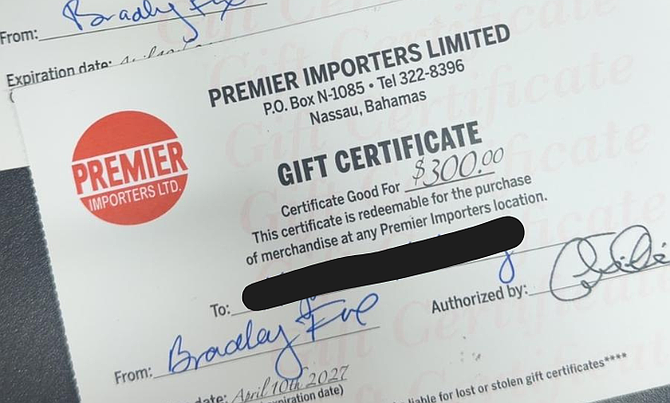
A pre-election controversy has erupted in The Bahamas over more than $200,000 in Hurricane Dorian relief gift certificates distributed to Abaco residents, after the head of the issuing company directly linked the funding to the national Ministry of Finance. Chris Lleida, chief executive officer of Premier Importers — the local firm that produced and will honor the vouchers — made the claim publicly this week, opening a fierce debate over whether public funds have been misused to influence voters just two weeks ahead of the country’s general election, more than six years after Dorian devastated Abaco.
According to Lleida, the finance ministry requested his company issue the gift certificates as part of long-delayed post-hurricane relief, with individual vouchers ranging in value from $200 to $500, for a total sum exceeding $200,000. He confirmed that his firm’s role is limited to producing and honoring the certificates, with all distribution responsibility held by the ministry and the third parties it designated. When pressed on the unusual timing of the rollout, coming years after the disaster and just weeks before voters head to the polls, Lleida acknowledged the obvious question: “Why didn’t this happen two years ago?”
Physical copies of the certificates obtained by The Tribune show they bear the signatures of two Bahamas Progressive Liberal Party (PLP) figures: Bradley Fox Jr., the PLP candidate for Central and South Abaco, and Preston Roberts, the party’s campaign coordinator and a sitting member of the Disaster Reconstruction Authority board. To date, no clear information has emerged about how many certificates have been distributed, what criteria were used to select recipients, or how the distribution process is being managed.
Lleida’s explosive claim has been forcefully rejected by senior PLP leadership. Valentine Grimes, a PLP trustee, stated that the party would never misuse public funds for this type of initiative, insisting that all materials distributed by party candidates are covered either by the party’s own budget or the candidate personally. “Anything that candidates give out to people, anything, is paid out by the party or the candidate,” Grimes said. When asked whether the distribution so close to an election constituted vote buying, Grimes acknowledged that similar practices occur across all political groups in the country — a longstanding unaddressed open secret in Bahamian politics. He argued that there is nothing improper about assisting vulnerable residents, even near an election, and that any interpretation of motive is up to individual voters.
Other PLP figures have offered conflicting accounts of the funding source. Roberts, whose signature appears on the certificates, said he believed the funds came from the party’s own private relief donations, fulfilling a years-old promise to Dorian survivors made after the 2019 storm. He explained that distribution is still ongoing, with plans to expand the program to North Abaco, and that vouchers are targeted to residents still recovering from storm damage — including single mothers and elderly residents, who receive higher-value certificates to cover needs like roofing, cabinetry, and bathroom repairs. Fox, the candidate whose signature also appears on the vouchers, declined to answer direct questions about the funding source or vote buying allegations, only offering a biblical quote in response to reporters.
Lleida pushed back against claims of partisan favoritism, noting that he has worked for years with cross-party lawmakers who use their constituency budgets to assist residents with home repairs and other needs. He added that while the current request was larger than usual, it was not out of the ordinary for his firm, and that he supports assistance reaching all eligible residents regardless of political affiliation. For local building supply businesses like his, he noted, the initiative also provides welcome economic support at a time when the local construction market remains sluggish.
Requests for comment from the Office of the Prime Minister went unanswered by press time. The controversy has thrown a sharp spotlight on a longstanding gap in Bahamian election law: the country still lacks a comprehensive, enforceable campaign finance framework, with no clear mandatory disclosure rules for political spending or binding regulations governing the use of public resources during election periods. Both major political parties have repeatedly pledged to implement comprehensive campaign finance reform over the years, but no such policy has been enacted to date, leaving the door open for questions about the intersection of government relief and political campaigning ahead of this month’s vote.