标签: Antigua and Barbuda

安提瓜和巴布达

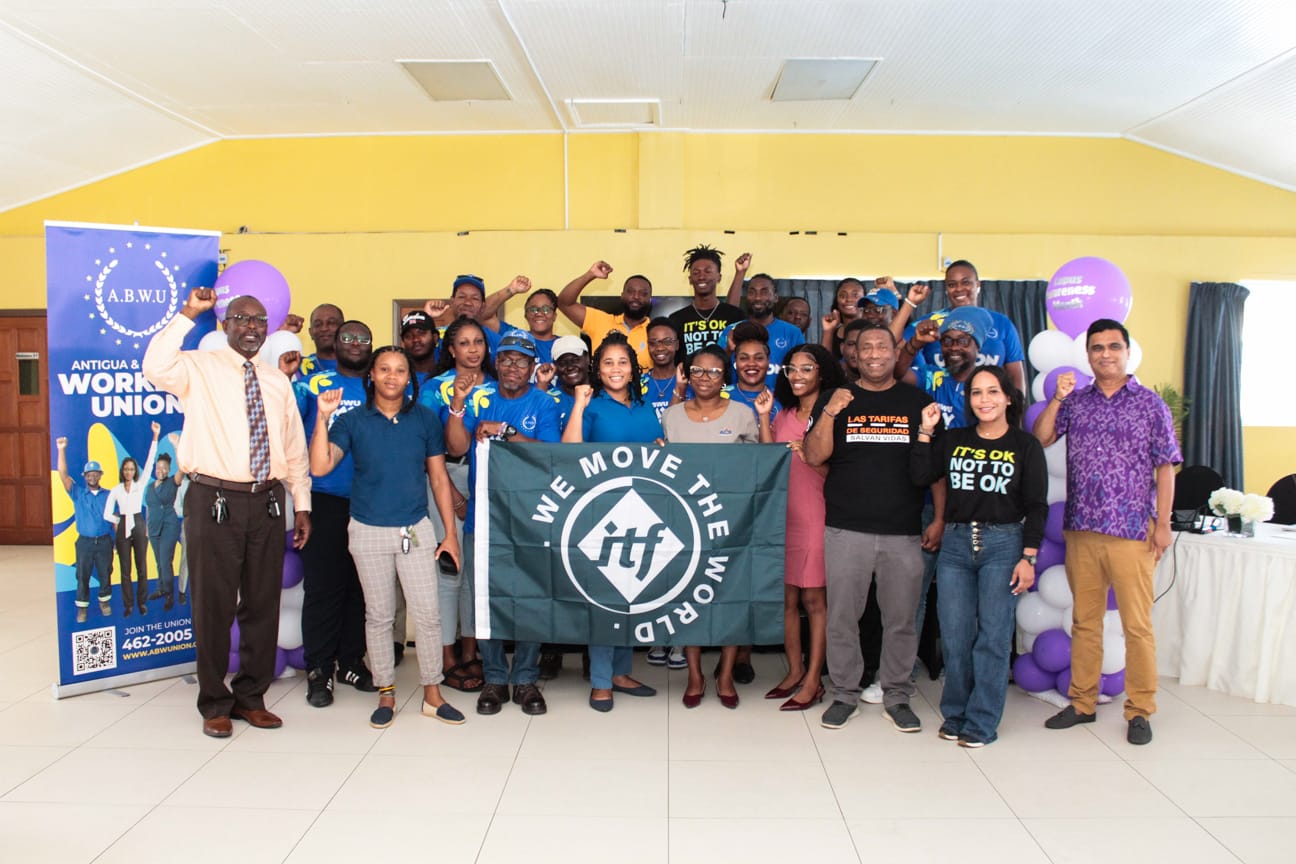
  • ABWU and International Transport Workers’ Federation Host Mental Health Workshop for Workers

    ABWU and International Transport Workers’ Federation Host Mental Health Workshop for Workers

    Workers’ mental health has taken center stage in Antigua and Barbuda, as two major labor organizations have launched a targeted capacity-building initiative to equip workplace representatives with the tools to tackle rising stress and end stigma around mental health discussions.

    The Antigua and Barbuda Workers’ Union (ABWU), in partnership with the International Transport Workers’ Federation (ITF), recently convened a two-day immersive workshop focused on stress management and mental health advocacy. The program, structured as a “train-the-trainer” initiative, brought together frontline workers and union leaders to build a network of wellness champions that can spread awareness across local workplaces.

    Leading the workshop sessions was Dr. Syed Asif Altaf, the ITF’s Global Well-being Programme Coordinator. Over the two days, participants explored a wide range of practical, actionable topics: from foundational understanding of how stress impacts physical and emotional health, to evidence-based coping strategies, to the specific roles and responsibilities of peer mental health first responders. The curriculum also centered underaddressed needs, with dedicated modules focused on stress vulnerability among young workers and women, two groups disproportionately impacted by unaddressed workplace mental health challenges.

    The workshop is just one part of a long-term collaborative commitment between ABWU and ITF to prioritize worker well-being and build more inclusive, supportive workplace cultures across the region. In opening remarks to attendees, ABWU General Secretary David Massiah emphasized that workplace stress is a universal issue that touches every sector and every community, calling on workers to lead demands for systemic change.
    “Stress does not discriminate – it affects every workplace and every family across our country,” Massiah said. “We cannot stop at individual coping strategies. We must keep pushing for policies and workplace cultures that put mental health at the top of the agenda, and ensure every worker has the support systems they need to not just work, but thrive.”
    For Dr. Altaf, the core mission of the training extends far beyond teaching stress management techniques. A central goal of the initiative is to dismantle the deep-seated stigma and cultural silence that have long prevented workers from seeking support for mental health challenges.
    “Across every region, there remains so much taboo and stigma around talking about mental health,” Dr. Altaf explained. “Most people struggle with stress or mental health challenges at some point, but too many suffer in silence because they fear judgment. We are here to change that narrative – break the stigma, break the silence, and build a community of open advocates for mental wellness.”
    ITF Regional Secretary Edgar Diaz echoed that commitment, outlining the multiplying impact the organizations hope to achieve through the train-the-trainer model. Rather than limiting learning to the small group of in-person attendees, the program is designed to turn participants into trainers who can bring this knowledge back to their own workplaces and peer groups.
    “Our goal over these two days was not just to share what the ITF has been doing to advance worker well-being globally, but to give shop stewards and local union representatives the expertise to lead this work themselves,” Diaz explained. “Participants leave here ready to train their coworkers, to pass on what they’ve learned, and expand this movement across every workplace in Antigua and Barbuda.”
    Diaz added that organizers were encouraged by the high level of engagement and enthusiasm from attendees throughout the workshop, a sign of the unmet demand for open conversation about mental health in the region. One participant, who attended the sessions, shared that the workshop filled a critical gap in local worker support, noting that public awareness of mental health remains low across Antigua.
    “This workshop is such an important step forward,” the attendee said. “People here just don’t have enough information about mental health, and workplaces have almost no support systems in place. It’s amazing that the union is taking this step to help us build that support for workers.”
    At the close of the two-day program, participants completed reflective evaluations to share feedback on the sessions and help organizers refine future trainings. All attendees received certificates recognizing their completion of the program, formalizing their new role as community mental health advocates ready to bring their skills and knowledge back to their workplaces.


  • Authorities Plan Remote Medical Booking System for Barbuda Residents

    Authorities Plan Remote Medical Booking System for Barbuda Residents

    Residents of Barbuda who have long endured the logistical and financial burden of repeated cross-island travel to schedule medical care in neighboring Antigua are set to receive long-awaited relief, following a cabinet-approved plan to roll out a remote digital appointment booking platform tailored to local healthcare needs.

    This digital initiative is just one core component of a sweeping overhaul of healthcare services across Barbuda, centered on upgrades to the island’s primary care facility, Hannah Thomas Hospital, and expanding the scope of local on-island medical offerings. Officials confirmed the details of the multi-part improvement plan during a post-Cabinet media briefing held this Thursday, shared by Director General of Communications Maurice Merchant.

    Per Merchant’s official announcement, the new platform will be developed through a cross-ministerial partnership between Antigua and Barbuda’s Ministry of Health and Ministry of Information Technology, combining healthcare expertise and digital innovation to solve a longstanding access gap.

    For decades, Barbudans seeking specialized diagnostic care available only in Antigua—including advanced imaging services such as MRIs and X-rays—have faced a grueling multi-trip routine. Under the current system, patients must first make the crossing to Antigua to secure an appointment slot in person, return to Barbuda to wait for their scheduled date, then travel back to Antigua a second time to attend their appointment. This cycle not only adds unnecessary travel costs but also creates dangerous delays for patients with urgent health concerns.

    The new remote booking system will eliminate this redundant travel, Merchant explained. Barbudan residents will be able to complete all required paperwork and reserve their preferred appointment slot entirely online from their homes on Barbuda, only making the single trip to Antigua once their scheduled appointment date arrives.

    Alongside the digital booking reform, the broader healthcare upgrade package brings two other impactful changes to Barbuda’s local care ecosystem: the restoration of on-site childbirth delivery services at Hannah Thomas Hospital, which were previously unavailable locally, and the launch of new in-island laboratory testing services. Both additions are designed to cut down on the need for routine, non-specialized medical travel to Antigua entirely, bringing essential care closer to home for Barbudan communities.

  • The Man Who Designed the Central Bank Logo in 1984 Dies

    The Man Who Designed the Central Bank Logo in 1984 Dies

    The Eastern Caribbean Central Bank (ECCB) is grieving the loss of Dennis Richards, the acclaimed regional artist who crafted the institution’s iconic logo nearly four decades ago. In an official statement released following Richards’ death, the ECCB paid tribute to the creative mind behind one of the Eastern Caribbean’s most recognizable institutional symbols, highlighting his far-reaching impact on both the bank and the broader regional community.

    Richards completed his original design for the ECCB logo on June 27, 1984, a work that has remained unchanged and deeply resonant through the decades. According to bank officials, the design is far more than a simple organizational marker: it distills the core aspirations of the Eastern Caribbean people, captures the unparalleled natural beauty of the island chain, and embodies the collective unity that defines the Eastern Caribbean Currency Union (ECCU). For 40 years, the logo has stood as a visual representation of regional collaboration and shared ambition, a legacy rooted entirely in Richards’ artistic vision.

    In 2023, as the ECCB kicked off a year of events marking its 40th anniversary, organizers made a point to honor Richards for his foundational contribution to the institution’s identity. The recognition cemented his status as a key figure in the bank’s history, shining a light on the artistic work that has shaped how the ECCB is perceived across the region and beyond.

    Beyond his commission for the ECCB, Richards was a beloved pillar of his local community. Those who knew him remember him as a committed public figure who consistently leveraged his artistic skills to lift up local cultural initiatives and strengthen civic engagement across the area. He dedicated much of his time and talent to nurturing regional arts, supporting emerging creators, and embedding creative expression into the daily life of Eastern Caribbean communities.

    In the statement, ECCB leadership offered its deepest sympathies to Richards’ family, close friends, and everyone who was influenced by his work and character. The bank emphasized that even as Richards is mourned across the region, his artistic legacy will live on through the logo that bears his creative mark, and his contribution to regional identity will continue to be acknowledged for generations to come.

  • Barbuda Caribana 2026 Officially Opens With Call for Cultural Pride and Unity

    Barbuda Caribana 2026 Officially Opens With Call for Cultural Pride and Unity

    One of the Antigua and Barbuda’s most anticipated annual cultural celebrations, Barbuda Caribana 2026, officially launched on Thursday evening, with event organizers and local government leaders calling on both native residents and visiting tourists to fully immerse themselves in the island’s distinct cultural heritage, back grassroots community events, and honor the unique identity of the Barbudan people across the weeks-long festival. The opening night ceremony blended solemn tradition and lively celebration, opening with formal blessings from local religious leaders, followed by a performance of the national anthem, public recognition of event sponsors, heartfelt tributes to the legacy of past Caribana queens, and energetic live musical sets from two popular local acts: New Gen Band and performing artist Empress. Deputy Chairlady Nadia Harris-George delivered the keynote address on behalf of Member of Parliament for Barbuda Trevor Walker, welcoming hundreds of gathered attendees under this year’s official festival theme, “A Cultural and Rhythmic Shift.” Harris-George explained that the 2026 theme was chosen to reflect the festival’s dual mission: elevating time-honored Barbudan cultural practices while making space for the evolution of the island’s cultural identity into a dynamic new era. “It’s about taking our rich Barbudian heritage — our soul-stirring calypso, our pulsing soca, our legendary hospitality, and our deep community bonds — and pushing them into a bold new era,” Harris-George told the crowd. In her remarks, she also outlined the full slate of major public events scheduled for this year’s festival, including the fan-favorite June Eclipse of Monarch competition, the popular Seafood Festival highlighting local coastal cuisine, the Caribbean Classic Horse Race, the iconic early-morning Jouvert street celebration, and the closing Last Lap street party that wraps up the festival each year. A senior representative from the Barbuda Caribana Organizing Committee used the opening ceremony to issue a call for broader, more consistent public support for local cultural initiatives, noting that the decades-old festival is far more than a tourist event: it encapsulates the island’s collective identity, centuries-long history, demonstrated resilience in the face of challenges, and unwavering national pride. “Caribana is ours. No one else can tell our story the way we can. No one can celebrate Barbuda the way Barbudan can,” the representative stated, urging locals to turn out for scheduled events, patronize local food and craft vendors participating in the festival, and actively pass down their cultural traditions to younger generations. As part of the opening ceremony, organizers also paid special homage to three past Caribana queens — Asha Frank, Kerrianne Walbrook, and Cynthia Harrigan — recognizing their lasting contributions to the festival’s iconic pageantry tradition and broader cultural legacy that has shaped the event for decades. Following the formal addresses and tributes, a local official officially declared the 2026 Barbuda Caribana open, and the evening shifted to a full night of live entertainment and celebration for attendees.

  • RCA Hosts Mental Health Workshop at Irene B Williams Secondary School

    RCA Hosts Mental Health Workshop at Irene B Williams Secondary School

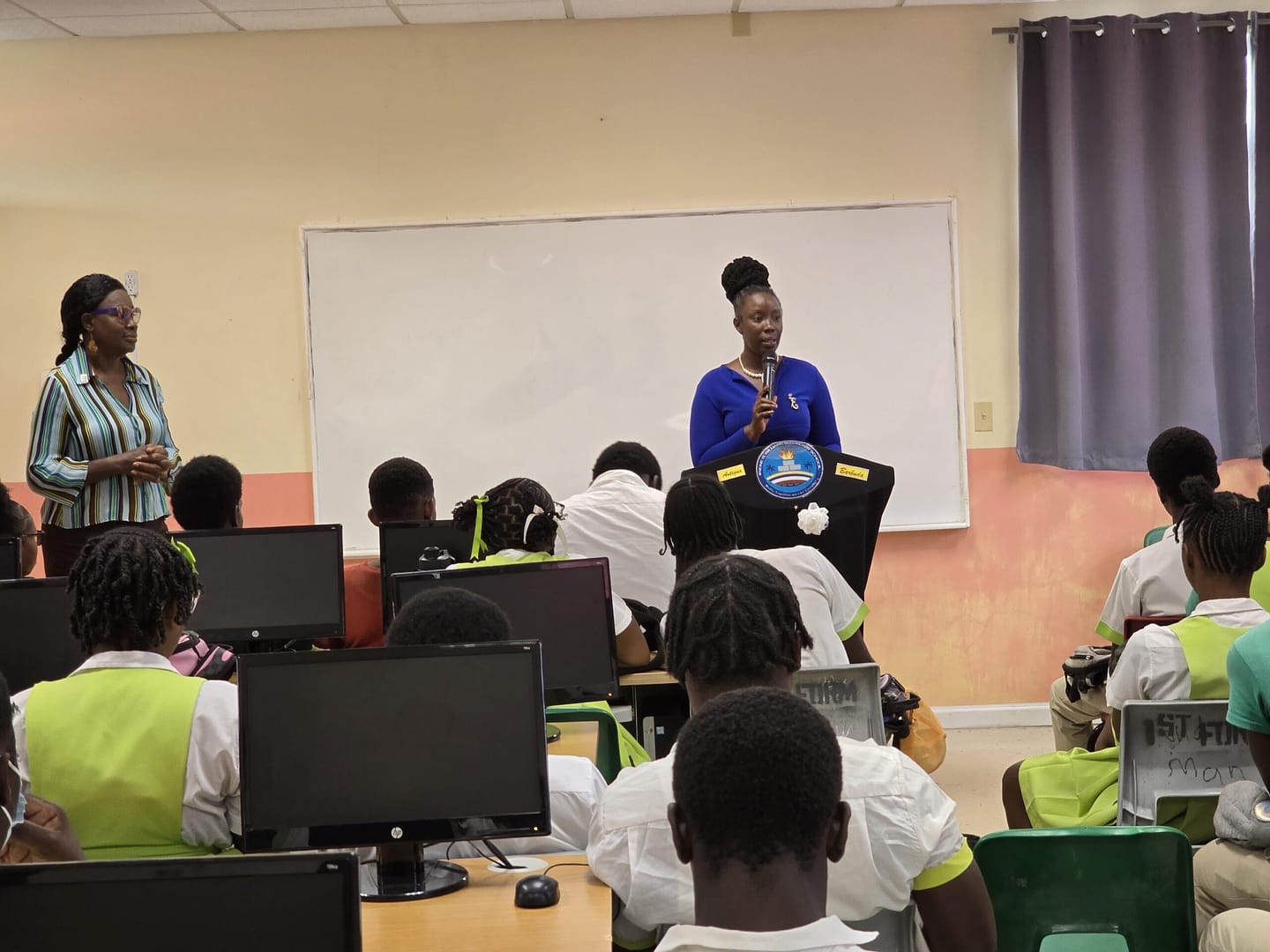
    On May 21, 2026, the Rotary Club of Antigua turned its long-standing commitment to youth holistic development into action, hosting a specialized mental health workshop for students at Irene B. Williams Secondary School. Organized in collaboration with prominent mental health advocate Chaneil Imhoff, the event was designed to create a judgment-free, supportive space where young people could openly explore common mental health struggles, build practical coping skills, deepen self-awareness, and learn the value of reaching out for professional and community support when facing distress.

    Tailored to address the unique pressures facing modern adolescents, the workshop combined interactive group discussions with hands-on guidance, focusing on equipping participants with actionable tools to navigate daily stress, clinical anxiety, peer pressure, and other common issues that impact young people’s wellbeing.

    Elisa Graham, president of the Rotary Club of Antigua, opened the event by underscoring the organization’s core mission: uplifting the nation’s younger generation through targeted, community-centered initiatives that address unmet needs. School leadership and student support staff echoed Graham’s enthusiasm for the collaborative project. Gretchen Christopher, guidance counsellor at Irene B. Williams Secondary School, emphasized that cross-organizational partnerships are critical to building robust support networks for students within school campuses.

    “Mental health challenges shape every part of a student’s life – their academic performance, their social connections, and their long-term emotional growth,” Christopher explained. “Workshops like this do more than teach skills; they reassure students they don’t have to struggle alone. There are people and organizations ready to stand with them through hard times, and we cannot thank the Rotary Club of Antigua and Ms. Imhoff enough for centering this critical work.”

    Ursula Willock, principal of the host school, also commended the initiative and urged attending students to engage fully with the day’s activities. “Our first priority is our students, and that means valuing not just their test scores, but their voices and their wellbeing,” Willock said. “Events like this break down the harmful stigma that keeps too many young people silent about their struggles, and help us build a school culture rooted in openness, mutual understanding, and compassion.”

    The core of the workshop consisted of a feature presentation and guided interactive discussions led by Imhoff, who encouraged attendees to make their emotional wellness a daily priority and speak openly about any concerns they face. “Too many young people grow up believing that asking for help is a sign of weakness, but that couldn’t be further from the truth,” Imhoff told participants. “A mental health challenge doesn’t define who you are. With the right support, practical coping strategies, and a little encouragement, every student can overcome the obstacles in their path and thrive.”

    For the Rotary Club of Antigua, the workshop is just one part of the organization’s ongoing dedication to improving young lives. Through education, community service, and advocacy, the club continues to develop initiatives that strengthen local communities and create long-term positive change for Antigua’s youth.

  • Agriculture’s footprint across CARICOM economies

    Agriculture’s footprint across CARICOM economies

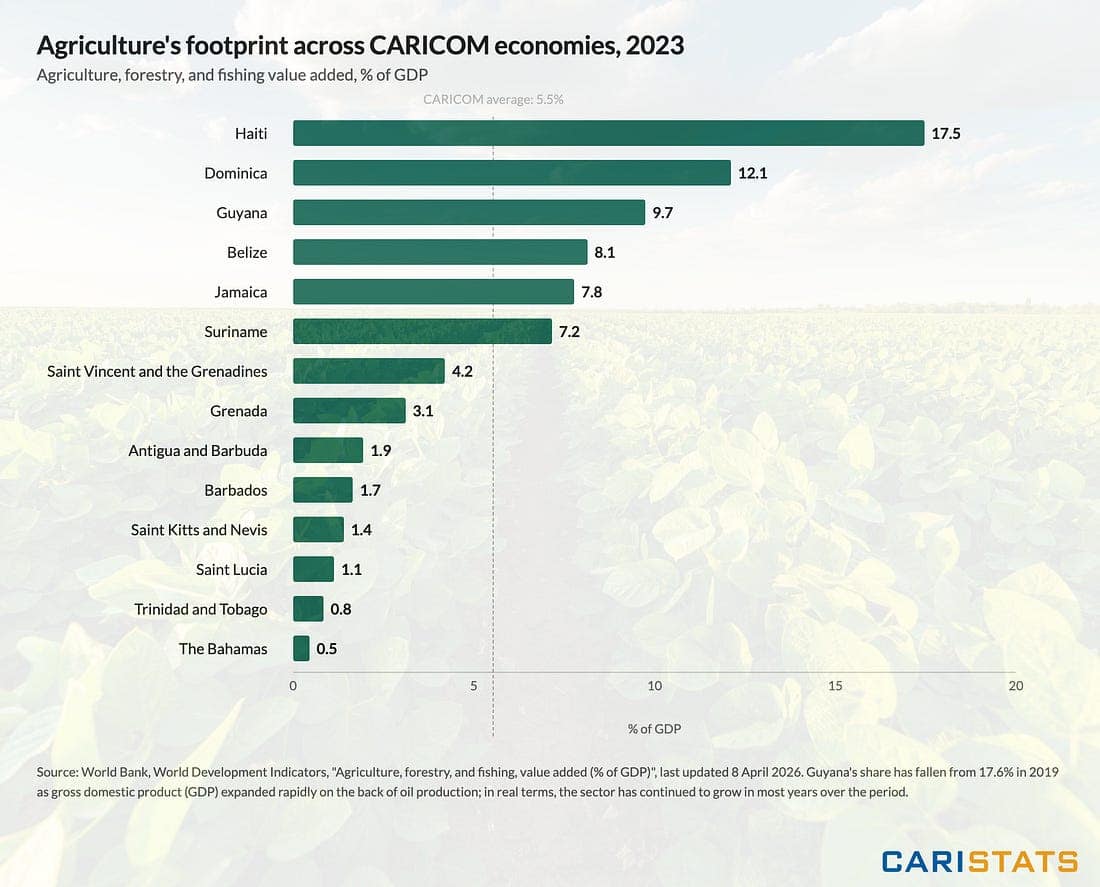
    New data from the World Bank’s World Development Indicators, last updated in April 2026, reveals a striking divergence in the contribution of agriculture, forestry, and fishing to gross domestic product across the 15 member states of the Caribbean Community (CARICOM) in 2023. Percentages range from a mere 0.5% to more than 17% of total national output, reflecting the vastly different economic development trajectories and core productive foundations that define each regional economy.

    At the upper end of the spectrum, Haiti retains the highest share of any CARICOM member, with the primary sector accounting for 17.5% of its total GDP. It is followed closely by Dominica at 12.1%, Belize at 8.1%, Jamaica at 7.8%, and Suriname at 7.2%. For these nations, agriculture remains a core pillar of economic activity, supporting widespread livelihoods and contributing meaningfully to overall national output.

    Guyana offers a particularly illustrative example of economic transformation reshaping the agricultural sector’s share. In 2019, agriculture, forestry, and fishing made up 17.6% of the country’s GDP, but that figure fell to 9.7% by 2023. Crucially, this shift does not stem from a contraction in agricultural output: the sector has recorded consistent expansion in most years over the four-year period. Instead, the drop reflects an unprecedented boom in Guyana’s emerging oil and gas sector, which has driven exponential overall GDP growth and reduced agriculture’s proportional contribution to the national economy.

    On the opposite end of the spectrum, a group of CARICOM economies built around service or extractive industries see agriculture contributing less than 2% of total GDP. The Bahamas tops this list at just 0.5%, followed by Trinidad and Tobago at 0.8%, Saint Lucia at 1.1%, Saint Kitts and Nevis at 1.4%, Barbados at 1.7%, and Antigua and Barbuda at 1.9%. These nations’ economic architectures are anchored by other high-value sectors, with tourism, hydrocarbon production, and international financial services driving the bulk of national output instead.

    Overall, the data underscores CARICOM’s status as a region of highly diversified economic profiles. The relative weight of agriculture in each member state’s GDP is directly shaped by the scope and composition of their broader productive bases, from resource extraction to tourism and finance.

  • NOAA predicts below-normal 2026 Atlantic hurricane season

    NOAA predicts below-normal 2026 Atlantic hurricane season

    The U.S. National Oceanic and Atmospheric Administration (NOAA) has released its official seasonal outlook for the 2026 Atlantic hurricane season, forecasting that overall storm activity will likely fall below the long-term average for the basin running from June 1 through November 30. According to NOAA’s National Weather Service forecasting team, the probability of a below-normal season stands at 55%, while near-normal activity carries a 35% chance and an above-normal season only a 10% likelihood. The agency projects the season will see between 8 and 14 named storms — systems producing sustained winds of 39 mph or higher. Of those named storms, 3 to 6 are expected to strengthen into hurricanes (winds of 74 mph or greater), with 1 to 3 growing into major hurricanes ranked Category 3, 4, or 5, which carry winds of 111 mph or higher. NOAA says it has 70% confidence in this projected range, which is noticeably lower than the historical average: a typical Atlantic season counts 14 named storms, seven hurricanes, and three major hurricanes. Commerce Secretary Howard Lutnick emphasized that NOAA and the National Weather Service have leveraged cutting-edge modeling and storm tracking infrastructure to stand ready to deliver real-time forecasts and emergency warnings as storms develop. “Our experts are integrating cutting-edge tools to ensure communities in the path of storms receive the earliest, most accurate information possible,” Lutnick said. NOAA Administrator Neil Jacobs, Ph.D., added that the agency’s rapid adoption of next-generation technologies — including artificial intelligence-powered weather models, reconnaissance drones, and new satellite data streams — allows forecasters to turn raw climate data into actionable guidance that protects American lives and livelihoods. “These new capabilities, combined with the unmatched expertise of our National Weather Service forecasters, will produce the most accurate forecasts possible to protect communities in harm’s way,” Jacobs noted. Multiple competing climate factors are shaping this year’s below-normal forecast. The primary driver is the expected development and intensification of El Niño conditions over the course of the hurricane season, a climate pattern that historically suppresses tropical cyclone formation in the Atlantic. Countering this effect, however, are slightly warmer-than-average Atlantic sea surface temperatures and weaker-than-average trade winds — two conditions that typically fuel more active hurricane seasons. Even with the forecast for reduced overall activity, NOAA’s National Weather Service Director Ken Graham stressed that uncertainty remains inherent in every seasonal outlook, and preparedness cannot be skipped. “Although El Niño’s impact in the Atlantic Basin can often suppress hurricane development, there is still uncertainty in how each season will unfold,” Graham said. “That is why it’s essential to review your hurricane preparedness plan now. It only takes one storm to make for a very bad season.” It is important to note that NOAA’s seasonal outlook only assesses overall basin-wide activity, rooted in large-scale climate and weather patterns. The outlook does not predict where or when individual storms will make landfall, as those outcomes depend on highly variable short-term weather patterns. No forecast of seasonal activity eliminates the risk of a destructive storm hitting coastal or inland communities. Graham urged at-risk communities to complete preparedness steps well ahead of any storm threat, directing residents to official resources including weather.gov/safety and Ready.gov for updated, evidence-based preparedness guidance. NOAA plans to release an updated 2026 seasonal outlook in early August, ahead of the historical peak of Atlantic hurricane activity, which typically runs from mid-September through October.

  • A police officer is under investigation for apparently showing support for convicted sex offender

    A police officer is under investigation for apparently showing support for convicted sex offender

    On Thursday, May 21, 2026, the Royal Police Force of Antigua and Barbuda’s Office of Strategic Communications issued an official public statement confirming that an internal probe into a controversial social media post tied to a recent high-profile sexual assault conviction is actively underway. The investigation was sparked after the problematic post emerged just days after a High Court jury found prominent local entertainer Horsford guilty of two grave offenses: indecent assault and serious indecency. Critics of the post have raised sharp objections, noting that its content was widely perceived as downplaying the severity of Horsford’s criminal conviction. Community observers and commentators pointed out that public expectations hold all law enforcement officers to a strict standard of upholding core principles: the rule of law, equal justice, community protection, and professional accountability. Any public comment that minimizes sexual violence, they emphasized, does lasting damage to public trust in police institutions. Beyond eroding confidence, critics warned that this kind of messaging amplifies longstanding fears among many citizens that some members of law enforcement hold disproportionately lenient attitudes toward certain offenders. Sexual violence is never a trivial matter or a joking offense, the statement from critics underscored, and inappropriate public commentary around such cases only further harms survivors of assault. In its official address, the Police Administration extended unreserved, sincere apologies to the survivor of the assault, as well as any member of the public who was harmed or offended by the problematic post. Horsford’s conviction wrapped up earlier this week following a full jury trial in the High Court, with a sentencing hearing scheduled to take place at a later, undetermined date. The police force’s public assurance of a serious, active investigation marks a formal response to growing public outcry over the incident.

  • APUA Apologizes After Water Disruptions Affect ABEC Registration Centres

    APUA Apologizes After Water Disruptions Affect ABEC Registration Centres

    A critical public service disruption has hit key voter registration sites across Antigua and Barbuda, prompting the Antigua Public Utilities Authority (APUA) to launch urgent restoration efforts after unexpected water outages shut down services at multiple Electoral Commission (ABEC) registration centers on Thursday.

    In an official public statement released the same day as the disruptions, APUA’s Water Business Unit issued a formal apology to the Antigua and Barbuda Electoral Commission, center staff, and all community members who were unable to access registration services due to the interruptions. The utility explicitly recognized the disproportionate harm the outages caused, noting that they blocked residents from accessing this time-sensitive, essential government service at the affected locations.

    APUA representatives confirmed that technical teams have been deployed across the affected service areas to resolve the outages, while also addressing longstanding distribution challenges that have impacted customers island-wide. The organization says it is currently conducting a full review of its existing operational protocols, with the goal of restructuring distribution networks to create more balanced, consistent water flow across all residential and public service communities.

    Alongside urgent restoration work, the utility is pursuing broader infrastructure and operational upgrades to address growing public frustration over repeated, recurring water interruptions across the island. APUA has emphasized that strengthening the overall reliability and consistency of the national water network is a top priority, with the immediate goal of returning full water service to the impacted ABEC registration centers as quickly as possible to allow public operations to resume normally.

  • Family Appeals for Help Finding Missing Teen Caleb Auguste

    Family Appeals for Help Finding Missing Teen Caleb Auguste

    Authorities have launched an active search operation for Caleb Auguste, an individual who has been officially reported missing to local law enforcement. As the investigation into his disappearance continues, police are reaching out to members of the public to request any information that could help locate Auguste and advance the case.

    People who may have seen Caleb Auguste recently, or hold any details about his current whereabouts that have not yet been shared with authorities, are strongly encouraged to reach out to law enforcement immediately. The simplest way to submit information is to visit the closest local police station in person, or contact investigators through the official designated phone lines set up for this case. Every small piece of information could prove critical to helping bring the search for Auguste to a safe conclusion, law enforcement representatives noted.