博客

  • UK Prime Minister Starmer announces resignation

    UK Prime Minister Starmer announces resignation

    In an emotional address from the steps of 10 Downing Street, Sir Keir Starmer has confirmed he will step down as both Prime Minister of the United Kingdom and leader of the Labour Party, opening the door for a fast-tracked leadership contest that will install Britain’s seventh prime minister in less than a decade by early September.

    Accompanied by his wife Victoria, Starmer said he had formally notified King Charles III of his decision to resign, and had already requested Labour’s national governing body to finalize a timeline for selecting his successor. Per the proposed schedule, nominations for the new Labour leader will open on July 9 and close by the summer parliamentary recess on July 16. If a contested race proceeds, the party will confirm its new leader — and therefore the UK’s new prime minister — before lawmakers return to Westminster in September.

    Starmer, who will remain in office at 10 Downing Street until the leadership process concludes, stressed he would dedicate all efforts to delivering a smooth and orderly transition of power, and would offer his full, unwavering backing to whoever takes over the role. “They will inherit a Britain that is far stronger and fairer than the one I inherited two years ago,” he said.

    First elected Labour leader in April 2020, Starmer led the party to a landslide general election victory in July 2024, taking office as prime minister shortly after. Looking ahead to his post-premiership life, an emotional Starmer said he planned to prioritize his family after leaving Downing Street. “When I leave the biggest job in the country, I shall spend more time on the most important job: being the best husband I can to my fantastic wife Vic, who has been a rock by my side through good times and bad; and being the best dad I can to my beautiful children, who are my pride and my joy.”

    Starmer’s resignation comes after weeks of growing internal and public pressure on his leadership. He spent the final weekend of his premiership deliberating on his future at Chequers, the prime minister’s official country retreat in Buckinghamshire. Internal discontent had been building since a poor showing for Labour across England, Wales and Scotland in May’s local and devolved elections, amplified by controversy over a series of last-minute policy U-turns on three major pledges within a single month, and the failed appointment of Lord Mandelson as UK ambassador to the United States. Mandelson was forced to step down from the post before taking office after new details emerged of his extensive ties to the late convicted sex offender Jeffrey Epstein, casting doubt on Starmer’s judgment and the competence of his Downing Street operation.

    Pressure surged last week after Andy Burnham, the former Greater Manchester Mayor and widely tipped potential successor, secured an emphatic victory in the Makerfield by-election over his Reform UK rival. Polling analyst Sir John Curtice described Burnham’s win as an extraordinary personal political achievement. Burnham will travel to Westminster on Monday to formally take up his parliamentary seat, cementing his position as the early frontrunner in the leadership race. Former Health Secretary Wes Streeting is also expected to announce a leadership bid in the coming days.

    Opening his resignation speech, Starmer pushed back against critics by defending his two-year record in government, highlighting progress on employment rights, immigration reform and reducing child poverty. He also argued he had restored stability to Labour after inheriting a party that was “politically, financially and morally bankrupt” in 2020. “The hard work of change was with a singular purpose – not power for power’s sake but to change Britain for the better, to build a fairer country with dignity and respect, where everyone is seen, everyone is valued, wealth and opportunity for all not just the privileged few,” he said.

    Opposition leaders were quick to respond to the announcement, with Conservative leader Kemi Badenoch dismissing Starmer as a “terrible prime minister” and attacking his policy agenda, including a rise in employer National Insurance contributions and what she called a failure to deliver meaningful welfare reform. Writing on X, Badenoch added: “But the problem isn’t just Starmer. Labour MPs only want higher taxes to hand out more benefits, as the welfare secretary has pointed out. These are Labour’s choices and their values, regardless of who is running the party.”

    Liberal Democrat leader Sir Ed Davey said the frequent turnover of prime ministers had left the British public fed up with broken promises and political stagnation. “The British people are sick of being let down by an endless merry-go-round of prime ministers while nothing really changes,” he said. “This time must be different. It can’t just be about changing who’s in Number 10, it has to be about changing our broken politics so we can fix our country.”

    Reform UK leader Nigel Farage joined calls for an early general election, arguing that the public — not just Labour MPs — should have a say on the country’s next leader. “If Labour thinks it can shove another professional politician into No 10, it has another thing coming,” Farage said. Green Party co-leader Zack Polanski said Starmer had lost public confidence because he failed to challenge the entrenched power of the UK’s political and economic establishment, adding that the country “needs a bold change of direction.”


  • Grenada PM calls for faster digital transformation across Caricom

    Grenada PM calls for faster digital transformation across Caricom

    As the Caribbean Community (Caricom) gathers to chart a digital path for the coming decade, Grenada’s Prime Minister Dickon Mitchell has made an urgent push for deeper regional collaboration, warning that collective action is the only way for Caribbean nations to hold their ground in an increasingly competitive global digital landscape.

    Mitchell, who serves as Caricom Quasi Cabinet’s Lead Head of Government for Science and Technology, delivered the call during the opening plenary of a regional ministerial meeting focused on information and communication technology (ICT). Hosted under the overarching theme “Accelerating Digital Development to 2030”, the gathering brought together senior ICT officials from across Caricom’s 15 member states to align on shared digital priorities.

    In his opening address, Mitchell emphasized that digital innovation is no longer a secondary policy concern, but a foundational pillar of modern economic resilience, national security, and long-term sustainable development across the region. He pointed to ongoing regional efforts already underway to advance shared digital goals, including progress on the Caricom Single ICT Space initiative, the development of the 2025–2030 Strategic Framework for Digital Resilience, and growing cross-border collaboration on cybersecurity threats that do not respect national boundaries.

    “If Caricom is to remain competitive and relevant, we need to act collectively and strategically to ensure that our region is not left at the margins of the global digital economy,” Mitchell told assembled delegates.

    The Grenadian leader stressed that small island developing states, which make up the vast majority of Caricom’s membership, cannot navigate the complex shifting tides of the digital age on their own. Key emerging challenges – from the rapid evolution of artificial intelligence (AI) to shifting rules for digital trade, emerging frameworks for data governance, and global debates over internet governance – require coordinated regional responses that no single small state can mount independently.

    Crucially, Mitchell argued that the region has completed enough preliminary policy planning, and now must shift its focus to tangible action. “We must move decisively from policy discussions to measurable implementation and outcomes to build a Caricom digital economy,” he said.

    On the topic of artificial intelligence, one of the fastest growing areas of global technological change, Mitchell offered a balanced perspective. He acknowledged AI’s transformative potential to overhaul public service delivery, boost cross-sector productivity, and spawn entirely new homegrown industries across the Caribbean. At the same time, he cautioned that widespread AI adoption must be rooted in core principles of inclusive access, public trust, and strong ethical governance to avoid exacerbating existing inequalities.

    To lay the groundwork for a robust regional digital economy, Mitchell outlined four key areas requiring increased investment: expanded and upgraded digital infrastructure, enhanced cross-border cybersecurity defenses, expanded digital skills training for workforces, and flexible regulatory frameworks that can keep pace with rapid technological change.

    He also placed particular emphasis on youth preparedness, noting that the region’s long-term global competitiveness will hinge on its ability to build digital capacity among young people, who represent the Caribbean’s future workforce and entrepreneurial base.

    By the close of the meeting, delegates reviewed and formally approved new frameworks covering cross-border digital cooperation, responsible AI governance, enhanced cybersecurity collaboration, and expanded regional digital skills development initiatives, moving the region one step closer to Mitchell’s vision of coordinated, implementable digital progress.

  • Bilzerian Among Three Facing Money Laundering Charges

    Bilzerian Among Three Facing Money Laundering Charges

    BASSETERRE, St. Kitts – Law enforcement authorities in the Federation of St. Kitts and Nevis have formally levelled money laundering and fraud-related charges against three people, including Paul Bilzerian, for their alleged involvement in a transnational financial conspiracy that stretched across nearly six years. The Royal St. Christopher and Nevis Police Force (RSCNPF) announced the charges Wednesday, marking a key milestone in an ongoing investigation into what officials call a major white-collar criminal operation.

    The three accused individuals are Paul Bilzerian and Terri Steffen, both residents of Frigate Bay, St. Kitts, and Gregory Gilpin-Payne, who resides on New Road in Basseterre. According to official allegations laid out by investigators, the trio conspired with multiple unindited co-conspirators between November 2018 and July 2024 to acquire roughly $50 million in funds through deliberate false representation of financial facts. After securing the illicit funds, prosecutors allege the group worked to disguise the illegal origins of the money through a complex web of financial transactions that form the core of the money laundering charges.

    Formal charges were officially registered on June 18, 2026, at the Basseterre Police Station, four days before the public announcement of the case. Both Bilzerian and Gilpin-Payne face four separate criminal counts: money laundering by transaction, conspiracy to commit money laundering, obtaining property by false pretence, and conspiracy to commit false pretence. Steffen faces a single count of conspiracy to commit money laundering in connection with the scheme. No details on potential upcoming court appearances or bail status have been released to the public as of the announcement.

    RSCNPF officials confirmed that the investigation into the alleged scheme is still active, with additional lines of inquiry still being pursued by law enforcement. In an official statement released alongside the announcement of charges, the police force publicly recognized the work of investigators assigned to its specialized White Collar Crime Unit, who led the multi-year probe into the allegations. The statement also reaffirmed the Caribbean federation’s unwavering commitment to rooting out and prosecuting transnational and domestic financial crime.

    “St. Kitts and Nevis will not serve as a safe haven or a transit point for fraud, misrepresentation, or the laundering of proceeds obtained through criminal activity,” the RSCNPF said in the statement. Officials added that law enforcement will continue to pursue all individuals connected to financial criminal activity with the full weight of local law, in line with the federation’s international commitments to counter money laundering and terrorist financing.

  • OAS moet zich vernieuwen om geloofwaardig te blijven

    OAS moet zich vernieuwen om geloofwaardig te blijven

    Against a backdrop of growing global skepticism toward intergovernmental cooperation, Organization of American States (OAS) Secretary-General Albert Ramdin has outlined a bold vision for deep-rooted transformation of the regional multilateral cooperation model, arguing that systemic evolution rather than full dismantling is the path forward for the bloc. Ramdin delivered his remarks during the 68th Lecture Series of the Americas, an event held alongside the OAS’s 56th General Assembly in Panama, which centered its discussions on the future of multilateral cooperation across the Americas. Ramdin acknowledged that international institutions including the OAS have faced mounting criticism in recent years, and he says he shares part of that public and political skepticism. In his view, the existing multilateral system has too often failed to clearly demonstrate how it advances the concrete interests of member states and their populations, eroding trust over time. Even so, Ramdin emphasized that cross-border collaboration is more critical today than at any point in modern history. No single nation can tackle the complex transnational challenges that define the 21st century alone, he argued, pointing to cross-cutting issues ranging from public health threats and climate change to organized crime, mass migration, and rapid disruptive technological change. All of these challenges demand coordinated, collective action from regional governments. “Our task is not to tear down the existing system and build something entirely new from scratch,” Ramdin stated. “It is to reshape it, make it more efficient, and preserve its credibility for the people it exists to serve.” Ramdin stressed that the OAS must continue evolving to meet new demands without abandoning the core founding mission that has guided the organization since its establishment. While global and regional contexts have shifted dramatically since the OAS was created, the fundamental need for coordinated regional cooperation across the Western Hemisphere remains as strong as ever, he said. The Secretary-General also highlighted the OAS’s long track record of impactful progress across decades of collaboration. He pointed to landmark agreements including the Inter-American Democratic Charter, the Inter-American Convention Against Corruption, and the Belém do Pará Convention to end violence against women as examples of enduring, transformative cooperation that has improved outcomes both within the region and beyond it. Moving forward, Ramdin said the OAS must take its next evolutionary step by aligning its working methods more closely with the current needs of member states. The reform agenda will center on boosting institutional efficiency, increasing transparency, and delivering more measurable, tangible results for communities across the region. Following Ramdin’s address, former OAS Secretaries-General José Miguel Insulza and Luis Almagro held a joint discussion exploring the future of multilateral cooperation in the Americas and the ongoing role the OAS must play in advancing regional stability and shared progress.

  • Tourism gloom ahead of today’s THA budget

    Tourism gloom ahead of today’s THA budget

    As the Tobago House of Assembly (THA) prepares to unveil its 2027 budget, key industry leaders across Tobago’s business and tourism sectors are sounding urgent calls for targeted intervention, warning that the island’s core tourism industry has spent decades in stagnation and now teeters on the edge of collapse. Reginald MacLean, head of the Tobago Hotel and Tourism Association, has painted a bleak picture of the current state of the island’s tourism economy, saying he holds little expectation for meaningful change from the upcoming budget address.

    MacLean argues that Tobago’s tourism sector, which has failed to grow for more than 30 years, is “extremely dead” in its current state, and would be faring even worse without consistent visitor traffic from neighboring Trinidad. To reverse decades of decline, he outlined three non-negotiable priorities the THA must advance immediately: restarting operations at shuttered major hotel properties, approving a long-pending loan guarantee requested by tourism industry stakeholders, and restoring pre-pandemic air connectivity between Trinidad and Tobago. Pointing to stark long-term trend data, MacLean noted that international visitor arrivals plummeted from more than 90,000 in 2005 to just over 11,000 today, a drop that underscores the sector’s chronic stagnation. He also called for the reinstatement of 24 daily round-trip flights between the two islands, a service level that existed before the COVID-19 pandemic, and pushed for administrative reforms to cut red tape in land approval processes, which he says have repeatedly delayed and discouraged new investment in tourism infrastructure.

    MacLean’s warning is echoed by Curtis Williams, chairman of the Tobago division of the Trinidad and Tobago Chamber of Industry and Commerce, who confirms that widespread financial strain is already pushing local businesses to the brink. Williams notes that multiple businesses across the island are struggling to meet payroll obligations amid weak economic activity, including one major resort that has gone four months without paying its staff. West Mount Irvine Bay Resort has confirmed the wage arrears but declined to offer further comment on the situation. Williams explains that the resort’s crisis is not an isolated case, saying many businesses are shifting funds between accounts just to keep their doors open.

    While tourism remains the island’s long-term economic backbone, Williams says the construction sector offers a viable short-term avenue to stimulate economic activity while tourism recovery takes root. During pre-budget consultations with the THA’s Finance Secretary, Williams’ group called for targeted public funding to launch a new island-wide development program that would inject momentum into the sluggish construction sector, which is currently operating far below capacity.

    The 2027 THA budget is structured around the administration’s newly launched “Pathway for Prosperity: Blueprint for Tobago 2026–2030,” a long-term strategic framework that lists sustainable tourism, food security, digital transformation, public sector strengthening, climate resilience, infrastructure development, and social inclusion for vulnerable groups as core policy priorities. The budget process launched in February 2026 with a planning circular sent to all THA divisions, followed by stakeholder consultations that ran from April 20 to June 2, 2026. The consultation process included input from eight distinct stakeholder groups, a final session with faith-based organizations, and more than 110 online public submissions. The 2027 budget will also incorporate four new administrative divisions into its framework: Legal Affairs; Strategic Planning and Development; Youth Empowerment and Sport; and Environment, Climate Resilience and Energy.

    As of the third quarter of 2026, the THA has received 70% of its allocated parliamentary funding from central government, and 67% of its earmarked development budget. The original 2026 fiscal allocation set aside $2.742 billion for recurrent expenditure and $201.5 million for development programs, with $9.2 billion allocated to the Community-Based Environmental Protection and Enhancement Programme (CEPEP) and $18 million allocated to the Unemployment Relief Programme (URP). To address an underfunding gap in the development program, the THA reallocated $164.473 million from its recurrent budget, bringing total available 2026 funding to $2.577 billion for recurrent spending and $365.973 million for development projects. As of May 2026, approximately $1.51 billion in recurrent spending has been disbursed, with an estimated $130 million in development spending already allocated (final figures are still being compiled). Roughly $186.5 million in development funding has been released to THA divisions, while unspent balances totaling approximately $101 million were used to settle outstanding contractor payments dating back to 2021, as well as funding for CEPEP, URP, and the Island-Wide Road Improvement Programme. Despite ongoing fiscal pressures, the Finance Secretary has confirmed that the THA has no plans to implement layoffs, salary cuts, or reductions in contract employment for the coming fiscal year.

  • PUT DOWN THE GUN

    PUT DOWN THE GUN

    A controversial annual report from the Police Complaints Authority (PCA) has sent ripples through Trinidad and Tobago’s law enforcement community, revealing that police were involved in 60 fatal shootings between October 1, 2024, and September 30, 2025 — the highest one-year death toll from police encounters in over a decade. The data, included in the PCA’s 15th annual report, was recently presented to Parliament, and it shows that independent oversight body launched full investigations into every one of these fatal incidents.

  • AI cloud over writing prize

    AI cloud over writing prize

    A major controversy over allegations of artificial intelligence-assisted writing has pushed one of the world’s most respected literary magazines to walk away from a long-running partnership with one of the most prominent short fiction awards in the Commonwealth. London-based literary publication Granta has formally announced it will cease publishing winning entries of the annual Commonwealth Short Story Prize, after 2026 Caribbean regional winner Jamir Nazir, a writer from Trinidad and Tobago, faced widespread public accusations that his winning submission relied on AI generation.

    In an official statement shared with *The Guardian* of the UK, Granta clarified that its decision centers on preserving its own editorial integrity by stepping back from external publishing partnerships where it holds no final editorial control. “The 2026 selection of the regional winners of the Commonwealth prize caused a great deal of controversy, based on the speculation that one or more of the stories may have been at least partially AI-generated, accusations that were strongly rejected by the authors,” the magazine said. “For the sake of our own editorial integrity, the Granta Trust board has now taken the decision that we will no longer engage in external publishing partnerships. We will keep the Commonwealth prize shortlisted stories on our website in the public interest, and wish our former partner, the Commonwealth Foundation, all the best in its work.” As of the latest reporting, the Commonwealth Foundation has not issued a formal response to Granta’s decision or requests for comment from *The Guardian*.

    The controversy ignited immediately after Nazir’s winning entry *The Serpent in the Grove* was published on Granta’s platform, drawing allegations of AI assistance from literary circles both in the Caribbean and across the globe. Kevin Jared Hosein, a Trinidadian author and former overall winner of the Commonwealth Short Story Prize, was one of the most vocal critics, declaring the prize “dead” in a May social media post, framing Nazir’s AI-linked win as the “first blow” to the award’s credibility, with the Commonwealth Foundation’s subsequent support for the writer and the judging panel as the second.

    Hosein argued that the story’s craft is fundamentally weak, claiming none of its metaphors or similes serve its core characters or narrative arc. While he acknowledged that proving AI use legally is nearly impossible, he contended that AI-assisted writing lacks the intentionality that defines meaningful, original literature. He also pointed to what he calls a “disappointing linguistic homogeneity” that repeats consistently across AI-generated fiction, a pattern he says is visible in Nazir’s work. After Granta announced its exit from the partnership, Hosein doubled down on his stance in a new Facebook post, writing: “I said it here first. For any serious writer: The Prize is Dead. This is such a terrible loss for emerging writers in so many regions. People who tried to defend the Serpent and criticise my stance on it ought to read the room. There is no appropriate response to this other than ferocious rejection. Granta is correct to do this.” He also criticized the Commonwealth Foundation’s inaction, calling the controversy “a very important lesson for any literary institution or competition going forward” that demonstrates “what inaction and negligence leads to.”

    Criticism of Nazir’s work spread to international academic circles shortly after publication. Ethan Mollick, a professor at the University of Pennsylvania, posted on social platform Bluesky that a “100% AI generated story just won the Commonwealth prize for the Caribbean region.” Discussion of the story picked up steam on X and Bluesky in mid-May, with critics pointing to what they call “obvious markers” of AI generation, including the story’s repeated use of three-part structural arrangements and “not x, but y” sentence constructions. Specific lines, such as “Sun on galvanise is a cruel instrument” and “She had the kind of walking that made benches become men,” were singled out as evidence of AI-generated prose.

    Nazir has repeatedly and forcefully rejected all claims of AI use, defending the full originality of his work and tying its style to his personal background and unique writing process. In a May statement posted to LinkedIn, he wrote: “I am directly addressing the baseless claims regarding my Commonwealth story. To be pellucidly clear: this work was entirely written by me, drawn from childhood memories of growing up in rural Trinidad.” He has also pushed back against the reliability of AI detection tools, noting that they frequently produce false positives when assessing carefully polished writing. In an email interview with *The Observer* UK in late May, Nazir explained that his unorthodox writing process – conducted entirely on an Android phone via speech-to-text, followed by minimal keyboard editing – is a necessity driven by chronic health conditions that make long periods of desk-bound typing physically impossible. “I have used this in my professional life and also to produce my story for the Commonwealth competition,” he added.

    The Caribbean regional judging panel praised Nazir’s work, with judge Sharma Taylor describing *The Serpent in the Grove* – a story following a struggling farmer, his silenced young wife, and a rural grove that holds forgotten secrets – as “polished and confident, with a melodic voice that lingers long after the final line. Jamir Nazir’s prose pulses with a voice of restraint and quiet authority.”

    The Commonwealth Foundation has stood by the 2026 winners from the start of the controversy. In an earlier official release, the organization said it takes AI allegations seriously, but after reviewing all available evidence, it continues to support all shortlisted and winning writers. It also acknowledged the “rapidly evolving challenges” generative AI poses for literature and creative fields, and announced it would conduct a full review of its judging processes to address future concerns. On May 19, Commonwealth Foundation Director-General Razmi Farook confirmed that all shortlisted writers had formally confirmed no AI was used in their submissions. “We place our confidence in the integrity of our contributors and the calibre and experience of the judges and Chair of the Judging panel, and stand by the assurances given by our authors as part of our process,” Farook said, adding that AI detection tools are widely known to be “not unfailing or infallible.”

    Founded to recognize outstanding unpublished short fiction from writers across Commonwealth nations, the Commonwealth Short Story Prize awards £2,500 to each regional winner and £5,000 to the overall winner. The 2026 competition drew 7,806 entries, the second-highest total in the award’s history. Alongside Nazir, the 2026 regional winners are Lisa-Anne Julien (Africa region, born in Trinidad and Tobago, based in South Africa), Sharon Aruparayil (Asia region, India), John Edward DeMicoli (Canada and Europe region, Malta), and Holly Ann Miller (Pacific region, New Zealand). The overall winner is scheduled to be announced on June 30.

  • Natuc stands with Alyssa

    Natuc stands with Alyssa

    Trinidad’s largest trade union bodies are pushing back against heavy-handed police action during this year’s annual Labour Day commemorations in Fyzabad, after the arrest of a prominent social justice activist and her mother drew widespread condemnation from labor leaders.

    National Trade Union Centre (NATUC) General Secretary Michael Annisette announced this week that the organization has retained a top senior legal advisor to conduct a full review of last Friday’s arrest of activist Alyssa Phillip, a case that leaders say raises serious questions about potential violations of constitutional rights. Annisette shared the details during a public press conference held at the Seaman and Waterfront Workers Trade Union (SWWTU) Hall in downtown Port of Spain, noting that the arrest was far from a routine law enforcement action.

    “We are not rushing to judgment, which is why we have brought in senior counsel to assess the matter. They will advise us on the clear constitutional breaches we believe the police committed in this incident,” Annisette told reporters.

    In a joint statement released alongside the Joint Trade Union Movement (JTUM), NATUC amplified its criticism, calling out what it labels an “excessive armed police presence” that marred the 2024 Labour Day events. For the global labor movement, Fyzabad holds deep historic significance as a hub for worker organizing in Trinidad, and Labour Day is universally recognized as a protected space for working people to gather, honor past struggles, and voice their concerns freely and democratically.

    “Labour Day is a sacred occasion for workers and their families. It was created to commemorate the struggles, sacrifices, and hard-won achievements of the working class, and it has always served as a platform for the free and democratic expression of workers’ views and concerns,” the statement read. “If any place and any day should allow workers and citizens to feel free and safe to peacefully and democratically express their views, that place is Fyzabad and that day is Labour Day.”

    The joint statement emphasized that the intimidating show of overwhelming police force had no place at the annual celebration, saying the aggressive tactics of some officers only distracted from the core purpose of the commemorations. Even with the controversy over the arrests, the unions reaffirmed that the day remained focused on celebrating the gains workers won through generations of collective action.

    The statement also confirmed that Annisette personally witnessed the detention of Phillip and her mother, Camille Caresquero. Leaders called the officers’ conduct alarming, saying that during the arrest, law enforcement personnel physically roughed up the two women and shoved aside Annisette’s teenage daughter to reach Phillip.

    “These three women did not deserve to be treated like common criminals. The excessive actions of the police were totally uncalled for, wholly unacceptable and cannot be justified under any circumstances, because the peaceful actions of these three women posed no security threat or threat to the safety of the public,” the unions argued.

    Following their arrest, both Phillip and Caresquero have been charged with three criminal offenses each. Phillip faces accusations of leading an unauthorized march, refusing an order to disperse, engaging in disorderly behavior, and resisting arrest. Her mother faces similar charges: failing to disperse when ordered, obstructing a police officer, and resisting arrest.

    The pair have been active participants in recent public demonstrations calling for accountability and transparency in the high-profile case of Kaia Sealy, who is charged with manslaughter and firearms offenses connected to the January 20 shooting death of her husband Joshua Samaroo during a police intervention in St Augustine.

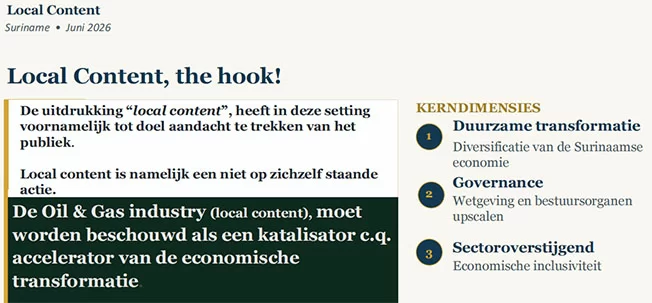
  • Local content moet Suriname voorbereiden op een economie ná de olie

    Local content moet Suriname voorbereiden op een economie ná de olie

    At a recent policy discussion hosted by the newly launched Surinamese foundation Stichting Passie voor Land en Volk, leading policy analysts and sector experts have called for a paradigm shift in how the nation approaches its emerging oil and gas industry, arguing that debates over local content requirements must extend far beyond simply creating jobs for Surinamese workers or awarding contracts to domestic firms.

    Three presenters — Antoon Karg, Sieglien Burleson and Wilgo Bilkerdijk — delivered insights from legal-governance, economic and strategic perspectives respectively. While their approaches differed, all three reached the same core conclusion: local content policies should not be treated as an end goal in themselves, but rather a targeted tool to build long-term, structural strength for Suriname’s entire economy.

    Central to the group’s argument is the framing that oil and gas are not the end point of Suriname’s economic development, but a temporary accelerant that should open doors for broader growth. Revenue generated from fossil fuel extraction, they argue, must be strategically deployed to boost competitiveness across other key sectors, including agriculture, manufacturing, technology, services and export-oriented industries. Without this intentional reallocation of resources, experts warn that Suriname risks locking itself into an oil-dependent economic model that will leave non-resource sectors stagnant and vulnerable once oil reserves are depleted.

    The presenters drew heavily on lessons from resource-rich nations around the world, highlighting that the discovery of large natural resource reserves rarely delivers broad, sustained prosperity automatically. In many cases, it has instead led to crippling economic dependence, rising import reliance, growing social inequality and the erosion of other productive domestic industries. The group specifically warned Suriname against the risk of “Dutch disease”, a well-documented economic phenomenon where a booming resource sector pushes up exchange rates and production costs, crowding out growth in other tradable sectors of the economy.

    To avoid these common pitfalls, speakers emphasized that Suriname must make early, targeted investments in public education, technological innovation, entrepreneurship, vocational skills training and institutional capacity building. They also noted that while a formal Local Content law is a necessary starting point, it is not sufficient on its own to deliver broad-based transformation. Instead, the experts called for a holistic national development strategy that aligns multiple government ministries, implementing agencies and civil society partners around shared long-term goals.

    Concrete policy proposals put forward during the discussion include the establishment of a National Development and Implementation Coordination Council, which would be tasked with strategic planning, cross-agency policy coordination, performance monitoring and delivery of national development targets. The group also recommended strengthening existing core institutions including the Chamber of Commerce and Industry, the Suriname Standards Bureau, the Suriname National Training Authority and the Economic Control Service.

    On the topic of managing future oil revenue, the presenters laid out a three-fund framework. In addition to the standard stabilization and savings funds that most resource-rich nations maintain, they proposed the creation of a dedicated National Development and Transformation Fund. This fund would allocate capital to high-priority long-term investments: public education, core infrastructure, national digitalization, clean energy transition, innovation capacity, agro-industrial development, and support for small and medium-sized enterprises. This structure, they argue, would convert temporary oil revenue into permanent, self-sustaining economic growth that outlasts the age of fossil fuel extraction.

    Opening the event, Jennifer van Dijk-Silos, chair of Stichting Passie voor Land en Volk, emphasized that Suriname currently faces a historic, once-in-a-generation policy choice. She called on all national stakeholders to leverage the new opportunities created by the emerging oil and gas sector to advance sustainable development, strengthen good governance, and build an economy that delivers inclusive prosperity for all Surinamese over the long term.

  • LISTEN: PM Wants $100 Million Bond to Build 5000 Homes Over 10 Years

    LISTEN: PM Wants $100 Million Bond to Build 5000 Homes Over 10 Years

    The twin-island nation of Antigua and Barbuda is advancing a bold new plan to tackle its growing affordable housing shortage, with the administration announcing a proposed $100 million housing bond to unlock large-scale construction growth. Prime Minister Gaston Browne shared details of the initiative during his regular weekly radio segment, *Browne and Browne Show*, on Saturday, outlining how the new financing would move the government closer to its 10-year target of delivering up to 500 new homes annually.

    Browne confirmed that government representatives have already held preliminary discussions with the First Caribbean International Bank (FCIB) about underwriting the bond issue, which he framed as a make-or-break component of the country’s national housing expansion strategy. “Cash flow constraints are a major barrier right now, so we have engaged FCIB about floating a $100 million dedicated housing bond,” Browne stated in his address. “They are reviewing the proposal seriously, and we are hopeful for a favorable outcome.”

    While the government has already delivered measurable progress through ongoing developments like the Booby Alley housing project, Browne acknowledged that two critical gaps have slowed construction momentum: limited access to large-scale financing and a nationwide shortage of skilled construction labor. To address the workforce gap, the Prime Minister added that the National Housing Development and Urban Renewal Company has already been directed to ramp up recruitment efforts to support the planned expansion of output. “We simply do not have enough skilled workers at the moment to hit our target pace,” he explained.

    If approved, the $100 million bond would immediately boost annual housing production to between 300 and 400 units, putting the government on a gradual path to hit its longer-term goal of 500 new homes per year over the next decade. Browne emphasized that the 10-year target would translate to at least 5,000 new homes delivered to Antigua and Barbuda residents by 2034, a milestone he said would deliver transformative change for the country’s living standards and social mobility. Based on average household size, 5,000 new homes would lift roughly 15,000 people into quality, middle-income housing, he noted.

    Demand for affordable housing in the country remains far outpaced by current supply, with Browne revealing that more than 7,500 completed applications for new housing are already waiting to be filled. Even as the government delivers new units, unmet demand continues to grow: “As soon as we complete a few hundred units, they are all occupied, and hundreds more new applications come in,” he said. This sustained unmet demand, the Prime Minister argued, confirms the urgent need for an accelerated construction program and proves that thousands of additional new homes will be occupied once completed. Officials project that the market can absorb up to 7,000 new homes in total, matching the country’s growing need.

    Beyond expanding access to affordable housing, the bond initiative fits into a broader government strategy to reduce residential overcrowding, support more low- and middle-income families in achieving home ownership, and stimulate sustained economic activity across the domestic construction sector, a key driver of local employment and GDP growth.