博客

  • ‘TRAUMATISED’

    ‘TRAUMATISED’

    For dozens of young Caribbean men who invested more than a year of their lives into a second-chance education and development programme, the sudden announcement of a temporary suspension has left deep uncertainty and emotional distress, shaking their hopes for academic and personal progress.

    The Military-Led Academic Training (MiLAT) programme, a youth development initiative designed to support at-risk young people in completing their secondary education through a structured military-style framework, has been paused indefinitely amid budget shortfalls and planned government reforms, Defence Minister Wayne Sturge has confirmed.

    One current participant, Kymani Bailey, spoke publicly about the devastating impact of the announcement, sharing his cohort’s fear that the pause will become permanent, just like other discontinued youth initiatives in the region. Bailey’s group of 58 participants is scheduled to sit their Caribbean Secondary Education Certificate (CSEC) exams next year, a milestone many had worked toward for 15 months after joining the programme to turn their lives around.

    “Last Monday night, leadership gathered us and broke the news: the programme was being suspended. All civilian teachers and non-military staff were sent home immediately, and academic classes were scrapped entirely—we were told only military drill activities would continue, before we were sent on an unplanned break,” Bailey explained in an interview with the Express.

    For Bailey and many of his peers, MiLAT represented a rare second chance. Many participants had previously dropped out of the traditional education system, and the programme offered structured learning, housing, a small stipend, and the opportunity to earn a full CSEC certification, a critical credential for future employment and higher education in the Caribbean.

    “After a year and three months of giving this everything we had, sacrificing everything to build a better future, it just got taken away from us. We’re all traumatized by this,” Bailey said. “I worked so hard to get here, and now I’m back to scrambling for opportunities like I did before. That’s really hard. Most of us were crying yesterday—we’re all heartbroken.”

    Bailey acknowledged that the programme had its challenges, noting that every institution faces highs and lows, but emphasized that MiLAT filled a critical gap for young people who had no other options to get their education back on track. He expressed particular concern for peers who were still in the process of turning their lives around, saying many of those young people will have no other support system if the programme is permanently shut down.

    Officially, the government notified parents that participants in Bailey’s intake were granted leave from July 1 to July 8, ahead of planned end-of-term assessments. But Bailey and his peers worry the leave will be extended incrementally until the programme is formally scrapped, a pattern that has played out with other defunct youth programmes in the country.

    A civilian staff member, who spoke to the Express on condition of anonymity to protect their career, confirmed the shock among non-military employees, saying staff were informed at a last-minute meeting that the programme was suspended, and Tuesday would be their final day of work. The source added that no severance or future employment information was provided, and staff are bracing for the programme to become permanently inactive, drawing direct comparisons to the long-shuttered Civilian Conservation Corps youth initiative.

    Affected staff include teachers, culinary workers, and other administrative employees who kept the residential programme running. Most concerning to both participants and staff, the source added, is that no official information has been released about what long-term plans are for the more than 50 young people currently enrolled in the programme, leaving their academic and personal futures hanging in the balance.

  • Sandy Point Benevolent Society (SPBS) mourns the passing of Founder and President, Dr. Stewart Orlyn Williams

    Sandy Point Benevolent Society (SPBS) mourns the passing of Founder and President, Dr. Stewart Orlyn Williams

    The Sandy Point Benevolent Society (SPBS), a leading non-profit focused on educational empowerment and community outreach, has confirmed the passing of its visionary founder and sitting president, Dr. Stewart Orlyn Williams. Dr. Williams died peacefully on June 26, 2026, after a months-long public battle with glioblastoma, an aggressive and incurable form of brain cancer. The official announcement of his death was released by SPBS in a press statement dated July 2, 2026.

    A native of the Sandy Point community, Dr. Williams was a 1976 alumnus of Sandy Point High School and built a respected professional career as a chemist. But his most enduring impact came from his lifelong commitment to lifting up the next generation in his hometown. What started as a small project among seven close friends to honor top-performing students at the local high school through the Principal’s Award grew dramatically under Dr. Williams’ steady leadership, eventually evolving into the formal non-profit SPBS nearly 20 years ago.

    Over the course of his decades of service, Dr. Williams held the role of SPBS president twice: first from 2005 to 2009, and again from 2015 until his passing in 2026, making him the organization’s longest-serving president to date. Driven by unshakable dedication, radical integrity, and deep compassion for his community, he expanded SPBS’ programming to include need-based scholarships, one-on-one youth mentorship, accessible educational resources, and broad charitable outreach across the region. Thousands of young people have benefited from these initiatives, going on to launch successful careers as doctors, accountants, educators, religious leaders and other professionals that might otherwise have been out of reach.

    Beyond his public contributions, those who knew Dr. Williams remember him as a devoted spouse and father, a loyal confidant, and a thoughtful leader whose quiet generosity and sharp wisdom left a mark on every person he met. His core belief—that those who have succeeded owe a debt to lift up those coming behind them—became the foundational ethos of SPBS, and is still reflected in the organization’s mission statement: “We give back so others can move forward”.

    Dr. Williams is survived by his loving wife Vernice Williams, his three daughters Sherise, Lauren, and Allison, his beloved grandchildren, his brother Lorenza “Larry” Williams, and a wide network of extended family, friends, colleagues, and community members whose lives he transformed through his work.

    The SPBS Executive Board and entire membership have extended their deepest sympathies to the Williams family, saying they are praying for divine comfort, resilience, and peace for the family during this period of grief. While the organization mourns the loss of its founding leader, members are also celebrating the extraordinary life of purpose and service Dr. Williams built.

    In a commitment to honor his legacy, SPBS has pledged to carry forward the work Dr. Williams spent decades building, continuing to expand access to educational opportunity, mentorship, and community service that transforms lives. Dr. Williams’ impact will not end with his passing; his legacy will continue to guide and inspire generations of community leaders and SPBS members for years to come.

    Rest well, Dr. Stewart O. Williams. Your work on earth is done, but the good you created lives on forever.

  • Nederland reserveert 66,6 miljoen euro voor slavernijprojecten in Suriname

    Nederland reserveert 66,6 miljoen euro voor slavernijprojecten in Suriname

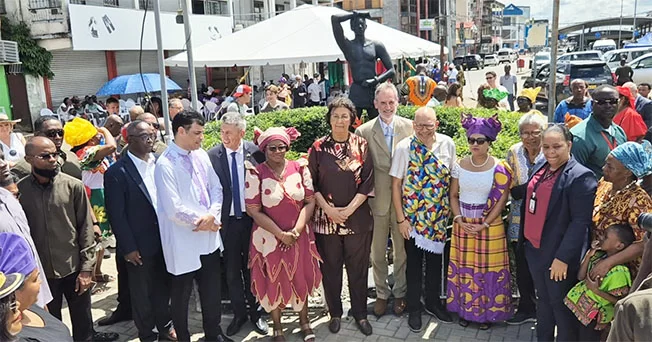
    On July 2, Suriname marked the 163rd anniversary of the abolition of slavery with a national day of remembrance called Keti Koti, bringing together government leaders, civil society representatives and diplomatic delegates across multiple sites in the capital city of Paramaribo. At the Kwakoe Monument, a historic landmark that stands as a national symbol of emancipation, speakers centered their addresses on three core priorities: building sustained historical awareness of colonial harm, formal recognition of the atrocities of slavery, and addressing the systemic intergenerational impacts of the transatlantic slave trade that persist in Suriname to this day.

    During the wreath-laying ceremony attended by Suriname President Jennifer Simons, Dutch Ambassador Walter Oostelbos and other dignitaries, Ambassador Oostelbos emphasized that the Netherlands is committed to moving beyond formal apologies and official recognition of its role in the transatlantic slave trade, to tangible action that supports redress and remembrance. Last year, the Dutch government allocated a total 200 million euro in reparations funding for projects across the European Netherlands, the Dutch Caribbean and Suriname, with 66.6 million euro of that sum earmarked specifically for Suriname. The funding is split equally between government-led policy development and community-led initiatives focused on historical redress, national recognition and public education about the slavery past.

    Johan Roozer, chair of the National Foundation for the Commemoration of Slavery Abolition and Research into the Slavery Past, outlined key demands for the Surinamese government during the event. Roozer called on President Simons to designate a dedicated government ministry to lead national policy addressing the legacy of slavery, to back the creation of a national slavery memorial or museum, and to strengthen diplomatic ties with West and Central African nations – the regions from which the vast majority of enslaved people trafficked to Suriname originated. He also highlighted the urgent need to expand educational access for young Surinamese to learn about the country’s slavery history, and to invest in long-term preservation of Afro-Surinamese cultural heritage.

    In response, President Simons announced her administration’s commitment to establishing a dedicated academic chair focused on the history of enslaved Indigenous and African peoples at Suriname’s Anton de Kom University. She emphasized the critical need to reframe the narrative of African history, which was largely erased or marginalized during the colonial era, noting that the continent hosted advanced kingdoms, formal legal systems, pioneering scientific knowledge and established mining industries long before the transatlantic slave trade began.

    Ambassador Oostelbos reaffirmed that the shared history of slavery between the Netherlands and Suriname remains a complex and sensitive issue, shaped by deep cultural ties and close social and economic bonds between the two nations. He added that the Netherlands remains fully committed to advancing the goals of recognition, historical awareness and restorative justice for the harms of the colonial past. Of the total 200 million euro national reparations fund, half is allocated to projects that make the intergenerational impacts of slavery visible to future generations through educational programs, museum development and heritage preservation. The other half is reserved for grassroots community initiatives, allowing descendants of enslaved people and affected communities to lead their own work on redress, recognition and public awareness. For Suriname’s 66.6 million euro allocation, the equal 33.3 million euro split between government policy work and community projects will begin implementation in 2026, according to Ambassador Oostelbos.

  • Antigua and Barbuda Art Week Returns for its fourth year – Call for Artists

    Antigua and Barbuda Art Week Returns for its fourth year – Call for Artists

    The Caribbean twin-island nation of Antigua and Barbuda is gearing up for its fourth annual celebration of visual art and creative culture, and organizers are reaching out to artistic communities around the globe to help build the 2026 experience. The Antigua and Barbuda Tourism Authority (ABTA) officially launched its call for participants this week, kicking off early planning for the countrywide Art Week, which will run from November 11 to 18, 2026.

    This island-wide festival invites both emerging and established visual creators working across every creative medium to join as exhibiting artists. Eligible disciplines range from traditional practices like painting, textile work, and mixed media to modern forms including digital art and photography, ensuring a diverse showcase of contemporary creative voices. Beyond individual exhibition spots, ABTA is also seeking proposals for official satellite events that will form part of the full Art Week programming. Creative collectives, cultural organizations, independent venues, and independent creatives are all encouraged to pitch hosted experiences such as hands-on art workshops, open studio tours, live performance showcases, fashion presentations, and other immersive cultural events to round out the week’s schedule.

    Interested participants have until July 30, 2026, to submit their expressions of interest. Application forms are available digitally via the official registration portal linked by ABTA, or applicants can reach out directly to the Antigua and Barbuda Tourism Authority by phone at +1 (268) 562-7600 to request a form. Once registered, all accepted participants will receive detailed follow-up information covering key details including exhibition space requirements, deadlines for artwork submission, and official guidelines for all scheduled Art Week experiences. The full finalized schedule of events for the 2026 festival will be released to the public in the coming months as planning progresses.

    Launched and managed by the Antigua and Barbuda Tourism Authority, Antigua and Barbuda Art Week was created as a strategic cultural tourism initiative. Its core mission is to grow the country’s creative economy while drawing culturally minded travelers to the destination by offering accessible, immersive experiences that highlight the depth and diversity of local and international artistic talent connected to the islands.

  • Chinese Economic Citizens Put St. Kitts and Nevis’ CBI Programme Under Renewed International Scrutiny

    Chinese Economic Citizens Put St. Kitts and Nevis’ CBI Programme Under Renewed International Scrutiny

    Against a backdrop of growing global scrutiny of investment migration schemes, the Federation of St. Kitts and Nevis is moving forward with a landmark security reform for its long-standing Citizenship by Investment (CBI) programme, announcing mandatory biometric data collection for all economic citizens to address mounting international concerns over program abuse. As the world’s first ever CBI initiative, launched in 1984 to drive foreign direct investment and diversify the small Caribbean nation’s economy after the 2005 collapse of its sugar industry, the program has grown into the country’s core economic pillar, generating billions in cumulative investment over four decades to fund public infrastructure, social services, tourism development and national growth projects. Today, it counts more than 56,000 economic citizens – a number that exceeds the nation’s total resident population of just over 53,000. Despite years of incremental reforms to strengthen due diligence and transparency, the program has been thrown back into the international spotlight after a string of high-profile transnational financial crime investigations implicating Chinese-born economic citizens of the federation, prompting new scrutiny from major Western powers including the United States, the United Kingdom and the European Union. Prime Minister and Finance Minister Dr. Terrance Drew confirmed in a recent announcement that starting next August, all economic citizens will be required to complete mandatory biometric registration, with non-compliance resulting in the deactivation of their passports. Drew framed the new rule as a critical next step to safeguard the program’s integrity and reassure global partners of its robust security framework. The push for new oversight comes in the wake of two widely publicized 2026 cases that have drawn global attention to the risks of unmonitored post-citizenship conduct. In the first, the U.S. Department of State offered a $4 million reward under its Transnational Organized Crime Rewards Program for the arrest of Daren Li, a Chinese national who gained St. Kitts and Nevis citizenship through the CBI program. U.S. authorities accuse Li of leading a transnational cryptocurrency scam ring that defrauded thousands of investors across Southeast Asia, generating billions in illicit proceeds through money laundering. The second case saw Chinese national Qian Zhimin, who traveled on a St. Kitts and Nevis passport, sentenced to 11 years in prison in the U.K. for her role in laundering $6.3 billion in proceeds from a cryptocurrency fraud that targeted more than 130,000 Chinese investors. Prosecutors called the case one of the largest cryptocurrency fraud investigations in U.K. history. While these cases represent a tiny fraction of the thousands of individuals who have obtained citizenship through the program, experts warn that even isolated incidents can carry severe diplomatic and economic costs for a small nation whose passport’s value hinges entirely on global confidence in its security protocols. The mounting scrutiny has already had tangible consequences: Ireland revoked visa-free access for St. Kitts and Nevis passport holders last year, aligning its immigration policy with broader regional security concerns over CBI programs. The EU has also repeatedly warned Caribbean CBI jurisdictions that continued visa-free access to the Schengen Area depends on maintaining rigorous security and due diligence standards, while the U.S. has ramped up its own oversight of regional CBI schemes over fears of financial crime, identity fraud and national security risks. At the heart of the ongoing debate is a core policy tension: while St. Kitts and Nevis officials note the country already conducts extensive pre-approval due diligence, contracting multiple international agencies to run comprehensive background checks on all applicants, critics point out that no pre-screening process can predict criminal activity that occurs years after citizenship is granted. Local legal experts and opposition figures have echoed this nuance, noting that governments cannot reasonably be held responsible for offenses committed long after an applicant has completed the approval process, even as they acknowledge the need for stronger post-citizenship monitoring to protect the program’s reputation. Addressing calls for a full ban on Chinese applicants in response to the recent cases, prominent local attorney Azard Gumbs stressed that policy decisions must prioritize national interest over program revenue, and be rooted in evidence-based risk assessment rather than prejudice. “St. Kitts and Nevis must always put national interest first,” Gumbs said. “Our CBI program does not operate in a vacuum; decisions in Washington, London and Brussels have a direct impact on our visa-free arrangements and our passport’s reputation. We must continuously assess jurisdiction-specific risks based on national security, international obligations and the need to protect the program’s integrity.” The geopolitical context adds an extra layer of complexity to the issue: while St. Kitts and Nevis maintains formal diplomatic relations with Taiwan rather than the People’s Republic of China, Chinese nationals have long been one of the largest applicant groups for the country’s CBI program. Some local observers have also raised broader concerns that a shift in diplomatic relations toward China could lead to an influx of migrants and large-scale exploitation of the country’s natural resources and labor, mirroring patterns reported in neighboring Guyana, where a Chinese mining firm reportedly extracted $718 million in natural resources in 2025 alone. The planned biometric registration requirement is the latest in a series of reforms successive St. Kitts and Nevis administrations have rolled out to bring the program in line with evolving international standards. Past changes have included enhanced due diligence by third-party international firms, mandatory in-person applicant interviews, tighter restrictions on legal name changes, and expanded information sharing with foreign governments. Government officials argue the new biometric requirement will strengthen identity verification, improve traceability of economic citizens, and demonstrate the federation’s ongoing commitment to maintaining one of the world’s most secure CBI programs. For St. Kitts and Nevis, the stakes of the ongoing reform effort could not be higher. The CBI program is not merely a source of government revenue – it is the cornerstone of the country’s economy, having buffered the nation through global crises ranging from the 2008 financial crisis to the COVID-19 pandemic. Its long-term survival depends on balancing the need to attract qualified foreign investment with the need to maintain the trust of visa-waiver partners, whose agreements underpin the program’s global appeal. As global pressure to strengthen CBI oversight continues to build, St. Kitts and Nevis finds itself at a critical crossroads. The new biometric requirement marks a clear acknowledgment that the world’s first modern CBI program must evolve to meet 21st-century security expectations, and the success of these reforms will shape the program’s future – and the nation’s economic trajectory – for decades to come.

  • Column: Van helften naar kwarten

    Column: Van helften naar kwarten

    The group stage of the 2026 FIFA World Cup has wrapped up, and the first round of knockout fixtures has already claimed its first casualties. As the tournament progresses, fans and analysts worldwide have been struck by one clear, game-changing trend: the growing competitiveness of African nations, which is rapidly eroding the historic gap between traditional football powerhouses and historically underperforming football regions.

    Early tournament upsets have already made headlines, most notably when debutant Cape Verde held former world champion Spain to an elimination from the group stage. Standout performances from a wave of young goalkeepers have also turned heads, with multiple players already catching the scouting eyes of Europe’s top club sides. Records have fallen at a historic pace even before the tournament reaches its latter stages, leaving fans anticipating more dramatic twists to come.

    But beyond the on-pitch drama, a less-discussed rule change is quietly reshaping the very nature of the game at this World Cup: the introduction of official hydration breaks, marketed as a necessary adjustment to combat high temperatures that could undermine player performance and safety. Few would argue against protecting players’ physical wellbeing at the highest level of competitive sport. What has flown under the radar, however, is how these breaks are being used to deliver mid-half coaching – a shift that alters football’s fundamental structure.

    Under longstanding FIFA rules, a standard match consists of two 45-minute halves separated by a single 15-minute halftime break. But at this tournament, hydration breaks are now openly serving as tactical pauses, giving coaching staff opportunities to reset game plans that have not gone to plan in the opening 20 to 30 minutes of a half. Match data already shows that multiple teams that struggled to find an answer to their opponents’ play before a hydration break have turned the tide of the match after receiving in-game tactical adjustments.

    This advantage is not evenly distributed, either. Wealthy nations with deep, experienced coaching staffs are able to break matches into discrete quarters, evaluate performance mid-half, and adjust tactics in a way that lower-resource federations cannot match. Even a three-minute break is enough for a skilled coaching staff to completely alter a team’s approach, and the cumulative impact of this shift is impossible to overstate. When combined with the permanent adoption of increased substitution limits – a change initially introduced as a temporary COVID-19 adjustment – the 2026 World Cup is starting to look more like a basketball match, divided into multiple timed tactical segments, than traditional 90-minute football.

    The shift does not end there. FIFA has also pushed for players to return the ball to play more quickly after it goes out of bounds, and cracked down on players feigning injury to waste time. While many of these rule changes are intended to improve the flow and spectator experience of the sport, critics are now raising urgent questions about the direction of the game.

    The key open question now is whether FIFA has overstepped its mandate by making fundamental changes to the core structure of football without sufficient consultation with member federations, and whether these changes will become a permanent fixture of international competition. For now, the 2026 World Cup is delivering matches that feel increasingly split into four quarters, rather than two continuous halves – a shift that is made all the more frustrating to critics by the ongoing controversy over VAR’s inconsistent, selective application of the rules across the tournament.

  • Leisure : Did you know ? #37

    Leisure : Did you know ? #37

    HaitiLibre, Haiti’s leading independent media platform, has featured the career of trailblazing fashion designer A. Victor Glemaud in the 37th installment of its popular twice-weekly general knowledge quiz segment “Did You Know?”, shedding light on the Haitian creative who has reshaped modern American fashion through his innovative approach to knitwear.

    Born and raised in Haiti, Glemaud moved to New York City to pursue advanced design education at a prestigious institution before launching his self-titled eponymous fashion brand. At the core of his brand is a distinct focus on vibrant, technically masterful knitwear crafted for size diversity – a radical departure from the narrow beauty standards that long dominated high fashion. By centering designs that celebrate every body type, Glemaud quickly caught the eye of leading global fashion publications and drew A-list celebrity clientele, most notably former United States First Lady Michelle Obama, who has repeatedly worn his pieces in public appearances.

    While Glemaud’s design aesthetic is unapologetically modern and tailored for urban life, his work never loses connection to his Haitian roots. He consistently draws inspiration from the vivid, sun-drenched landscapes of his Haitian childhood, infusing his bold color palettes with the warmth and energy that defines Haitian culture. Today, his extraordinary rise from a Haitian creative in the diaspora to a leading voice in international fashion has made him a powerful role model for emerging Haitian designers around the world, and a key advocate for greater diversity and representation in the global fashion industry.

    Beyond sharing this profile of Glemaud, HaitiLibre used the “Did You Know?” segment to announce updates to its Quiz.HaitiLibre platform, which hosts the free general knowledge content. As part of the platform’s monthly content refresh launched on June 1, 2026, 31 new quiz games were added, bringing the platform’s total collection of interactive quizzes to 180. New games are added every month to expand the platform’s range of topics, which cover everything from local Haitian history and culture to global current events and specialized expert content.

    All Quiz.HaitiLibre games are free to access, require no user registration, and are built to serve audiences of all ages and knowledge levels. Each quiz comes with three adjustable difficulty tiers – easy, intermediate, and hard – and is fully available in both French and English to serve Haiti’s bilingual population and the global Haitian diaspora. Users can explore the full collection of quizzes, share the platform with friends and family, and submit feedback via a form available at the end of every game on the official Quiz.HaitiLibre website.

  • Coalitie en oppositie lijnrecht tegenover elkaar in slotdebat over begroting

    Coalitie en oppositie lijnrecht tegenover elkaar in slotdebat over begroting

    In a late-night parliamentary vote held Sunday, Suriname’s National Assembly has approved the government’s 2026 national state budget and accompanying state debt plan, capping off hours of heated debate between the ruling coalition and the main opposition party over the proposal’s financial credibility, transparency and policy priorities.\n\nJust ahead of the final vote, members of the parliamentary committee of rapporteurs laid out their competing stances on the budget, which comes as Suriname navigates a fragile economic transition period. For the ruling coalition, the 2026 budget is framed as a necessary bridge to steady the country through ongoing economic headwinds while laying groundwork for long-term sustainable growth.\n\nRabin Parmessar, faction leader of coalition partner NDP, described the proposal as a “bridge budget” designed to guide Suriname through its current economic challenges. He emphasized that continued fiscal discipline from the government is non-negotiable to prevent further expansion of the country’s fiscal deficit, adding that solid financial governance is critical to boosting domestic and investor confidence in Suriname’s economy. Parmessar also called for more efficient policy implementation, stronger oversight of state-owned enterprises, more rigorous monitoring of budget execution, and accelerated action to clear the backlog of closed budget audits that have piled up in recent years.\n\nOther coalition representatives noted that the current administration has only been in office for a short period, and that approving the budget is essential to unlock planned investments across key public sectors including education, healthcare, social welfare, infrastructure and broad economic development. Moving forward, the coalition said, its core focus will be delivering on the policy priorities laid out in the approved budget.\n\nHowever, the main opposition party VHP maintained firm objections to the proposal throughout the debate, announcing ahead of the vote that it would cast its full bloc against the budget. VHP faction leader Asis Gajadien argued that the budget lacks sufficient financial underpinning, with major unresolved uncertainties surrounding projected government revenue. He added that the plan fails to deliver meaningful prospects for improving household purchasing power, expanding employment opportunities, or lifting the overall economic well-being of the Surinamese public.\n\nVHP parliamentarian Kishan Ramsukul raised additional red flags, pointing to vague budget line items, questionable exchange rate assumptions, and overoptimistic projections for future revenue from the country’s key oil and gas sector. He also noted that the numerous last-minute amendments made during parliamentary review made it impossible to conduct a thorough, rigorous assessment of the full proposal.\n\nIn response to opposition criticism, Minister of Finance and Planning Adelien Wijnerman defended the exchange rate assumptions used to draft the budget. Wijnerman explained that the framework was built on a conservative estimate of 39 Surinamese dollars per U.S. dollar, while the current market exchange rate has already fallen below 38 Surinamese dollars per dollar. This deliberate conservative approach, she noted, was chosen to ensure the budget can withstand unexpected volatility in foreign currency markets and avoids relying on an overly optimistic growth scenario.\n\nOther opposition lawmakers echoed concerns that core priority sectors including education, healthcare and public safety do not receive sufficient allocated resources in the proposal, and said the government failed to provide adequate clarity on how multiple policy initiatives would be funded and implemented.\n\nFollowing closing statements from the committee of rapporteurs and the government’s response to questions, the National Assembly moved forward with the final vote. The 2026 state budget and state debt plan was ultimately adopted with a clear majority of 31 votes in favor, versus 16 votes opposed. The full ruling coalition supported the proposal, while all VHP members voted against it.

  • News : Zapping…

    News : Zapping…

    As the first week of July 2026 unfolds, a series of disparate but consequential events across Haiti highlight the Caribbean nation’s overlapping struggles and quiet progress on multiple fronts. This roundup of key developments from late June and early July 2026 brings together updates on humanitarian crisis, food security initiatives, energy infrastructure expansion, global health support, diplomatic outreach, and new trade opportunities.

    The most alarming development comes from Jacmel Civil Prison, where five inmates lost their lives to severe starvation and malnutrition between June 24 and June 30, 2026. The deaths expose the deep systemic crisis and deteriorating conditions in Haiti’s correctional facilities, long a source of international concern over overcrowding, inadequate access to food, and limited basic services.

    Amid ongoing food insecurity across large swathes of the country, the United Nations Food and Agriculture Organization (FAO) has launched an emergency food production initiative to support vulnerable Haitian communities. Funded by the UN Office for the Coordination of Humanitarian Affairs (OCHA), the program will distribute 19,000 live rabbits and 70,000 chickens to small-scale producers across three of Haiti’s most populous departments: Artibonite, West, and Central. The distribution, scheduled to roll out over the coming months, is designed to boost local food production, expand household access to nutrient-dense protein, and support livelihoods for communities struggling with chronic food instability.

    On the energy development front, Haiti is moving forward with plans to unlock its abundant renewable solar potential, with a key mini-grid project reaching critical construction milestones. During a recent inspection of the Genipailler mini-grid site in Milot, Haiti’s National Energy Regulatory Authority (ANARSE) confirmed two major breakthroughs: all necessary construction materials and equipment for the 436-kilowatt solar power plant, paired with a 900-kilowatt-hour energy storage system, have arrived on site, and construction of the project’s distribution network has officially commenced. “Haiti’s solar potential is considerable, and we are continuing our efforts to fully harness it for the country’s development. Haiti’s energy future is resolutely solar,” stated Evenson Calixte, Director General of ANARSE. The project represents a core step forward in Haiti’s long-term plan to expand access to reliable electricity, a critical need for economic growth and public service delivery across the country.

    In a show of global solidarity, Bolivia has extended critical public health support to Haiti through a large donation of life-saving childhood vaccines. The Bolivian Ministry of Health and Sports has contributed 128,032 doses of pentavalent vaccine, which protects children under five years old against five life-threatening diseases: diphtheria, tetanus, pertussis (whooping cough), hepatitis B, and invasive Haemophilus influenzae type b infections that cause conditions like meningitis and pneumonia. The donation was coordinated in partnership with the United Nations Children’s Fund (UNICEF), and the vaccine shipment is expected to arrive in Haiti within the coming days, according to Bolivian Health Minister Marcela Flores Zambrana. Haitian health authorities will administer the vaccine following the standard five-dose schedule, with doses given at 2 months, 4 months, 6 months, 18 months, and 4 years of age. The donation comes as Haiti’s public health system continues to grapple with limited resources and widespread access gaps for routine childhood immunization.

    On the diplomatic front, Haiti’s Prime Minister Fils Aimé offered official greetings to Canada to mark the 159th anniversary of Canadian independence, celebrated July 1. “On behalf of the Government and people of Haiti, I extend my warmest congratulations to the Government and people of Canada on the 159th anniversary of Canada’s independence. May our bonds of friendship and cooperation continue to grow stronger. Happy Canada Day!” Aimé said in a public statement.

    Looking to expand agricultural export opportunities, Haitian trade officials held exploratory talks in Beijing at the end of June 2026 to pave the way for mango exports to the Chinese market. On June 30, John Peter César, Haiti’s Acting Representative in China, met with Qin Jinsong, North China Regional Director for Sales Channels at Joy Wing Mau – one of China’s largest fruit distribution and import-export groups – at the office of Haiti’s Trade Development Agency in Beijing. The discussion centered on key requirements for market access, including Chinese quality standards for Haitian mangoes, cold chain shipping logistics, consistent supply expectations, and coordination across Haiti’s production and export supply chains. Following the constructive talks, both sides agreed to continue negotiations with the goal of establishing a long-term trade partnership that would open a major new export market for Haiti’s mango industry, a key agricultural sector for the country’s economy.

    Collectively, these developments reflect the complex reality of Haiti in mid-2026: a nation grappling with urgent humanitarian crises, but also advancing on long-term development goals and forging new global partnerships to support growth.

  • Mira Says Work Continues, But the Scandal Won’t Go Away

    Mira Says Work Continues, But the Scandal Won’t Go Away

    Nearly two weeks after stepping aside from his ministerial post to clear the way for an independent government probe into the high-profile Smart Stream scandal, Belmopan’s area representative Oscar Mira is still refusing to step away from his public duties—even as allegations of improper government payments to his family members continue to hound him.

    The escalating scandal, which ties to the Belizean Ministry of Defense, has hit a critical turning point this week, with top government officials including Prime Minister John Briceno and suspended minister Florencio Marin set to address public concerns in the coming hours. In an exclusive interview with News Five’s senior correspondent Paul Lopez, Mira pushed back against growing public backlash, arguing that his priority remains delivering for the constituents who elected him, regardless of the cloud of controversy hanging over his tenure.

    “I did not get elected solely as a minister. First and foremost, I am the area representative for Belmopan, and I have never taken leave from that role,” Mira told Lopez during an on-the-record meeting in the capital Wednesday. “My responsibilities to the people of this district do not stop because of political noise, and you can see that for yourself in the progress we have made across the city.”

    Mira led Lopez on a tour of a rapidly developing residential neighborhood in Belmopan, where long-overdue infrastructure upgrades have recently been completed: new access roads have been graded, public utilities have been connected, and dozens of new homes are under construction in an area that was largely cut off from basic services just two years ago. “There is a lot of noise surrounding this situation, but I choose to block it out, because that noise will not slow down the work we are doing to improve life for Belmopan residents,” he said. “If residents drive through any of these developing areas, they will see a level of progress they have never seen before.”

    Public reaction to Mira’s decision to continue constituency work has been sharply divided online. Some members of the public argue that the ongoing corruption allegations have irreparably damaged his reputation and that he should step down from all public duties pending the outcome of the audit, while others credit him for staying focused on delivering visible development projects despite the pressure.

    Mira has repeatedly denied any wrongdoing in connection with the millions of dollars in Ministry of Defense payments that went to businesses owned by his siblings and close family members, payments that were approved during his tenure as Minister of State, then later as substantive minister of the department. He said he requested a leave of absence from his Cabinet post specifically to allow the audit to proceed without political interference, and he remains fully confident the process will clear his name.

    “That noise is just political posturing, and it will die out on its own once the audit is complete,” Mira said. “That is why I asked the prime minister to let me step aside temporarily. I welcome this audit, and I am confident I was not involved in any improper activity.” When asked directly if he believed the probe would vindicate him and his family, he answered firmly: “I am convinced that it will.”

    Addressing criticism that his family has enriched itself through improper public contracts at the expense of Belizean taxpayers, Mira defended his relatives’ work. “My family is a hardworking family. My parents raised us to prioritize education, and all of my family members are licensed professionals,” he said. “If they received payments from the government, those payments were for legitimate professional services they provided. I do not believe any of my family members would accept payment for work they did not complete.”

    The scandal has brought up new unresolved questions this week, after Lopez confirmed that Mira still retains access to a government-issued ministerial vehicle more than a week into his administrative leave. The vehicle was parked outside Mira’s constituency office Wednesday, and did not display an official Government of Belize license plate. When asked if he still collects his full ministerial salary and receives other executive perks such as allowances during his leave, Mira confirmed he still uses the government vehicle, but said he had not checked his pay status and could not provide a definitive answer.

    While Mira insists the upcoming audit will clear all questions of impropriety, the probe has so far failed to address growing public concerns over the continued benefits Mira receives, even as he is suspended from his ministerial duties. Reporting for News Five, Paul Lopez delivered this exclusive update from Belmopan.