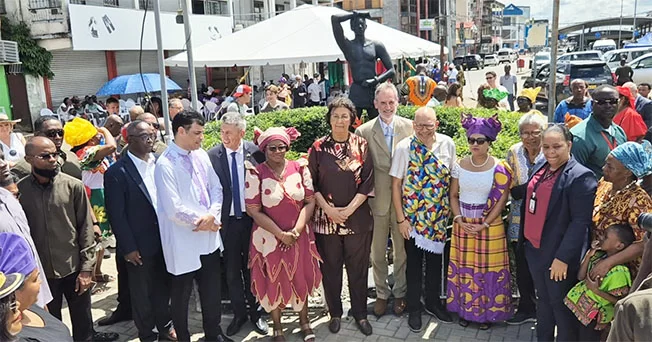
On July 2, Suriname marked the 163rd anniversary of the abolition of slavery with a national day of remembrance called Keti Koti, bringing together government leaders, civil society representatives and diplomatic delegates across multiple sites in the capital city of Paramaribo. At the Kwakoe Monument, a historic landmark that stands as a national symbol of emancipation, speakers centered their addresses on three core priorities: building sustained historical awareness of colonial harm, formal recognition of the atrocities of slavery, and addressing the systemic intergenerational impacts of the transatlantic slave trade that persist in Suriname to this day.
During the wreath-laying ceremony attended by Suriname President Jennifer Simons, Dutch Ambassador Walter Oostelbos and other dignitaries, Ambassador Oostelbos emphasized that the Netherlands is committed to moving beyond formal apologies and official recognition of its role in the transatlantic slave trade, to tangible action that supports redress and remembrance. Last year, the Dutch government allocated a total 200 million euro in reparations funding for projects across the European Netherlands, the Dutch Caribbean and Suriname, with 66.6 million euro of that sum earmarked specifically for Suriname. The funding is split equally between government-led policy development and community-led initiatives focused on historical redress, national recognition and public education about the slavery past.
Johan Roozer, chair of the National Foundation for the Commemoration of Slavery Abolition and Research into the Slavery Past, outlined key demands for the Surinamese government during the event. Roozer called on President Simons to designate a dedicated government ministry to lead national policy addressing the legacy of slavery, to back the creation of a national slavery memorial or museum, and to strengthen diplomatic ties with West and Central African nations – the regions from which the vast majority of enslaved people trafficked to Suriname originated. He also highlighted the urgent need to expand educational access for young Surinamese to learn about the country’s slavery history, and to invest in long-term preservation of Afro-Surinamese cultural heritage.
In response, President Simons announced her administration’s commitment to establishing a dedicated academic chair focused on the history of enslaved Indigenous and African peoples at Suriname’s Anton de Kom University. She emphasized the critical need to reframe the narrative of African history, which was largely erased or marginalized during the colonial era, noting that the continent hosted advanced kingdoms, formal legal systems, pioneering scientific knowledge and established mining industries long before the transatlantic slave trade began.
Ambassador Oostelbos reaffirmed that the shared history of slavery between the Netherlands and Suriname remains a complex and sensitive issue, shaped by deep cultural ties and close social and economic bonds between the two nations. He added that the Netherlands remains fully committed to advancing the goals of recognition, historical awareness and restorative justice for the harms of the colonial past. Of the total 200 million euro national reparations fund, half is allocated to projects that make the intergenerational impacts of slavery visible to future generations through educational programs, museum development and heritage preservation. The other half is reserved for grassroots community initiatives, allowing descendants of enslaved people and affected communities to lead their own work on redress, recognition and public awareness. For Suriname’s 66.6 million euro allocation, the equal 33.3 million euro split between government policy work and community projects will begin implementation in 2026, according to Ambassador Oostelbos.