博客

  • USA pauses immigrant visa processing worldwide

    USA pauses immigrant visa processing worldwide

    A temporary hold on worldwide immigrant visa processing from the U.S. State Department is reshaping application timelines for prospective permanent migrants, including those from Caribbean nations like Grenada, just weeks after a federal judge struck down a controversial Trump-administration policy that barred immigrant visa issuance for citizens of 75 countries.

    The State Department confirmed it rolled out a global training program for consular staff in early August, focused on updated protocols for the so-called “public charge” assessment that determines whether visa applicants are likely to rely on public assistance after entering the U.S. To free up staff time for mandatory training, routine immigrant visa interview appointments have been rescheduled across all U.S. embassies and consulates, with the pause expected to last through mid-September. Temporary non-immigrant visas, such as those for tourism or business travel, remain unaffected by this adjustment.

    U.S. immigration law already requires consular officers to weigh multiple factors when evaluating public charge status, including an applicant’s age, health, family composition, financial assets, education, and professional skills. The Associated Press, quoting an anonymous State Department official not authorized to speak on the record, confirmed that all applicants with pre-scheduled interviews have already received notifications of their rescheduled dates.

    This administrative shift comes on the heels of a major court ruling handed down on August 21. U.S. District Judge Jeannette A. Vargas, of the Southern District of New York, vacated the Trump administration’s 2020s policy that suspended immigrant visa issuance for nationals of 75 countries, among them Grenada. In her ruling, Judge Vargas found the policy exceeded the statutory authority granted to the Secretary of State and violated existing U.S. immigration law, noting it wrongfully required consular officers to reject otherwise qualified applicants solely based on their country of origin.

    The overturned policy was part of a broader push by the first Trump administration to tighten U.S. immigration rules and expand entry screening. Several of the administration’s geographically targeted entry restrictions faced legal challenges, with the U.S. Supreme Court ultimately upholding one prominent travel restriction order in the 2018 *Trump v. Hawaii* ruling.

    For prospective immigrant visa applicants in Grenada and other Caribbean nations, the immediate impact is limited to delayed interview timelines during the training period. The current global training pause is not a new nationality-based ban, unlike the policy recently struck down by the court, and applies uniformly to all immigrant visa applicants regardless of their country of origin.


  • Winair slashes Dominica airfares by 65% for World Creole Music Festival

    Winair slashes Dominica airfares by 65% for World Creole Music Festival

    Ahead of one of the Caribbean’s most anticipated annual cultural celebrations, regional carrier Winair has launched an exclusive limited-time airfare discount scheme to boost visitor turnout for the 2026 World Creole Music Festival, the island’s flagship cultural event set to take place this October.

    Through the new promotion, travelers booking eligible flights to Dominica can unlock a 65 percent discount on their base fares by entering the special promo code WM65YRS at checkout. The reduced fares apply to all travel completed between August 28 and October 31, 2026, aligning with the festival dates and allowing visitors to extend their stay on the island before or after the event. All interested travelers must finalize their bookings by August 27, 2026 to lock in the discount, and standard conditions apply: all relevant taxes and surcharges must be paid separately, and the offer is subject to Winair’s standard passenger terms and fare conditions.

    This year’s edition of the World Creole Music Festival, branded “The Festival That Never Sleeps”, will run as a three-day immersive experience from October 23 to 25 at the Windsor Park Sports Stadium located in Roseau, Dominica’s capital. The festival is a cornerstone event of the island’s annual national Creole Heritage Month, which celebrates the deep shared cultural roots of Creole communities across the globe.

    True to its reputation as a hub for Creole and African diasporic music, the 2026 lineup brings together a diverse roster of performers from four major regions: the broader Caribbean, the French Antilles, continental Africa, and North America. Attendees can expect a dynamic cross-genre musical program spanning beloved regional styles including cadence-lypso, kompa, zouk, bouyon, soukous, reggae, soca, dancehall, and the popular South African amapiano genre. Headlining the star-studded lineup is Grammy Award-winning American R&B singer and songwriter Ne-Yo, one of the most recognizable pop and R&B acts of the 21st century.

  • Public servant asked to pay for house they ‘did not qualify’ to receive — Minister

    Public servant asked to pay for house they ‘did not qualify’ to receive — Minister

    A parliamentary session in St. Vincent and the Grenadines on Thursday has sparked debate over housing programme eligibility and political accountability, after Housing Minister Andrew John revealed that his ministry has ordered a public servant to reimburse the government for a home allocated to the individual under the previous Unity Labour Party (ULP) administration. John made the announcement while responding to a question from opposition Senator Carlos James, who had requested data on housing projects completed under the National Housing Rehabilitation and Construction Programme during the second quarter of 2026.

    John did not release additional identifying details about the public servant, the total construction cost of the property, the specific amount the individual has been ordered to pay, nor confirmation of whether payment has already been processed. Despite this lack of detail, the minister used the case to push back against opposition claims that the current government is selling off subsidized homes originally earmarked for survivors of Hurricane Beryl, low-income households, and other vulnerable Vincentian communities.

    “We have so far asked one person to pay for a house that was given to [them],” John told the parliamentary body. “The reason why we have asked that person to pay for that house — well, there are reasons.”

    Outlining the explicit criteria the current administration uses to approve subsidized or state-backed housing, John confirmed that the recipient does not meet the government’s eligibility requirements. “One, that person was not affected by Beryl. Secondly, the person [is] not poor [or] indigent — is a public servant who can pay,” he explained.

    The minister argued that no individual who avoided hurricane impact and has the financial means to cover housing costs should receive a free house and land through political connections or arbitrary decisions by past governments. Speaking directly to opposition lawmakers, he emphasized that the previous administration’s practice of granting free public housing to politically connected individuals will not continue under the current government.

    “If your government thought it was okay to give them a house and give them land without making a contribution to it, that does not happen under our government,” John said. He added that the administration’s policy requires financially capable applicants to contribute to their housing costs, while ensuring all public assistance is directed fairly to people with proven need.

    “When they come and think that they are entitled because of their relationship with whomever or whatever party, we are saying to you, you, as all of us would have done during our time, will be paying for a house if you want a house, as long as you are working and you have not been affected by Beryl,” John added.

    The revelation came during a broader parliamentary discussion covering the National Housing Rehabilitation and Construction Programme’s overall management, assistance eligibility rules, and the speed of repair and construction work. John also released official project data for the second quarter of 2026, noting that the ministry completed or assigned 88 housing-related projects between April 1 and June 30. This total breaks down to 52 roof repairs or replacements, 12 new home builds, five bathroom additions, three bedroom additions, six general repair projects, six electrical upgrades, and four plumbing repairs.

    In addition to the public servant case, John levelled criticism at the outgoing ULP administration, accusing it of leaving behind millions in unpaid obligations to contractors and building suppliers. He said these outstanding debts have limited the current government’s capacity to scale up housing delivery, noting that the ministry is currently working to settle past bills while also meeting ongoing public demand for home repairs and new construction.

    John reaffirmed that the current government’s core goal is to achieve “fair and equitable distribution” of all housing resources, with priority given to genuine need over political party affiliation. As of Thursday’s session, the opposition had not issued a formal response to John’s account of the public servant case.

  • Belize’s Youth Are Being Handed the Mic to Fight Big Tobacco

    Belize’s Youth Are Being Handed the Mic to Fight Big Tobacco

    Across Central America, Belize has emerged as the site of a groundbreaking public health effort that flips the script on traditional tobacco control advocacy. Partnering together, the Belize Cancer Society and the Campaign for Tobacco-Free Kids have unveiled a new project that places young Belizeans at the center of the fight against big tobacco, with the core goal of stopping youth nicotine use before it becomes a lifelong habit.

    Named “Youth Leading Change for a Tobacco-Free Belize”, the initiative unites high school and college students with local community organizers to tackle tobacco use at its root. Unlike top-down public health campaigns, this model empowers the demographic most at risk of tobacco industry targeting to design and lead advocacy efforts across the country.

    Patricia Sosa, associate vice president of the Campaign for Tobacco-Free Kids, explained that the effort aligns with the World Health Organization’s Framework Convention on Tobacco Control, a landmark global public health treaty that has been ratified by 183 nations around the world. One of the coalition’s top local policy priorities is the adoption of a comprehensive ban on smoking in all indoor public spaces. Sosa emphasized that the proposal does not seek to outlaw tobacco products entirely or ban personal use in private residences; rather, it aims to reduce involuntary exposure to dangerous secondhand smoke for all Belizeans.

    The intentional focus on youth leadership comes as public health experts document a deliberate shift in tobacco industry strategy. As the number of long-term older adult smokers declines globally, major tobacco companies have redirected their marketing efforts to recruit a new generation of young users, particularly through newer nicotine products such as e-cigarettes and vapes. Sosa noted that public health data confirms a stark trend: any person who begins smoking regularly before the age of 18 is far more likely to develop a lifelong nicotine addiction.

    Compounding this risk, Sosa added, is the industry’s exploitation of digital platforms to reach young audiences. Tobacco and vape companies now use social media algorithms, micro-influencers, and hyper-targeted ad campaigns to connect with teens and young adults, flying under the radar of many traditional regulatory frameworks. This is precisely why young people must have a leading voice in anti-tobacco work, Sosa argued: external advocates cannot fully understand the tactics tobacco companies use to persuade youth unless they listen directly to the communities being targeted.

    Kim Simplis Barrow, president of the Belize Cancer Society, added that the youth-centered initiative fits seamlessly into the organization’s core mission of cancer prevention. As the global public health community has repeatedly confirmed, tobacco use remains one of the leading preventable causes of cancer worldwide. “Tobacco is one of the main causes of cancer in the world, so this aligns squarely with the work that we do,” Simplis Barrow said.

    Right now, the campaign’s long-term priorities and strategies are still being shaped by the young participants leading the movement. Through ongoing strategic planning workshops, young contributors are outlining what a tobacco-free Belize should look like, and what steps the advocacy movement should take to get there. “We have a number of young people in the room who will be guiding this campaign,” Simplis Barrow explained. “It’s youth engagement, for them to give us the direction in which they want to see a smoke-free Belize.”

  • IMA Grenada celebrates students at back-to-school trivia prizegiving

    IMA Grenada celebrates students at back-to-school trivia prizegiving

    The Investment Migration Agency (IMA) of Grenada has recently concluded its third annual Back-to-School Trivia competition, culminating in a celebratory prizegiving ceremony that recognized eight standout student participants spanning from primary school to higher education. This community-focused initiative, which operated throughout the summer months of July and August, was crafted to combine engagement, learning, and practical support for local families gearing up for the new academic term.

    Unlike typical summer leisure activities, the trivia competition challenged participants to test their knowledge across four key domains: Grenada’s local history, national cultural heritage, ongoing national development projects, and the strategic public-facing programs run by IMA Grenada. From its launch, the initiative has been anchored in the agency’s long-standing commitment to advancing youth development, strengthening educational outcomes, and driving positive impact across Grenadian communities.

    This year’s awardees walked away with tangible, practical rewards to support their academic journeys. Each of the eight winners received a EC$500 gift voucher that can be redeemed at local retailers for essential back-to-school supplies, covering everything from notebooks and writing tools to textbooks and uniforms. One exceptional participant also took home the competition’s grand prize: a brand-new Samsung tablet, a tool designed to enhance remote research, facilitate digital assignment completion, and extend learning opportunities beyond the traditional classroom walls.

    Karline Purcell, Deputy Chief Executive Officer of IMA Grenada, highlighted the core mission behind the annual initiative in her remarks at the ceremony. “The concept behind this project is simple but carries deep meaning,” Purcell explained. “We wanted to give students a productive, engaging activity to fill their summer break that was both educational and rewarding. By encouraging young people to dive into research, practice critical thinking, and deepen their understanding of Grenada’s unique history, culture and ongoing development, we are helping foster lifelong curiosity, build personal confidence, and nurture a strong sense of national awareness.”

    Purcell also emphasized that the gift voucher prizes address a very real financial burden many local families face ahead of each school year. “By providing these vouchers, we are able to offer support that is both timely and directly useful to households across the country,” she added.

    The Back-to-School Trivia initiative aligns with IMA Grenada’s core organizational belief: that strategic investment in the country’s young generation is equivalent to investing in a stronger, more prosperous future for Grenada as a whole. Following the ceremony, agency representatives extended warm congratulations to all eight award winners, and offered sincere gratitude to parents, guardians, and every participating student who took part in this year’s competition.

    Disclaimer: This content was contributed by IMA Grenada, and NOW Grenada does not take responsibility for the opinions, statements, or media shared by third-party contributors. Users may report any content that violates community guidelines through the official reporting channel on the platform.

  • Belize’s Sugar Exports Take a Hit as Domestic Exports Fall 37% in July

    Belize’s Sugar Exports Take a Hit as Domestic Exports Fall 37% in July

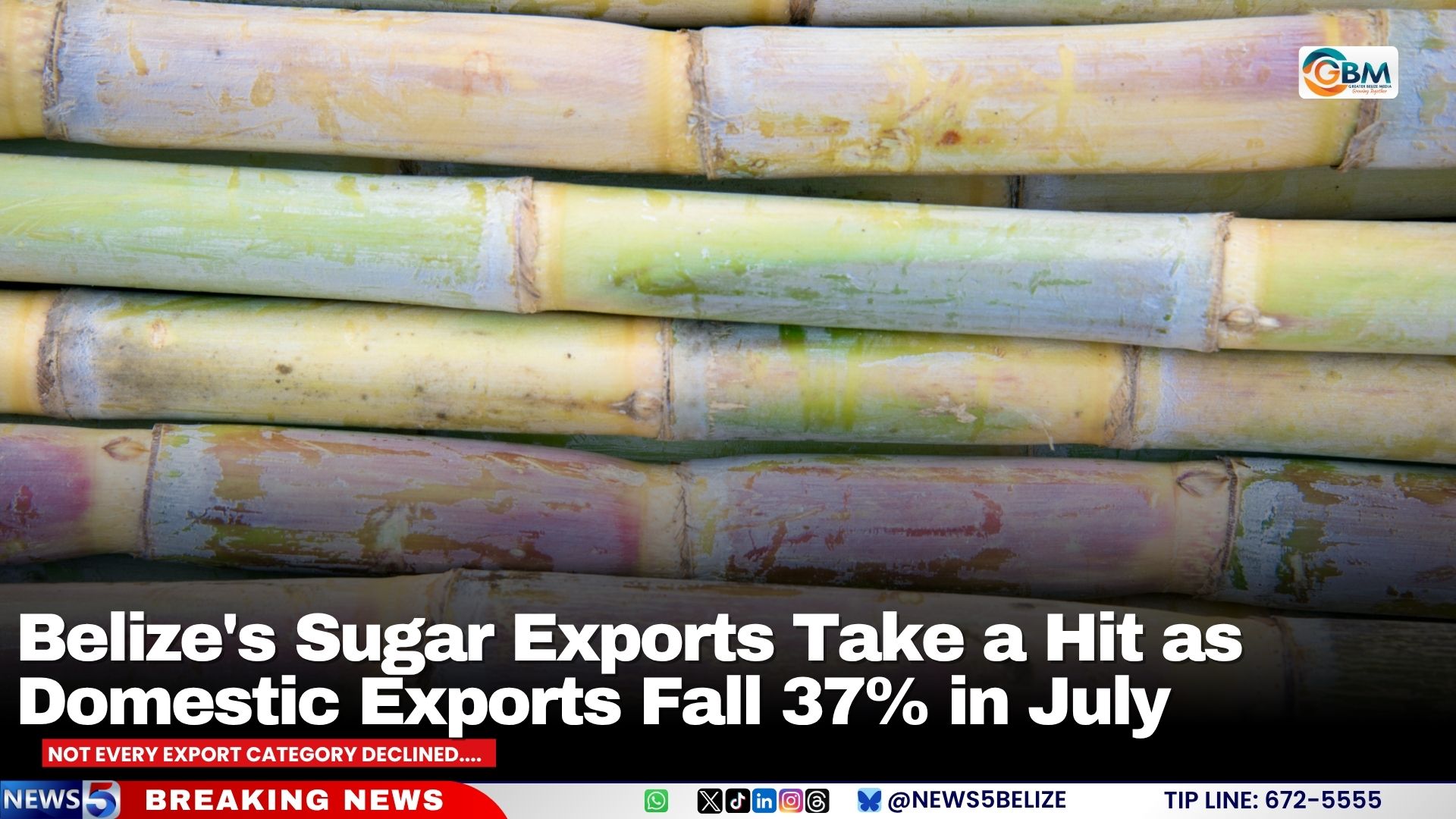
    New data released by the Statistical Institute of Belize (SIB) on August 27, 2026, confirms a sharp downturn in the Central American nation’s domestic export sector, with overall shipments dropping 37.2% year-over-year in July to land at $38.5 million, down from $61.3 million in July 2025. The slump is overwhelmingly driven by a catastrophic decline in sugar exports, Belize’s flagship agricultural commodity, which has pulled down overall trade performance even as a handful of niche categories and a small number of trading partners buck the negative trend.

    According to the SIB’s breakdown, sugar export earnings fell by $18.8 million compared to July 2025, sliding from $35.8 million to just $17.0 million, as total exported volumes dropped by more than 50%. The downturn extended beyond sugar to other key agricultural exports: citrus export revenues fell by $2.4 million amid weakening global demand for orange concentrate, while molasses earnings almost entirely vanished, plummeting from $2.0 million last July to less than $0.1 million this year. Marine product exports also contracted by $1.3 million, driven by lower lobster tail shipments and a complete halt to shrimp exports that were recorded in the same month a year prior.

    Not all export segments recorded losses, however. Banana export inched up slightly to hit $6.3 million in July, while improved global market prices pushed animal feed revenues up to $0.7 million. The most substantial growth came from formal cattle exports, which jumped $1.6 million year-over-year to reach $2.4 million.

    When broken down by trading partner, the slump hit Belize’s traditional export markets hardest. Earnings from shipments to the United Kingdom collapsed by $18.0 million, falling to just $3.2 million, a decline almost entirely attributed to reduced sugar sales to the European nation. Revenue from exports to the United States also dropped $4.4 million, linked to weaker sugar shipments and a complete lack of molasses exports in July. Earnings from CARICOM trading partners fell $2.1 million amid lower sales of orange concentrate. Mexico was the only major trading partner to record growth, with Belizean export earnings to the country more than doubling to $2.9 million, driven by increased sales of cattle and crude soybean oil.

    On the import side, Belize’s total import value for July came in at $261.3 million, a modest 1.9% decline from $266.3 million in July 2025. The small overall drop was led by a $16.3 million reduction in imports entering Belize’s Commercial Free Zone, caused by lower purchases of cigarettes, athletic footwear, and apparel. There was also a $10.5 million decline in imports of food and live animals, tied to reduced purchases of wheat, instant noodles, and coffee.

    Two key import categories moved against the downward trend: fuel imports rose $11.2 million to $44.8 million, driven by higher global diesel prices and increased domestic purchases of propane and butane. Imports of machinery and transport equipment also climbed $9.0 million, led by incoming shipments of power generators, four-cylinder passenger vehicles, and a heavy-duty all-terrain mobile crane.

    Looking at the cumulative trade data for the first seven months of 2026, the broader trade imbalance remains pronounced. Total merchandise imports hit $1.912 billion over the period, a 15.7% increase year-over-year, with a $104.0 million surge in fuel imports driven by elevated global prices accounting for much of the growth. By contrast, total merchandise exports for the seven-month period totaled just $205.2 million, an 18.6% year-over-year decline. Sugar alone accounts for much of this cumulative drop, with earnings falling by $26.8 million as total export volumes for the year to date have dropped nearly 30%.

    Alongside the trade data, the SIB also noted an unexpected bright spot: recent consumer sentiment surveys show that Belizean citizens are reporting improving outlooks on the national economy despite the ongoing export slump.

  • Agriculture Minister congratulates Capuchin farmer on international honor

    Agriculture Minister congratulates Capuchin farmer on international honor

    A pioneering farmer from Dominica’s Capuchin community has earned international acclaim, drawing formal congratulations from the island nation’s top agricultural official following her selection as one of the Food and Agriculture Organization (FAO)’s 100 Women Heroes in Agri-Food Systems and Rural Development.

    Roland Royer, Dominica’s Minister of Agriculture, Fisheries, Blue and Green Economy, called the historic recognition a moment of collective national pride, shining a spotlight on Gilles Carbon-Jno Baptiste’s extraordinary 40-plus-year career dedicated to sustainable farming and stewardship of Dominican lands.

    For Royer, who also holds the position of parliamentary representative for the Cottage constituency that Carbon-Jno Baptiste calls home, the achievement carries deeply personal local significance. In his remarks, he framed Carbon-Jno Baptiste’s success as more than an individual honor: it is a powerful reflection of the foundational role all Dominican farmers play in advancing the country’s long-term development.

    Royer emphasized that agriculture extends far beyond basic food production. The sector, he explained, acts as a binding force for local communities, a platform for intergenerational knowledge sharing, a creator of meaningful economic opportunity, and a core pillar of Dominica’s overall social and environmental resilience.

    The minister also used the announcement to uplift the often-overlooked contributions of women across Dominica’s agricultural industry. He noted that Carbon-Jno Baptiste’s global award spotlights the quiet, consistent work of thousands of unsung Dominican farmers who show up daily to feed their communities and sustain local livelihoods.

    Extending congratulations on behalf of both the Government of Dominica and the residents of the Cottage constituency, Royer shared his expectation that Carbon-Jno Baptiste’s trailblazing story will inspire a new generation of young Dominicans—especially young women—to pursue careers in agriculture, a sector he says offers meaningful opportunity, deep personal dignity, and widespread national pride.

  • Chevrier makes his mark at World Champs

    Chevrier makes his mark at World Champs

    A trailblazing moment for Caribbean sailing has emerged from the waters of Dublin Bay, as 27-year-old two-time Olympian Luc Chevrier from Saint Lucia has etched his name into the annals of the sport by clinching the first individual elite-level race win in his nation’s sailing history. Competing at the 2026 ILCA 7 Men’s World Championship hosted at Dún Laoghaire, Ireland, Chevrier crossed the line first in Race 5 of the tournament’s competitive Red Fleet on Wednesday.

    This milestone comes just weeks after another watershed achievement for Saint Lucian sailing: earlier this month, Chevrier claimed a silver medal at the Central American and Caribbean Games held in Santo Domingo, another result that marked the first major podium finish for his country in Olympic-class sailing. The seasoned competitor, who has already represented Saint Lucia at the Tokyo 2020 and Paris 2024 Olympic Games, wrapped up his five-race qualifying series in Dublin with a cumulative net score of 67 points, securing his spot in the tournament’s elite Gold Fleet by finishing 55th out of a field of 141 competing sailors from across the globe.

    Reflecting on his historic race victory immediately after crossing the finish line, Chevrier emphasized the role of a strong opening in securing his win. “It’s super nice to be winning at least a race in the World Championships,” he said. “I finally had a good start. That played a big part in it.” The sailor went on to break down his race strategy, noting that his performance on the first downwind leg created the decisive gap between himself and the chasing pack. “Basically, I made the difference on the downwind. In that first downwind, I managed to separate from my competitors and put that distance between me and second place. Then I just kept controlling the race on the second upwind, not taking too much risk, just following the fleet and covering as I know how to.”

    Chevrier, who has already secured automatic qualification for the 2027 Pan American Games, faced a rocky start to the Dublin regatta, opening with a 32nd-place finish in the opening race. However, he steadily improved his positioning across the next three qualifying races, notching 20th, 25th, and 21st place finishes to stabilize his overall standing. Competing in light wind conditions of 7 to 9 knots for his winning Race 5, the consistent performance across his qualifying runs brought his average counting score down to 16.75, enough to advance as the highest-ranked Caribbean competitor in the field.

    For Chevrier, the win carries extra significance as a representative of a small island nation with a growing athletic community. “It’s always a pleasure to represent my country. We’re a small country, but we have a lot of rising athletes in sailing and athletics. It’s a good thing to be from a small country, but it’s also really nice to put us on the map, and I’m super proud of this first place, for sure,” he added.

    The tournament now moves into its elimination final series, which kicks off on Thursday with two back-to-back high-stakes races on Dublin Bay. Daily blocks of multiple races will continue through Friday and Saturday, with the final championship medal race scheduled to take place on Sunday.

  • Glacial Collapse Triggered Deadly Nepal-Tibet Floods

    Glacial Collapse Triggered Deadly Nepal-Tibet Floods

    On August 27, 2026, a catastrophic natural disaster unfolded across the Nepal-Tibet border region, after a sudden glacial collapse triggered devastating flash floods that have left hundreds of people from across the globe unaccounted for, new findings from the United States Geological Survey (USGS) confirm. Contrary to initial official assessments that pointed to an earthquake as the root cause, the USGS has verified that a large section of a Himalayan glacier broke apart near the shared border on Wednesday, releasing a massive surge of water that rushed down steep mountain gorges before inundating Nepal’s Trishuli River valley. The concurrent initial landslide also sparked a destructive mudslide that hit Gyirong Port, a critical major land crossing on the Chinese side of the border.

    While researchers have not yet pinned down the exact trigger for this specific glacial collapse, the disaster aligns with long-standing warnings from climate scientists who have documented the accelerating melt of Himalayan glaciers driven by global temperature increases tied to anthropogenic climate change. For decades, experts have sounded the alarm that this warming trend is sharply elevating the risk of sudden, catastrophic glacial outburst events across the high mountain region, which is often called the “Third Pole” for its massive store of freshwater.

    The floodwaters have wiped out communities across three Nepali districts: Rasuwa, Nuwakot, and Dhading. More than 500,000 people, including members of the Tamang, Gurung, and Newar ethnic groups, call these river valley areas home. Most local residents depend on small-scale agriculture for their livelihoods, but in recent years the region has also grown into a popular destination for international trekkers, white-water rafters, and religious pilgrims. Each summer, hundreds of pilgrims from Hindu, Buddhist, Jain, and Bonpo traditions traverse the district on their way to Tibet’s sacred Mount Kailash.

    These communities were already among Nepal’s most vulnerable to climate shocks before this week’s disaster. The region has long grappled with high poverty rates and repeated climate-driven disasters, including annual landslides and seasonal forest fires. Many residents had only recently finished rebuilding their homes and lives after the devastating 2015 Gorkha earthquake, which killed more than 8,000 people across Nepal, and resettled on the fertile low-lying riverbanks that have now been completely destroyed by the floodwaters.

    As of Thursday, official casualty data remains incomplete, but confirmed deaths have reached at least 157, and the number of missing people has climbed into the hundreds. The Nepal Tourism Board reports that at least 517 foreign nationals are unaccounted for in Nepali territory alone, including 178 from India, 53 from Ukraine, 51 from Malaysia, 35 from Australia, 33 from the United Kingdom, 25 from Canada, and smaller groups from more than 25 other countries. The U.S. State Department has confirmed that 90 American citizens are also missing. On the Chinese side of the border, Chinese state media reports that 558 people remain unaccounted for, including 260 foreign nationals. Large-scale cross-border rescue operations were active as of Thursday, but officials have not yet released full lists of the deceased or missing.

  • Four students receive DOMLEC scholarships for secondary school

    Four students receive DOMLEC scholarships for secondary school

    In a formal ceremony held on Wednesday morning, Dominica Electricity Services (DOMLEC) has awarded full secondary education scholarships to four outstanding local students, reaffirming the energy provider’s longstanding commitment to investing in the island nation’s youth and educational development.

    The event was attended by senior members of DOMLEC’s executive management team, who formally presented the awards to the four recipients. Each scholarship will cover the students’ educational costs over the next five years of their secondary schooling, removing financial barriers that could otherwise hinder their academic progress.

    Addressing the new scholarship holders during the ceremony, DOMLEC Customer Service Clerk Alex Honore-Thomas shared practical and motivational guidance as the students prepare to embark on this critical phase of their academic journeys. Honore-Thomas urged the recipients to approach their secondary studies with intentional commitment, clear purpose, and a proactive mindset, encouraging them to seize every learning and growth opportunity available to them during their secondary school years.

    The four awardees represent four different secondary institutions across Dominica. Merjhana Guiste will attend Portsmouth Secondary School, while Daville Alexander and Kira Bertrand will enroll at Dominica Grammar School. The fourth recipient, Kaley Fabien, will pursue studies at Author Waldron SDA Academy.

    This scholarship initiative is not a one-off effort, but part of DOMLEC’s ongoing corporate commitment to supporting local student advancement. Company leaders framed the program as a strategic investment in education, noting that strong educational outcomes for young Dominicans form the foundational building blocks for long-term collective and individual success across the island.