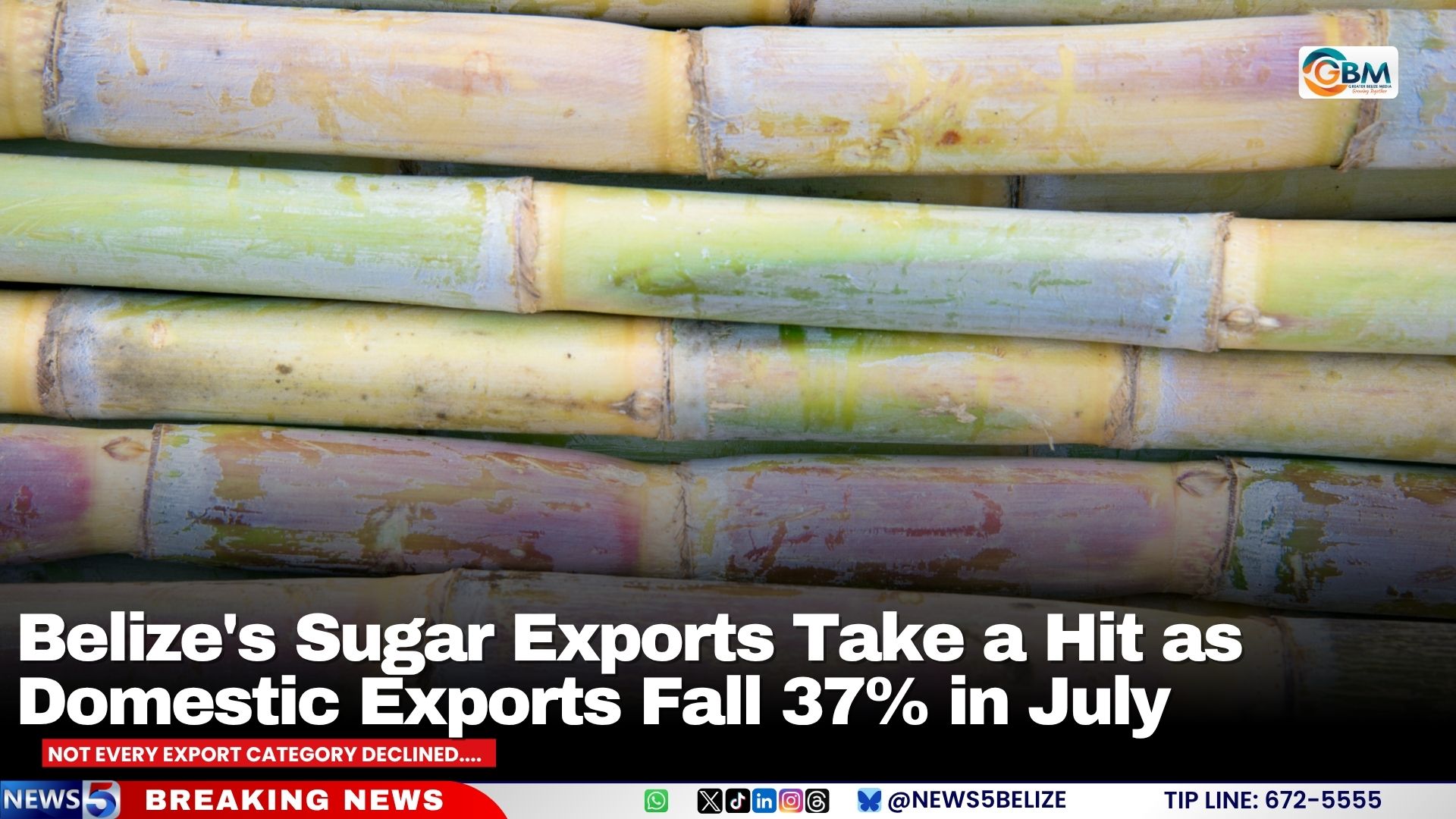
New data released by the Statistical Institute of Belize (SIB) on August 27, 2026, confirms a sharp downturn in the Central American nation’s domestic export sector, with overall shipments dropping 37.2% year-over-year in July to land at $38.5 million, down from $61.3 million in July 2025. The slump is overwhelmingly driven by a catastrophic decline in sugar exports, Belize’s flagship agricultural commodity, which has pulled down overall trade performance even as a handful of niche categories and a small number of trading partners buck the negative trend.
According to the SIB’s breakdown, sugar export earnings fell by $18.8 million compared to July 2025, sliding from $35.8 million to just $17.0 million, as total exported volumes dropped by more than 50%. The downturn extended beyond sugar to other key agricultural exports: citrus export revenues fell by $2.4 million amid weakening global demand for orange concentrate, while molasses earnings almost entirely vanished, plummeting from $2.0 million last July to less than $0.1 million this year. Marine product exports also contracted by $1.3 million, driven by lower lobster tail shipments and a complete halt to shrimp exports that were recorded in the same month a year prior.
Not all export segments recorded losses, however. Banana export inched up slightly to hit $6.3 million in July, while improved global market prices pushed animal feed revenues up to $0.7 million. The most substantial growth came from formal cattle exports, which jumped $1.6 million year-over-year to reach $2.4 million.
When broken down by trading partner, the slump hit Belize’s traditional export markets hardest. Earnings from shipments to the United Kingdom collapsed by $18.0 million, falling to just $3.2 million, a decline almost entirely attributed to reduced sugar sales to the European nation. Revenue from exports to the United States also dropped $4.4 million, linked to weaker sugar shipments and a complete lack of molasses exports in July. Earnings from CARICOM trading partners fell $2.1 million amid lower sales of orange concentrate. Mexico was the only major trading partner to record growth, with Belizean export earnings to the country more than doubling to $2.9 million, driven by increased sales of cattle and crude soybean oil.
On the import side, Belize’s total import value for July came in at $261.3 million, a modest 1.9% decline from $266.3 million in July 2025. The small overall drop was led by a $16.3 million reduction in imports entering Belize’s Commercial Free Zone, caused by lower purchases of cigarettes, athletic footwear, and apparel. There was also a $10.5 million decline in imports of food and live animals, tied to reduced purchases of wheat, instant noodles, and coffee.
Two key import categories moved against the downward trend: fuel imports rose $11.2 million to $44.8 million, driven by higher global diesel prices and increased domestic purchases of propane and butane. Imports of machinery and transport equipment also climbed $9.0 million, led by incoming shipments of power generators, four-cylinder passenger vehicles, and a heavy-duty all-terrain mobile crane.
Looking at the cumulative trade data for the first seven months of 2026, the broader trade imbalance remains pronounced. Total merchandise imports hit $1.912 billion over the period, a 15.7% increase year-over-year, with a $104.0 million surge in fuel imports driven by elevated global prices accounting for much of the growth. By contrast, total merchandise exports for the seven-month period totaled just $205.2 million, an 18.6% year-over-year decline. Sugar alone accounts for much of this cumulative drop, with earnings falling by $26.8 million as total export volumes for the year to date have dropped nearly 30%.
Alongside the trade data, the SIB also noted an unexpected bright spot: recent consumer sentiment surveys show that Belizean citizens are reporting improving outlooks on the national economy despite the ongoing export slump.