
On Tuesday, Suriname’s National Assembly passed a landmark amendment to the 2019 law establishing the country’s Center for Innovation and Productivity (CIP), securing unanimous 35 votes in favor of the regulatory overhaul. The reform package aims to resolve long-standing structural bottlenecks that have prevented the institution from reaching full operational capacity since its founding, equipping it to drive national productivity gains and foster innovation across Suriname’s economy.
博客
-

The Rise of EV Mechanics in Belize?
Belize’s ongoing transition to electric mobility has hit a landmark milestone, with the official opening of the country’s first dedicated Electric Vehicle Laboratory at the Orange Walk Institute of Technical and Vocational Education and Training (ITVET). Built to address a critical gap in the nation’s EV ecosystem, the new facility will develop a skilled local workforce capable of servicing the growing fleet of electric passenger and public transit vehicles across the country.
Fifteen local trainees have already completed an intensive two-day introductory training course at the lab, with full formal programming set to launch this coming September. The upcoming curriculum will cover core EV industry skills, ranging from advanced diagnostics and routine maintenance to complex repair work for all types of electric vehicles.
The $95,000 facility, stocked with specialized industry-grade equipment, was made possible through funding from the European Union, with implementation led by the United Nations Development Programme (UNDP). Michael Lund, Deputy Resident Representative for the UNDP, explained that the training lab marks the final component of a broader national electric transit pilot project that has already delivered tangible results across Belize. “This project has delivered city buses for Belize City, new inter-district electric buses, installed a network of public charging stations, supported the development of updated EV-related legislation… and now it completes the ecosystem with workforce training,” Lund noted.
For many prospective EV buyers in Belize, a persistent barrier to adoption has been uncertainty around access to qualified repair and maintenance services. Neil Hall, E-Transit Coordinator for the Belize City Council, emphasized that the new lab directly resolves this top consumer concern. “The biggest question on people’s minds when considering an electric vehicle is always, ‘If something breaks, who will fix it?’ This facility completely eliminates that worry,” Hall said.
Prior to the lab’s opening, all EV servicing across Belize was almost exclusively handled by a single private provider, Caribbean Motors, leaving much of the country underserved for maintenance support. The new training initiative aims to spread specialized EV expertise to communities across every district, creating a decentralized, accessible support network that can accommodate projected growth in EV ownership over the coming years.
-

Flow reveals details of customer rebates after major outage
One month after a widespread two-day service outage disrupted connectivity across Saint Lucia and multiple Eastern Caribbean markets, regional telecom provider Flow has formally released the full details of its customer compensation plan, outlining targeted rebate structures for different user segments.
The outage, which struck between June 21 and 22, knocked out service for thousands of residential and business customers connected to Flow’s regional network. The company classified the disruption as a crisis-level incident, immediately activating its centralized Regional Network Disaster Response and Recovery Centre alongside local crisis management teams to address the issue. Flow has confirmed the outage stemmed from unanticipated damage to subsea internet infrastructure, an event outside of the provider’s direct operational control.
Now, as network service has been fully restored, Flow has broken down how rebates will be distributed across its customer base, with no action required from users to claim their compensation. For residential customers on fixed plans — which include home internet, wired landline telephone service, and cable television subscriptions — rebates will be automatically credited directly to customer accounts. Postpaid mobile subscribers and commercial clients under the Liberty Business umbrella will see a one-day service credit deducted from their upcoming monthly billing statement. Prepaid mobile users, meanwhile, have already received a complimentary 24-hour service bundle that includes 2GB of mobile data, plus unlimited local calling and text messaging.
In a statement addressing the compensation rollout, Flow Saint Lucia Country Manager Chris Williams acknowledged the widespread disruption the outage caused. “Our customers depend on us every day, and we understand the inconvenience and disruption this outage caused to their personal lives and businesses,” Williams said. “Although the incident resulted from damage to subsea infrastructure beyond our control, we believe compensating our customers is simply the right thing to do.”
Beyond addressing immediate customer impacts, Flow also announced it is undertaking a full review of its regional network infrastructure to strengthen resilience against future outages. Planned upgrades include expanding route diversity for critical connectivity links and adding more robust backup network capacity to reduce downtime risks from similar subsea infrastructure incidents.
-

Five Months Later, Fire Victim Still Needs Help
It has been nearly five months since an early-morning blaze turned a Belize City family’s home into unrecognizable ash, but the road to recovery remains incomplete, leaving the household in desperate need of public assistance to cross the finish line of their rebuilding journey.
The disaster unfolded in the early hours of Good Friday this year, when Ashanti Garnett, the 34-year-old head of the household, woke to a nightmare. At 1 a.m., she opened her eyes to find half of her residence already engulfed in roaring flames. Her husband was away at his overnight shift when the fire broke out, leaving Garnett alone with her four-year-old daughter to escape. With mere seconds to react, she grabbed her young child and fled the burning structure, leaving every possession behind except for a single blanket they carried out.
Following an on-site investigation, the Belize Fire Department concluded the fire was sparked by an unexpected electrical surge, a freak accident that left the family with no warning and no time to prepare. For Garnett, the destruction was total. Not only did the family lose every piece of furniture, clothing, and personal item they owned, but a number of their household pets also died trapped inside the burning home.
Garnett, a self-employed nail technician, operated her small business out of her home. When the fire destroyed the property, it also wiped out her entire source of income overnight. Today, the family lives in cramped conditions, renting a single small room as they slowly work to lay the foundation for a new permanent home. What started as a devastating loss has grown into an overwhelming financial burden that the family can no longer bear on their own. That is why Garnett has taken the step of reaching out directly to the general public for any support that can be offered.
“Even if it’s a few pieces of lumber, or a secondhand stove, anything at all will make a difference,” Garnett said in an emotional appeal. “Every small donation helps, and I would be forever grateful for any help the community can give us right now.”
-

CARICOM moves towards ferry trial within months as cargo cost-cruncher
After concluding their annual flagship summit in Saint Lucia this week, leaders of the Caribbean Community (CARICOM) have taken a major step forward in delivering a long-planned regional intra-Caribbean ferry service, approving a limited proof-of-concept trial that could launch within three months using an existing vessel owned by Trinidad and Tobago. The initiative is rooted in a years-long push to address one of the bloc’s most persistent strategic gaps: costly, inefficient intra-regional transport that inflates consumer prices, undermines food security, and slows the growth of cross-border trade and people-to-people connection.
Under a two-track approach outlined by Mia Amor Mottley, Barbados Prime Minister and CARICOM’s lead prime minister for the CARICOM Single Market and Economy (CSME), the bloc will pursue both a short-term trial of an existing vessel while laying the groundwork for a permanent, privately operated service. Mottley emphasized the urgency of the project during Wednesday’s closing press conference, framing the ferry as a core policy tool to fight soaring regional inflation driven in part by global energy market volatility tied to renewed conflict in the Persian Gulf.
While technical and feasibility assessments continue, CARICOM heads have given the green light to begin discussions with the Trinidad and Tobago government to deploy one of the country’s existing inter-island ferries for a limited southern Caribbean trial. Trinidad and Tobago Prime Minister Kamla Persad Bissessar has confirmed the country’s willingness to contribute a vessel for the pilot, noting the nation’s 100-year history of operating inter-island ferry services between Port of Spain and Scarborough. Early discussions have identified the *Galleons Passage*—a 74-meter catamaran roll-on-roll-off ferry commissioned in 2018, with capacity for 400 passengers and 60 vehicles, plus on-board passenger amenities including a cafeteria, bar and VIP lounge—as the leading candidate for the trial. The pilot is expected to launch first in the southern and eastern Caribbean, with initial sailings proposed between Guyana and Trinidad and Tobago, before any potential expansion.
To inform long-term planning, CARICOM leaders have tasked the CARICOM Private Sector Organisation (CPSO)—which has facilitated negotiations between governments and maritime industry stakeholders—and the CARICOM Secretariat to develop a full feasibility dossier. The document will include detailed data on proposed passenger ticket and freight pricing, with an explicit focus on ensuring affordability and accessibility for vulnerable groups and small cross-border traders. It will also outline the project’s underlying financial model, including long-term sustainability projections, capital investment requirements, potential funding sources, and an assessment of commercial risk and public benefit, which will determine whether the bloc grants final approval for a permanent service.
Mottley noted that the private sector is expected to take up to a year to source purpose-built vessels for a permanent service, while regulators work through the necessary legal and regulatory reforms to enable seamless cross-border movement. A key priority for the coming months will be harmonizing regional rules on license and insurance recognition, a critical step to allow cargo vehicles to roll on and off the ferry at different ports without bureaucratic delay. Leaders also emphasized the need to assess existing port infrastructure and ramp facilities across the proposed trial route to ensure they can accommodate ferry operations.
The push for a regional ferry is not a new effort: a working group including Barbados, CPSO, the Caribbean Development Bank and other member states has spent years evaluating fast ferry options, particularly for moving agricultural produce across the Caribbean archipelago. Private sector ventures like Barbados-based Connect Caribe have already developed proposals for a linked service connecting Guyana, Trinidad and Tobago, Barbados and Eastern Caribbean states, marketing projected ticket prices below $100 USD. The mixed passenger-cargo model is designed to drive down both travel and shipping costs, addressing the well-documented drawbacks of current intra-regional transport options: limited cargo capacity and prohibitively high ticket prices for air travel.
Despite the renewed momentum, the project has faced repeated delays in past years, tied to challenges including vessel acquisition, port infrastructure upgrades, customs and immigration harmonization, and lingering uncertainty over the level of sustained investor and government commitment. Industry observers have also flagged unresolved concerns: that without careful planning, the service could either become an expensive niche offering limited to wealthy travelers, or become a significant drain on public finances if projected revenues fail to materialize. The summit’s focus on affordability, accessibility and rigorous financial modeling reflects a deliberate effort to address these longstanding concerns.
Mottley tied the ferry initiative directly to the bloc’s ongoing efforts to shield Caribbean households from soaring imported inflation, amplified by recent renewed tensions between the U.S. and Iran that have pushed up global oil prices. “We are singularly focused on being able to reduce the cost of intra-island cargo, which, in addition to the other measures that we have taken to increase disposable income of our citizens, but also to reduce the cost of freight, the cost of gas, and the cost of electricity,” she told reporters. Acknowledging growing uncertainty from the Persian Gulf conflict, she added that CARICOM governments are committed to working collectively to mitigate impacts on regional populations, even as the ferry project moves forward as a work in progress. Detailed operational negotiations and regulatory treaty drafting are set to begin in the coming weeks, with leaders hopeful the proof-of-concept trial will launch before the end of 2024.
-

Govt plans new insolvency framework to bolster financial stability
Barbados is advancing sweeping reforms to its national financial ecosystem, with a landmark depositor protection bill currently under legislative debate and a comprehensive new bankruptcy and insolvency regime slated for launch before the end of the year, Finance Minister Ryan Straughn confirmed during a Wednesday address to the country’s Senate.
The legislative package comes as the island nation’s credit union sector undergoes explosive growth, transforming from a niche community financial model into a core pillar of the national economy that now requires updated regulatory guardrails to match its expanding systemic importance. Speaking as the upper chamber began debate on the Protection of Depositors Bill, Straughn emphasized that the legislation is just the first cornerstone of a multi-pronged strategy to strengthen depositor security, boost public trust in Barbados’ banking system, and create a stable regulatory environment that supports the continued expansion of the credit union movement.
Straughn explained that the upcoming insolvency framework will act as a critical complement to the new deposit protection regime, establishing a clear, streamlined legal process for resolving failing financial institutions. Under the proposed structure, the Barbados Deposit Insurance Corporation (BDIC) will serve as the official liquidator for failed institutions, operating under strict regulatory supervision to accelerate asset disposition and speed up the resolution of claims for creditors and shareholders alike. “These reforms are non-negotiable for building greater public and market confidence in our financial system,” Straughn told lawmakers.
For ordinary Barbadians, the Protection of Depositors Bill marks a historic shift: for the first time, credit union deposits will receive the same level of state-backed insurance protection that has long been available to traditional bank depositors. The new protections will cover more than 200,000 credit union members across the country, as well as small business account holders and working families who rely on credit unions as their primary financial institution. “What this bill does is stand behind the thousands of Barbadians who have put their savings into credit unions,” Straughn said. “It delivers an entirely new level of security for depositors across every part of the country.”
The urgent push for updated regulation stems from the sector’s unprecedented expansion over the past 18 years. Straughn reported that total assets held by Barbadian credit unions have skyrocketed from just $403 million in 2007 to nearly $3 billion by the end of 2025, representing an almost sevenfold increase in size. Two credit unions have now grown large enough to qualify as systemically important institutions – a designation that means their failure could pose broad risks to the entire national financial system. Straughn specifically noted that one of these large credit unions is bigger than the smallest commercial bank operating in Barbados, and pointed to a regulatory gap that the new bill closes: one credit union already owns a subsidiary deposit-taking institution covered by existing insurance rules, but the parent credit union itself has never been protected before.
The reform effort also answers years of advocacy from the Barbados Co-operative and Credit Union League, which has long pushed for equal regulatory treatment and protection for its member institutions. The existing national deposit insurance scheme, launched in 2007, currently covers commercial bank deposits up to a ceiling of $25,000. Under the new legislation, that same $25,000 limit will apply to credit union deposits, and Straughn noted that the threshold aligns with global best practices for deposit insurance systems, which typically target coverage for around 95% of all deposit accounts. In Barbados, the existing $25,000 limit is projected to cover roughly 91% of all eligible credit union accounts, since the vast majority of depositors hold account balances below that cap.
Straughn clarified that coverage will apply to the full balance of any account under the threshold: a depositor with $19,000 in savings will receive their full balance back in the event of institutional failure, while those holding balances over $25,000 will be covered up to the $25,000 limit. The combination of extended deposit protection and a modernized insolvency process is designed to future-proof Barbados’ financial system as the credit union sector continues to grow and evolve.
-

CHASE hails Windies’ batting display in series victory
On Tuesday, cricket fans across the Caribbean witnessed a historic milestone at Antigua’s Sir Vivian Richards Cricket Stadium, as the West Indies sealed a landmark 1-0 Test series victory over Sri Lanka, with the second Test ending in a hard-fought draw. Following the final wicket, West Indies skipper Roston Chase opened up about what made the historic win possible, pointing to the team’s transformed batting consistency as the critical foundation for the result.
Breaking a 23-year drought against Sri Lanka in Test cricket, the result marks a significant turnaround for the side after a challenging 2023 campaign. Over the course of the series, West Indies batsmen delivered a dominant display with the willow, amassing a mammoth total of 1,234 runs across three innings. The standout innings included four centuries and three half-centuries, a far cry from the batting collapses that have plagued the regional side in recent matchups against Sri Lanka.
Opening batsman Amir Jangoo finished the series as the top run-scorer, notching 242 runs at an impressive average of 60.37, just edging out captain Chase himself, who accumulated 217 runs at an average of 59.61. For Chase, the win carries extra weight, as the side had struggled to overcome Sri Lanka for decades, both at home and on the road.
“I’m very elated, especially against a team like Sri Lanka that we have struggled to beat even at home and especially when we go away to them,” Chase said post-match. “So to come here and not just beat them but in a dominating kind of way when we haven’t won against them in 23 years, it feels great, especially after the year that we had last year.”
The all-rounder explained that deliberate, targeted work on batting improvement was a core focus of the team’s pre-series preparation, a strategy that paid dividends when it mattered most. For years, the West Indies has relied heavily on its bowling attack to deliver results, often leaving bowlers with underwhelming totals to defend. Chase pushed for a cultural shift ahead of the series, challenging batters to give their bowling unit competitive scores to work with.
“It was mostly the bowling that stood up for us in the majority of the games. It’s something that I really put forward to the guys, that we need to be able to at least give the bowlers something to work with. They raised their hands tremendously in this series,” Chase said. “These are big hundreds and not only that, we turned them into big totals as well. Not just one guy getting 100 and we (the team) probably just getting over 250. For two guys to get hundreds in two innings, that says a lot.”
Chase also expressed pride in his own standout performance as leader, crediting his teammates for the support that allowed him to lead from the front. “I mean this is the first series where I really had an outstanding performance. I’ve been trying but to go and actually lead from the front, so it feels great. I just wanna congratulate the guys for helping me to achieve this as the leader of the team,” he added.
The series’ standout performer, all-rounder Justin Greaves, who claimed both Man of the Match and Man of the Series honors, called the achievement the highlight of his professional career to date. “This will be top of the list. Contributing to a team win and then contributing to a series win as well, also the first series win in the test championship for us, so it’s a very big achievement,” Greaves said.
Greaves, who has now notched three Test centuries in his young career, with two of them coming at the Sir Vivian Richards Stadium, attributed his success at the venue to familiarity. He currently plays domestic cricket for the Leeward Islands, meaning he has spent hours batting on the stadium’s pitch, learning its idiosyncrasies. “It is home for me at the moment, playing for the Leewards, so I have gotten accustomed to the surface and it’s usually a pretty good one. Once you get in, you know, you could really add big scores,” he explained.
-

NCCU supports Morne Jaune–Rivière Cyrique reunion with community outreach initiatives
A long-standing financial cooperative in Dominica has cemented its ties to rural communities in the country’s southeast region through a new partnership focused on cultural celebration and grassroots development. The National Cooperative Credit Union (NCCU) has joined forces with the Morne Jaune–Rivière Cyrique Reunion organization to roll out a slate of community-centered projects that honor the cultural heritage of the two connected villages while advancing local progress.
As outlined in an official press statement from NCCU, the first wave of collaborative work launched on Monday, July 7, when a team of NCCU staff joined local residents to complete a road improvement scheme in the Morne Frayal area. Beyond infrastructure investment, the credit union also delivered critical donations to the Rivière Cyrique Health Centre, bolstering the facility’s ability to deliver essential healthcare services to local families.
The day of activities wrapped up with a community networking gathering hosted at Morne Jaune Primary School. During the event, NCCU representatives connected with cooperative members, emphasizing the value of their ongoing partnership amid ongoing shifts across the global financial industry. Representatives encouraged members to keep deepening their engagement with the cooperative movement as the sector evolves.
For NCCU, the partnership is far more than a one-off community gesture: it is a reflection of the institution’s 15-year commitment to serving southeast Dominica, where it operates three regional sub-offices in St. David’s, Grand Fond and La Plaine. The credit union notes that its support for the Morne Jaune–Rivière Cyrique Reunion aligns with its core organizational mission: investing in locally led projects that generate long-term public good, and nurturing the close, trusting bonds that have long defined its relationship with members and communities across the island.
Officials added that the collaborative activities created valuable space for the credit union to strengthen connections with local residents, build deeper reciprocal relationships, and contribute to initiatives that will leave a lasting positive imprint on quality of life in the twin villages.
-
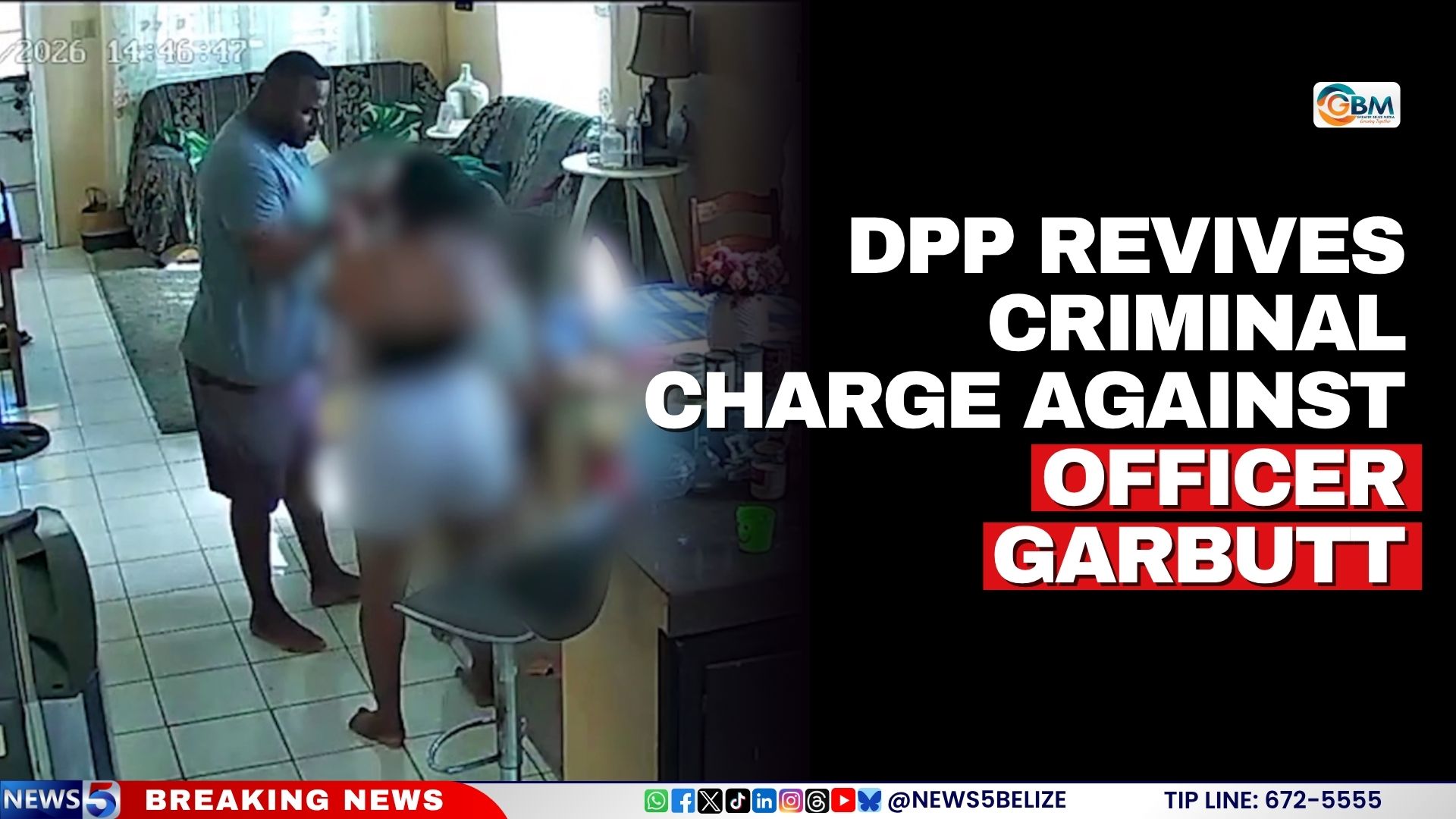
DPP Revives Criminal Charge Against Officer Garbutt
In a significant legal development unfolding in Belize that raises core constitutional questions, the Office of the Director of Public Prosecutions (DPP) has secured a court ruling to reinstate a criminal harm charge against serving police constable Phillip Garbutt, more than two months after the original case was thrown out.
The charge against Garbutt centers on allegations of harm against the minor son of his common-law wife. The case first reached the Belize City Magistrate’s Court in April 2026, when a sitting magistrate dismissed the charge entirely, resulting in Garbutt being cleared of wrongdoing in the initial proceeding.
Prosecutors led by DPP Cheryl-Lynn Vidal challenged the April dismissal, arguing that the original magistrate had overstepped their legal authority by striking the charge from the court docket. Vidal emphasized that reactivating the case is a critical step to uphold justice for the child at the center of the allegations, stating that the earlier dismissal had no standing in law and the proceeding must move forward to a full hearing.
Garbutt’s defense attorney, Alifah Elrington, mounted a fierce opposition to the DPP’s motion, framing the reinstatement as a violation of Belize’s constitutional protections against double jeopardy — the legal principle that bars a person from being tried twice for the same offense. Elrington argued that the April dismissal amounted to a full acquittal, so any renewed prosecution would contravene fundamental legal rights.
After hearing arguments from both sides, Chief Magistrate Deborah Rogers ruled in favor of the DPP, determining that the April dismissal was a “complete nullity” because the original magistrate did not hold the legal power to dismiss the charge in the first place.
In the immediate aftermath of the ruling, Elrington confirmed that the defense will pursue the next step in the legal process: seeking a case stated, a procedural mechanism that will ask Belize’s High Court to review the question of law at the heart of the dispute and issue a binding ruling on the legality of the charge’s reinstatement. The outcome of the upcoming High Court review will set a key precedent for procedural authority and double jeopardy protections in Belize’s lower court system.
-
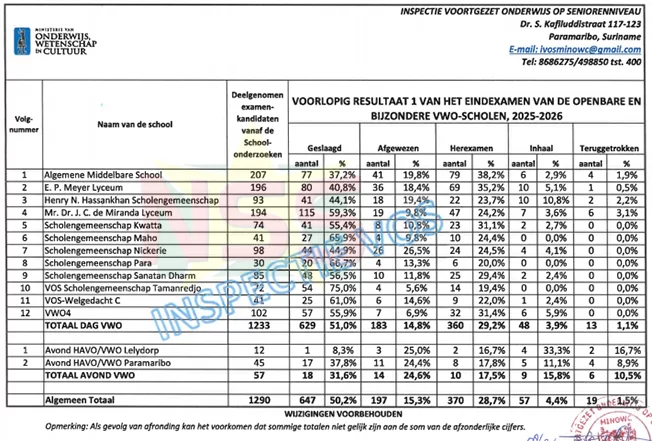
Voorlopig 34,3% geslaagd voor HAVO en 50,2% voor VWO; veel kandidaten naar herexamen
On July 8, the Dutch Ministry of Education, Science and Culture (OWC) published preliminary final exam results for the 2025-2026 academic year across two major secondary education tracks: Higher General Secondary Education (HAVO) and Pre-University Education (VWO), revealing mixed outcomes that still show an overall upward trend compared to last year.
Across all HAVO programs, just 34.3% of 1,946 total candidates passed their final exams immediately on their first attempt. Breaking down the HAVO numbers: 668 students earned an immediate pass, 414 failed outright, 628 have been scheduled for a retake exam, 98 are eligible for a delayed make-up exam, and 138 candidates withdrew from the exam cycle before results were finalized. Two-year HAVO programs posted particularly underwhelming preliminary results: Christelijk HAVO recorded a 31% immediate pass rate, while HAVO-III notched a comparable 35.9% pass rate. Three-year HAVO tracks, by contrast, delivered more consistent, stable performance across the board.
For VWO, the more rigorous pre-university track, outcomes were far stronger: 50.2% of 1,290 total candidates passed immediately. The VWO breakdown shows 647 immediate passes, 197 outright failures, 370 candidates moving to retakes, 57 eligible for delayed make-ups, and 19 candidate withdrawals. Private VWO institutions boasted standout results this year: Arthur A. Hoogendoorn Atheneum led all schools with a 93.5% preliminary immediate pass rate, with 72 of its 77 candidates passing on the first try. Nassy Brouwer College followed with a strong 69.8% pass rate, while ACI recorded a solid 64.3% immediate pass rate.
Overall, nearly one-third of all candidates across both education tracks will need to complete a retake exam to earn their diploma.
The release of this year’s results was delayed by several days after officials discovered errors in two math exam papers, Wiskunde 1 and Wiskunde Q. Education Minister Dirk Currie explained that one question on Wiskunde 1 did not align properly with the curriculum students had prepared for, while two questions on Wiskunde Q were incomplete. In collaboration with subject teachers and school principals, ministry officials implemented grading corrections to ensure no student was unfairly penalized for the exam errors.
Ministry officials frame the 2025-2026 results as a positive development overall. The Inspectorate for Senior Secondary Education notes that while performance gaps between individual schools remain, preliminary full-year results show a clear upward trajectory compared to the 2024-2025 academic year. Inspectors also project that final pass rates will rise significantly once all retake exams are completed and scored.