博客

  • High Court orders Commissioner of Information to process requests about ExxonMobil, the Commissioner of Information’s office

    High Court orders Commissioner of Information to process requests about ExxonMobil, the Commissioner of Information’s office

    In a landmark ruling centered on governmental transparency and energy sector accountability, Guyana’s High Court has mandated retired Justice Charles Ramson, the country’s Commissioner of Information (COI), to resolve three long-pending freedom of information requests filed by prominent civil society activist and dual-qualified chartered accountant and attorney Christopher Ram by November 27, 2026. The ruling, delivered in a 38-page judgment by Justice Nicola Pierre, marks a critical rebuke of the COI’s years-long delay in addressing requests focused on ExxonMobil’s operations in Guyana’s oil sector and the COI’s own institutional reporting under the 2011 Access to Information Act.

    Ram submitted three separate formal requests for information in March 2025, all of which Ramson failed to process after requiring Ram to first submit the requests to other relevant public authorities – a step Ram complied with, only to still receive no formal decision on his applications. Two of the three requests focus exclusively on transparency around the ExxonMobil-led oil consortium operating under Guyana’s 2016 Petroleum Agreement. The first asks for detailed records of the consortium’s tax payments made through the Ministry of Natural Resources, including specific documentation of total amounts paid, official tax assessment certificates, proof of compliance with Article 15.4 of the 2016 agreement, and data aligned with the Extractive Industries Transparency Initiative (EITI) reporting standards. The second ExxonMobil-related request seeks financial data on the consortium’s annual revenue and spending between 2021 and 2025, as well as clarification on the accounting treatment of any revenues that were not recorded in Guyana’s national Consolidated Fund.

    The third request, filed March 12, 2025, seeks institutional transparency from the COI’s own office, calling for all annual operational reports on the Access to Information Act submitted to Guyana’s National Assembly between 2015 and 2023, compliance reports submitted to the responsible minister between 2011 and 2023, full statistical breakdowns of all information requests processed under the act (including counts of requests received, granted, denied, and appealed) for the 2015–2023 period, and a list of all public authorities that submitted required compliance reports to the minister during that timeframe. Under Guyana’s Access to Information Act, the responsible minister is legally required to lay an annual operational report before the National Assembly no later than nine months after the close of each calendar year.

    In her judgment, Justice Pierre firmly rejected the COI’s core arguments, including his claim that Ram was required to submit requests to other public authorities before applying to his office, and his assertion that his own office does not qualify as a public authority subject to information requests under the act. The judge clarified that the Access to Information Act does not impose any requirement for prior application to another agency as a precondition for processing requests under sections 16 to 18 of the law. She further confirmed that all records requested in the March 12 application qualify as official documents held by a public authority, making them legally compellable under the act.

    Pierre also pushed back against the COI’s claim that fulfilling the request for his office’s records would amount to forcing him to “self-oversee” his own conduct. She emphasized that the COI’s statutory role is that of a central clearinghouse for processing information requests, not an oversight body for other agencies, and that the request merely seeks existing official records, not a review of the COI’s own actions. The judge also formally criticized the COI’s defensive legal approach during the proceedings, noting that his blanket denial of receiving most of Ram’s correspondence failed to meet the standards of candour required of public officials in judicial review cases – particularly in a case centered on freedom of information. Pierre found that the existing documentary evidence, including correspondence authored by the COI himself, clearly confirmed that the COI received all three of Ram’s valid, legally compliant requests, and that his requirement for Ram to first approach other agencies did not constitute a formal decision on the applications as required by law.

    In her final orders, Pierre ruled that the COI’s inaction amounted to a de facto refusal of the March 12 request, and ordered him to process all three requests in full compliance with the Access to Information Act and the terms of her judgment within the 60-day window. She specified that if the COI grants access to any requested records, he must provide them in accordance with statutory procedures. If he determines that a requested document does not exist or cannot be located after a thorough search, he must provide Ram with formal written notice, explicit reasons for the denial, and clear information about Ram’s right to pursue further judicial review. Pierre declined to order the COI to provide reasons for a substantive refusal that he never formally issued, instead opting to enforce the statutory duty he had failed to carry out: processing and deciding on the pending requests.

  • T&T, US unite against criminal networks

    T&T, US unite against criminal networks

    Trinidad and Tobago has cemented its place as a trailblazer within the U.S.-led Shield of the Americas coalition, becoming the first member state to align with Washington in labeling 25 transnational criminal groups as foreign terrorist organizations. The landmark move earned public praise from top U.S. hemispheric affairs official Juan Pablo Segura, who framed the decision as a major leap forward in the coalition’s shared fight against the cross-border harm of narcoterrorism.

    Just days ahead of the designation announcement, Prime Minister Kamla Persad-Bissessar joined U.S. President Donald Trump and other regional leaders at a high-level Shield of the Americas summit to coordinate collective security strategies. Shortly after that meeting, she took the stage at the 81st United Nations General Assembly in New York to outline Trinidad and Tobago’s global security agenda ahead of its 2027-2028 term on the UN Security Council.

    During her UN address, Persad-Bissessar emphasized that transnational criminal networks pose disproportionate risks to small island states like her own. Trinidad and Tobago, she noted, already bears the direct costs of these activities, from rising gang violence and drug trafficking to the uncontrolled flow of illegal weapons and illicit funds across its borders. Restoring public safety has been a core priority of her administration, she added, and the government has deepened collaboration with the U.S. and other international partners to dismantle criminal syndicates operating in the region. She confirmed that countering the illegal cross-border movement of firearms and narcotics will be a top policy priority during her country’s Security Council tenure, with plans to push for improved weapons tracing mechanisms, expanded cross-border intelligence sharing, enhanced maritime and border cooperation, and tighter coordination between source, transit and destination nations for illicit goods.

    The landmark decision has sparked nuanced discussion among regional security experts. In an interview with local outlet *Express* following the official announcement, prominent regional security consultant Dr. Garvin Heerah acknowledged the clear security benefits Trinidad and Tobago can gain from deeper alignment within the Shield of the Americas initiative. Launched by the United States in March 2026, the coalition’s stated core goals include combating drug cartels, transnational criminal networks, illegal migration and foreign interference in the Western Hemisphere. Heerah noted that the entire Caribbean region, including Trinidad and Tobago, faces a growing array of transnational threats — from drug and weapons trafficking and human smuggling to maritime crime, money laundering, cyberattacks and organized criminal networks. Expanded intelligence sharing, coordinated cross-border operations, enhanced maritime surveillance, tightened border security and closer law enforcement cooperation would deliver tangible benefits to Trinidad and Tobago and its Caribbean neighbors, he said.

    At the same time, Heerah urged policymakers to carefully weigh the geopolitical implications of the partnership, warning that the country must guard against advancing a foreign security agenda at the expense of local interests. “The important question, however, is whose security agenda are we advancing, and how do we ensure that Caribbean interests remain at the centre of the equation?” he said. Heerah stressed that Trinidad and Tobago’s participation in the coalition goes far beyond a standard security cooperation arrangement, carrying clear geopolitical weight given competing strategic priorities: the U.S. holds broad strategic interests across the Western Hemisphere, while Trinidad and Tobago and the broader CARICOM bloc have their own distinct national and regional priorities.

    Heerah clarified that closer cooperation does not require surrendering national sovereignty, nor should sovereignty be used as an excuse to reject mutually beneficial security collaboration. “For me, the principle should be partnership without dependency; cooperation without compromising sovereignty,” he outlined. He called on the Trinidad and Tobago government to secure clear, public clarity on key terms of the partnership, including what types of intelligence will be exchanged, the legal framework that governs data sharing, who retains control over shared intelligence, and what operational powers foreign partner forces will hold within Trinidad and Tobago’s borders. He also raised questions about the rules governing joint operations and how potential disagreements will be managed if U.S. and Trinidad and Tobago strategic interests diverge down the line. Heerah emphasized that these questions are not anti-American, but rather fundamental responsible national security planning for any sovereign state.

  • How will it be enforced?

    How will it be enforced?

    Two major Trinidad and Tobago organizations have thrown their support behind a controversial government legislative push to raise minimum legal age limits for alcohol, tobacco, cannabis and gambling, though one industry group has flagged critical gaps in enforcement planning.

    The administration led by Prime Minister Kamla Persad-Bissessar announced via social media this week that it will table The Miscellaneous Provisions (Alcohol, Cannabis, Dangerous Drugs, Gambling and Tobacco) Bill, 2026 before national parliament imminently. If passed, the legislation will overhaul the country’s age restrictions for regulated goods and activities: lifting the minimum legal age for purchasing, possessing and consuming alcohol and tobacco from 18 to 21, while setting a new 25-year minimum age threshold for cannabis access and all forms of legal gambling.

    Road safety non-governmental organization Arrive Alive has fully endorsed the proposed changes, grounding its support in decades of public health research on adolescent development. Sharon Inglefield, president of Arrive Alive, explained that peer-reviewed research consistently confirms that the human brain does not finish full structural and cognitive development until approximately 25 years of age. Early exposure to alcohol, nicotine and other controlled substances, she noted, not only disrupts healthy neural growth but also impairs core cognitive functions including problem-solving, impulse control and decision-making.

    Beyond its support for the legislative reform, Inglefield highlighted that the NGO runs a free, evidence-based education program for primary and secondary schools across the country designed to teach young people about the risks of impaired decision-making from alcohol. The program centers on an interactive experience where students wear specialized alcohol-impairment goggles that simulate the disorienting visual and motor effects of intoxication, helping them experience first-hand the dangers of drinking, particularly for inexperienced road users. Inglefield added that underage drinking also ties directly to the country’s persistent road safety crisis of drunk driving, a issue Arrive Alive has prioritized for decades, and called on schools across the nation to book the interactive program for their campuses.

    The Bar Owners Association of Trinidad and Tobago (BOATT) has also confirmed it does not oppose the core goal of raising the minimum drinking age to protect younger people from harm, but association president Satesh Moonasar warned that the legislation will fail to meet its intended objectives without complementary policy changes to address enforcement challenges. Moonasar pointed out that current rules do not require Trinidad and Tobago residents to carry official national identification at all times, making it nearly impossible for licensed vendors and law enforcement to reliably verify the age of people purchasing or consuming alcohol.

    He raised pointed questions about unregulated informal sales, noting that illegal alcohol vendors operating out of small unlicensed stores are unlikely to enforce age checks even after the law changes. For public consumption of alcohol, which remains legal in Trinidad and Tobago, Moonasar asked how police officers would confirm a person’s age if they are suspected of underage drinking but do not carry ID. Echoing a previous proposal from Homeland Security Minister Roger Alexander to mandate universal carry of national ID, Moonasar argued that the two policies must be implemented together to work effectively. Without mandatory ID, he explained, police would be forced to take all suspected underage drinkers into police stations to contact parents, creating unnecessary logistical and operational burdens that will undermine consistent enforcement of the new age rules. Moonasar emphasized that BOATT’s concerns are not intended to block the reform, but to push the government to address critical gaps before the bill goes into effect, to ensure it actually delivers on its goal of reducing underage access to alcohol and tobacco.

  • OPEN TO ABUSE

    OPEN TO ABUSE

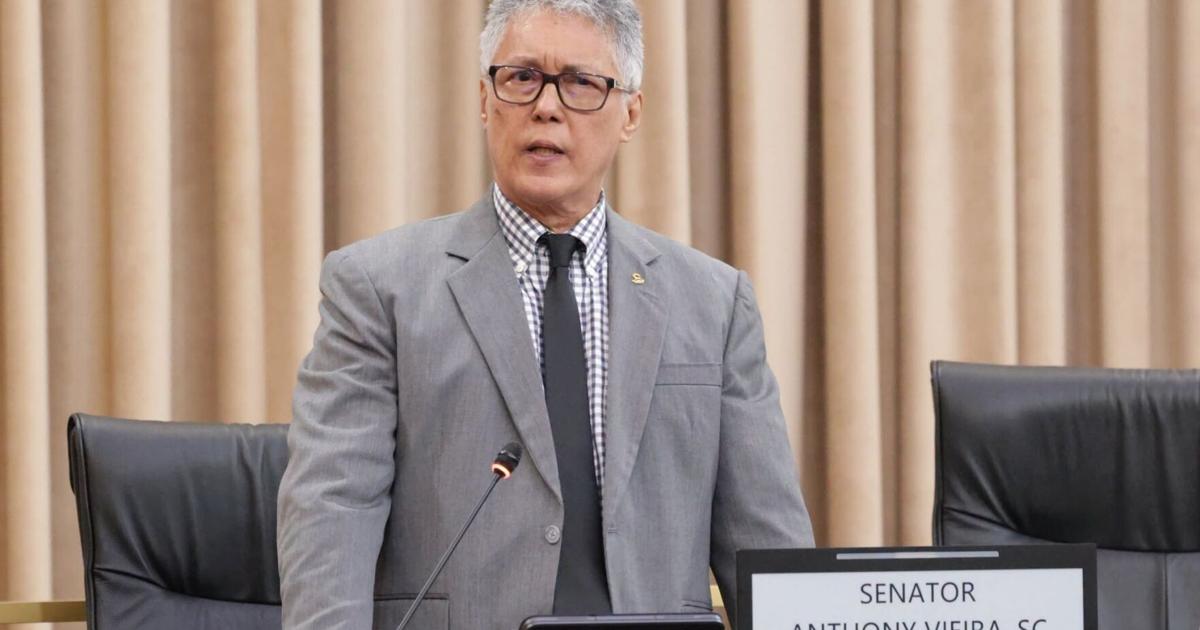
    A sharp public feud has erupted in Trinidad and Tobago’s Senate this week, after Independent Senator Anthony Vieira delivered a sarcastic, cutting rebuke to Prime Minister Kamla Persad-Bissessar’s inflammatory verbal attacks on independent legislators, while issuing a dire warning about a proposed new procurement bill that he argues puts the public purse at grave risk of misuse.

    The conflict traces back to a recent unanimous vote by the nine-member Independent Senate caucus against the government’s Special Operations Bill, which triggered a wave of harsh criticism from Persad-Bissessar. The Prime Minister labeled the independent lawmakers “satanic”, “demons”, and “Luciferian monsters”, claiming they harbored “demonic hatred” for law-abiding citizens, and announced that her administration would no longer consider any amendments put forward by the Independent bench.

    Vieira, firing back in his address to the Senate Wednesday, leaned into the prime minister’s insults with biting sarcasm, quipping that his supposed demonic status granted him unique insight into the greed and moral rot that can plague public officials handling state funds. “Now, Mr President, a benefit of being satanic and demonic is that I have insight into the souls of men,” Vieira said. “I understand those whose moral compasses and codes are compromised, as I understand the seven deadly sins, in particular, greed.”

    The senator’s retribution came as he launched a full-throated attack on the 2026 Public Procurement and Disposal of Public Property (Amendment) Bill, a piece of government legislation framed as a measure to streamline business operations. Vieira warned that the proposed changes to the existing procurement framework would erode critical anti-corruption safeguards, systematically marginalize the independent Office of Procurement Regulation (OPR), and open new doors for self-interested actors to siphon public funds.

    Persad-Bissessar’s refusal to accept amendments from independent legislators directly shaped Vieira’s approach to the bill: he told the chamber he had opted not to spend time drafting improvements, after his earlier work on amendments for another bill went entirely ignored. “I had hoped that the benches would have worked together to avoid a financial ambush dressed up as the ease of doing business. But in light of the Prime Minister’s declared refusal to accept amendments from the Independent bench, I decided to save my time and energy,” he explained. “On a special zones bill, I spent two days working on amendments to improve the legislation. To no avail. That’s not happening today.”

    Vieira pushed back against the dangerous assumption underpinning the bill, arguing that legislators cannot craft public financial rules on the premise that every official entrusted with state money will act with integrity. Pointing to long-standing patterns of misconduct in Trinidad and Tobago, he noted repeated allegations of “fraud, corruption, favouritism, conflicts of interest, contract splitting, and misuse of public resources.” He invoked two locally well-known phrases — “the land of Bobol” and the term “Trickydadian” — to illustrate the widespread cultural awareness that many actors actively seek to exploit loopholes in public rules for personal gain.

    “We cannot afford to sacrifice the guardrails of good governance on the altar of convenience,” Vieira warned. “In this country, the danger of corruption is not abstract. Here, corruption is a real and present danger.” He even raised a provocative hypothesis: that special interest grifters are already positioning themselves to access public funds if the bill passes.

    The senator rejected the framing that the reform forces a choice between regulatory efficiency and accountability, arguing that the goal should be to build a procurement system aligned with the core accountability mandates of the original 2015 Public Procurement Act. While he acknowledged that the legislation could be improved with targeted changes, he emphasized that without robust safeguards, the bill creates massive opportunity for abuse. “It will shield grifters from accountability and consequence,” he said, adding that the core question at stake is how much unaccountable discretion the state should be allowed to exercise over public funds.

    Using vivid imagery to describe the impact of the reforms on existing protections, Vieira compared the current procurement regime to a fortified castle built to protect national assets from exploitation. “When crafting the parent Act, we try to put a moat and castle wall between our national assets and those who would seek to plunder,” he said. “I fear that with this legislation, we are lowering the drawbridge and we are leaving the castle door wide open and defenceless.”

    Though the OPR will technically remain in place after the amendment, Vieira warned that the changes will strip the regulator of any meaningful enforcement power, leaving the watchdog sidelined just like the independent senators themselves. “The regulator may still be standing at her sentry post, but now her arms are going to be folded as she is weaponless,” he said. “Sadly, like us on the Independent bench, there are those who would like to see her too marginalised, helpless, or made useless.”

    Vieira concluded that the bill represents a harmful step backward for governance, with risks that far outweigh any potential benefits. Closing as he opened, he leaned back into the prime minister’s insults to drive home his opposition: “Mr President, it’s going to take a lot more than holy water and mantras to get me to vote in support of this bill.”

  • Prime Minister Drew Meets with Deputy Prime Minister Hanley in Miami, Reaffirms Confidence in Government

    Prime Minister Drew Meets with Deputy Prime Minister Hanley in Miami, Reaffirms Confidence in Government

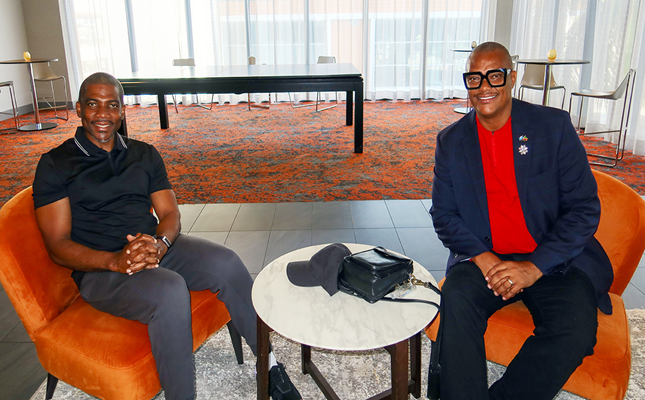
    In a high-level working meeting held in Miami on September 28, 2026, St. Kitts and Nevis Prime Minister Hon. Dr. Terrance M. Drew held in-depth discussions with Deputy Prime Minister Hon. Dr. Geoffrey I. Hanley, reaffirming unified commitment to advancing the federation’s national agenda and expressing full confidence in his government’s leadership.

    The gathering followed Hanley’s return from leading the St. Kitts and Nevis delegation to the 81st Session of the United Nations General Assembly (UNGA81) in New York City. Hanley traveled to Miami to deliver a comprehensive on-the-ground briefing to Drew on pressing domestic issues, the government’s ongoing policy work, and the outcomes of the federation’s diplomatic engagements during the UN assembly.

    Over the course of the meeting, the two senior leaders walked through detailed updates on all core domestic portfolios, reviewed key takeaways from the federation’s time at UNGA81, aligned on the government’s ongoing priority initiatives, and addressed a range of other matters critical to national development.

    In remarks released by the Prime Minister’s Office (PMO) following the meeting, Drew shared his positive assessment of the discussion. “It was a pleasure to welcome my Deputy Prime Minister and to receive a full update on the work of our Government and our Federation’s engagements at the United Nations,” Drew said. “I am encouraged by all that continues to be accomplished on behalf of our people.”

    Drew extended explicit gratitude to Hanley and his entire Cabinet for their consistent, committed leadership during this period. He also specifically recognized Hon. Konris Maynard, who stepped into the role of Acting Prime Minister while Hanley led the national delegation to the UN General Assembly.

    Addressing the public of St. Kitts and Nevis directly, Drew reaffirmed his unshakable commitment to the shared national vision for the federation. “To the people of St. Kitts and Nevis, I remain deeply grateful to God and my family, and for your prayers and support, which have been a genuine source of strength,” he said. “My commitment to you, and to the vision we share for our Federation, remains unwavering, and I look forward to returning to my full duties in due course.”

    This official press release was distributed by the PMO and published by local media outlet SKNVibes.com, which notes that it was run in its original submitted form without editorial corrections to spelling or grammar, and that the views expressed do not necessarily reflect those of SKNVibes, its sponsors, or its advertisers.

  • Licht bewolkt in de ochtend met kans op onweer in de middag

    Licht bewolkt in de ochtend met kans op onweer in de middag

    The final Tuesday of September is forecast to bring warm conditions to Pararamibo, Suriname, with a notable shift in weather moving from afternoon into evening. Local meteorological projections paint a clear picture of how conditions will evolve through the day, starting with calm, mild conditions at dawn.

    Morning hours are expected to be tranquil across the capital, with temperatures settling between 24 and 26 degrees Celsius when the day begins. The sky will range from partly cloudy to mostly clear with only light wind blowing in from the east or northeast. Sunrise is scheduled for approximately 6:30 a.m. local time, giving residents a mild start to the day before temperatures climb.

    As the afternoon progresses, temperatures will rise rapidly, bringing significant heat to the region. Forecasters project peak afternoon temperatures will reach between 36 and 38 degrees Celsius, with heat indexes pushing perceived temperatures as high as 38 to 39 degrees Celsius. Wind will remain light to moderate through the mid-afternoon, maintaining its eastern direction, and sunset is set to occur around 6:33 p.m. local time.

    A distinct weather change arrives as evening sets in, starting around 6:00 p.m. Multiple independent weather modeling systems have predicted increasing chances of rain and thunderstorms moving through Paramaribo during the evening window, with the highest probability of precipitation falling between 6:00 p.m. and 11:00 p.m. local time. As storms move through, temperatures will gradually decrease to between 28 and 30 degrees Celsius. Even with cooling temperatures, high atmospheric humidity will keep conditions feeling muggy and close for residents through the evening.

  • Walker Raises Alarm Over Weekly Break-Ins in Barbuda

    Walker Raises Alarm Over Weekly Break-Ins in Barbuda

    A sitting member of Parliament for the Caribbean island of Barbuda has sounded a urgent public alarm over a sharp, destabilizing rise in residential break-ins, telling national legislators that property crimes are now occurring every single week on the small island. Trevor Walker brought the pressing public safety issue to the floor of Parliament during ongoing debate over the 2026 Firearms (Amendment) Bill, a legislative package crafted to introduce harsher penalties and stricter regulatory measures aimed at curbing gun-related violence and other high-priority criminal offenses across the nation of Antigua and Barbuda.

    During his remarks to the legislative body, Walker shared a personal, recent example of the crisis, confirming that a home owned by a relative of his wife was targeted by burglars just last Friday. The MP went on to connect the growing frequency of break-ins to a longstanding concern he has held: the relocation of convicted repeat offenders and individuals with active criminal histories from the larger island of Antigua to Barbuda following their release from incarceration.

    Walker told fellow lawmakers that dozens of relocated offenders currently residing in Barbuda are legally required to check in regularly with local police, and that on any given day, multiple people can be seen completing this mandatory reporting at the island’s central police station. He even shared that he wishes he held the legal authority to remove these individuals from Barbuda, a remark that comes despite the fact that free movement between Antigua and Barbuda is guaranteed as unrestricted domestic travel within the single sovereign nation.

    The MP’s comments aligned with the broader goals of the proposed firearms legislation, as he made clear he fully supports government efforts to crack down on violent crime and emphasized he holds a stance of “zero tolerance” for the current elevated levels of criminal activity on his constituent island. Walker also used the opportunity to call for increased and improved resourcing for the small detachment of police officers permanently stationed in Barbuda, specifically highlighting the need for additional patrol vehicles to help officers respond more effectively to emerging reports of crime.

    He was careful to acknowledge and praise the existing work of police leadership and frontline officers in Barbuda, noting that local law enforcement already responds actively and diligently to every reported incident. Even with that recognition, he stressed that the current volume of criminal activity outpaces the resources available to local police, making additional investments non-negotiable.

    Walker doubled down on his concern about repeat offenders, noting that the recent break-in at his relative’s home was especially disconcerting because the primary suspect is believed to be someone who has already been convicted of multiple prior offenses. Closing his remarks, the MP argued that meaningful progress on the island’s crime crisis requires both tougher, clearer legislation and consistent, effective enforcement. He emphasized that local residents should not be forced to accept weekly burglaries and persistent criminal activity as a normal part of daily life on the island.

  • U.S Says Only Migrants With Final or Expedited Removal Orders Would Qualify Under U.S.-Antigua Proposal

    U.S Says Only Migrants With Final or Expedited Removal Orders Would Qualify Under U.S.-Antigua Proposal

    Negotiations over a potential bilateral migrant transfer agreement between the United States and Antigua and Barbuda are still ongoing, with no final deal yet reached, after Washington publicly released its draft operating framework alongside the Caribbean nation’s counter-proposal over the weekend.

    Under the U.S. government’s proposed framework, eligibility for transfer to Antigua and Barbuda is strictly limited to a narrow group of migrants: only third-country nationals who have already received final or expedited removal orders from U.S. immigration authorities can be considered for transfer. Additional pre-transfer conditions are also laid out in the draft, including mandatory medical clearance issued by the U.S. Department of Homeland Security to confirm an individual is fit to travel. This restrictive eligibility criteria makes clear that the arrangement, if enacted, would only apply to people already marked for deportation by U.S. officials, with no room for transferring migrants outside this defined group.

    The U.S. draft also outlines explicit exclusions that bar certain groups from being transferred. Unaccompanied minors under the age of 18 are categorically excluded, as are citizens and nationals of Antigua and Barbuda itself. Most people with known criminal records are also blocked from participation, with the only exception being individuals whose only offenses are violations of U.S. immigration law.

    A key oversight provision retained by Antigua and Barbuda in the U.S. draft is full authority to reject any individual proposed for transfer. Any nominee that does not receive approval from the Antigua and Barbuda government will not be admitted to the country, and will instead be sent back to U.S. custody, the U.S. document confirms. Before any transfer is processed, U.S. authorities are required to share all available information on the proposed individual with Antigua and Barbuda, covering biometric data, nationality, date of birth, gender, results of medical screening, and any available details regarding criminal history.

    In response to the U.S. proposal, the government of Antigua and Barbuda has submitted its own counter-proposal that adds extra layers of safety and oversight to the arrangement. These additional safeguards include requirements for explicit, written prior approval for every individual transferred, more stringent criminal and national security screenings, mandatory health and immigration verification, enhanced sharing of protection-related data, and a requirement for valid travel documentation for all transferees.

    Antigua and Barbuda is also pushing for formal confirmation that every person proposed for transfer has been fully informed that Antigua and Barbuda will be their destination, understands that the arrangement is temporary in nature, and has provided written confirmation of their willingness to be relocated.

    As negotiations between the two governments continue, Attorney General and Minister of Legal Affairs Sir Steadroy Benjamin is set to table both the U.S. proposal and Antigua and Barbuda’s counter-proposal before the country’s House of Representatives for legislative review.

  • U.S. Says Antigua Free to Accept More Than Seven TCN’s A Month If It Wants

    U.S. Says Antigua Free to Accept More Than Seven TCN’s A Month If It Wants

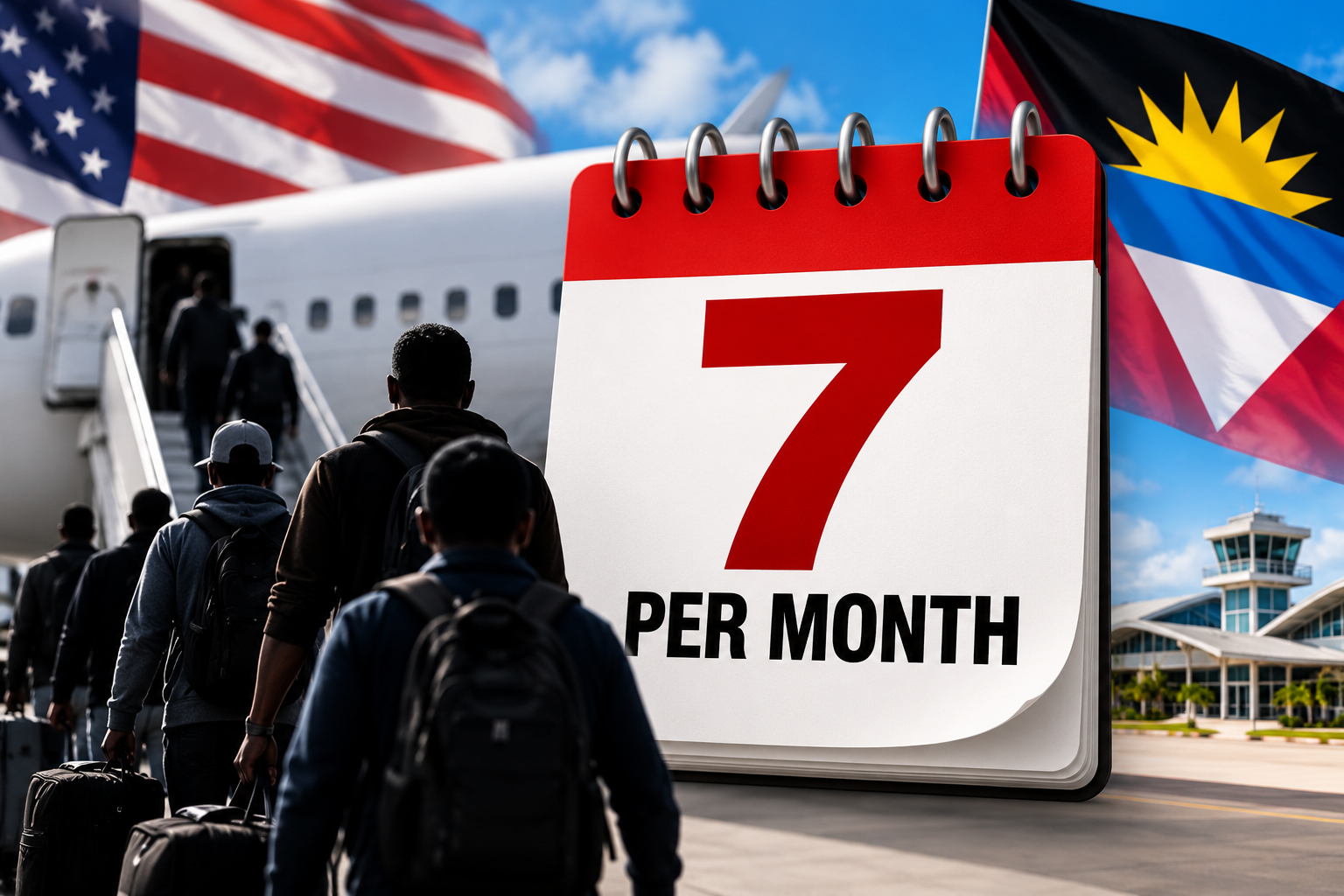
    As ongoing bilateral negotiations over a proposed third-country national transfer framework continue, new details have emerged revealing key discrepancies between the U.S. draft proposal and Antigua and Barbuda’s counteroffer, with both sides differing sharply on monthly and quarterly transfer limits.

  • U.S. Proposal Excludes People With Known Criminal Records From Transfer to Antigua and Barbuda

    U.S. Proposal Excludes People With Known Criminal Records From Transfer to Antigua and Barbuda

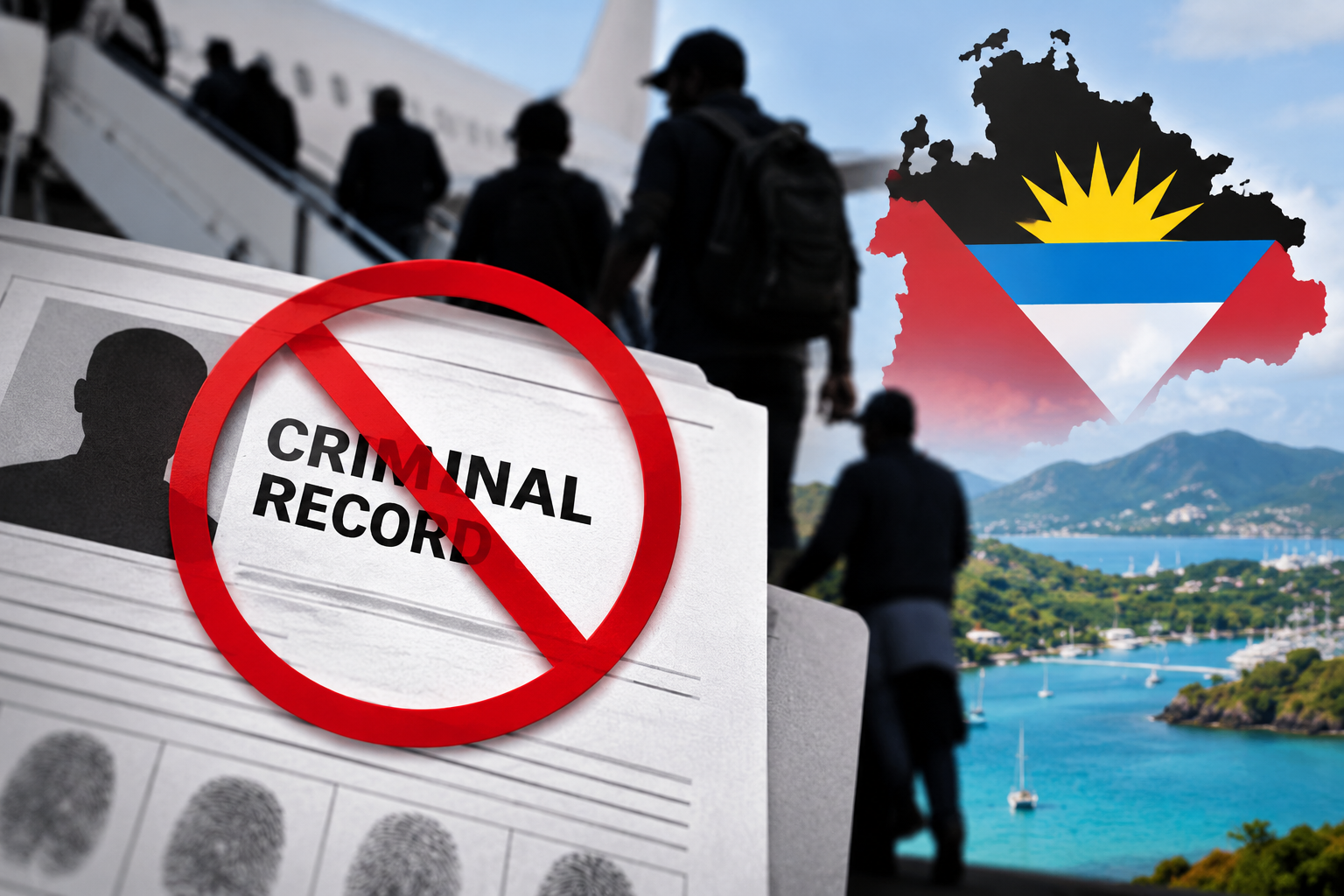
    Negotiations between the United States and Antigua and Barbuda over a framework for transferring third-country nationals removed from U.S. territory are ongoing, with both sides having tabled distinct proposals outlining eligibility rules, security safeguards, and transfer limits. The U.S. draft proposal, which was made public alongside Antigua and Barbuda’s counterproposal by the Caribbean nation’s government on Sunday, includes strict eligibility guardrails that would bar most individuals with known criminal records from being transferred. The only exception to this criminal record ban would be offenses solely related to violations of U.S. immigration law. Additional categories excluded from eligibility under the U.S. plan include unaccompanied minors under the age of 18, as well as citizens and permanent nationals of Antigua and Barbuda. To qualify for potential transfer under the U.S. framework, individuals must hold final or expedited removal orders issued by U.S. authorities and hold medical clearance for travel issued by the U.S. Department of Homeland Security. Crucially, the U.S. proposal does not mandate that Antigua and Barbuda accept every individual put forward for transfer. Any candidate that does not receive formal approval from Antigua and Barbuda’s government cannot be admitted into the country and must be returned to U.S. custody. Before any transfer proceeds, U.S. officials are required to share all available background information on the individual, including biometric data, nationality details, date of birth, gender, medical screening results, and either documentation of any known criminal record or official confirmation that no criminal history is on file. The current negotiations stem from a preliminary memorandum of understanding signed by both governments in Washington back in December 2025, which laid the groundwork for talks on establishing a formal transfer process. Antigua and Barbuda has responded to the U.S. proposal with a counterproposal that adds multiple layers of additional safeguards to protect the nation’s sovereignty and reduce potential burdens. Key demands in the Caribbean nation’s counterproposal include requiring explicit, prior written approval from Antigua and Barbuda for every individual proposed for transfer, more robust criminal and national security screenings, additional health and immigration background checks, requirements for valid travel documentation, and formal confirmation that the individual has been notified of their destination and provided written consent to the transfer. Antigua and Barbuda’s proposal also caps the total number of transfers at seven individuals per three-month period, a limit the government emphasizes is a maximum ceiling, not an mandatory quota or obligation to accept transfers. This cap represents a notable departure from the U.S. proposal, which allows for a higher volume of transfers and permits Antigua and Barbuda to choose whether to exceed any preliminary numerical limits. Antigua and Barbuda’s government says its counterproposal is designed to preserve the nation’s sovereign right to approve or reject every transfer candidate, while ensuring that any final agreement does not place an unsustainable security, financial, or administrative strain on the country. As negotiations continue, both the U.S. proposal and Antigua and Barbuda’s counterproposal are scheduled to be presented to the nation’s House of Representatives by Attorney General and Minister of Legal Affairs Sir Steadroy Benjamin. No final agreement has been reached, and talks between the two governments are still ongoing.