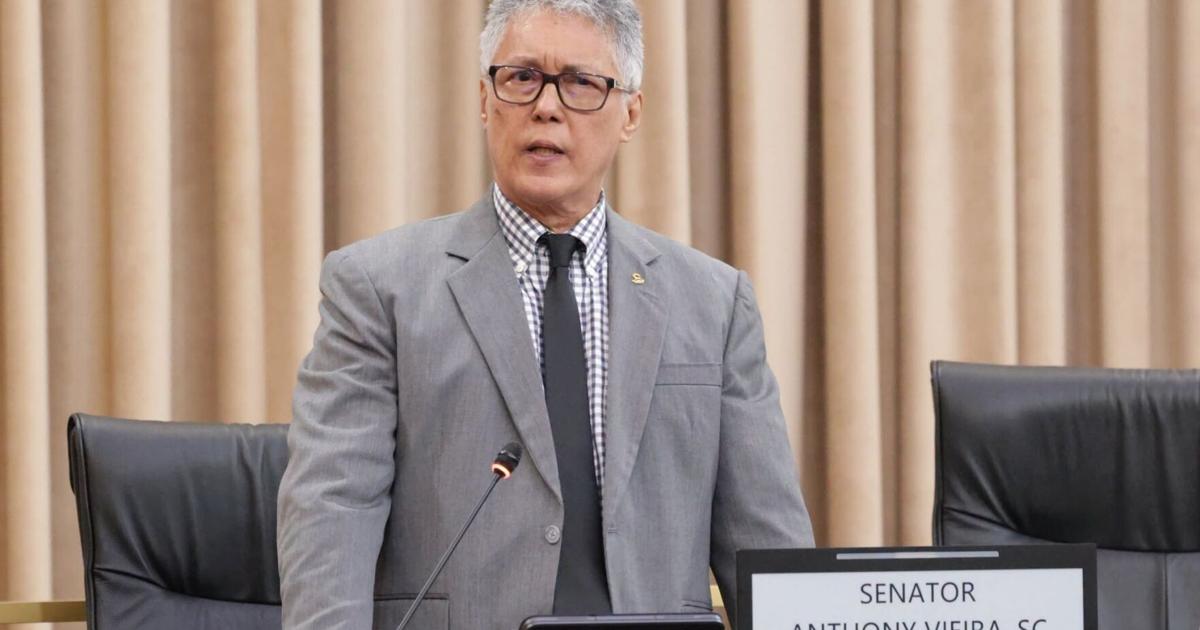
A sharp public feud has erupted in Trinidad and Tobago’s Senate this week, after Independent Senator Anthony Vieira delivered a sarcastic, cutting rebuke to Prime Minister Kamla Persad-Bissessar’s inflammatory verbal attacks on independent legislators, while issuing a dire warning about a proposed new procurement bill that he argues puts the public purse at grave risk of misuse.
The conflict traces back to a recent unanimous vote by the nine-member Independent Senate caucus against the government’s Special Operations Bill, which triggered a wave of harsh criticism from Persad-Bissessar. The Prime Minister labeled the independent lawmakers “satanic”, “demons”, and “Luciferian monsters”, claiming they harbored “demonic hatred” for law-abiding citizens, and announced that her administration would no longer consider any amendments put forward by the Independent bench.
Vieira, firing back in his address to the Senate Wednesday, leaned into the prime minister’s insults with biting sarcasm, quipping that his supposed demonic status granted him unique insight into the greed and moral rot that can plague public officials handling state funds. “Now, Mr President, a benefit of being satanic and demonic is that I have insight into the souls of men,” Vieira said. “I understand those whose moral compasses and codes are compromised, as I understand the seven deadly sins, in particular, greed.”
The senator’s retribution came as he launched a full-throated attack on the 2026 Public Procurement and Disposal of Public Property (Amendment) Bill, a piece of government legislation framed as a measure to streamline business operations. Vieira warned that the proposed changes to the existing procurement framework would erode critical anti-corruption safeguards, systematically marginalize the independent Office of Procurement Regulation (OPR), and open new doors for self-interested actors to siphon public funds.
Persad-Bissessar’s refusal to accept amendments from independent legislators directly shaped Vieira’s approach to the bill: he told the chamber he had opted not to spend time drafting improvements, after his earlier work on amendments for another bill went entirely ignored. “I had hoped that the benches would have worked together to avoid a financial ambush dressed up as the ease of doing business. But in light of the Prime Minister’s declared refusal to accept amendments from the Independent bench, I decided to save my time and energy,” he explained. “On a special zones bill, I spent two days working on amendments to improve the legislation. To no avail. That’s not happening today.”
Vieira pushed back against the dangerous assumption underpinning the bill, arguing that legislators cannot craft public financial rules on the premise that every official entrusted with state money will act with integrity. Pointing to long-standing patterns of misconduct in Trinidad and Tobago, he noted repeated allegations of “fraud, corruption, favouritism, conflicts of interest, contract splitting, and misuse of public resources.” He invoked two locally well-known phrases — “the land of Bobol” and the term “Trickydadian” — to illustrate the widespread cultural awareness that many actors actively seek to exploit loopholes in public rules for personal gain.
“We cannot afford to sacrifice the guardrails of good governance on the altar of convenience,” Vieira warned. “In this country, the danger of corruption is not abstract. Here, corruption is a real and present danger.” He even raised a provocative hypothesis: that special interest grifters are already positioning themselves to access public funds if the bill passes.
The senator rejected the framing that the reform forces a choice between regulatory efficiency and accountability, arguing that the goal should be to build a procurement system aligned with the core accountability mandates of the original 2015 Public Procurement Act. While he acknowledged that the legislation could be improved with targeted changes, he emphasized that without robust safeguards, the bill creates massive opportunity for abuse. “It will shield grifters from accountability and consequence,” he said, adding that the core question at stake is how much unaccountable discretion the state should be allowed to exercise over public funds.
Using vivid imagery to describe the impact of the reforms on existing protections, Vieira compared the current procurement regime to a fortified castle built to protect national assets from exploitation. “When crafting the parent Act, we try to put a moat and castle wall between our national assets and those who would seek to plunder,” he said. “I fear that with this legislation, we are lowering the drawbridge and we are leaving the castle door wide open and defenceless.”
Though the OPR will technically remain in place after the amendment, Vieira warned that the changes will strip the regulator of any meaningful enforcement power, leaving the watchdog sidelined just like the independent senators themselves. “The regulator may still be standing at her sentry post, but now her arms are going to be folded as she is weaponless,” he said. “Sadly, like us on the Independent bench, there are those who would like to see her too marginalised, helpless, or made useless.”
Vieira concluded that the bill represents a harmful step backward for governance, with risks that far outweigh any potential benefits. Closing as he opened, he leaned back into the prime minister’s insults to drive home his opposition: “Mr President, it’s going to take a lot more than holy water and mantras to get me to vote in support of this bill.”