博客

  • Drug case against Jamaican businessman dropped in Antigua

    Drug case against Jamaican businessman dropped in Antigua

    Regional Caribbean media outlet Caribbean Media Corporation (CMC) reports from St John’s, Antigua, that a major drug-related prosecution against Jamaican-born local entrepreneur Francis Young has been formally terminated after the Office of the Director of Public Prosecutions (DPP) of Antigua and Barbuda elected not to move forward with the case.

    Chief Magistrate Ngaio Emanuel officially recorded the discontinuation of proceedings against Young in court, but the DPP has not released any public explanation for its abrupt decision to drop the case.

    Young’s prosecution stemmed from a high-stakes drug seizure in May 2025 at the Deep Water Harbor port facility. When authorities searched an incoming cargo shipment, they uncovered 62 pounds of concealed cannabis, with local law enforcement estimating the contraband had an illicit street value of EC$372,000. Young was originally charged alongside co-accused Nadeem Brandon Doumith in connection with the seizure.

    While Young has been cleared of all charges, the legal case against Doumith remains active. The next court hearing for Doumith is scheduled to take place on August 8, 2026. Both men originally faced a slate of severe drug offenses, including conspiracy to traffic illegal narcotics, possession of cannabis, possession with intent to distribute cannabis, illegal importation of cannabis, and involvement in the supply of controlled substances.

    Public records show Young has resided in Antigua for four years alongside his wife and three minor children, and he runs a local business that provides employment for multiple Antiguan workers.

    This case marks the second high-profile drug prosecution that the Antigua DPP’s office has discontinued in less than a month. Just one week prior, prosecutors moved to dismiss charges against 48-year-old Canadian national Roselynee Crisostomo, who was arrested after authorities found 67 pounds of cannabis in her possession at VC Bird International Airport in March 2026. Unlike the Young case, the DPP cited undisclosed medical reasons as the justification for ending that prosecution.

  • Two killed in Kenya protests over US Ebola centre — rights group

    Two killed in Kenya protests over US Ebola centre — rights group

    NAIROBI, KENYA – Deadly clashes have erupted over a planned United States Ebola quarantine facility in central Kenya, leaving at least two civilians dead and intensifying public and legal pushback against the project, a Kenyan human rights organization confirmed this Tuesday. The violence comes amid deep public anger over Washington’s plan to house and quarantine American travelers exiting the Democratic Republic of the Congo (DRC), which is currently grappling with an aggressive, months-long Ebola outbreak.

    The proposed 50-bed isolation center, constructed on Kenyan military land at Laikipia Air Base roughly 125 miles northwest of Nairobi, was originally scheduled to welcome its first patients last week. Under the original agreement, the facility would be run exclusively by US medical personnel to monitor Americans arriving from the DRC, where the outbreak has already claimed dozens of lives. As part of the broader partnership, the US State Department announced last week it would allocate $13.5 million to bolster Kenya’s overall national Ebola preparedness infrastructure.

    Despite the promised investment, the plan triggered swift public outrage across Kenya, with many residents objecting to the use of Kenyan territory to host potential Ebola patients and criticizing the lack of public transparency around the bilateral agreement between Nairobi and Washington. Violent demonstrations erupted near the facility site on Monday, with local media footage showing crowd clashes with security forces, who responded by firing tear gas to disperse protesters.

    Hussein Khalid, executive director of Kenyan rights group VOCAL Africa, announced via social media platform X that a 27-year-old man was shot and killed during the Monday unrest, dying instantly at the scene. Khalid told Agence France-Presse Tuesday that a second fatality has been confirmed, though the victim’s identity is still pending official verification. Kenyan police have so far declined to confirm the two deaths in statements to AFP.

    In a public statement posted to X Tuesday, Kenyan President William Ruto defended the planned facility, pushing back against public anxiety and framing the project as a standard component of Kenya’s national public health preparedness framework. “This facility is neither unique nor exceptional, but part of a broader national preparedness system,” Ruto wrote. “It will be there to serve the people of Kenya and to serve our friends, including the Americans. We are a responsible government. We know what we are doing. So people should relax.”

    To date, Kenya has not recorded any confirmed Ebola cases, even after widespread screening of incoming cross-border and international travelers. However, neighboring Uganda has documented 15 cases linked to the DRC outbreak, including one death. As of Tuesday, the World Health Organization (WHO) reports the DRC outbreak – declared back in mid-May – has reached 321 confirmed cases, with 48 total deaths recorded so far. One American citizen, a medical missionary working in the DRC, has contracted the virus; he has already been evacuated for treatment in Germany.

    The legal challenge to the facility gained traction this Tuesday, after Kenya’s High Court extended an existing temporary moratorium on the project’s opening. The pause was requested by the Kenyan legal and rights organization Katiba Institute, which filed a formal petition opposing the center. The court ordered the Kenyan national government to release all documents and formal agreements related to the facility within a seven-day deadline, amid widespread demands for transparency.

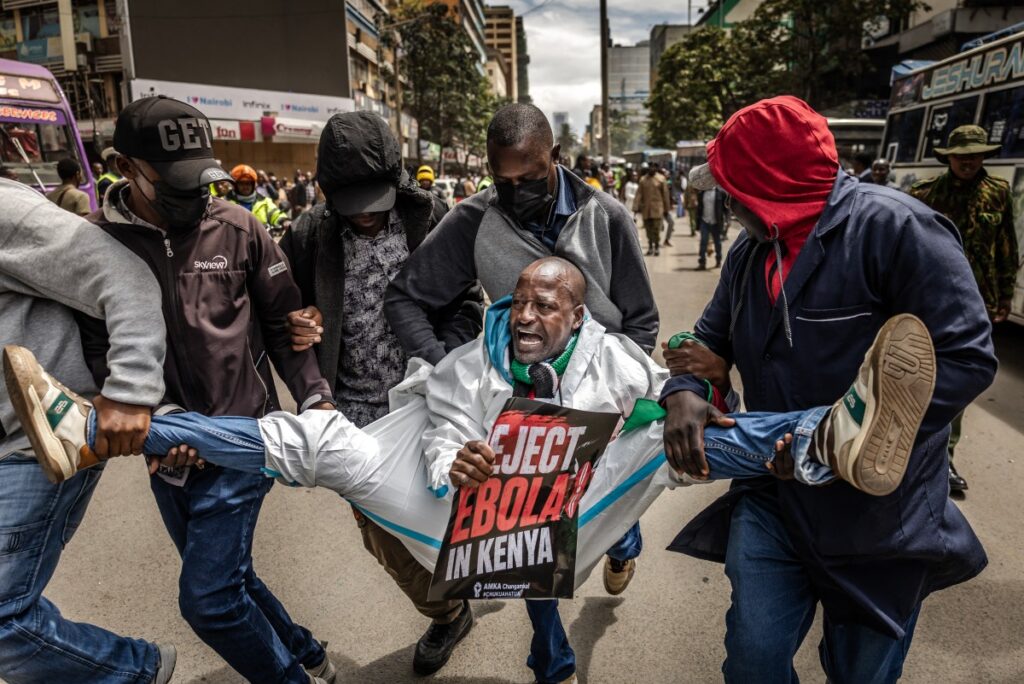
    On Tuesday, a small contingent of peaceful protesters gathered in downtown Nairobi to continue their opposition. Demonstrators wore white medical protective gear and carried a symbolic coffin marked with the word “Ebola”, alongside signs reading “Reject Ebola in Kenya”.

    The controversial project has also drawn criticism from political figures in the United States. The Democratic majority staff of the US House Foreign Affairs Committee issued a statement via X criticizing the plan, arguing: “The Trump admin should bring Americans home and help them, not outsource that responsibility to a foreign government.”

  • White House press gala rescheduled after shooting

    White House press gala rescheduled after shooting

    Weeks after a violent assassination attempt targeting then-President Donald Trump forced an emergency evacuation and shut down the annual White House correspondents’ dinner, event organizers have announced the gala will be revived next month with upgraded security protocols. The White House Correspondents Association (WHCA) confirmed the long-awaited rescheduling in a member notice issued Tuesday, scheduling the revamped gathering for Friday, July 24 in Washington, D.C.

    The chaotic original event unfolded on April 25 at a downtown Washington hotel. As Trump prepared to deliver his scheduled keynote address, a gunman opened fire at an exterior security checkpoint near the event ballroom, triggering an immediate emergency evacuation of the sitting president. The accused attacker, 31-year-old Cole Allen, a California resident, has since entered a plea of not guilty to a series of felony charges, including attempted assassination of the president.

    In an official email circulated to WHCA members, association president Weijia Jiang framed the decision to reschedule as a stand against violent intimidation, tying the moment to the United States’ ongoing 250th founding anniversary celebrations. “We will not allow an act of violence to have the last word, especially during a year when we are reflecting on the 250th anniversary of America and everything we stand for,” Jiang stated.

    Jiang confirmed that the rescheduled event will roll out substantially enhanced safety measures and revised entry protocols to prevent a repeat of the April incident. Unlike the large, glitzy annual gathering that typically draws thousands of journalists, government officials, and public figures to the Washington Hilton, the July event will be structured as a smaller, more intimate gathering, Jiang added. Specific details regarding the exact venue, ticket sales, and event programming are still being finalized and will be released to members in the coming weeks.

    Notably, the WHCA president declined to confirm whether Trump would be in attendance at the rescheduled dinner. Trump himself has publicly voiced support for reviving the disrupted event, and has also cited the security breach to bolster his push for construction of a controversial new event ballroom on White House grounds, a project that has drawn political pushback from critics.

  • Mathematicians say ‘don’t believe hype’ on AI capabilities

    Mathematicians say ‘don’t believe hype’ on AI capabilities

    In a collective rebuke of growing commercial overstatement of artificial intelligence’s capabilities in pure mathematics, more than 150 mathematicians from leading academic institutions across Europe, Japan, the United States and other regions have put their names to a public statement calling on the global mathematics community to push back against the trend of AI developers leveraging the discipline to inflate their products’ reputations.

    The statement, dubbed the Leiden Declaration, arrives amid a wave of aggressive claims from major AI corporations about their systems’ supposed breakthroughs in mathematics — including supposed solutions to long-unresolved open problems in the field and strong performances in high-level competitive mathematics challenges. The signatories specifically urge governments and research funders not to fall for the overblown marketing surrounding AI’s current mathematical competencies.

    Ulrike Tillmann, vice-president of the International Mathematical Union (IMU), offered her public backing for the declaration, noting that while AI has unlocked intriguing new opportunities for mathematical inquiry, the risks and ethical questions it introduces demand rigorous, critical examination. “The future of mathematical research must be guided by human judgment, fair and transparent practices, and the shared values of the global mathematical community, Tillmann emphasized in her endorsement.

    The declaration itself calls out the core conflict of interest driving the current hype: AI developers operate under intense commercial pressure to overstate what their tools can do, as hundreds of billions of dollars in venture capital and public investment hang in the balance. Unlike peer-reviewed mathematical research, which advances at a deliberate, verification-focused pace, AI development and publicity is driven by market timelines. This leads to misleading framing, the declaration argues, where narrow performance on specific mathematical tasks is incorrectly presented as proof of general reasoning ability in commercial AI models.

    Michael Harris, a Columbia University professor and co-author of the declaration, explained the high-stakes dynamic at play to AFP. “There is a competition to the death on the part of the main labs… they are trying, using mathematics… to attract investment so that each of them will be left standing, Harris said. This scramble for funding comes as the AI industry is in a period of major market expansion: in recent weeks, Elon Musk’s SpaceX, which owns AI developer xAI, and AI startup Anthropic have both moved forward with plans for initial public offerings, with industry leader OpenAI widely expected to follow suit shortly.

    The declaration also pushes back against recent high-profile endorsements of AI’s research potential from leading mathematicians. Just one week before the declaration’s release, OpenAI shared a social media video featuring Terence Tao, a UCLA professor and former Fields Medal winner — the highest honor in pure mathematics — praising the company’s AI tools for their ability to support mathematical research. Harris acknowledged Tao’s immense contributions to the global mathematics community but argued that it is unhealthy for the field to consistently hold up a single mathematician as the official voice endorsing commercial AI tools.

    Beyond the problem of co-opting mathematics for commercial marketing, the signatories outline a host of deeper risks to the discipline itself. AI systems can generate logically plausible but fundamentally incorrect mathematical proofs that are extremely difficult for human researchers to verify, they note. The technology also erodes clear attribution for the foundational human research that AI models are built on.

    Longer-term harms to research culture are also a major concern: widespread adoption of AI in mathematics could push more researchers to chase trendy, AI-aligned problems at the expense of exploring less hyped but equally important lines of inquiry. It could also weaken traditional peer review systems and reorient academic research to serve the priorities of commercial AI developers, rather than the open, self-directed inquiry that has long defined university-based mathematics.

    The declaration also highlights broader societal harms tied to unregulated AI development, including risks of weaponization for warfare, expansion of mass surveillance, political interference, and increased environmental damage from energy-intensive AI model training. In closing, the statement urges all practicing mathematicians to carefully assess the ethical implications of any AI-related work they take on, and to step away from projects that cause undue harm.

  • Dominican Republic achieves Category 2 ranking in Global Labor Rights Index

    Dominican Republic achieves Category 2 ranking in Global Labor Rights Index

    In a landmark recognition for regional labor rights progress, the Dominican Republic has secured placement in Category 2 of the 2026 Global Rights Index released by the International Trade Union Confederation (ITUC), cementing its status among the top three countries in the Americas for the protection of collective labor rights.

    The Caribbean nation shares this strong standing with Barbados, while Uruguay remains the sole regional economy to hold the highest classification of Category 1, according to statements from the Dominican Ministry of Labor.

    Developed to benchmark global labor conditions, the ITUC index assesses four core pillars of international labor standards: freedom of association for workers, the right to collective bargaining, legal protection for strike action, and equitable access to labor justice systems. Across more than 150 nations, the index has emerged as one of the most widely referenced global yardsticks for measuring institutional commitment to workers’ rights, guiding decision-making for cross-border investors, multilateral organizations, and labor industry stakeholders worldwide.

    Dominican Labor Minister Eddy Olivares Ortega emphasized that the new ranking reflects tangible, sustained progress across the country’s efforts to strengthen labor governing institutions, expand inclusive social dialogue between workers, employers and the state, and align domestic regulations with the core international labor principles advanced by the International Labour Organization (ILO).

    Olivares credited the improved outcome to collaborative cross-sector work, noting that the achievement would not have been possible without coordinated efforts from the national government, organized worker groups, employer associations, and public labor institutions, all of which have aligned to advance fair employment relations and broader social justice across the Dominican workforce.

    Notably, the 2026 ranking marks an upgrade in the Dominican Republic’s standing compared to previous ITUC evaluations. This improvement comes at a time when the global landscape has seen widespread rollbacks of labor protections, with many nations recording setbacks in workers’ rights amid post-pandemic economic shifts and evolving labor market pressures.

    Moving forward, the Dominican Ministry of Labor has reaffirmed its long-term commitment to advancing policy reforms that further strengthen core labor rights. Key priority areas include expanding protections for freedom of association, improving collective bargaining frameworks, enhancing workplace safety standards, increasing the reach and efficacy of labor inspections, and upholding balanced protections for both workers and employers across all sectors of the national economy.

  • Cuba rejects US ‘slander’ over sanctioned army business group

    Cuba rejects US ‘slander’ over sanctioned army business group

    HAVANA, Cuba — Cuban authorities issued a forceful rejection this Tuesday of what it calls American “slander” targeting GAESA, the island nation’s military-backed economic conglomerate that has become the latest focus of sweeping new United States sanctions. The fresh restrictions, announced earlier in May, represent a sharp escalation of the Trump administration’s long-running pressure campaign against Cuba’s communist-led government, a campaign that has included public musings from former President Trump about potential US takeover of the island.

    In unveiling the new sanctions, then-Secretary of State Marco Rubio leveled sharp accusations against GAESA, an entity analysts estimate controls roughly 70 percent of Cuba’s total national economy. Rubio claimed the conglomerate operates as an unaccountable “state within a state,” accumulating massive wealth for a small ruling elite while ordinary Cuban citizens bear the cost of its opaque operations. “It hoards the profits from its businesses for the benefit of a small elite,” Rubio stated.

    Cuba’s official response, released in a public statement Tuesday, pushed back firmly against these claims, rejecting characterizations of GAESA as either an opaque institution or a parallel structure operating outside of Cuban state oversight. “On the contrary,” the statement read, the conglomerate “has been a coordinated response of proven efficiency to the economic siege that has historically sought to suffocate the Cuban Revolution” — a direct reference to the US trade embargo that has been in place against Cuba since 1962.

    The latest round of US sanctions strengthens existing restrictions on GAESA, ordering a full freeze on all of the conglomerate’s assets held within US jurisdictions and imposing harsh penalties on any foreign companies that choose to conduct business with the entity. Cuban officials framed the measures as “the most intense, disproportionate, and dangerous escalation in the recent history of relations between Cuba and the United States.”

    The statement also highlighted GAESA’s widespread contributions to Cuban public welfare and economic stability, noting the conglomerate played a critical role in sustaining the island’s economy through the height of the COVID-19 pandemic and has overseen the construction of more than 10,000 new residential homes for Cuban citizens. “Its work speaks for itself, and it does so above the state slander concocted in Washington,” the statement concluded.

    Multiple independent sources confirmed to AFP on Tuesday that Spanish hospitality giant Iberostar has begun exiting from 12 Cuban hotel properties it previously operated in partnership with GAESA-affiliated firms. The company made the decision to withdraw from hotels co-managed with Gaviota, Cuba’s state tourism group that is a core subsidiary of GAESA, one insider confirmed. “As of June 1, Iberostar is pulling out of all its hotels (run with) Gaviota,” a second senior tourism industry source corroborated.

    When contacted by AFP for comment, the Mallorca-based hospitality group declined to provide on-the-record details about its decision. Sources added that Iberostar will maintain its existing co-management agreements for hotels owned directly by Cuba’s national tourism ministry, separate from GAESA-linked entities.

    Iberostar’s exit follows a similar move by Canadian mining corporation Sherritt, which terminated its long-standing partnership with GAESA earlier this year after facing US sanctions penalties for its operations in Cuba.

  • Chris Williams appointed honorary chair of Young Entrepreneurs Association of Jamaica

    Chris Williams appointed honorary chair of Young Entrepreneurs Association of Jamaica

    KINGSTON, Jamaica — In a strategic move to set the stage for the next chapter of expansion and community impact, the Young Entrepreneurs Association of Jamaica (YEA) has named prominent Caribbean business leader Chris Williams as its new honorary chair, the organization confirmed in an official statement released Tuesday.

    The appointment aligns with YEA’s long-term leadership transition plan, as current president Cordell Williams is scheduled to step down from his role in 2026. During Cordell Williams’ tenure, the association has delivered substantial growth, expanding its reach across Jamaica and deepening its national engagement with emerging entrepreneurs and industry stakeholders.

    Cordell Williams explained that the selection process for the new honorary chair was deliberate and targeted, focused on finding a leader who combines top-tier expertise in global entrepreneurship with a core commitment to nurturing talent, building robust organizational systems, and strengthening institutional capacity. “We reviewed multiple highly qualified candidates, and this decision was made after careful consideration,” he noted. “Chris Williams brings an unparalleled mix of forward-thinking vision, industry credibility, decades of hands-on experience, and a deeply rooted dedication to lifting up the next generation of Jamaican entrepreneurs. He is exactly the leader we need to guide our association to new heights of growth.”

    The appointment carries particular symbolic weight: Williams also served as the featured keynote speaker at YEA’s official launch event, marking his return to the organization in a leadership role as a full-circle milestone for both the group and the business leader.

    Widely recognized as one of the most successful business figures across the Caribbean, Williams has over 30 years of experience building and scaling high-impact organizations across multiple sectors. He previously held the role of chief executive officer at NCB Capital Markets before going on to co-found PROVEN Group, where he led the firm from its early startup days to a regional financial conglomerate holding roughly US$3 billion in total assets.

    Beyond his corporate work, Sir Richard Branson selected Williams to chair the Branson Centre of the Caribbean, where he has supported hundreds of emerging entrepreneurs across the Caribbean region to grow their businesses. He also contributed to the founding of the Jamaica Stock Exchange Junior Market as a founding charter committee member, and later served as the market’s deputy chairman. Today, Williams holds positions as co-founder and chairman of Different Group, a real estate investment firm focused exclusively on Caribbean market opportunities.

    In his remarks accepting the appointment, Williams stressed that sustainable entrepreneurial growth requires a more intentional, disciplined and structured approach to business building for emerging founders across Jamaica. As honorary chair, he will take on two core responsibilities: serving as a strategic advisor and mentor to YEA’s current leadership team, and working to expand and strengthen the association’s partnerships across the private sector, investment community, national policymakers, and the broader regional entrepreneurial ecosystem.

    YEA was founded as a national non-profit organization focused on empowering emerging Jamaican entrepreneurs. It provides members with access to critical business tools, professional networking opportunities, industry knowledge, and growth opportunities designed to help them build sustainable companies, generate new jobs for Jamaican workers, and contribute to long-term economic and social transformation across the country.

  • Medicinal cannabis rollout expected before end of June

    Medicinal cannabis rollout expected before end of June

    The Bahamas is on the cusp of launching its first formal medicinal cannabis industry, with officials confirming that a final partnership agreement with U.S.-based cannabis supply chain tracking firm Metrc has cleared the way for rollout to begin within the next month, potentially before the end of June.

    Lynwood Brown, chairman of the Bahamas Cannabis Authority, shared details of the milestone in an interview with The Tribune, explaining that the deal was finalized several weeks ago and removes the final regulatory and operational barriers to unveiling the country’s new licensing framework, official industry website, and public application process.

    One of the authority’s top priorities ahead of opening applications is addressing a marked gap in public understanding of the new regulated industry. Brown emphasized that widespread public awareness remains insufficient, prompting the organization to prepare an aggressive, multi-channel public education campaign that will kick off alongside a formal launch press conference. The initiative will clarify key details for residents, including eligibility for industry participation, allowed and restricted locations for retail dispensaries, and the core public health mission of the sector.

    Notably, the authority intentionally delayed full implementation until after the country’s general election to avoid forcing any new incoming administration to adopt a regulatory structure designed by the previous government. With the incumbent administration retaining power, Brown confirmed the authority will move forward with its original pre-election development plan.

    The path to securing a technology partner was not without delays. Brown revealed that officials initially held negotiations with another leading tracking provider, BioTrack, but a corporate acquisition of the firm forced the authority to restart the selection process from scratch. Ultimately, the board settled on Metrc, which Brown described as a reliable partner ready to guide the Bahamas through building its first regulated medicinal cannabis market.

    “We are satisfied with our negotiations with Metrc. We have signed the contract for them to be our platform provider and guide us through this virgin territory,” Brown said. “They are eager to meet the Bahamian people and have a press conference to be introduced.”

    At the core of Metrc’s role is building a robust regulatory oversight system designed to block illicit cannabis from entering the legal market and protect public health. Every single cannabis seed will be assigned a unique barcode that tracks the plant through every stage of cultivation, processing, and final sale to consumers, creating an unbroken trail of accountability that makes it extremely difficult for unregulated black market product to infiltrate the legal supply chain. Random batch testing will be conducted at multiple points along the supply chain to close any remaining regulatory loopholes.

    The system will also address other common regulatory risks, including multiple prescription shopping by patients and the sale of substandard products that do not meet required medicinal quality and safety standards. Brown noted that even existing unlicensed cultivators who successfully obtain legal licenses will not be able to sell crops they grew prior to regulation, as any pre-license product would lack the required end-to-end tracking. The authority estimates that the first legal, regulated medicinal cannabis products will not reach patients for at least 18 months after licensing opens.

    Brown declined to share details on the financial terms of the Metrc contract or the authority’s total budget allocation, noting that those details will be released publicly as part of the Ministry of Health’s upcoming budget presentation. The national medicinal cannabis initiative is led by the Ministry of Health, with cross-agency support from the Attorney General’s Office, the Ministry of Agriculture, and domestic banking institutions, all of which have contributed to shaping the industry’s regulatory framework.

    Brown repeatedly stressed that public education will remain the authority’s top priority in the lead-up to launch, emphasizing that this is a strictly public health-focused initiative, not a recreational cannabis program. “Because of the critical nature of public health, we have to spend resources to get as much information in the hands of the public as possible because the public’s health and safety depends on it and we’re not taking this lightly,” he said.

    Moving forward, the authority is committed to full transparency as it builds the new industry, with a core goal of encouraging active Bahamian participation. “We are looking for Bahamians to be our partners on this, and in order for them to be partners we have to be transparent,” Brown said. “We won’t rush it, but we want to move as fast as possible while being as safe as possible.”

  • Government updates prescription rules to improve access to medicines

    Government updates prescription rules to improve access to medicines

    In a transformative move aimed at upgrading the nation’s public healthcare infrastructure, the Dominican government has formally approved sweeping updates to the regulations governing outpatient prescription and dispensing under the Dominican Social Security System (SDSS), with the changes codified in Decree 286-26. At the core of the reform is a policy shift designed to break down longstanding access barriers for patients: prescriptions written by licensed physicians outside of a patient’s contracted Health Risk Administrator (ARS) network will now be recognized as valid for insurance coverage, a change that upends previous restrictive rules that limited coverage to in-network providers only.

    Leadership from the National Social Security Council (CNSS), the body overseeing the Dominican Social Security System, has framed the reform as a patient-centric update that addresses critical gaps in the current healthcare framework. CNSS President Aura Celeste Fernández Rodríguez emphasized that the new rules will eliminate unnecessary treatment interruptions for patients who seek care from out-of-network physicians, while also expanding individual patient autonomy when choosing healthcare providers. Fernández called the update a meaningful milestone in ongoing efforts to expand equitable access to healthcare and modernize the country’s Family Health Insurance program.

    Beyond expanding access, the revised regulatory framework introduces enhanced accountability measures to boost medication safety and oversight. New, stricter standards for prescription documentation require clearer patient identification, detailed diagnosis records, and comprehensive clinical documentation, all of which will improve end-to-end traceability of controlled and prescription medications. Under the new rules, licensed pharmacies bear formal responsibility for verifying prescription compliance before dispensing medications, especially for substances classified as controlled substances that carry higher risks of misuse.

    The reform also sets a roadmap for the gradual adoption of standardized electronic prescription systems across the SDSS. Digital prescription tools are expected to cut down on common medication errors caused by illegible handwritten notes, streamline communication between treating clinicians and dispensing pharmacies, and bring the Dominican healthcare system’s medication management practices in line with global modernization standards. Additionally, the updated regulations formalize guidelines for partial medication dispensing when clinically appropriate, a change that supports more efficient use of pharmaceutical supplies and reduces unnecessary waste of healthcare resources.

    Regulatory authorities note that the updated regulatory structure strengthens state oversight of licensed pharmaceutical establishments, reinforces national commitments to medication safety, and creates new tools to crack down on the illegal sale of prescription medications that occur without proper medical authorization. For the Dominican government, the comprehensive reform represents a balanced step forward: it expands patient access to life-sustaining medications while reinforcing public health protections that keep communities safe, laying the groundwork for a more equitable, efficient, and secure national healthcare system.

  • PPV operators granted 16% increase in two phases

    PPV operators granted 16% increase in two phases

    KINGSTON, Jamaica — Jamaica’s national administration has greenlit a 16% overall fare increase for public passenger vehicle (PPV) operators, rolling out the pricing adjustment in two incremental stages starting this month.

    The proposal for higher fares, which has been under official review since April 2024, will be implemented in two equal 8% increments. The first 8% adjustment will go into force across all regulated public passenger routes in June, with the second matching 8% hike scheduled to take effect in July.

    Transport Minister Daryl Vaz made the official announcement of the approved increase on Tuesday morning, explaining that the decision to spread out the adjustment instead of imposing it all at once was made to reduce the inflationary shock that an immediate 16% jump would have imposed on regular commuters.

    Vaz emphasized that the phased rollout was crafted as a compromise solution, designed to address the ongoing financial pressures that have pushed PPV operators to request higher fares while also shielding Jamaican households from the full immediate impact of higher transportation costs on already stretched household budgets.