NAIROBI, KENYA – Deadly clashes have erupted over a planned United States Ebola quarantine facility in central Kenya, leaving at least two civilians dead and intensifying public and legal pushback against the project, a Kenyan human rights organization confirmed this Tuesday. The violence comes amid deep public anger over Washington’s plan to house and quarantine American travelers exiting the Democratic Republic of the Congo (DRC), which is currently grappling with an aggressive, months-long Ebola outbreak.
The proposed 50-bed isolation center, constructed on Kenyan military land at Laikipia Air Base roughly 125 miles northwest of Nairobi, was originally scheduled to welcome its first patients last week. Under the original agreement, the facility would be run exclusively by US medical personnel to monitor Americans arriving from the DRC, where the outbreak has already claimed dozens of lives. As part of the broader partnership, the US State Department announced last week it would allocate $13.5 million to bolster Kenya’s overall national Ebola preparedness infrastructure.
Despite the promised investment, the plan triggered swift public outrage across Kenya, with many residents objecting to the use of Kenyan territory to host potential Ebola patients and criticizing the lack of public transparency around the bilateral agreement between Nairobi and Washington. Violent demonstrations erupted near the facility site on Monday, with local media footage showing crowd clashes with security forces, who responded by firing tear gas to disperse protesters.
Hussein Khalid, executive director of Kenyan rights group VOCAL Africa, announced via social media platform X that a 27-year-old man was shot and killed during the Monday unrest, dying instantly at the scene. Khalid told Agence France-Presse Tuesday that a second fatality has been confirmed, though the victim’s identity is still pending official verification. Kenyan police have so far declined to confirm the two deaths in statements to AFP.
In a public statement posted to X Tuesday, Kenyan President William Ruto defended the planned facility, pushing back against public anxiety and framing the project as a standard component of Kenya’s national public health preparedness framework. “This facility is neither unique nor exceptional, but part of a broader national preparedness system,” Ruto wrote. “It will be there to serve the people of Kenya and to serve our friends, including the Americans. We are a responsible government. We know what we are doing. So people should relax.”
To date, Kenya has not recorded any confirmed Ebola cases, even after widespread screening of incoming cross-border and international travelers. However, neighboring Uganda has documented 15 cases linked to the DRC outbreak, including one death. As of Tuesday, the World Health Organization (WHO) reports the DRC outbreak – declared back in mid-May – has reached 321 confirmed cases, with 48 total deaths recorded so far. One American citizen, a medical missionary working in the DRC, has contracted the virus; he has already been evacuated for treatment in Germany.
The legal challenge to the facility gained traction this Tuesday, after Kenya’s High Court extended an existing temporary moratorium on the project’s opening. The pause was requested by the Kenyan legal and rights organization Katiba Institute, which filed a formal petition opposing the center. The court ordered the Kenyan national government to release all documents and formal agreements related to the facility within a seven-day deadline, amid widespread demands for transparency.
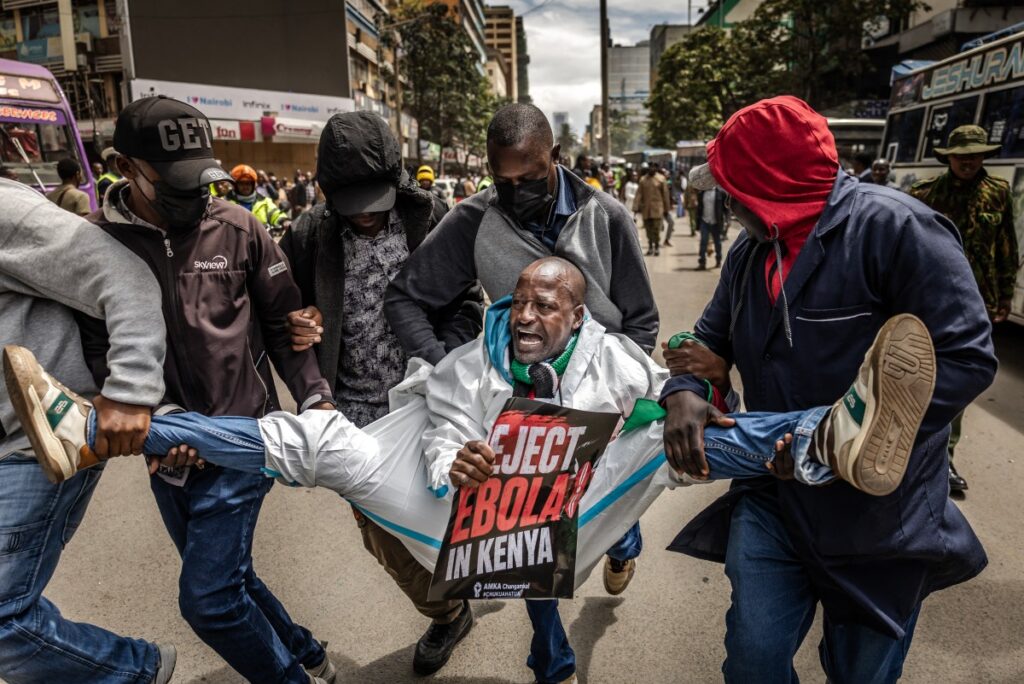
On Tuesday, a small contingent of peaceful protesters gathered in downtown Nairobi to continue their opposition. Demonstrators wore white medical protective gear and carried a symbolic coffin marked with the word “Ebola”, alongside signs reading “Reject Ebola in Kenya”.
The controversial project has also drawn criticism from political figures in the United States. The Democratic majority staff of the US House Foreign Affairs Committee issued a statement via X criticizing the plan, arguing: “The Trump admin should bring Americans home and help them, not outsource that responsibility to a foreign government.”