博客

  • Two Men Detained After Suspected Drug Bust on Pares Main Road

    Two Men Detained After Suspected Drug Bust on Pares Main Road

    A late-night roadside crash has uncovered an alleged illicit drug trafficking operation on Paros Main Road, leading law enforcement to take at least two men into custody, according to official initial reports. The incident unfolded shortly after 10 p.m. on Tuesday, when local police were dispatched to the scene following reports of a crashed vehicle parked along the road edge.

    When responding officers arrived, they made an unexpected discovery: multiple pounds of suspected cannabis were in the process of being moved between the crashed vehicle and a second connected vehicle when the accident occurred. The crash inadvertently revealed the illegal transfer, putting an immediate stop to the alleged operation.

    In the hours after the incident unfolded, a large crowd of curious bystanders gathered near the restricted zone to observe the ongoing law enforcement activity. Police quickly established a cordon around the entire area to secure evidence and allow investigative teams to process the scene without interruption.

    As of the latest update, law enforcement officials have not released formal details confirming the exact quantity of suspected controlled substances seized from the scene. They also have not indicated whether additional suspects connected to the alleged operation are still being sought, or if further arrests will be made in the coming days as the investigation continues.

  • Antigua and Barbuda Parliament Passes Law to Put Unclaimed Bank Money to Public Use

    Antigua and Barbuda Parliament Passes Law to Put Unclaimed Bank Money to Public Use

    On Tuesday, the lower legislative chamber of Antigua and Barbuda approved the 2026 Banking Amendment Bill, a landmark piece of legislation that overhauls the national rules governing abandoned bank deposits and unclaimed assets, while opening a new pathway to redirect stagnant financial resources toward targeted regional economic growth.

    Introducing the bill to parliament, Prime Minister Gaston Browne laid out that the reform updates decades-old outdated protocols for handling unclaimed property within the domestic banking sector, covering everything from long-dormant customer accounts to forgotten valuables held in bank safety deposit boxes, all while cementing stronger legal protections for depositors and their rightful heirs.

    Under the current regulatory framework that has been in place for years, abandoned funds are transferred to the Eastern Caribbean Central Bank (ECCB) after a decade of inactivity, and if no valid claim is filed within an additional 10 years, the assets are permanently forfeited. The new amended law upends this structure: it allows unclaimed funds to be transferred to the governments of member states of the Eastern Caribbean Currency Union, while enshrining an indefinite right for original depositors or their beneficiaries to reclaim full value of the assets at any point, as long as they can verify their legal ownership.

    Browne emphasized to lawmakers that this structure offers far more robust protection for asset owners than the outgoing legislation, which placed a hard expiration on all claims. He added that across the entire Eastern Caribbean Currency Union, unclaimed deposits add up to an estimated $48 million US dollars – a massive underutilized asset pool that can be put to productive public use without ever compromising the rights of owners and their heirs.

    Beyond the reform of unclaimed asset rules, the prime minister outlined an ambitious broader vision for regional economic transformation centered on the ECCB’s substantial foreign reserve holdings. Currently, the ECCB holds roughly $6 billion US dollars in foreign reserves, the vast majority of which are invested overseas. Browne is proposing that between 5 and 7 percent of these reserves be allocated to finance strategic regional development projects, with a priority focus on two critical areas: renewable energy development and regional food security.

    For decades, the Eastern Caribbean dollar has been celebrated for its strong reserve backing, which currently sits close to 98 percent – far higher than the mandatory regulatory threshold. Browne argued that deploying a small fraction of these reserves to regional projects will generate inclusive economic growth without putting monetary stability at any meaningful risk. He noted that investments in local renewable energy infrastructure would cut the region’s heavy reliance on costly imported fossil fuels, bring down consumer electricity prices, further strengthen foreign reserve positions over time, and help member states meet their international climate change mitigation commitments.

    Browne disclosed that the ECCB’s Monetary Council has already reached a preliminary consensus to move forward with the proposal, and noted that additional amendments to regional banking legislation will likely be required to formally grant the ECCB authority to make these strategic regional investments. He stressed that the plan does not involve permanently distributing central bank reserves; instead, the funds will be disbursed as repayable loans, which will replenish the reserve pool over time while financing projects that deliver long-term shared economic benefits for the region.

    A core principle of the proposal, Browne added, is that all investments made through this initiative must remain under regional and local ownership, rather than falling under the control of foreign private entities. The Antigua and Barbuda government prioritizes strategic projects like utility-scale renewable energy plants that include significant public and local private investment, so that profits generated by these projects stay within the region to support further growth. “We believe very strongly that ownership is empowerment,” Browne stated.

    To illustrate the immediate local impact of the unclaimed funds reform, Browne noted that Antigua and Barbuda alone holds roughly $38 million US dollars in unclaimed deposits. After setting aside a sufficient reserve portion to cover any potential future claims, the remaining balance can be redirected to national development projects, rather than sitting idle in overseas accounts.

    The new legislation also establishes a clear regulatory framework for unclaimed contents of safety deposit boxes. Under the new rules, valuables that remain unclaimed for 10 years may be sold through public auction, with the proceeds held in a newly created Safe Deposit Box Liquidation Fund for an additional 10 years, giving owners or heirs extra time to come forward to claim the funds.

    Addressing any potential concerns about government overreach, Browne clarified to lawmakers: “We’re not just trying to go and confiscate people’s money. We’re not trying to steal people’s money. We’re trying to use that money for the development of our respective countries.”

    During parliamentary debate, Trevor Walker, the member of parliament for Barbuda, raised questions about the provision that reduces the waiting period before assets are classified as abandoned to 10 years, but expressed support for the overall direction of the legislation. Walker backed the government’s focus on renewable energy development, saying that the country must continue its transition toward affordable clean power while ensuring that major strategic investments stay under local control.

    “We must control it. It must not be outsourced,” Walker said, adding that the proposal represents the kind of forward-thinking policy that can improve long-term economic and environmental sustainability while lowering living costs for ordinary citizens. Walker ultimately announced his support for the bill, calling it a bold initiative that will strengthen Antigua and Barbuda’s global reputation as a progressive investment destination and move the country beyond outdated, conventional approaches to economic development.

  • Rising demand for accommodations puts focus on teacher training

    Rising demand for accommodations puts focus on teacher training

    Across Barbados, as national initiatives to boost youth literacy gain momentum, experienced education professionals are sounding the alarm over a critical gap in support for students with neurodiverse and learning difficulties, calling for targeted investments in specialized teacher training to meet growing community need.

    Dr. Astra Babb, a long-serving educator and founder of the respected Astra Babb Reading Clinic, made the case for expanded support Monday as she officially opened a five-week summer literacy intervention program at Barbados Community College. In an interview with Barbados TODAY, Dr. Babb explained that while most pre-service teacher training programs prepare educators to work with neurotypical learners, they rarely provide the deep, specialized instruction required to support students with learning differences and exceptionalities, including autism spectrum disorder.

    “Most teachers do not receive comprehensive training on how to adapt instruction for autistic children,” Dr. Babb noted. “Historically, teacher training programs have centered almost entirely on the needs of the typical learner, though I have received promising reports that the government is now rolling out new programs to help educators build these critical skills.”

    The growing urgency for expanded specialized support is underscored by rising demand for formal examination accommodations across Barbados’ education system. Data from the recent Barbados Secondary School Entrance Examination shows 240 requests for special consideration this year alone, a marked increase from 194 requests in 2023 and 183 the year prior.

    Juanita Brathwaite-Wharton, a senior psychologist with the Ministry of Education’s Student Support Services Division, previously told Barbados TODAY that this upward trend is not a sign of more learning difficulties overall, but rather reflects growing awareness among parents and educators of the needs of neurodiverse students. More families are now seeking formal psychological assessments to clarify their child’s learning profile and identify targeted supports that help them thrive academically and socially, Brathwaite-Wharton explained. Following those assessments, parents are increasingly advocating for accommodations both during high-stakes examinations and in daily classroom instruction.

    Brathwaite-Wharton has also echoed calls for expanded ongoing professional development for teachers, pointing out that every classroom in the country serves students with a wide range of diverse learning needs that require flexible, specialized approaches.

    Dr. Babb emphasized that students with learning differences process information differently than their neurotypical peers, requiring specialized instructional strategies and trained educators to unlock their full potential. “These children need tutors who understand how their brains learn, because cognitive function works differently than it does for the typical child, so educators must be equipped with specific skills to meet them where they are,” she said.

    She welcomed the government’s reported plans to expand specialized training opportunities for current and future teachers, noting that these investments will directly strengthen the entire education system’s ability to serve every student, regardless of their learning needs.

    The unmet demand for targeted learning support is clearly visible in the overwhelming response to Dr. Babb’s annual summer reading program. Originally designed to cap enrollment at 100 students, the clinic was forced to expand the cohort to 130 to accommodate last-minute requests, with parents still reaching out Monday morning to secure spots even after the program hit its new capacity limit. “I originally set the cut-off at 100, but right now we are at 130, and that’s all we can take,” Dr. Babb said.

  • St Kitts and Nevis Withdraws Interest in Hosting 2027 CARIFTA Games

    St Kitts and Nevis Withdraws Interest in Hosting 2027 CARIFTA Games

    BASSETERRE, St Kitts — In an official announcement made public July 15, the Federation of St Kitts and Nevis has formally withdrawn its bid to host the 2027 CARIFTA Games, after cross-stakeholder consultations concluded staging the premier regional athletics championship in 2027 does not align with the country’s current strategic priorities.

    The journey toward this decision began four months prior, during the 2026 iteration of the CARIFTA Games held in April. When no formal bids were submitted for the 2027 edition by the required deadline, both St Kitts-Nevis Athletics and the athletics association of Trinidad and Tobago stepped forward to express preliminary interest in taking on hosting duties.

    Shortly after expressions of interest were registered, North American, Central American and Caribbean Athletics Association (NACAC) president Mike Sands announced a critical overhaul of the host selection process during an April 6 press briefing. Under the new policy, all interested national athletics associations must secure a formal financial guarantee from their national government before a host nation is finalized. This rule change was implemented explicitly to avoid repeating past mistakes: when St Kitts and Nevis previously hosted the CARIFTA Games, the local athletics association was left holding unsustainable long-term financial debt after the event concluded.

    Following the new framework, St Kitts and Nevis officials conducted weeks of coordinated talks between the national government, St Kitts-Nevis Athletics, and the St Kitts and Nevis Olympic Committee. In an interview with local outlet SKNVibes on July 15, Sports Minister Samal Duggins confirmed that all participating parties reached a unanimous consensus to step back from the 2027 hosting slot.

    “Across all relevant institutions, particularly the Olympic Committee, we agree that next year is not the most ideal window for us to host this event,” Duggins explained. “We have formally requested to defer our hosting to a future date, which will be announced at a later time.”

    NACAC had previously set a 14-day timeline to select a host once it received all required documentation from interested bidders. As of Wednesday’s announcement, it remains unclear whether Trinidad and Tobago has completed its submission of the required government guarantee documentation to the regional governing body.

    Despite withdrawing from the 2027 edition, Duggins emphasized that the government of St Kitts and Nevis remains fully committed to hosting the CARIFTA Games at a more opportune future date. He stressed repeatedly that the decision is rooted in timing, not a lack of enthusiasm or capacity to host the regional tournament.

    “The Government is excited to bring the CARIFTA Games back to St Kitts and Nevis,” Duggins said. “We simply sat with all stakeholders and recognized that next year is not the optimal time to deliver a successful event.”

    Duggins also outlined the government’s broader long-term strategy for growing the nation’s sports tourism sector, which includes ongoing refurbishment projects for existing sporting infrastructure across the Federation. He pointed to the country’s recently successful hosting of the OECS Championships as proof of St Kitts and Nevis’ ability to deliver high-quality regional and international sporting events, noting this track record reinforces the government’s goal to attract more such competitions in the coming years.

    The 2027 CARIFTA Games are currently scheduled to take place over the Easter weekend, running from March 26 to March 29, 2027.

  • DSC graduates urged to embrace lifelong learning as world rapidly changes

    DSC graduates urged to embrace lifelong learning as world rapidly changes

    Last week, more than 300 students crossed the commencement stage at Dominica State College (DSC), marking a major milestone in their academic journeys while receiving bold guidance on what comes next from environmental lawyer and keynote speaker Annika Bellot.

    Bellot challenged the 2026 graduating class to reframe their hard-earned degrees: instead of seeing the credential as the final destination of their education, she argued it is tangible proof that they have already mastered the most critical skill for a fast-shifting modern world: the ability to learn new things.

    In a stirring address that redefined common ideas of leadership and success, Bellot pushed back against the narrow focus on immediate employment that often shapes new graduates’ priorities. “Leadership itself is not just a title, it’s not a position, it’s not just standing on a podium or being placed on a program; leadership is the decision to live in a way that expands what other people believe is possible in this life,” she told the crowd of graduates, family, and faculty.

    She went on to urge graduates to look beyond the question of what job they can secure immediately after graduation, encouraging them to instead reflect on deeper questions: what kind of person they want to become, what spaces they need to enter to grow into that person, and what new skills, perspectives and conversations they need to pursue along the way.

    Bellot emphasized that the rapidly changing global landscape makes lifelong adaptability far more valuable than static knowledge. Industries shift, climate change reshape economies, technology redefines daily life, and artificial intelligence is already transforming the very nature of work, she noted. In this new world, she said, success will not go to those who only know how to complete a fixed set of tasks. Instead, the future will reward continuous learners: people who can adapt, think across disciplinary lines, communicate clearly, solve complex problems, and approach challenges with creative, unconventional thinking.

    Beyond professional preparedness, Bellot added that the emerging generation of Dominican nurses, teachers, entrepreneurs, public servants and community leaders must cultivate a lasting curiosity about the world around them to drive meaningful change across the island nation.

    Following Bellot’s keynote, DSC Interim President Trudy Christian reflected on the institution’s 23-year history of expanding access to education across Dominica. Though the college is still in what Christian called its “fledgling stage of adulthood,” she noted that it has already made extraordinary contributions to building human capital for every sector of the Dominican local economy.

    Unlike many specialized post-secondary institutions, DSC has structured its offerings to meet the diverse needs of Dominican learners: it currently delivers more than 30 distinct academic programs that combine technical and vocational education and training (TVET) with nursing education, teacher training, and a broad range of arts and science disciplines all under one institutional umbrella. Christian explained that beyond the annual cohort of full degree graduates, the college also boosts the employability of hundreds more community members each year through short courses and professional development training programs, all delivered by a team of roughly 140 full-time dedicated faculty and staff.

    Christian highlighted that the college’s work would not be possible without consistent investment and support from the Dominican government, private sector partners and a network of community collaborators, expressing deep gratitude for that ongoing backing. She also addressed public policymakers and institutional leaders who may grow frustrated by the slow pace of incremental progress when large long-term goals remain unmet. When policymakers ask what return they get on their investment in DSC, Christian said the impact of the institution cannot be measured in immediate, short-term gains. The work of the college is rooted in generational transformation and long-term national transformation – outcomes that will deliver lasting, meaningful glory for the entire nation, she emphasized.

    As a testament to DSC’s outsize impact on Dominican society, Christian noted that in 2026 alone, DSC alumni were selected as featured commencement speakers at nearly every secondary school graduation across the country. These invitations were extended to alumni specifically because of their proven contributions to Dominican society and their ability to inspire the next wave of young learners, Christian added, offering clear evidence that the college’s investment in students is rippling across generations.

  • Parliament Approves US$10 Airport Charge Increase to Fund Aviation, Regional Obligations

    Parliament Approves US$10 Airport Charge Increase to Fund Aviation, Regional Obligations

    On Tuesday, Antigua and Barbuda’s House of Representatives passed the landmark Airport Administration Charge (Amendment) Bill, 2026, greenlighting a $10 incremental increase to airport administration fees for all passengers departing the country for destinations outside the Caribbean. Prime Minister Gaston Browne told lawmakers the adjustment is a core policy step designed to strengthen regional aviation systems, upgrade critical airport infrastructure, and deliver consistent, reliable funding to key regional governing institutions. The fee hike forms a central component of a broader collective agreement reached between leaders of the Organisation of Eastern Caribbean States (OECS) and the Caribbean Community (CARICOM), which aims to build a more predictable, sustainable financing framework for shared regional bodies, Browne explained. For years, member states across both blocs have accumulated tens of millions of dollars in unpaid institutional contributions, with Antigua and Barbuda itself carrying decades of outstanding arrears. Browne pushed for a shift toward automatic, consistent contribution payments, noting the new revenue stream will directly address the persistent funding gaps that have hampered regional institutions’ operations. Of the $10 in additional revenue generated per eligible passenger, $2.50 will be allocated directly to the Eastern Caribbean Civil Aviation Authority (ECCAA). This funding is critical to Antigua and Barbuda’s ongoing push to regain Category 1 aviation safety status from the U.S. Federal Aviation Administration (FAA), a designation that would open new travel opportunities for regional carriers. Restoring Category 1 status is a non-negotiable prerequisite for regional airlines including LIAT to operate direct routes to U.S. destinations, spanning the U.S. Virgin Islands, Puerto Rico, and the U.S. mainland, Browne stressed. “Many residents of the U.S. Virgin Islands have already requested direct air connections between the territory and Antigua and Barbuda, as well as other OECS member states,” Browne said. “But that goal is impossible to achieve until we restore our Category 1 safety status.” The prime minister commended ECCAA Director Anthony Whitaker and his team for resolving the safety deficiencies that were flagged in past FAA reviews, and he expressed optimism that the authority will successfully regain the designation following a formal FAA assessment scheduled for later this year. Even if the assessment results are positive, however, Browne warned that long-term success depends on consistent, adequate financing for the regional aviation regulator. Currently, ECCAA’s existing headquarters in Antigua and Barbuda lacks the space to hire and accommodate the additional qualified staff required to maintain Category 1 standards. The guaranteed, steady revenue from the fee hike will deliver the financial stability the regulator needs to move forward with constructing a new purpose-built headquarters, he confirmed. Beyond supporting ECCAA and aviation safety upgrades, the new revenue will deliver broader benefits across the region and Antigua and Barbuda. Browne noted that the additional funds will allow the country to make more consistent, on-time contributions to OECS and CARICOM institutions, gradually reduce its longstanding arrears, fund national climate resilience projects, and ensure the country has sufficient resources for ongoing airport infrastructure maintenance. The government recently completed a $55 million project to repair and expand V.C. Bird International Airport, and the new revenue stream will protect that public investment through consistent, long-term maintenance, he added. In a key clarification, Browne emphasized that the fee adjustment will not impact passengers traveling within the Caribbean. No increase will apply to regional air travel originating or ending within the bloc; the full $10 hike only applies to passengers traveling to destinations outside the Caribbean from Antigua and Barbuda. “This does not affect regional travelers at all – there is zero increase to the regional airport charge,” Browne told assembled legislators. “This fee only applies to people traveling externally from Antigua and Barbuda, outside of the Caribbean region.”

  • Gospel artist Karlos Cobham eyes global breakthrough with Avidity nod push

    Gospel artist Karlos Cobham eyes global breakthrough with Avidity nod push

    From topping Billboard charts to earning a spot on a major U.S. gospel awards shortlist, Barbados native Karlos Cobham, a contemporary gospel artist based in the United States, is capturing global attention once again. This time, he is reaching out to his community back home for support to push his nomination bid forward on one of independent gospel music’s most prominent platforms.

    Cobham, who previously landed a Grammy consideration for his 2022 Billboard No.1 Christian hip-hop track *Royalty* featuring Emcee N.I.C.E., is now poised to make history as a two-category shortlisted contender for the 2026 Avidity Gospel Music Awards. Holding dual roles as CEO and flagship artist of his independent label KWEST Records, the multi-talented songwriter and producer is nominated in two high-profile categories: Gospel Rap Artist of the Year, and Gospel R&B/Hip Hop Single of the Year for his 2025 hit *Blessed*.

    Hosted by the Avidity Recording Academy (ARA), an organization dedicated to lifting up recording artists, industry professionals and creative collaborators across the independent music sector, the 11th annual Avidity Gospel Music Awards will run from November 6 to 9 in Dallas, Texas. Built around a core mission of recognition, education and advocacy, the academy works to celebrate outstanding artistic achievement, raise industry-wide professional standards, and nurture emerging talent for the next generation. Through its focus on driving innovation across music creation, production, education and technology, ARA aims to empower independent creators to build sustainable, long-term careers in the broader global music industry.

    With the first round of public voting set to close this Sunday, Cobham has issued a public call to his fellow Barbadians to back his bid by casting their votes at aviditygospelawards.com/vote. He emphasized that local support can not only boost his campaign but also cement Barbados’ growing reputation as a hub of talented gospel artists on the international music stage.

    In an exclusive telephone interview with Barbados TODAY from his base in New York on Tuesday, Cobham shared that his core focus remains advancing faith through music. “Everything I do is centered on advancing God’s Kingdom and serving him,” he explained. The chart-topping artist also admitted that self-promotion does not come naturally to him. “To be honest, I find it hard to promote myself. I spend most of my time highlighting other artists on my radio show. I know marketing is a critical part of this industry, so I may end up hiring an agent to handle that side of things for me,” he said.

    Notably, Cobham’s path to the Avidity shortlist mirrors his previous journey to Grammy consideration: he never actively campaigned for a spot. Just as his 2022 No.1 *Royalty* earned Grammy consideration without aggressive promotion on his part, his name landed on the Avidity awards ballot entirely without any outreach or marketing from his team. He also pointed out that many independent artists pay to be considered for award nominations, and while he was approached to do the same, he declined the offer.

    With a career that already spans international stages, Cobham has performed across Jamaica, Canada, the United Kingdom and the United States, sharing lineups with Grammy-winning artist Tasha Cobbs Leonard and collaborating with some of the biggest names in contemporary gospel: gospel reggae trailblazer DJ Nicholas, Grammy-nominated producer and singer Canton Jones, and acclaimed rapper Dee-1. Beyond his work in music, Cobham is also the founder of KWEST International Inc, a non-profit organization focused on supporting creative and visual arts programming.

    Official final nominees for the 2026 Avidity Gospel Music Awards will be announced on August 4 at 8 p.m. Barbados time, via a public livestream hosted on the Avidity Gospel Awards official Facebook page. The first round of voting is open to the general public, while the final round is restricted to voting members of the Avidity Recording Academy. In this initial phase, public votes narrow down the shortlisted candidates to determine who advances to final nominee status. Organizers have confirmed that only one vote is allowed per person, and any duplicate votes cast from the same person, device or IP address will be automatically discarded.

  • Jahciba Shoy Granted Bail Pending Crown Appeal

    Jahciba Shoy Granted Bail Pending Crown Appeal

    In a development that has advanced a high-profile murder case in the Caribbean legal system, Jahciba Shoy has walked free on bail this week, days after a High Court judge threw out the murder charge against him — but prosecutors have already moved to challenge that ruling, leaving the final outcome of the case uncertain.

    Shoy’s release was finalized on Tuesday, when High Court justices granted his bail application with a $10,000 surety requirement, structured to allow two independent guarantors to back the bond without an upfront cash deposit. The temporary release comes after a weeks-long period of continued custody that followed the initial dismissal of the charge: last week, the trial judge sided with the defense’s argument that the prosecution had failed to present sufficient evidence to support a conviction, but prosecutors immediately filed an official notice of appeal, which kept Shoy in detention while his bail request was processed.

    The core of the defense’s case, presented by lead defense attorney Wendel Alexander, was a no-case submission that argued the entire prosecution case rested on nothing more than unfounded suspicion and unproven conjecture. Alexander maintained that no evidence presented by the prosecution met the legal standard required to sustain a murder conviction, and the trial judge agreed. In the official ruling, the judge found that the Crown, the prosecuting body in the case, had failed to establish a prima facie case that Shoy needed to answer in court, justifying the full dismissal of the murder charge.

    Shoy was initially charged in connection with a fatal shooting that shook the local community in May 2023. The incident took place at the Pick ’n Mix Mart located on DeSouza Road, during an armed robbery that left 25-year-old Roudi Shmaly, a Syrian national residing in the area, dead.

    Now, the legal process will move to the Court of Appeal, where justices will review the High Court’s ruling to determine whether the dismissal of the murder charge was legally sound. The appellate court will ultimately decide whether to uphold the original dismissal or order new trial proceedings against Shoy.

  • APUA Pipe Installation Works to Affect Traffic on Market Street Today

    APUA Pipe Installation Works to Affect Traffic on Market Street Today

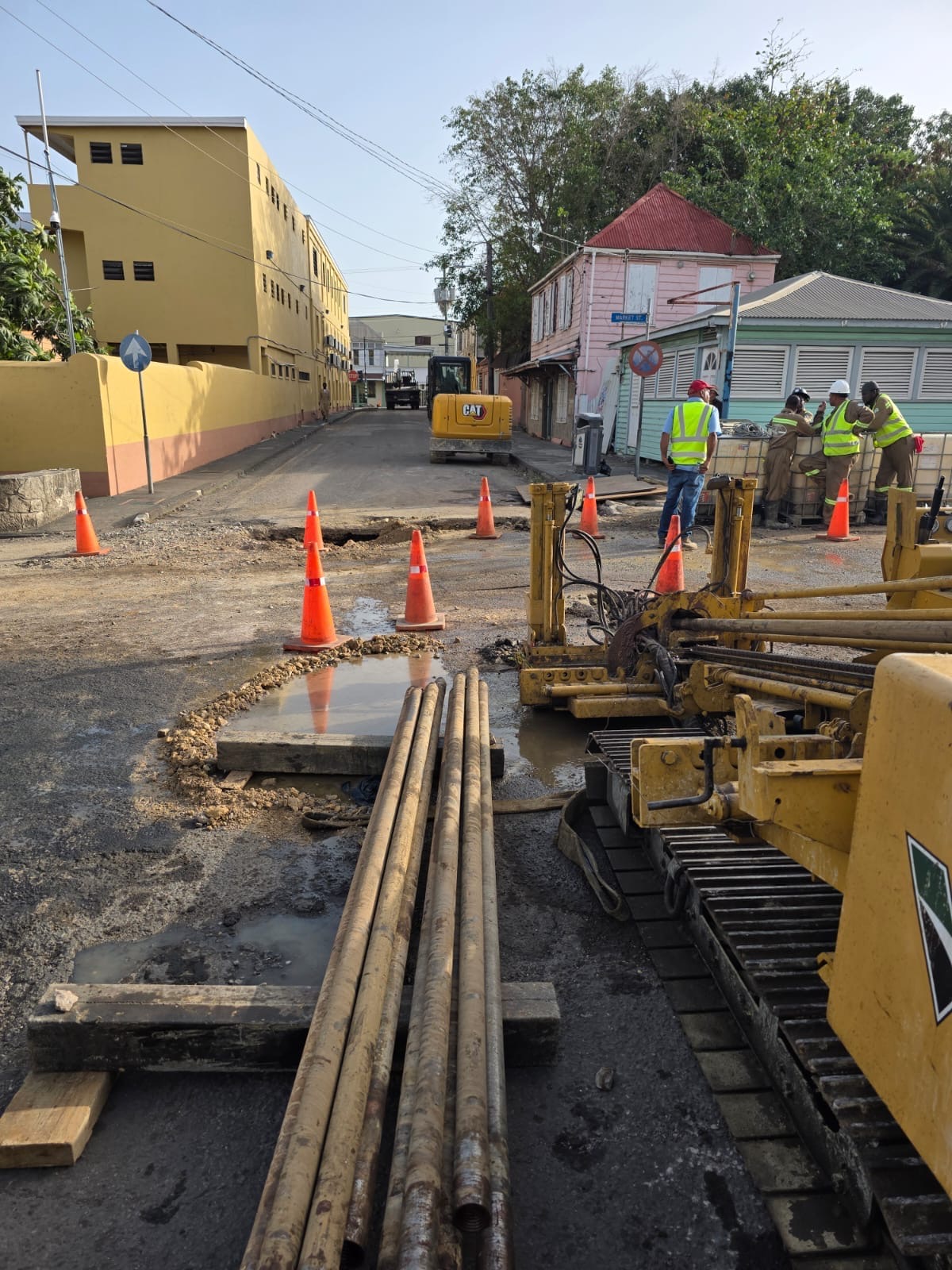
    Commuters traveling through central St. John’s should prepare for minor travel delays and altered traffic patterns on Wednesday, as the Antigua Public Utilities Authority (APUA) Water Business Unit launches critical pipe installation work along a key stretch of Market Street. The active work zone spans the segment of Market Street between Newgate Street and Church Street, bringing utility crews and heavy drilling equipment to the high-traffic downtown corridor. The project is being executed by APUA’s specialized Horizontal Directional Drilling team, a group trained to carry out subsurface infrastructure work with minimal above-ground disruption to local businesses and daily travel. Once completed, the installation will enable the utility to permanently retire the aging, corroded water pipes running along adjacent Newgate Street, replacing outdated infrastructure with a brand-new, more reliable water distribution connection. APUA officials have clarified that the upgrade is not an isolated maintenance task, but a core component of a broader contingency strategy designed to strengthen St. John’s municipal water supply. Currently, the capital city’s primary water source is the Grays Hill Reservoir; the new connection will add a redundant, stable supply line fed by the Fort James Reverse Osmosis Plant, boosting the city’s ability to cope with unexpected supply interruptions and meet growing demand from residents and downtown businesses. To minimize safety risks and reduce congestion, APUA is calling on all motorists and pedestrians passing through the area to exercise extra caution, slow down when approaching the work zone, and follow all directional guidance posted by on-site work crews. The authority has also issued an advance statement of gratitude to the local public, acknowledging that temporary traffic changes will cause minor inconvenience, and thanking residents and commuters for their understanding and ongoing cooperation as the utility works to improve long-term water infrastructure for the entire community.

  • OPINION: If road safety is a productivity issue, so is insurance access

    OPINION: If road safety is a productivity issue, so is insurance access

    ### Connecting Road Safety and Insurance Reform: Unlocking Productivity Growth for Saint Lucia

    Saint Lucia’s National Competitiveness and Productivity Council (NCPC) has framed the island’s persistent road safety crisis as far more than a public safety challenge – it is a critical drag on national productivity. Addressing nearly 400 law enforcement officers recently, NCPC Director Lisa Florent-Montoute laid out stark data to back this claim: the island is now home to more than 95,000 registered vehicles, all traveling across infrastructure originally designed for a total population of just 180,000. In 2023 alone, the country recorded nearly 3,000 road accidents, over 350 of which were classified as major collisions. Every incident pulls workers out of employment, burdens households with unexpected medical costs, causes costly property damage, and in the worst cases, results in preventable loss of life.

    While NCPC’s diagnosis of the productivity drain from road accidents has drawn broad agreement, one interconnected issue has rarely been tied to the crisis: the broken state of Saint Lucia’s motor insurance market. While policymakers discuss road safety improvements in one forum and rising insurance costs in another, the obvious link between the two has gone unaddressed: lasting improvement on either front cannot be achieved without fixing the other.

    For everyday drivers in Saint Lucia, comparing insurance options to find the right coverage is an unnecessarily burdensome process. Requesting a quote requires long waits from providers, many of whom never follow up at all. Most drivers abandon the search after contacting two or three providers, and renew their existing policy regardless of whether it offers fair pricing or adequate coverage. Even the process of securing a single quote requires reams of time-consuming paperwork that discourages comparison shopping.

    Price is far from the only challenge facing drivers. The common impulse to chase the lowest available premium often leaves drivers underinsured, because two policies with drastically different price tags can both be appropriate depending on their deductibles, coverage exclusions, and the provider’s track record for timely claim payouts. True access to functional insurance requires clear visibility into these differences, so drivers can select coverage that matches their unique risk profile – not just the cheapest option on the market. Without easy access to transparent, comparable information, most Saint Lucian drivers end up underprotected for the risks they face on daily commutes.

    The consequences of this opaque market are already playing out across the island. In 2024, Guyana & Trinidad Mutual announced it would suspend issuing new motor policies due to soaring claim costs, while other providers implemented steep premium hikes. For example, third-party motorcycle insurance has risen 50 percent in just two years, jumping from $800 to $1,200. Kingson Jean, vice president of the National Association of Driving Schools, warns that price hikes will not reduce the number of vehicles on the road – they will increase the number of uninsured drivers. When working families are forced to choose between covering basic needs like food and rent and paying for insurance, coverage will almost always lose out.

    Jean notes that insurers do need to maintain financial stability to meet their legal obligation to provide coverage, but the reality remains that every uninsured or underinsured driver shifts the cost of accidents onto other road users or the public sector.

    A separate gap exists in NCPC’s current proposed road safety reform plan. The council has put forward a common-sense policy that would allow drivers involved in minor collisions to exchange information and file incident reports digitally, clearing congested roads quickly instead of blocking traffic for hours. However, nearly all insurers in Saint Lucia still require an official police report to process any claim, even for low-impact fender benders. This requirement is not arbitrary: police reports serve as a key check against inflated or fraudulent claims. Without aligning the new digital reporting rules with insurers’ claims requirements, drivers who follow the new process will still be forced to visit police stations days later to satisfy their insurer’s rules, defeating the purpose of the reform.

    NCPC’s proposed Road Safety and Traffic Management Collaborative has the potential to close this policy gap if it is given sufficient mandate. Neighboring Barbados implemented a similar aligned reform successfully several years ago, where only major collisions now require formal police intervention.

    Saint Lucia’s government and the Financial Services Regulatory Authority (FSRA), the country’s insurance regulator, hold the authority to deliver meaningful, coordinated change. A concrete starting point would be a new requirement that forces insurers to publish their full rate cards, coverage terms, deductibles, coverage exclusions, and historical claim processing timelines in a single, accessible format that allows drivers to compare options side by side.

    Regulators across the globe are already pushing for similar reforms to encourage more efficient, transparent insurance markets. For example, Nigerian regulators passed a rule last year requiring insurers to settle all valid claims within 60 days, with penalties for non-compliance. Rules like this push providers to streamline their claims processes, which directly addresses many of the cost and efficiency issues NCPC is working to solve.

    It is important to acknowledge that Saint Lucia’s insurers are already facing genuine upward cost pressure that deserves policy attention, but the ask for transparency is a modest one: regardless of the final price point the market settles on, drivers deserve clear information to make informed decisions about their coverage.

    None of these changes need to wait for established market incumbents to act. Saint Lucia has a small but growing community of local entrepreneurs and technologists that have already transformed how the island’s residents bank, shop, and transfer money. The insurance sector has largely sat out this digital revolution, leaving a clear gap – and a clear need – for local tech leaders to help increase transparency and accessibility for drivers, breaking the decades-old status quo held by a small handful of providers.

    Closing her remarks, Florent-Montoute noted that every minute of delays reduced, every accident prevented, and every life saved adds up to a stronger, more productive Saint Lucia. This is a worthy standard to hold reform to – and that standard requires full transparency to ensure drivers can find, understand, and afford the coverage they need before an accident ever occurs.

    *This analysis is from Christian Amir Wayne, founder of Breadfruit Technologies Inc., a digital motor insurance brokerage planning to launch in Saint Lucia.*