博客

  • Staatsschuld stijgt naar SRD 189,9 miljard

    Staatsschuld stijgt naar SRD 189,9 miljard

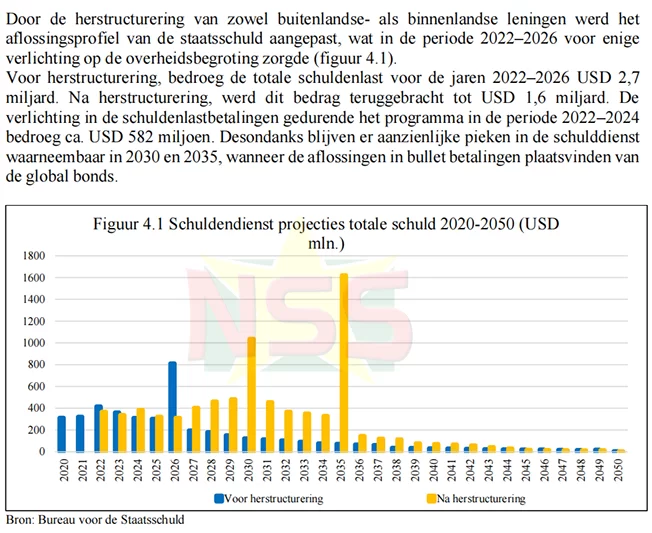
    New data released in Suriname’s 2026 Public Debt Plan reveals that the South American nation’s total sovereign debt reached 189.9 billion Surinamese dollars, equal to approximately $4.9 billion, by the close of 2025. Hefty near-term debt repayment obligations that were originally scheduled for 2025 have been restructured and pushed out to 2030 and 2035, according to the document from Suriname’s Public Debt Office.

    Official statistics from the General Bureau of Statistics (ABS) put the country’s debt-to-GDP ratio at 129.6% as of the end of 2025. Calculated under the methodology used by the International Monetary Fund (IMF), that ratio stands at a lower but still elevated 108.7%. Total scheduled debt service for 2026 is currently projected at 15.7 billion Surinamese dollars, equal to roughly $405 million at current exchange rates.

    The Public Debt Office outlines several key drivers behind the ongoing rise in Suriname’s national debt. These include the disbursement of new cross-border loans, a major recapitalization effort for the Central Bank of Suriname (CBvS), the inclusion of the Value Recovery Instrument in the national debt portfolio, and growing backlogs in overdue payments to domestic government suppliers.

    Breaking down the total debt balance, more than $4.1 billion of the total is classified as external obligations to international creditors, while roughly $823 million consists of domestic debt held by local institutions and investors. Close to 90% of all Suriname’s sovereign debt is denominated in foreign currencies, a structure that leaves the country’s public finances highly exposed to sudden exchange rate swings that can increase the local currency cost of repayments overnight.

    Over the course of 2025, Suriname concluded nearly $2 billion in new loan agreements with a range of global and regional development institutions. A large share of these new arrangements went toward refinancing existing expensive debt, but the country also secured new development financing targeted at key economic sectors and infrastructure projects.

    Among the new development funding, the Saudi Fund for Development provided a $20 million loan to expand and upgrade Suriname’s energy generation and power distribution infrastructure. The Inter-American Development Bank (IDB) allocated $25 million to support the country’s struggling aviation sector. The World Bank contributed more than $22 million to fund climate adaptation projects and flood risk reduction initiatives across the country. In March 2025, the IMF also disbursed the final $44.6 million tranche of funding under Suriname’s ongoing economic reform program supported by the fund.

    The largest single financing transaction of 2025 closed in November, when Suriname launched $1.575 billion in new international bonds with 5-year and 10-year maturities, alongside a $300 million dedicated social bond. Proceeds from this issuance are primarily earmarked for refinancing maturing legacy debt and clearing outstanding past payment obligations.

    Despite the current elevated debt burden that weighs heavily on the national budget, Suriname’s government projects that the country’s debt position will improve steadily over the medium term. The optimistic outlook is tied to forecasts of broad economic growth, rising foreign direct investment in the country’s emerging offshore oil sector, and the expected start of commercial crude oil production from 2028 onward.

    A formal debt sustainability analysis conducted by the government projects that these developments will push the debt-to-GDP ratio back below the legal national debt ceiling of 60% by 2029. Until that milestone is reached, however, public debt servicing will remain one of the biggest spending pressures on the Surinamese government’s annual budget.

  • Begroting 2026 fors verhoogd: uitgaven stijgen met SRD 16 miljard; tekort  51% BBP

    Begroting 2026 fors verhoogd: uitgaven stijgen met SRD 16 miljard; tekort 51% BBP

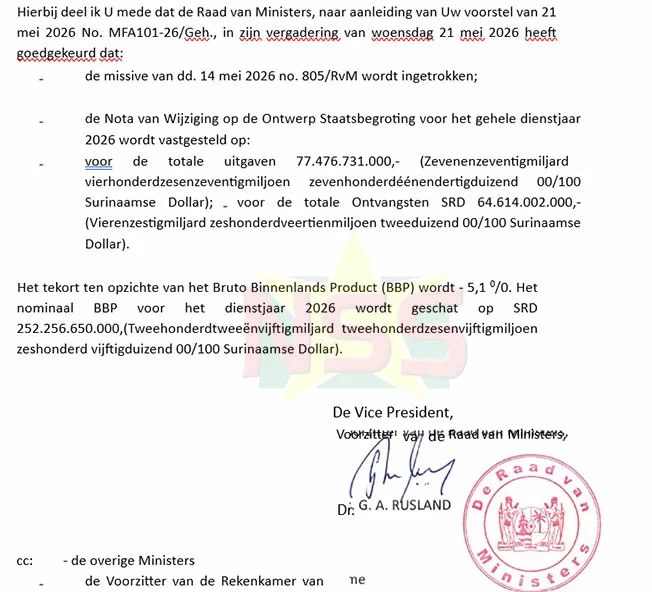
    In a major overhaul of its initial fiscal planning, Suriname’s Council of Ministers has approved substantial amendments to the 2026 draft state budget, updating both revenue and expenditure projections to levels far higher than the framework adopted by the previous administration back in September 2025. The revised fiscal blueprint, formalized in a new Note of Amendments that replaces an earlier May 14, 2026 cabinet communication, is set to open debate in the National Assembly on June 15, with deliberations scheduled to conclude on July 13.

    Under the updated figures, total government spending for 2026 is now set at 77.48 billion Surinamese dollars (SRD), while total projected revenue comes in at SRD 64.61 billion. This combination leaves an estimated budget deficit of roughly SRD 12.86 billion. The new numbers mark a dramatic shift from the previous administration’s baseline projections, which pegged total spending at SRD 61.08 billion and total revenue at SRD 54.82 billion, with a deficit forecast equal to 3.5% of gross domestic product (GDP).

    Compared to that initial framework, total expenditures have increased by SRD 16.39 billion, representing a 26.8% upward adjustment. Projected revenue, meanwhile, has grown by SRD 9.79 billion, a 17.9% rise from earlier estimates. The deficit as a share of GDP has also seen a steep increase: it is now projected to hit 5.1% of GDP, a 1.6 percentage point jump that equals a 45.7% increase relative to the original deficit forecast.

    Notably, the nominal GDP estimate for 2026 has also been revised sharply upward. Where the September 2025 framework projected 2026 GDP at SRD 179.97 billion, the amended note puts GDP at SRD 252.26 billion. That amounts to a more than SRD 72 billion upgrade, equal to a roughly 40% increase from the original forecast.

    When the revised budget goes under full review in the National Assembly, the biggest points of scrutiny are expected to center on how the larger deficit will be financed, and what implications expanded borrowing will have for the country’s long-term public finance stability. Rabin Parmessar, chair of the National Assembly’s Standing Committee on Finance and State Budget from the National Democratic Party (NDP), confirmed that parliament has completed all preliminary preparations for the review, and all specialized subcommittees tasked with examining individual budget sections have been formally established.

  • Police commissioner receives honorary doctorate

    Police commissioner receives honorary doctorate

    In a historic first for the Guyana Police Force (GPF), top law enforcement leader Clifton Hicken has been awarded an honorary doctorate (honoris causa) in Human Rights and Social Justice from International American University (IAU), marking a groundbreaking milestone for the institution’s leadership ranks. The official announcement was made by GPF on Saturday, confirming that Hicken is the first serving police commissioner in the entire history of the force to earn doctorate-level academic distinction.

    Fact-checking of the GPF’s official announcement confirms the honor was presented during the 2026 Iconic Felicitation of Exemplary Achievements (IFEA) Awards, an event organized by AIMLAY, an India-headquartered global recognition body that facilitates nominations of high-achieving professionals across dozens of industry sectors for outstanding contributions to their fields. Public records from IAU list AIMLAY as one of 38 official authorized recruitment and nomination partners for the institution’s honorary degree programs.

    The formal convocation ceremony was hosted at IHG’s Crowne Plaza San Francisco Airport in Burlingame, California, with the degree conferred by IAU’s Los Angeles-based School of Business. Hicken also received additional recognition for his career-long contributions at the parallel 2026 Global Excellence Summit held alongside the convocation.

    In its official statement, GPF emphasized that the field of human rights and social justice holds particular relevance for 21st-century policing. The agency noted that modern law enforcement carries core responsibilities centered on protecting marginalized and vulnerable populations, building stronger bridges between police and communities, advancing fair and equal treatment under the law, supporting youth development programs, addressing the pervasive crisis of domestic violence, and rebuilding public trust in law enforcement institutions.

    The GPF added that Hicken’s achievement underscores the force’s longstanding institutional commitment to prioritizing education, professional excellence, leadership development, and a culture of continuous lifelong learning among all serving personnel.

    Per GPF’s announcement, the latest honor is far more than a personal accolade: it stands as a key milestone in Hicken’s decades-long academic and professional journey, reflecting his unwavering commitment to ethical leadership, public service, advancing human rights, championing social justice, expanding community development, and strengthening institutional capacity within the Guyana Police Force.

    Hicken brings a robust academic foundation to his role as police commissioner, holding two professional diplomas in public management and related disciplines from the University of Guyana, as well as a Master of Business Administration with a specialization in Human Resource Management from the UK’s University of Bedfordshire. Throughout his decades-long career, he has also completed dozens of specialized professional training programs covering core law enforcement competencies, from leadership and organizational management to human rights practice, domestic violence intervention, public order management, emergency response, search and rescue operations, tactical deployment, and organizational development. His training experience includes programs hosted by leading regional and international institutions, including the University of Guyana, the University of the West Indies Cave Hill School of Business, the San Salvador Law Enforcement Academy, and multiple global law enforcement and security training initiatives.

    The GPF closed its announcement by extending formal congratulations to Hicken on the unprecedented achievement, framing the honor as a point of collective pride for the entire force.

  • The Prime Minister announces the elimination of taxes on batteries and solar panels

    The Prime Minister announces the elimination of taxes on batteries and solar panels

    On June 5, 2026, top Haitian government officials, cross-sector partners, youth environmental activists, and education leaders gathered at Port-au-Prince’s Karibe Hotel for an official World Environment Day ceremony hosted by the country’s Ministry of Environment. Centered on the theme “Green Jobs Serving a Sustainable Haiti,” the event brought together cabinet ministers from eight key government departments alongside technical, financial, and community stakeholders to outline the nation’s path forward for climate action and sustainable development.

    Opening the proceedings, Minister of Environment Valéry Fils-Aimé centered youth leadership as the foundational pillar of Haiti’s environmental transition. He detailed the ministry’s ongoing work across six core priority areas: public sanitation expansion, protected area conservation, degraded ecosystem restoration, widespread environmental education, national climate change mitigation, and targeted green job development. Reaffirming the government’s commitment to realizing Haitian youth’s vision for a sustainable 2050, Fils-Aimé highlighted key recent milestones, including the official launch of the national clean-up initiative “Konbit Ayiti Zewo Dechè” and the removal of more than 60,000 cubic meters of accumulated waste from urban centers across the country.

    In his keynote address, Prime Minister Alix Didier Fils-Aimé underscored the untapped economic potential of green industries to create stable, accessible employment for Haitian young people. The centerpiece of his announcement was a landmark policy change: the full elimination of import and consumption taxes on both batteries and solar panels. Framed as a concrete, ambitious step forward, the policy formalizes the Haitian government’s commitment to advancing a national energy transition, protecting critical ecosystems, and building an inclusive, green-centered sustainable economy. The reform is designed to lower barriers to renewable energy access for households, small businesses, and public institutions, while cutting the nation’s reliance on carbon-intensive traditional energy sources.

    Following the formal ceremony, the Prime Minister toured on-site exhibition spaces hosted by the Ministry of Environment’s technical departments, the National Agency for Protected Areas (ANAP), the National Solid Waste Management Service (SNGRS), private environmental enterprises, and local green artisans. Displayed innovations and achievements spanned recycling technology, waste-to-resource recovery, biodiversity conservation, renewable energy solutions, and circular economy initiatives.

    Minister of Planning Sandra Paulemon used her remarks to outline the severe, interconnected environmental challenges Haiti continues to face. She outlined the extent of existing damage: widespread deforestation has stripped mountain ecosystems, critical watersheds are in decline, rivers suffer from dangerous silt accumulation and pollution, unmanaged waste overwhelms public spaces, residential neighborhoods, and coastal areas, and the nation faces extreme climate vulnerability to recurrent hurricanes, flooding, prolonged drought, soil erosion, and deadly landslides that disproportionately harm low-income and marginalized communities.

    Paulemon emphasized that environmental action is not an abstract policy goal but a matter of national survival. “The environment is the land we cultivate, the water we drink, the air we breathe, and the legacy we will leave to our children,” she stated. Turning to the event’s theme of green job development, she outlined the strategic role that sustainable employment can play in driving Haiti’s broader economic and social transformation. Key green sectors including reforestation, urban sanitation, integrated waste management, watershed protection, sustainable agriculture, renewable energy, recycling, ecotourism, and green infrastructure offer a unified solution to multiple national crises, simultaneously driving job growth, reducing poverty, advancing environmental protection, and strengthening social cohesion across communities.

    Despite acknowledging the scale of the challenges ahead, Paulemon closed with a message of determined hope for the nation’s future. “I refuse to believe that Haiti’s destiny is one of decline, vulnerability, or resignation,” she said. “I believe in the Haitian people’s capacity to transform difficulties into opportunities, challenges into solutions, and crises into new beginnings.”

  • CDB recommits to tackling regional challenges through strategic realignment

    CDB recommits to tackling regional challenges through strategic realignment

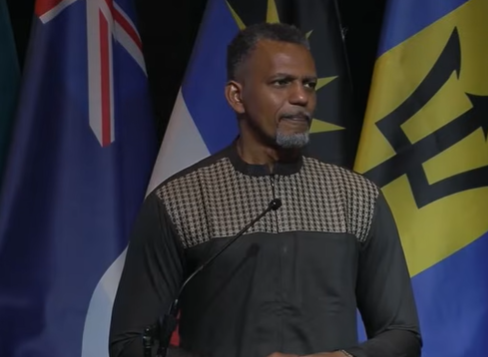
    NASSAU, Bahamas — In a landmark closing address at the Caribbean Development Bank’s (CDB) 56th Annual Meeting held in Nassau on 7 June 2026, CDB President Daniel Best announced a sweeping strategic realignment, reaffirming the institution’s commitment to confronting the Caribbean region’s most urgent development challenges and raising living standards for local communities.

    The policy shift comes after sustained pressure from a broad coalition of regional stakeholders, including youth leaders, national policymakers and industry advocates, who have called on the regional development lender to prioritize high-impact areas: youth capacity-building, professional skills training, climate resilience, and inclusive, sustainable economic expansion. For years, the bank has faced growing expectations to expand its support for the Caribbean’s development agenda, amid overlapping crises ranging from crumbling core infrastructure and unmet workforce readiness needs to rising global geopolitical uncertainty and accelerating climate-related disasters.

    Addressing delegates and regional leaders at the ceremony, President Best acknowledged the widespread concerns raised by stakeholders, confirming that the bank has heeded calls from its governing board and Caribbean youth for a more coordinated development approach and faster execution of ongoing institutional reforms and core strategic priorities. Against this backdrop, Best committed the CDB to accelerating action across all its operations, outlining the new direction: “by aligning our efforts across countries and partners, accelerating decision-making, and deploying practical solutions that translate policy into progress.”

    “Our focus is to move to implementation to impact, from plans to performance, and to ensure that every action we take delivers meaningful and lasting change for the Caribbean,” Best emphasized.

    Turning to the broader global context shaping the Caribbean’s outlook, Best noted the region continues to grapple with a cascade of interconnected challenges: escalating climate shocks, rising geopolitical tensions across major economies, persistent fiscal constraints for small island developing states, slowing global demand and growth, and the onset of the 2026 Atlantic hurricane season, which brings annual risk of catastrophic damage to Caribbean coastal communities and infrastructure.

    “Friends, we arrived this week carrying the weight of a world in flux,” Best said. “These realities have not changed, but we continue to approach these challenges with collective purpose. Throughout this meeting, we listened to one another. We exchanged ideas and together we confronted some of the defining questions of our time.”

    President Best highlighted that the week’s deliberations centered on three core priorities: boosting regional competitiveness, strengthening systemic resilience to shocks, and expanding economic and social opportunities for current and future generations. Despite the stacked challenges facing the region, Best said a unifying, forward-looking consensus emerged from the talks.

    “The future of the Caribbean will not be determined by the challenges we face; it will be determined by the choices we make in response to them,” he stated.

    He also referenced opening remarks by Bahamian Prime Minister Philip Davis, who urged regional leaders to reject a mindset of merely enduring hardship. “Our goal cannot simply be to survive. Our mission is to thrive,” Best quoted Davis as saying.

    According to Best, this proactive, growth-focused philosophy is embedded in the CDB’s newly adopted 2026-2035 Strategic Plan, which guided all discussions during the annual meeting. “At its heart lies a simple proposition: resilience is not an end in itself. Resilience is the foundation upon which prosperity is built,” he explained.

    Under the restructured strategic agenda, the CDB will maintain its longstanding commitment to advancing economic, social, and environmental resilience, while elevating three priorities to the core of all operations: youth development, ambitious climate action, and institutional capacity-building for strong regional governance.

    Discussions held during the meeting’s Impact Room sessions reinforced a key insight for the bank: sustainable long-term development across the Caribbean cannot be funded through public sector resources alone. To fill financing gaps, Best noted that the region must ramp up efforts to mobilize cross-border private investment, strengthen local and regional entrepreneurship, and build a policy and regulatory environment that enables broad, investment-led economic growth.

    During breakout sessions focused on the CDB’s EDGEx initiative, participants also emphasized the growing critical role of robust data, evidence-based research, and shared knowledge in designing effective development policy and delivering measurable outcomes. Best stressed that Caribbean nations need to invest in modern, scalable national data systems, expand cross-border knowledge sharing, and leverage locally generated evidence to guide public decision-making and speed up the delivery of tangible development results.

    Finally, Best noted that discussions on climate finance reiterated a harsh reality long understood by Caribbean nations: the region, which contributes less than 1% of global greenhouse gas emissions, bears a disproportionate share of climate change’s damaging impacts, and requires targeted, accessible climate finance to build resilience and reduce risk.

  • Towards the Digital Transformation of the haitian Education System

    Towards the Digital Transformation of the haitian Education System

    In a landmark move to modernize learning across the Caribbean nation, Haiti’s Ministry of National Education and Vocational Training (MENFP) has officially launched a dedicated national body tasked with steering the full digital transformation of the country’s public education system, announced by Education Minister Vijonet Déméro in a formal ministerial decree published on July 6, 2026.

    Citing longstanding gaps in outdated teaching practices, fragmented school governance, and unequal access to modern learning materials, Minister Déméro framed the new commission as a critical strategic priority aligned with the need to integrate 21st-century information and communication technologies (ICT) into every level of Haitian education. The official order draws its legal authority from the 1989 Decree that governs the structure and operations of the national education ministry.

    Officially named the National Commission for the Digital Transformation of the Education System (CNTNSE), the 11-member intersectoral body will operate directly under the oversight of MENFP. Its core mandate is to design, lead, and coordinate a unified national strategy for digitizing the entire education sector, bringing together stakeholders from government agencies, academic institutions, private industry, and international partners to align efforts and avoid fragmented initiatives.

    The commission’s leadership and membership draws representation across multiple key sectors to ensure broad buy-in and technical expertise. Renan Michel, Inspector General of MENFP, will serve as the commission’s chair. Additional voting members include Gerald Belaire from the National Bureau of External Security (BUNEXE), Jean Joseph Mackenzie Charles from the Tunisian Union of Information and Communication Technologies (UTICE), Pierre Jean from the University of the South (US), Jean Misgaire Fanor from the French Center for Continuing Education (CFCE), and designated representatives from the National Telecommunications Council (CONATEL, technical and financial partners, the Network of Departmental Public Universities, state-recognized private universities, and the Departmental Directorates of Education. The final seat is reserved for an expert in educational and digital engineering appointed directly by the Minister’s office. The commission is also authorized to recruit ad-hoc technical specialists from any public or private entity to support its work as needed.

    CNTNSE’s responsibilities are structured across four core focus areas that cover every stage of the digital transformation process. On the strategic front, the body will develop a comprehensive National Digital Transformation Plan for Education (PNTNE), establish unified technology standards for all schools nationwide, and roll out mandatory digital skills training for all education system employees. For pedagogical initiatives, it will oversee the development and regulation of digital learning platforms, including massive open online courses, manage the conversion of traditional print textbooks to digital formats, and coordinate ongoing upskilling for classroom teachers on digital teaching tools. For infrastructure, the commission will conduct a national audit of existing internet connectivity and technological equipment in schools and regional education offices, then develop a multi-year investment plan to close gaps. Finally, the commission will lead partnership and resource mobilization efforts, working with public, private, and international stakeholders to secure the technical and financial support needed to implement large-scale digital projects.

    The commission’s formal term runs for 24 months, from June 5, 2026, to June 5, 2028, with the option of renewal based on the ministry’s strategic priorities and progress achieved. To ensure full transparency and accountability, the body is required to submit quarterly progress updates on its Digital Roadmap (DRM) to the Minister’s office, in addition to a full annual report covering achievements, challenges, and next steps. The new commission went into immediate effect following the publication of the ministerial decree and will be formally registered with all relevant Haitian government bodies.

    This initiative marks one of the most ambitious structural overhauls of Haiti’s education system in recent decades, with the potential to expand access to quality learning resources for thousands of students across the country who currently lack access to modern educational tools.

  • Technology : DevExpo 2026 Final, list of the 5 winning projects

    Technology : DevExpo 2026 Final, list of the 5 winning projects

    On June 6, 2026, the fifth iteration of DevExpo, Haiti’s premier innovation competition focused on digital transformation, concluded its final round at Port-au-Prince’s Montana Hotel. Co-organized by local tech group Banj and the Digicel Foundation, the pitch event drew high-profile attendees from across the public and international development sectors, including representatives from the United Nations Development Programme (UNDP) Haiti, Haiti’s Ministry of Commerce and Industry, Sogebank Group, the Inter-American Development Bank, and dozens of partner organizations invested in advancing Haiti’s tech ecosystem.

    Launched earlier this year in March 2026, the 2026 DevExpo carried the central theme of “AI for Social Impact,” created to center and amplify the technical talent of young Haitian innovators. The competition challenged participants to leverage artificial intelligence and cutting-edge digital tools to tackle pressing, real-world challenges across key sectors of Haitian society, from public education and healthcare to small business development and expanded access to critical community services.

    The selection process began with more than 200 project submissions from across the country. After an initial rigorous evaluation round, 29 projects advanced, with 10 ultimately earning a spot in the final pitch competition. At Saturday’s finale, five standout startups were selected as winners, splitting a total prize pool of 5 million Haitian gourdes to fund further development and scaling of their community-focused solutions, each of which uses AI to address unmet social and economic needs across Haiti.

    The first-place winner, ZònPam, took home 2 million HTG for its real-time community security platform. The tool alerts local residents to ongoing incidents and marks high-risk areas across the country, while integrating an AI chatbot named Nora that answers user questions related to public safety.

    Second place went to Kòb Mwen, which received 1.5 million HTG. The fintech solution is designed to expand financial inclusion for Haitian communities, offering built-in budgeting education and accessible personal finance management tools for users who often lack access to traditional banking services.

    Three projects tied for third place, each awarded 500,000 HTG. The first of these is Smart Digital Health for Haiti, also known as KURA, an e-health initiative that streamlines medical record management, remote patient monitoring, and telehealth services to expand access to care across underserved areas of Haiti. Next is The Baccalaureate, an AI-powered adaptive learning platform that provides personalized study guidance and targeted practice exercises to help Haitian secondary students prepare for their national baccalaureate exams. The third third-place winner is PHARx, a pharmaceutical sector platform that simplifies medication access for patients, improves inventory tracking for local pharmacies, and streamlines connections between patients and care providers.

    Competition organizers have expressed confidence that the development of these five projects will drive tangible, positive innovation and widespread social benefit across Haiti. UNDP Haiti extended formal congratulations to all five winning teams, noting that their work underscores the extraordinary capacity of Haitian youth to turn ambitious creative ideas into actionable, impactful solutions for national development. By continuing its support for DevExpo, UNDP reaffirms its long-term commitment to strengthening Haiti’s digital innovation and entrepreneurship ecosystem for future generations.

  • Nieuw SVJ-bestuur kiest Nita Ramcharan als voorzitter

    Nieuw SVJ-bestuur kiest Nita Ramcharan als voorzitter

    In a landmark electoral meeting held Saturday evening, the Suriname Association of Journalists (SVJ) has installed a new governing board, co-founder Nita Ramcharan taking the helm as the organization’s new president. The full seven-member leadership slate also includes Ivan Cairo as vice president, Wilfred Leeuwin as general secretary, Vishmohanie Thomas as treasurer, Amanda Palis as second secretary, Raeyen La Rose as second treasurer, and Harvey Panka as commissioner.

    Following the formal ceremonial handover of the gavel from outgoing president Naomi Hoever, the new board publicly outlined its ambitious strategic roadmap to transition SVJ from a traditional professional interest group into a respected, authoritative national industry institute. The leadership has identified three core priority areas: advancing the professionalization of Suriname’s journalism sector, strengthening the association’s standing in national public life, and driving improvements in reporting quality, professional ethics, and press freedom across the country.

    Over the coming months, the board will first launch a comprehensive review of SVJ’s founding statutes and internal operational bylaws, to align the organization’s governance framework with its new strategic goals. It will also establish a network of issue-specific working committees, designed to expand grassroots member participation in shaping organizational policy and planning public activities.

    Skills training and professional development will be a top budget and policy priority for the new term. The association plans to roll out targeted training initiatives covering high-demand areas including investigative and electoral journalism, media law, professional ethical practice, digital safety for reporters, artificial intelligence applications for news work, fact-checking, and press freedom advocacy.

    In a statement following the election, the new board emphasized that independent, professional journalism is more critical than ever in an era defined by the rise of social media, widespread disinformation, and rapid technological change. To address these new challenges, SVJ will also push for strengthened industry self-regulation, formal professional accreditation for journalists, and updated national professional standards for the field.

    Beyond internal organizational reform, the new leadership has committed to opening structured dialogue with Suriname’s government branches, public institutions, and civil society organizations. The goal of these engagements is to strengthen the legal and social standing of journalists and defend press freedom across the nation.

    The board’s full policy direction is formalized in its recently published election manifesto, and all initiatives will be further refined through ongoing consultation with SVJ’s membership base. Observers frame this leadership transition and new strategic agenda as a pivotal step for Suriname’s journalism sector, aimed at unifying the professional community, raising reporting standards, and rebuilding public trust in independent media.

  • US judge strikes down Trump policies targeting immigrants from 39 countries

    US judge strikes down Trump policies targeting immigrants from 39 countries

    On a pivotal Friday ruling that delivered a major legal rebuke to one of the Trump administration’s hardline immigration policies, a federal judge struck down a sweeping set of restrictions that halted adjudication of asylum, work permit, green card, and citizenship applications for immigrants born in 39 nations across Africa, Asia, Latin America and the Middle East.

    Chief U.S. District Judge John McConnell, an appointee of former Democratic President Barack Obama sitting in Providence, Rhode Island, found the policies implemented by U.S. Citizenship and Immigration Services (USCIS) lacked any valid statutory or regulatory authority. In his scathing 42-page opinion, McConnell wrote that the arbitrary freeze left thousands of law-abiding applicants trapped in permanent legal uncertainty, or what he termed “indeterminate legal limbo.”

    McConnell emphasized that every affected immigrant had followed all procedural requirements laid out by congressional legislation and USCIS’s own official regulations, yet were forced to wait months — and in many cases years — without any word on their legally filed applications for immigration benefits. “USCIS’s hold on adjudications cannot be attributed to anything that these individuals did wrong; rather, it arises solely by the happenstance of their birth,” the judge wrote. He further added that the policies were shaped by impermissible anti-immigrant bias, a motive that federal law explicitly bars from influencing administrative decision-making.

    The restrictions were rolled out as part of a broader immigration crackdown launched by the Trump administration in the wake of a November 2020 shooting that killed two National Guard members in Washington, D.C. The attack was perpetrated by an Afghan immigrant, and the administration subsequently expanded existing travel bans to impose a full halt on all immigration benefit processing for applicants from 39 countries, including high-profile entries such as Afghanistan, Iran, Haiti, Somalia, Venezuela and Syria. At the time, the White House defended the measures as necessary national security vetting to screen out potential security threats.

    Friday’s ruling marked a landmark legal victory for a cross-coalition of immigrant advocacy groups and labor unions, which first brought the challenge against the policies in March of the same year. The coalition was represented by Democracy Forward, a progressive legal organization whose executive director Skye Perryman celebrated the court’s decision. “This ruling reaffirms a basic principle: the federal government cannot shut down lawful immigration pathways or discriminate against people based on where they come from,” Perryman said in a statement following the decision.

    As of Friday evening, the U.S. Department of Homeland Security, the parent agency of USCIS, had not issued any immediate response to requests for comment on the ruling. McConnell closed his opinion by underscoring that the rule of law requires equal application to all people regardless of origin, noting that USCIS had failed to uphold even basic legal standards in implementing the controversial policies. “Indeed, the agency has violated the very immigration laws that Congress has charged it with administering, as well as the administrative laws that govern the agency’s actions,” he wrote.

  • Derde helft WK 2026: De laatste dans van Ronaldo, Messi en andere sterren op het toernooi

    Derde helft WK 2026: De laatste dans van Ronaldo, Messi en andere sterren op het toernooi

    As the 2026 FIFA World Cup fast approaches, football fans across the globe are gearing up for what promises to be a historic tournament. While the month-long spectacle will introduce a new wave of young, hungry talent to the world stage, it will also mark a poignant farewell for some of the most legendary players to ever grace the game. For these icons, this edition of the World Cup will almost certainly be their final chance to compete on football’s biggest platform, closing out decades of extraordinary careers.

    Cristiano Ronaldo, Portugal
    Fitness has long been the cornerstone of Cristiano Ronaldo’s glittering 20-plus-year career, and even at 41, the Portuguese forward continues to defy the limits of age. This season alone, he notched 30 goals in 37 appearances for Saudi side Al Nassr, bringing his all-time international goal tally for Portugal to an unrivaled 143. As the second-oldest player at this year’s tournament – outranked only by Scotland’s 43-year-old goalkeeper Craig Gordon – Ronaldo is set to become the first European player to compete at six separate World Cups, a record that may stand for generations. For the five-time Ballon d’Or winner, this tournament carries extra weight: the World Cup trophy is the only major honor missing from his extensive trophy cabinet, making this his final shot at completing football’s ultimate collection of accolades.

    Lionel Messi, Argentina
    Much like his long-time rival Ronaldo, Lionel Messi will also make his sixth World Cup appearance this summer, leading Argentina in their bid to defend the World Cup title they claimed in dramatic fashion in Qatar 2022. Now 38, Argentina’s all-time leading goalscorer and most capped player has battled persistent injury issues in the build-up to the tournament, casting doubt over his match fitness and ability to endure the grueling schedule of a 48-team World Cup. Yet even with question marks surrounding his physical condition, the eight-time Ballon d’Or winner remains the undisputed heart and soul of the South American side, whose passion for football is tied inextricably to Messi’s success.

    Luka Modric, Croatia
    The 40-year-old Croatian midfield magician Luka Modric is preparing to step onto the World Cup stage for the fifth and final time. After steering Croatia to a surprise runner-up finish in 2018 and a bronze medal in 2022, Modric remains a core leader for his national side, even after recent facial surgery that interrupted his club season. The Croatian captain, who earned legendary status for his vision and control of the midfield, still holds hero status in a national team that has repeatedly outperformed expectations on the global stage. For fans around the world, this tournament is the last chance to watch Modric weave his magic before he retires from international football.

    Neymar Jr, Brazil
    At 34, Neymar Jr is far younger than Ronaldo, Messi and Modric, but his spot in Brazil’s 2026 squad was far from a given. The Seleção’s all-time leading goalscorer returns to the national side after two and a half years away from international duty, a comeback that has sparked massive excitement among Brazilian football fans. Whether his recall is a bold gamble or a masterstroke from head coach Carlo Ancelotti remains to be seen. With age and a long history of persistent injuries taking their toll, and with Neymar set to be 38 by the 2030 World Cup, this tournament is almost certainly the fourth and final World Cup appearance of his storied career.

    Manuel Neuer, Germany
    Widely regarded as the most revolutionary goalkeeper of his generation and one of the greatest shotstoppers in the history of the sport, 40-year-old Manuel Neuer came out of football retirement to earn a spot as Germany’s starting goalkeeper for 2026. As German head coach Julian Nagelsmann noted recently, Neuer’s aura and presence within the squad is irreplaceable, even after nearly two years away from international football. This will be Neuer’s fifth World Cup appearance, and his first since Germany’s 2014 World Cup triumph in Brazil, giving fans one final chance to watch the German legend between the posts on the global stage.

    Mohamed Salah, Egypt
    Widely considered the greatest Egyptian footballer of all time, and one of the finest to ever emerge from Africa, Mohamed Salah rose to global superstardom during his trophy-laden nine-year spell at Liverpool, where he won nine major club honors. Now 33, past the peak of his physical powers, and coming off a disappointing season that culminated in his departure from Anfield, this tournament will only be his second World Cup appearance, and very likely his last. Egypt is only competing in its third ever World Cup, and while expectations are tempered, Egyptian fans still pin their hopes on their beloved number 10 to lead them to their first ever World Cup knockout stage victory.

    Kevin De Bruyne, Belgium
    As the standout playmaker of Belgium’s celebrated “Golden Generation” that emerged on the global stage in 2014, Kevin De Bruyne has continued to deliver elite performances for both club and country. The Napoli midfielder, who turns 35 later this month, is set to make his fourth and almost certainly final World Cup appearance. De Bruyne’s creative vision and passing accuracy will be critical to Belgium’s hopes of a deep tournament run, and he will be determined to lead his side to a memorable final chapter for the nation’s Golden Generation.

    Virgil van Dijk, Netherlands
    Dutch captain Virgil van Dijk, who turns 35 next month, is no longer the all-dominant center-back that led Liverpool to a Champions League title and a Premier League title in consecutive seasons. With the Dutch national team expected to transition to a younger defensive line by the 2030 European Championship, this third World Cup appearance will almost certainly be his last. Even so, his leadership and experience remain invaluable to a young Dutch side looking to make an impact on the 2026 tournament.

    Sadio Mané, Senegal
    One of the most dynamic wingers of his generation, Sadio Mané heads to the 2026 World Cup seeking redemption after a devastating leg injury forced him to miss Senegal’s 2022 World Cup campaign in Qatar. Now 34, the Senegalese all-time leading goalscorer with 53 international goals, is past the peak of his career, which included successful spells at Liverpool and Bayern Munich. Mané was a key part of Senegal’s run to the 2023 Africa Cup of Nations final, a match that was ultimately replayed following a mid-game protest from Senegal. Mané has already stated that the 2023 AFCON was his last major continental tournament, making this third World Cup his final appearance on the global stage, even if national staff have not given up hope of convincing him to extend his international career.

    Guillermo Ochoa, Mexico
    Mexican goalkeeper Guillermo Ochoa joins the exclusive club of Ronaldo and Messi as one of only three players in history to compete at six different World Cups. The veteran shotstopper, who turns 41 next month, had not been called up to the Mexican national side for years, but earned his spot in the squad for the 2026 tournament, which is co-hosted by Mexico. Famous for his match-winning performances in past World Cup campaigns, Ochoa will retire from professional football after the tournament ends, bringing an end to one of the most storied careers in Mexican football history.

    For all these legendary players, the 2026 World Cup is more than just another tournament: it is a final chance to add new glory to already legendary careers, and a poignant farewell to the global stage that made them household names across the world.